In 1914, the American painter Marsden Hartley was living in Berlin. There he loved Karl von Freyburg, a young Prussian lieutenant. In October of that year, in the first months of the First World War, von Freyburg was killed in battle. He was 24.
Hartley responded with Portrait of a German Officer. The painting contains no face and no body. It is built from flags, epaulets, military insignia, letters and numbers. For decades it was described as an abstraction about war.
The painting is a portrait, written in code. "KvF" is von Freyburg's initials. "24" is his age. "4" is his regiment. The Iron Cross is the medal he was awarded after his death. Hartley put the man he loved into the painting in the only form the time allowed: as coded information.
This collage brings the code out. Hartley's composition remains, and in front of it stands Dirk Yager, a German gay adult film star. His head is framed by the painting's central yellow triangle. He wears a black leather harness, shorts and gloves, and the straps over his shoulders follow the lines of a uniform. Beside him, the number 24 is still visible. The painting Hartley built to leave the body out now contains a living, breathing body.
Making this collage further revealed something in Hartley's painting. Beside Yager hangs a form from an officer's uniform: a tassel with a long shaft above a rounded base. The painting is composed as a torso, and this form sits where the groin would be. As a painter, I read it plainly as genitalia. This then is not only a portrait. It is a nude portrait, which makes sense, as Hartley was painting his lover.
I have not seen this formally discussed. That is not surprising. Art history has a long habit of looking away from queer sexual content. A coded language is also meant to be read by very few people: the artist, and those closest to him. Hartley coded his lover's name as initials and his age as a number. He also coded his body.
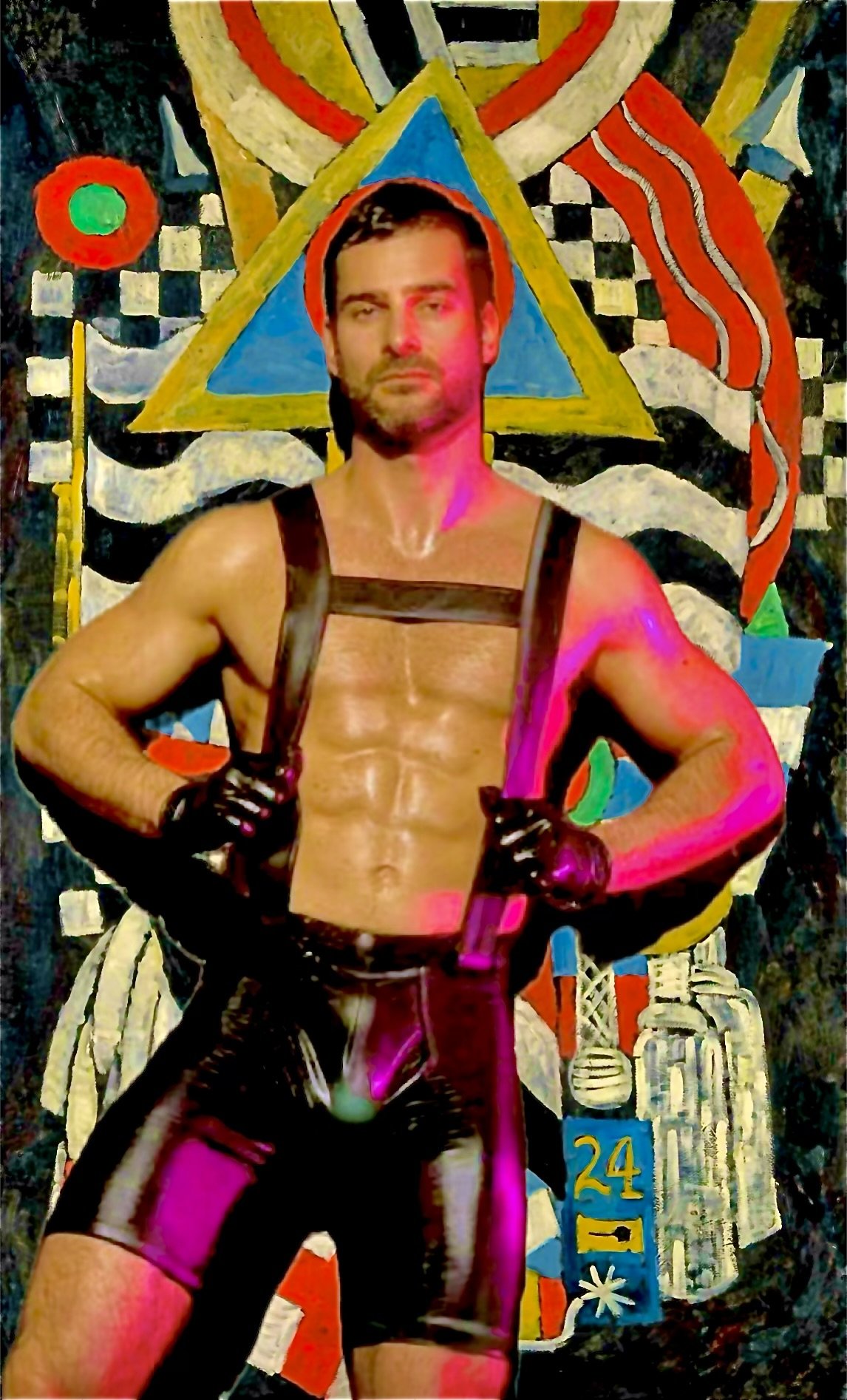

The two figures, von Freyburg and Yager, are two German men separated by more than a century. During his lifetime, von Freyburg could only be recorded as initials and numbers, while Yager is photographed openly as a gay man by his own choice. The collage places them in the same frame to honor both of their realities.
Layering onto an existing work is not new. In 1919, Marcel Duchamp drew a mustache on a reproduction of the Mona Lisa. I also work on a reproduction, in my case a digital one.
This is the method of all of my work: take the subtext, the code, and make it context, make it legible. Hartley named his lover in letters and numbers. This collage brings the idea of him into corporeal form, so that we can see him the way Hartley no doubt saw him when he looked back at this painting. Hartley did not see numbers and initials. He saw his beloved, Karl.
Sources: Marsden Hartley, Portrait of a German Officer (1914), Metropolitan Museum of Art, Alfred Stieglitz Collection; Marcel Duchamp, L.H.O.O.Q. (1919).