Five Centuries of Men
1440s — Donatello's Bronze David
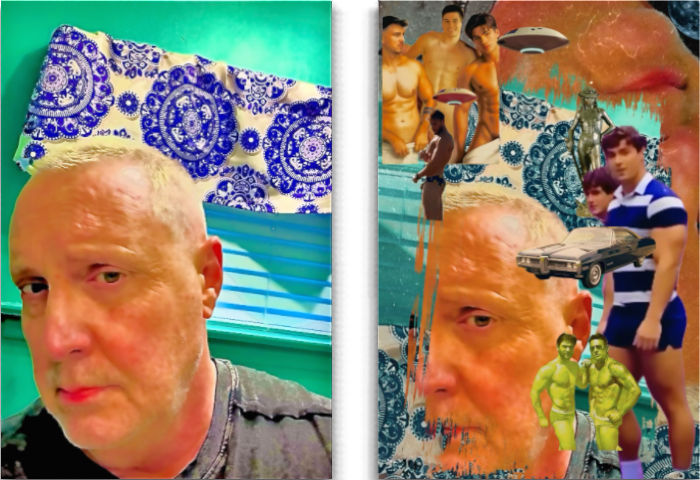
The sculpture comes from the Medici circle in Florence. It is one of the first freestanding nude male bronzes since antiquity, and historians have discussed its homoerotic qualities for generations. It is the earliest historical reference in the collage.
1960s — The Physique Pair
Two bodybuilders, tinted chartreuse, represent mid-century physique photography by artists such as Bob Mizer. Physique magazines presented themselves as fitness publications. For gay men, they were one of the few available sources of images of other men.
1980s — The Rugby Shirt
Two young men in a striped rugby shirt and short shorts represent a period when gay men were appearing in public more openly. At the same time, straight men were beginning to adopt the fashions of an emerging queer culture. Styles that began in gay communities, such as fitted clothing, short shorts, and the pink Izod polo shirt, entered mainstream menswear, often without straight men recognizing where they came from.
2020s
Shirtless contemporary figures at the upper left, and a man in a yellow-patterned swim brief, come from social media. In Donatello's time, sculpture and painting set the standard for male beauty. Today, social media does the same work. Photographers, content creators, and the men who post their own images now shape how the male body is seen. The medium has moved from bronze to the phone screen, but artists, including women, define what we see when we look at men.
The Objects
The 1969 Pontiac Bonneville
My father drove this car. Its size, power, and audacious styling taught me early what a man is supposed to look like. It belongs here with the figures, because it is another image of masculinity. These lessons reached me through ordinary family life, not only through art.
The Jupiter 3
The two saucers are the Jupiter 2 spacecraft from the 1960s television series Lost in Space, styled in my iconography as the Jupiter 3. They represent witness, freedom, and escape.
The Blue Moon
The moon in the upper right represents witness, longing, and desire.
Witness
The journey of this artwork begins with a simple selfie. The collage gathers five centuries of men around my face, with the eye at the center, the Jupiter 3, and the Blue Moon all marking the same idea: I see this history, and I place it in plain view.
The selfie shows a man alone in a room. The collage becomes the history that man carries with him.
— Behan
Postscript: For the personal history behind my move from painting to digital collage, please read "From Darkroom to Digital: A Personal Timeline."