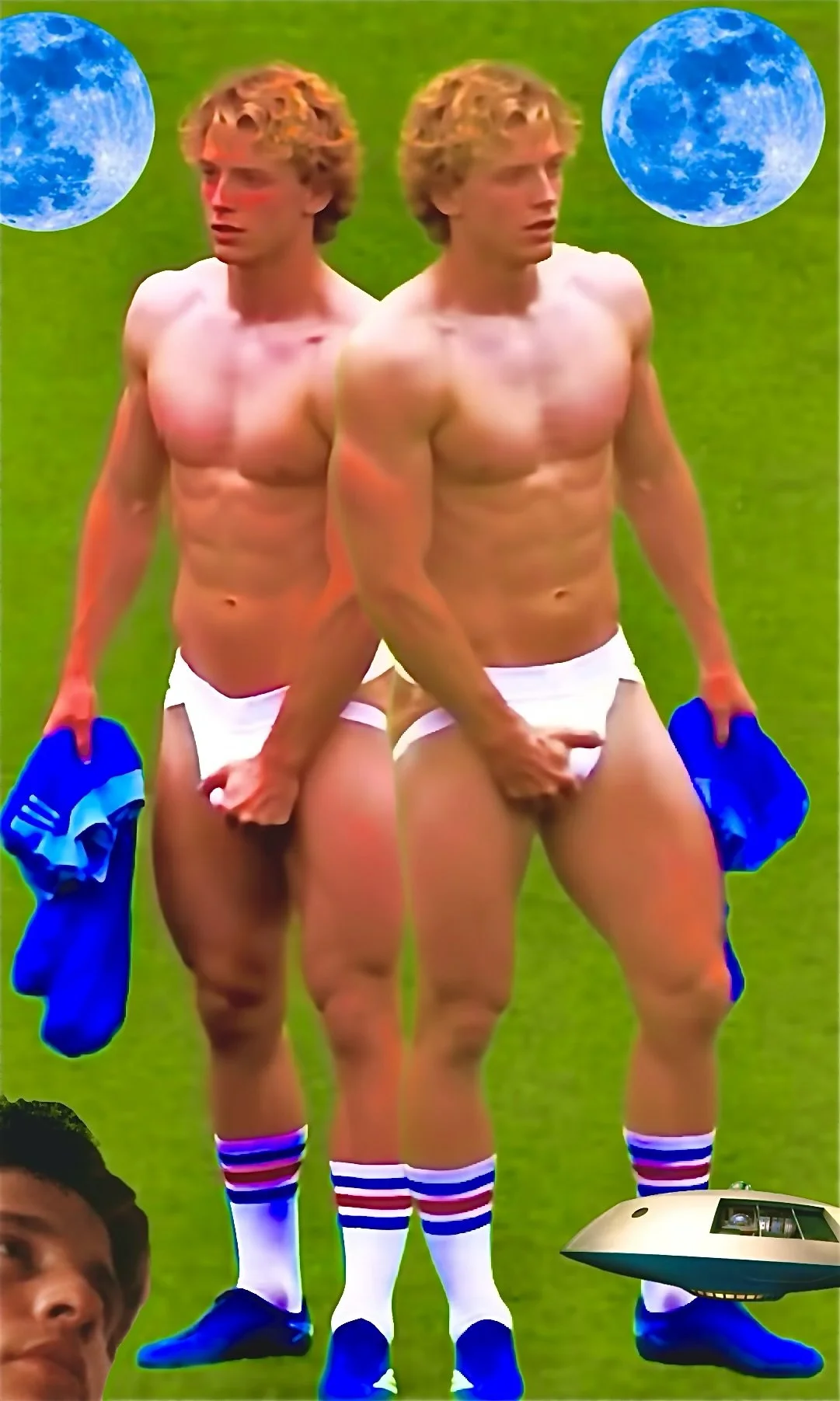
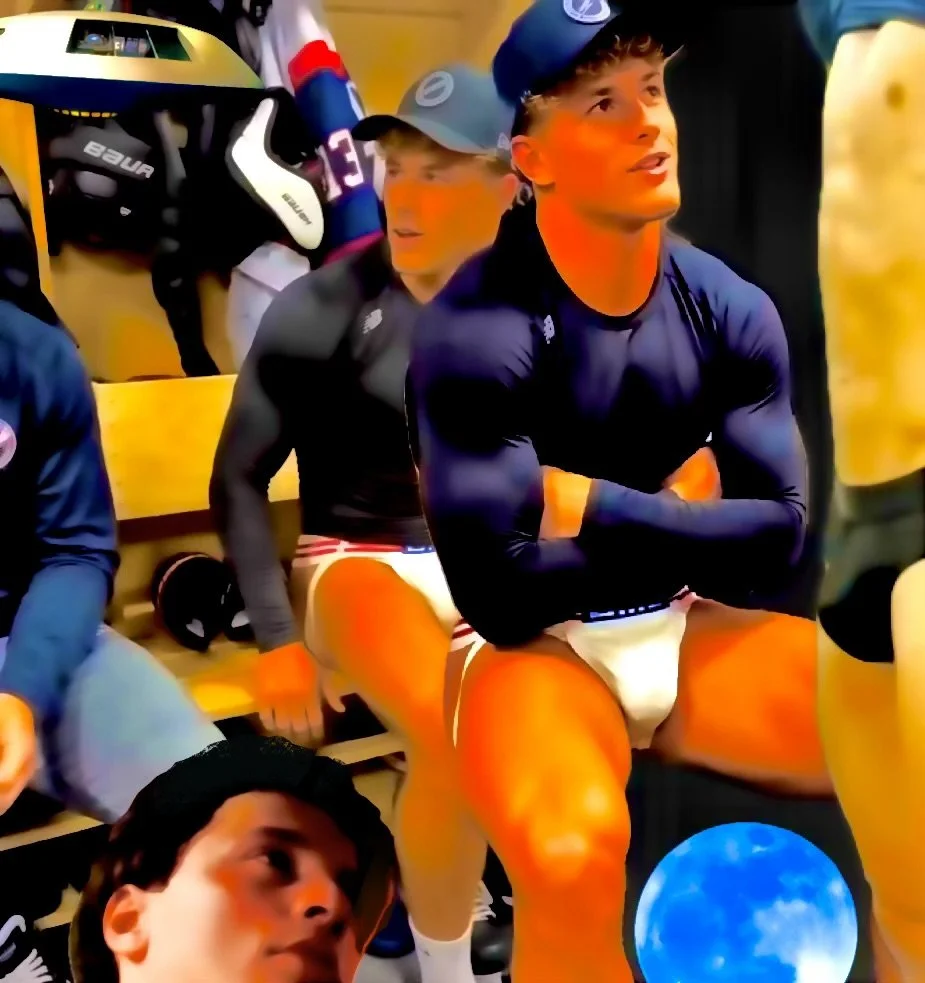
These seven collages from Wednesday morning hold together as one set. Recurring figures, a shared color structure and a repeated layering of space unify them. Each one uses a different setting: a locker room, a river, a storybook cabin, a playing field, a barred window, a beach and a beach shower. This post looks at the set as a whole, using the elements of art and the principles of organization.


Elements of Art
Color. The set is built on complementary contrast. Saturated orange and amber skin tones are set against blue: the blue moon, the sky, the water, the jerseys, the socks and the shorts. The cabin collage reverses the balance. Warm amber fills that interior, and the cool blue appears only in the moon and the snowy window.
Value. The value range is high-key and pushed to the extremes. Highlights on skin are close to white, and the darks are compressed into hair, shadows and clothing. This keeps each figure separate from its ground.
Line. Vertical lines repeat through the set: palm trunks, shower poles, window bars and standing figures. Diagonals break up these verticals in the diving figure, an extended arm and a raised leg.
Shape and form. The figures are modeled with strong light, so they read as three-dimensional forms. The blue moon and the Jupiter 3 saucer are flat, hard-edged shapes. Placing flat icons over modeled figures makes clear that the image is assembled.
Space. Each collage is built in three layers. A cropped figure or head is pressed against the bottom edge in the foreground, a standing figure fills the middle ground, and a separate setting sits behind. The space is stacked in layers rather than continuous.
Texture. The smooth, processed surface of the skin contrasts with the textures of the grounds: foliage, tree bark, wood grain, a knitted scarf, sand and water.



Principles of Organization
Repetition and rhythm. The blue moon appears in all seven collages, and Jupiter 3 appears in six. The same young man's upturned head, cropped at the lower edge, recurs across the set. The blond athlete is doubled on the playing field and then appears again on the beach. These repetitions set up a rhythm from one collage to the next.
Emphasis. In most of the collages, one standing figure near the center holds the focal point, and the surrounding figures direct the eye back to him.
Movement. Gaze controls movement. The recurring head looks up and across each frame, and the viewer's eye follows that line to the central figure. The diver in the river collage adds movement from top right toward the center.
Scale and proportion. Scale shifts within each image. The foreground heads are larger than life, while figures in the background are small. The moon and saucer change size from piece to piece.
Balance. The balance is asymmetrical. A heavy foreground mass at one lower corner is offset by an icon in the opposite upper corner. The playing-field collage is the exception: it is almost symmetrical, with two moons over two matching figures.
Contrast. The set contrasts warm with cool, modeled with flat, and photographic figures with the illustrated cabin interior.
Unity and variety. The seven settings provide variety. The recurring icons, the repeated head and the consistent color structure provide unity. Together, they read as one morning's work.