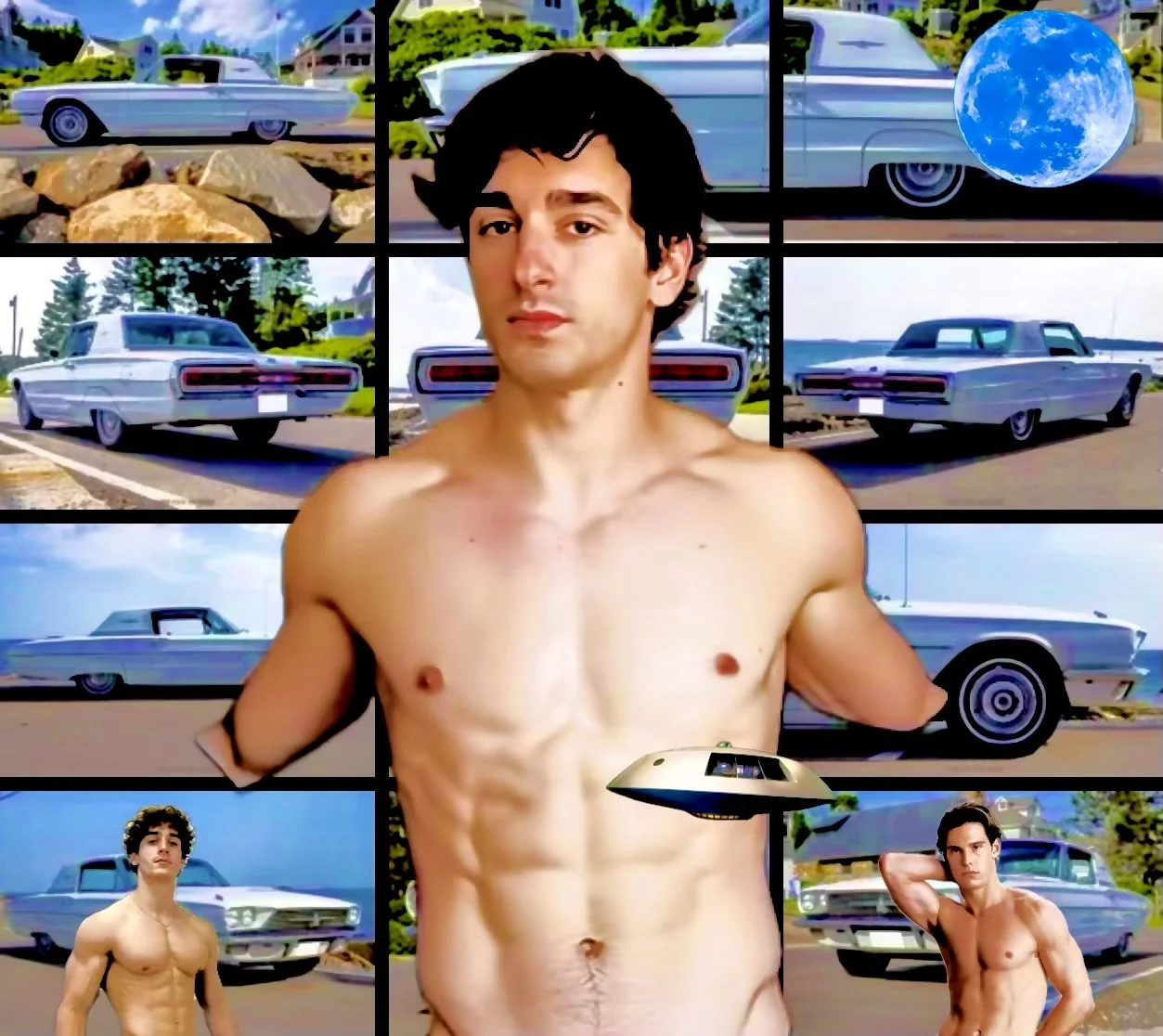
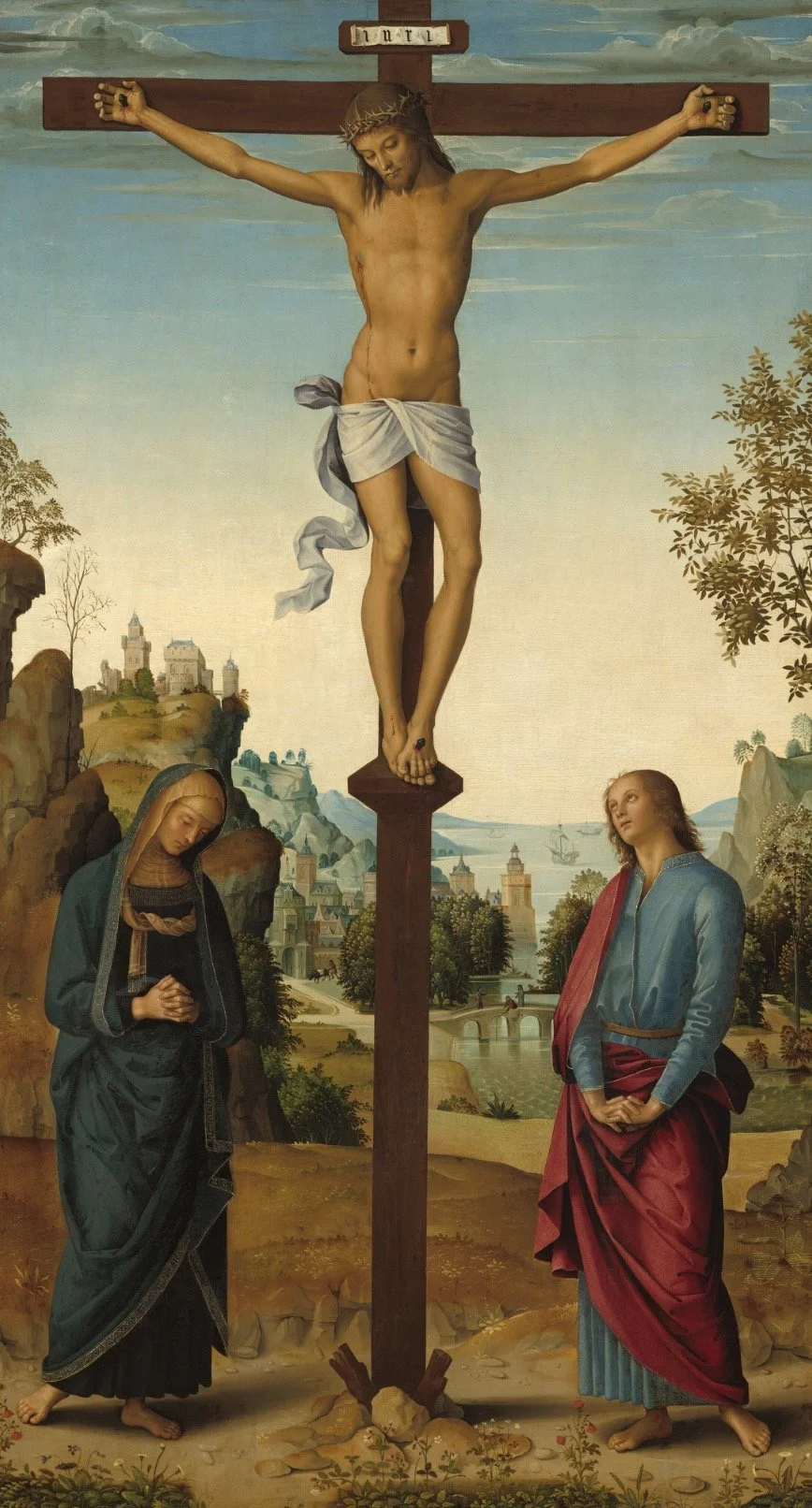
Technology now holds the central place in Western life that Christianity held for more than a thousand years. This collage puts a young man from the social media feed in the position of the crucified Christ to make that change visible.
The source is Perugino's Crucifixion with the Virgin, Saint John, Saint Jerome, and Saint Mary Magdalene, painted around 1482–85 for a chapel in San Gimignano and now in the National Gallery of Art in Washington. It is the center panel of a triptych. Christ hangs at the center. The Virgin and Saint John stand below him in a calm, open landscape.
The collage keeps the structure of the painting. At the center is a thirst trap: a shirtless young man posted to draw attention, likes and desire. He stands with his arms extended. Two more men stand in the lower corners in place of Mary and John.
For centuries, the Crucifixion is the most accepted place in Western art to show a nearly nude male body and to look at it for a long time. Artists study it, and viewers contemplate it. Today the feed fills that role. The thirst trap holds the same position, and his waistband sits where Perugino paints the loincloth.
Both bodies are given up. Christ gives his body for others. The thirst trap gives his body to the platform, which turns attention into data and profit.
The witnesses change as well. In Perugino's painting, Saint John looks up at Christ. In the collage, the two men in the corners look out at the viewer. The viewer is now the witness, and likes take the place of prayer.
Perugino's triptych is made of panels, and so is the collage. In the 1480s, the altarpiece is the main public image most people see. Here the panels form a grid of a mid-1960s Ford Thunderbird, repeated like images on a screen. Ford names the car after the thunderbird, a sacred being in many Indigenous North American traditions. A machine takes the name of a sacred figure, the same transfer the collage shows.
Jupiter 2 is the spear. In the Gospel of John, a Roman soldier pierces Christ's side with a lance to confirm his death. Christian tradition names the soldier Longinus, and the Holy Lance becomes one of the central relics of the Passion. Perugino shows the wound in Christ's side.
The lance is advanced technology in its time. Forged iron weapons, made in large numbers and issued to a professional army, are the basis of Roman power. Jupiter 2, the spacecraft from the 1960s television series Lost in Space, stands for the most advanced technology of its era: space travel and the computer. In the collage it is aimed at the side of the central figure, at the place of the wound. In both images, the leading technology of the age pierces the body at the center.
The blue moon is time. Christianity divides history into before and after Christ, and that calendar is still in use. Technology now measures time by its own releases, updates and versions. The moon sits above the scene and marks the age the viewer is living in.
Christianity spread through the technology of its time. Early Christians adopted the codex, the bound book, and moved along Roman roads and trade routes. The religion was legalized in 313 and made the official religion of the empire in 380. It became the framework of Western life: the calendar, the law, the art.
AI and digital technology spread the same way, through networks, and at much greater speed. They make promises once made by religion: to heal, to know everything, to extend life, to transform the human being.
The 1960s setting is deliberate. In April 1966, Time magazine runs its cover "Is God Dead?" In the same years, the car, the television and the space program are offered to Americans as the future.
The dependence is real. This week, a server failure takes Outlook and Teams offline for millions of people across the Americas and the world. Schools, courts and businesses stop.
Perugino paints a body at the center of an ordered world, offered for devotion. The collage places a body at the center of a screen, offered for attention. The question is what we now look up to, and what it asks of us.
From Thunderbirds to Jupiter 2s, a male body offered up for devotion. Some things change, some things stay the same.
— Behan
Sources: National Gallery of Art, Washington, Pietro Perugino, The Crucifixion with the Virgin, Saint John, Saint Jerome, and Saint Mary Magdalene, c. 1482/1485, Andrew W. Mellon Collection; Gospel of John 19:34; Time, April 8, 1966.