Dr. Zachary Smith, Major Don West, and the Hidden Language of Lost in Space 2026
“Don’t let him answer that or we’ll be standing here hours listening to the miseries of a galactic castaway.”
“Major, you irk me.”
— Don West and Dr. Zachary Smith, Lost in Space, “A Change of Space,” Season 1, 1966
Lost in Space ran for 83 episodes on CBS between 1965 and 1968. Its official premise — a pioneering family lost in space after their mission is sabotaged — was the main plot. Produced by Irwin Allen and loosely based on The Swiss Family Robinson, the show was a product of its moment: the space race, the Cold War, the heteronormative American family as cultural ideal. It was popular, occasionally thrilling, and it ran for three seasons before CBS cancelled it in 1968.
Within that run, threading through the main plot without displacing it, was a subplot that this essay proposes to examine as if a main plot — not because it was, but because in holding it up to the light, something precise and historically significant becomes visible.
That subplot was the relationship between Major Don West and Dr. Zachary Smith. And what it encoded, for two very different audiences watching the same screen in 1966, was nothing less than the entire architecture of the closet, straight and gay male identity in mid-century America.
Don West: The Straight Man
Major Don West, played by Mark Goddard, was the show’s action hero. Square-jawed, physically seductive, projecting the uncomplicated masculinity that the 1960s demanded of its leading men — he was, in the language we’d now use, straight-coded apparel in a silver space suit. He had a nominal romance with the Robinson’s oldest child Judy. Since the Jupiter 2 was crashed through most of the series, he didn’t have a lot to do as a pilot.
Enter Dr. Smith.
Don West despised Dr. Smith openly, vocally, and with remarkable consistency across all three seasons. His contempt was performative, ritualized, and ongoing.
He could never get rid of Smith. The ship kept crashing. Smith kept surviving. Don kept fuming.
What straight male viewers recognized in Don West was their own reaction to effeminacy. And more deeply homosexuality, which in 1966 was a word that could not be spoken on network television. Don West’s fury gave straight male America a weekly fare of boundary-enforcement that felt entirely natural, entirely justified. It was the acceptable face of a reaction that ran deeper than anyone was prepared to admit.
As Don himself once put it, through gritted teeth, when Smith announced his arrival with “Never fear, Smith is here!” — “I had to open my big mouth.”
Dr. Smith as Fay Wray
Jonathan Harris played Dr. Smith as a type of femme fatale, a Fay Wray — the perpetual object of a monster’s attention, always imperiled, never quite consumed.
Harris created the character as an effete villain — a Russian spy and general meddler whose inability to adjust robotic mechanisms in a manly way provided the engine that drove the series. He was cowardly, vain, dramatically self-pitying, and constitutionally allergic to physical labor. He described himself as “much too fragile” for work. He was, by every available cultural signal of the era, coded as gay.
And here is where the trope broke down — or rather, where the closet revealed its own anxiety.
Most gay men in the 1960s did not read like Dr. Smith. They read like Don West. They were the pilots, the athletes, the stoic ones, the men who showed up and did the work and kept their mouths shut about everything that mattered. The effeminate villain was what the dominant culture needed gay men to be backwards in heels. Dr. Smith gave straight America a gay man it could manage: laughable, obvious, dependent, ultimately harmless.
Gay viewers watching Dr. Smith saw something quite different. They saw a man who had entered a hostile environment without invitation, made himself indispensable through sheer force of personality, and refused absolutely to be ejected.
They saw a survivor.
Every week Don West threatened to throw him off the ship. Every week Dr. Smith was still there. That persistence, that refusal, that immunity to shame — gay audiences in 1966 recognized it as a survival strategy because it was one they knew intimately.
When Smith silenced West with “Major, you irk me” — four words delivered with the quiet confidence of a man who has decided that other people’s opinions are not his problem — gay viewers heard something beyond comedy. They heard defiance.
Camp and Queer Subs
The shift Lost in Space made in its second season toward a more openly comic register is often described as the show going camp.
Susan Sontag, writing in her landmark 1964 essay “Notes on Camp,” defined camp not as frivolity but as a serious aesthetic position — a sensibility that sees the world in quotation marks, that insists on the artificiality of performance, that refuses to take the dominant culture’s pretensions at face value. Camp, she argued, neutralized moral indignation by adopting a playful relationship to what others treated as deadly serious.
For gay men in particular, camp was not a choice or failing so much as a method of survival. The closet is, among other things, a training ground in the reading of subtext — in understanding that what is performed and what is felt are entirely different things. Gay audiences of the 1960s were extraordinarily fluent in the distance between surface and meaning. They read Dr. Smith not as the show intended — as comic relief, as cautionary figure — but as something more truthful. A man living, as they were, in the gap between the performance and the reality.
That gap was not trivial. The Lavender Scare was still sending federal employees home for the crime of homosexuality. The DSM still classified gay men as mentally ill. Don West’s contempt for Dr. Smith was, in this context, not merely a television trope. It was a weekly rehearsal of social enforcement. And Dr. Smith’s survival of it, week after week, was something gay audiences in 1966 were not accustomed to seeing.
Two Audiences, One Subplot
What is historically significant about the West-Smith dynamic is that it served two large and culturally opposed audiences simultaneously.
For straight male viewers, the subplot provided ritual confirmation. Don West’s exasperation was recognizable and morally uncomplicated. The effeminate man was the problem. The straight man’s contempt was the appropriate response. The boundary was maintained. Nothing required further examination.
For gay male viewers, the subplot provided representation by inversion. Dr. Smith was not who gay men were. He was what the culture imagined gay men to be. But in watching him survive, persist, and refuse to disappear, gay audiences found something sustaining. Their relationship was not incidental to the series — it helped create its tension and kept both audiences
The dynamic was repeatable, reliable, and utterly writable, never requiring resolution. It was, in the most precise sense, a cultural pressure valve — releasing tension for one audience while quietly providing sustenance for another.
The Trope and the Reality
The cultural machinery that produced Dr. Smith was the same machinery that produced the Lavender Scare, the pathologizing of homosexuality, and the entire apparatus of mid-century American homophobia and the closet. Gay men were characterized as weak, effeminate, untrustworthy — a threat to the masculine order that Don West represented and enforced.
The reality was entirely different. The gay men of the 1960s were largely invisible precisely because they looked like everyone else — like Don West, not like Dr. Smith. They were in the military, the police force, the corporation, the suburb. They were stoic. They were competent. They kept their expressions neutral, their counsel private, their suits blue. And they watched Dr. Smith on Tuesday nights and felt, in ways they may not have been able to articulate, something complicated and true.
The trope was wrong. It was always wrong. But it was what the culture asked for, and Lost in Space delivered it with sufficient intelligence and Jonathan Harris’s sufficient genius to make it endure across three seasons and two subsequent revivals.
The Collages
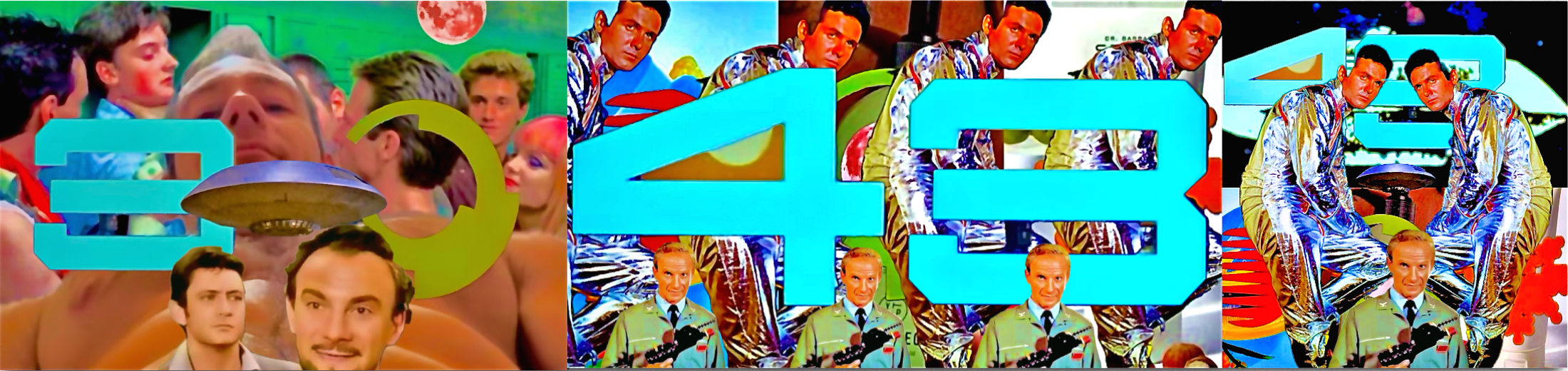
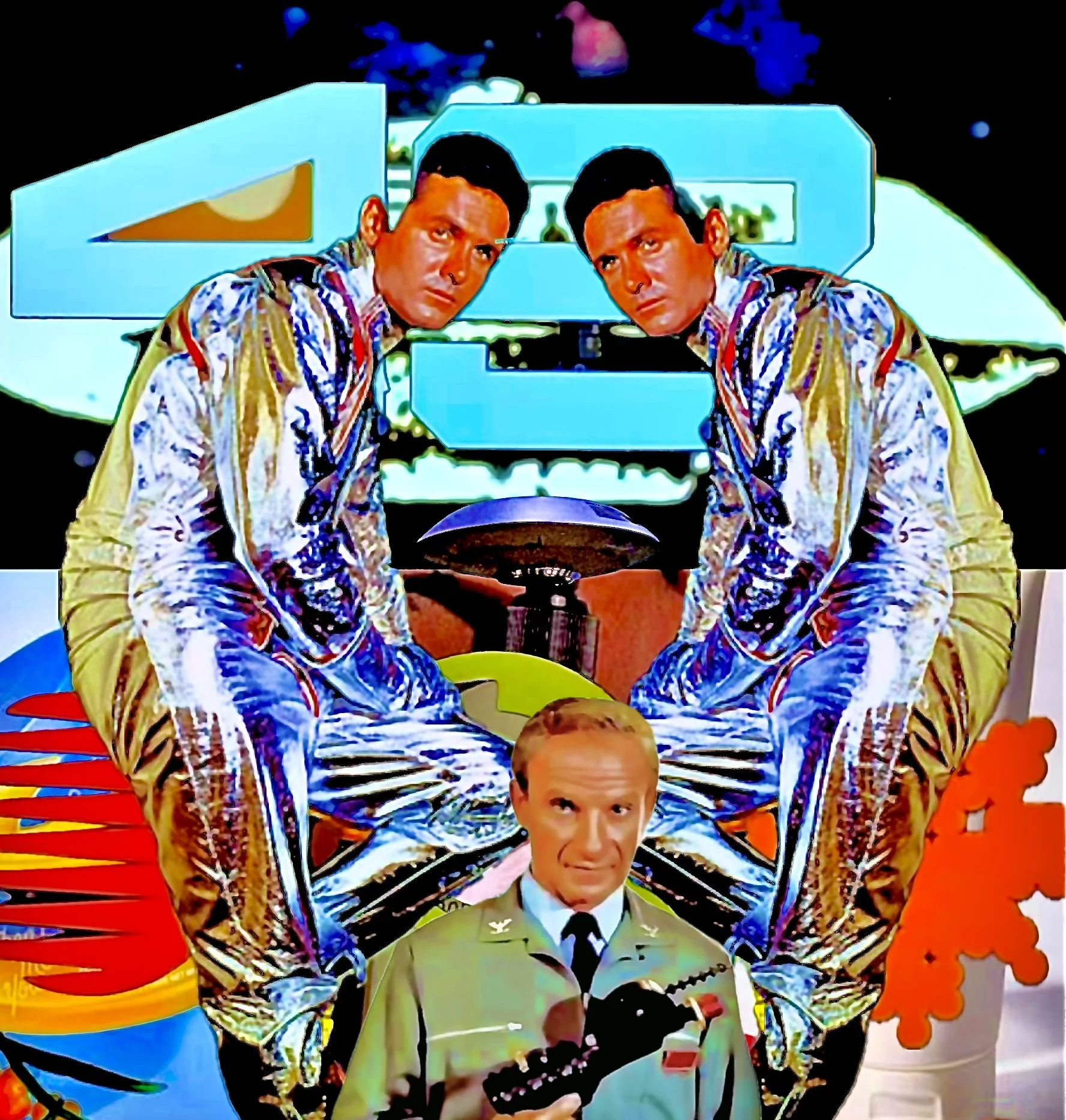
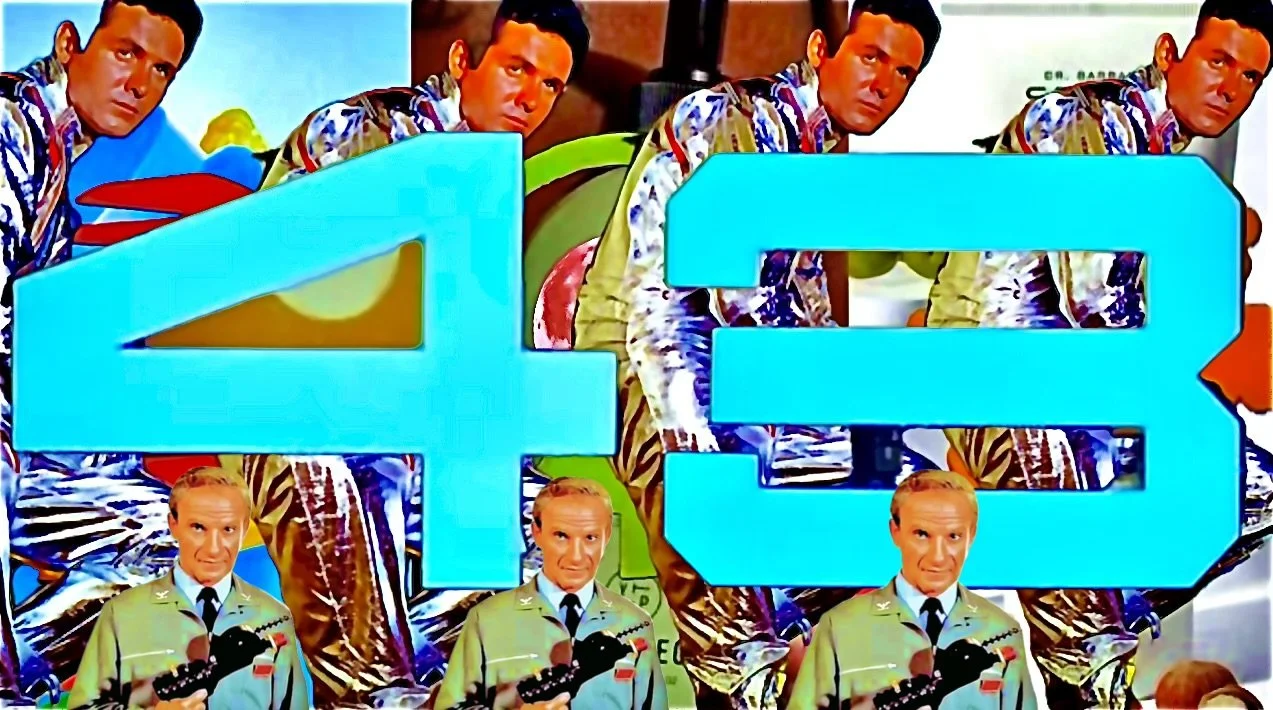
Behan’s collages look directly at this dynamic and render it in visual form. Dr. Smith is present alongside the multiplied, mirrored figure of Don West. The 4:3 ratio of the triptych is not accidental — four Don Wests to three Dr. Smiths, majority to minority, straight to gay. The blood moon watches. Jupiter 3 hovers. The Closet Series documents what the show itself could never name.
What It Means Now
Lost in Space ended in 1968, one year before Stonewall. It was never formally a queer show. It could not be. But embedded in its weekly ritual of contempt and survival was a precise map of how gay and straight male identity operated in America at a moment when neither could speak directly to the other.
The subplot was doing serious work. Don West’s contempt and Dr. Smith’s four words of quiet defiance were the whole of it — hiding in plain sight, on CBS, on Tuesday nights, in 1966. Who could ask for more?