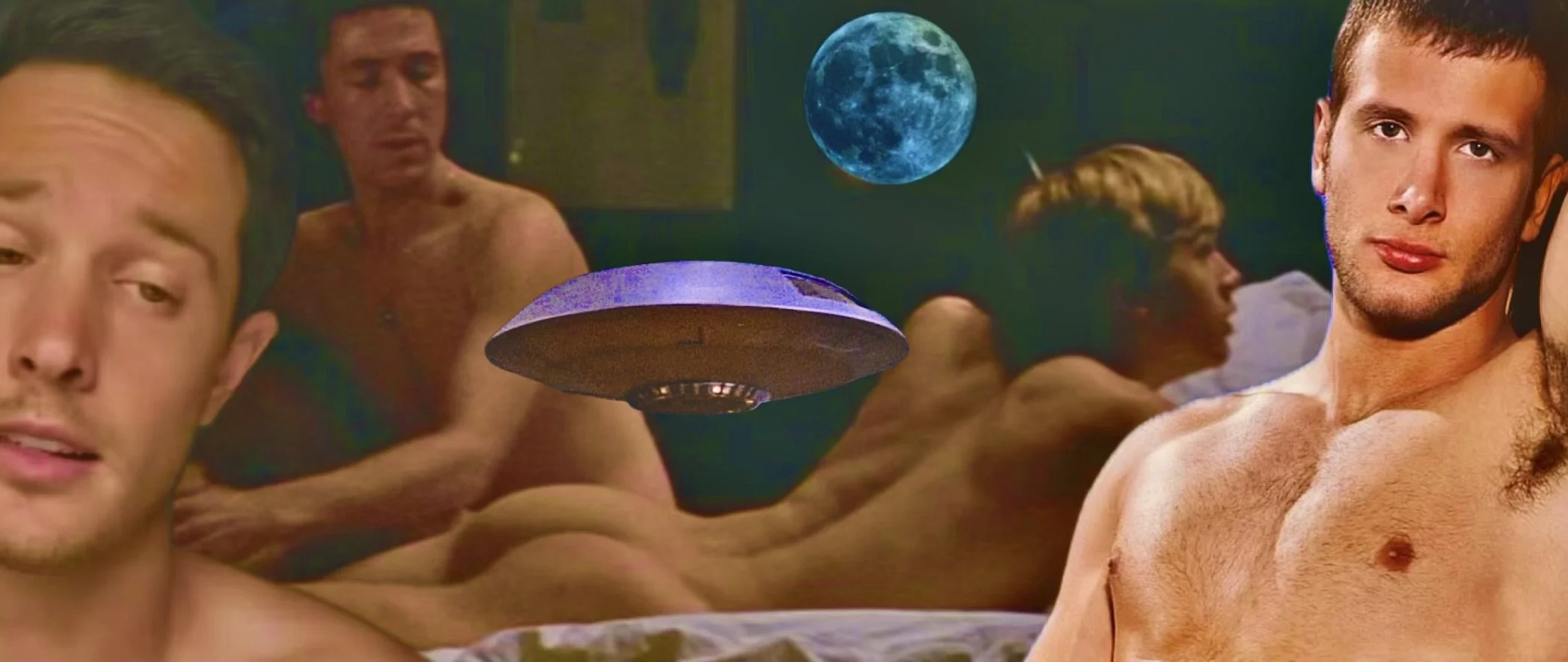
It Can Only Be Pantomime
Digital Photocollage, 2026
Queer as Folk arrived in Britain in 1999 and in America in 2000. For many gay men, it was the first time they had seen themselves reflected on television — not coded, not tragic, not comic relief. Actually seen.
And yet. Most of the men playing those roles were straight. Charlie Hunnam. Aidan Gillen. Gale Harold. Hal Sparks. Skilled actors, all of them. Allies, some of them. But straight men performing gay life from the outside in — which means, however gifted, working from observation rather than memory. From research rather than survival. These series aired at the exact moment the community was still counting its dead. The subtext of every scene, every kiss, every bed — was the dying. The friends who didn’t make it. The lovers buried before the medications arrived. That subtext was not available to a straight actor in 1999 or 2000, because dominant culture had spent two decades constructing a wall between who AIDS happened to and who it didn’t. Straight men walked through that period largely untouched by it. Gay men did not. You cannot research your way into that grief. You cannot perform it from the outside.
Russell T. Davies, who created the British original, eventually arrived at the only honest conclusion: that casting a straight actor in a gay role produces pantomime. Not because straight actors lack craft, but because gayness is not a set of behaviors you can study and replicate. It is a life. It is the specific weight of a closet. It is the particular quality of desire that has been told it does not exist.
And still today, in 2026, nothing has fundamentally changed. Wentworth Miller came out as gay in 2013. His run as a major Hollywood leading man was over. He eventually walked away from Prison Break entirely, saying he was done playing straight men — because straight men were the only roles available to him. Jonathan Bennett, the heartthrob of Mean Girls, came out in 2017. He works. He does Hallmark Christmas movies. That is what the industry offered him.
Meanwhile, straight men who play gay collect awards for their “courage.” Tom Hanks won the Academy Award for Philadelphia in 1994 — playing a gay man dying of AIDS while actual gay men dying of AIDS were invisible to Hollywood. The industry called it “brave.” “Brave” is a word they reserve for straight men doing gay men a favor. Gay actors don’t get cast in those roles. They don’t get the gay roles. They don’t get the straight roles. They don’t get the roles.
Ben Whishaw said it plainly: gay actors must read as straight to achieve mainstream success. The closet is not just something gay men build for themselves. Hollywood builds it for them, finances it, and then gives awards to straight men for visiting it briefly and leaving.
It can only be pantomime.
The Closet Series has been watching. The blood moon knows. Jupiter 3 isn’t surprised. — Behan.