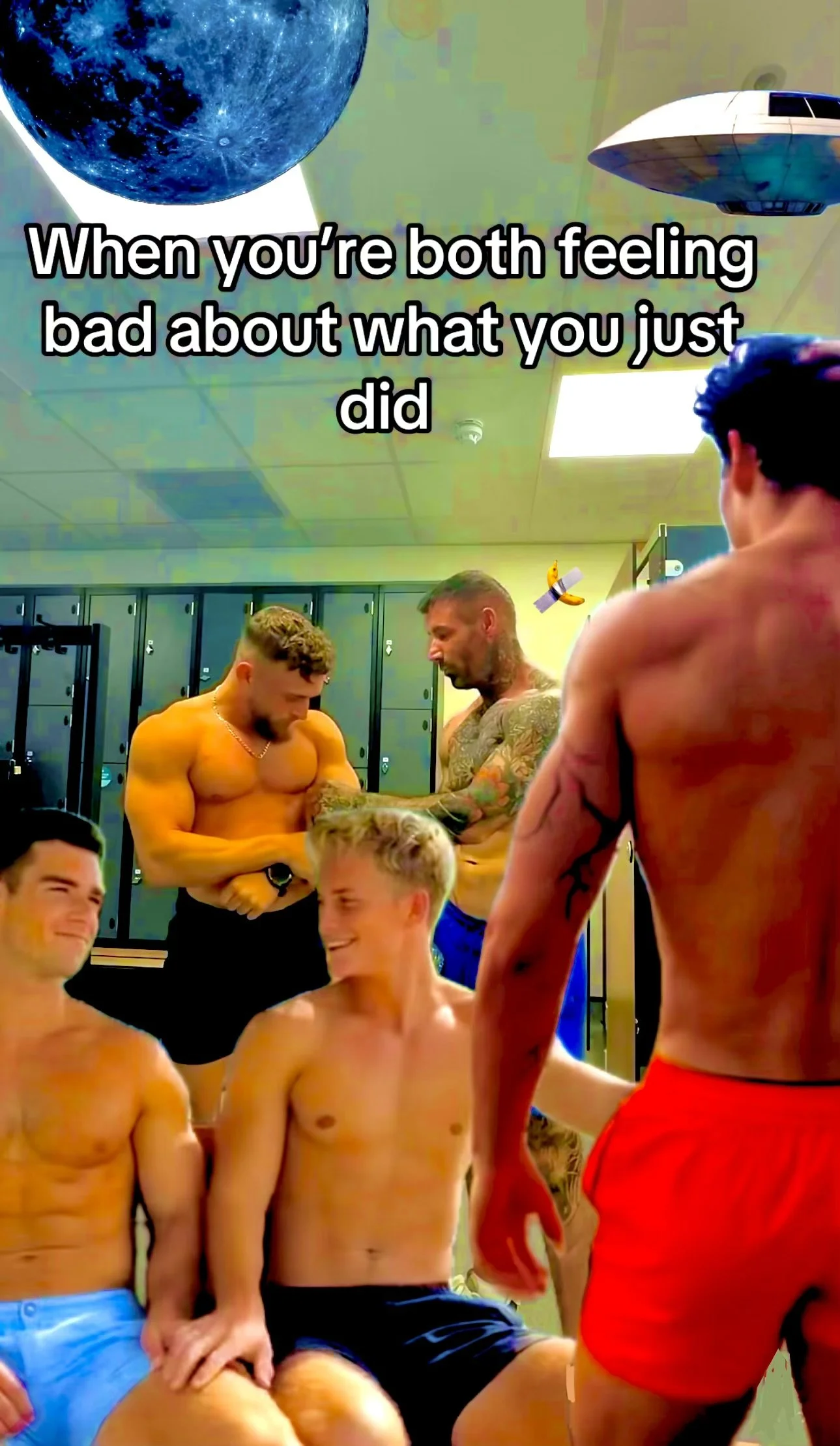
On Gay Baiting, Gay for Pay, and Gay Play in US Culture Today | Digital Photo Collage | 2026
The Hydra of gay play, gay for pay, and gay baiting by straight men on queer culture is an attempt to repress and replace an authentic view of gay life with a false premise.
It has three heads. Each one operates differently. All three serve the same purpose.
Gay Play: Beginning in the 1980s, it became fashionable for straight actors to play gay men in film — framed as a demonstration of range, a sign of serious craft. What it produced instead was a codified performance: a set of mannerisms, affectations, and attitudes that had nothing to do with how gay men actually live. When James Corden played a gay character in The Prom (2020), critics called it “the worst gayface in a long, long time” — regressive, offensive, a walking stereotype. Tom Hanks, who won an Oscar playing a gay man in Philadelphia, later said plainly: “Could a straight man do what I did now? No, and rightly so.” Director Russell T Davies, who cast only gay actors in It’s a Sin, explained why: “Acting gay is a bunch of codes for a performance. It is not authenticity.” The codes are not gay life. They are straight men’s idea of gay life — performed for straight audiences, adjudicated by straight critics, awarded by straight academies.
Gay for Pay: The adult film industry formalized a second head of the Hydra. Straight men performing gay sex for money — framed always as transgression, as something done reluctantly, under persuasion, for a price. The subtext is never subtle: gay sex is something a real man would never choose freely. It requires payment. It requires coercion. It is, by definition, shameful. This genre represents straight men’s fantasy of what gay men are — a market to be exploited, a boundary to be performed crossing, a shame to be monetized and reinforced.
Gay Bait: Social media delivered the third head. Straight men — often fitness influencers, streamers, athletes — deploy homoerotic imagery, language, and suggestion to capture gay audiences and drive engagement, then retreat behind the disclaimer: I’m straight. I was just acting. The post that generated this collage is a precise example. Two men in a locker room. The original caption: When you’re both feeling bad about what you just did. The implication is clear. The shame is the point. What they “just did” is something they would never do in real life — and the humor, the engagement, the clicks depend entirely on that shame remaining intact.
Every morning The Closet Series scrolls social media looking for exactly this — the shame being reinforced by straight actors into queer communities. With this found post, three figures were superimposed over the original image of two men in the locker room, the blue moon witnessing, Jupiter 3 overhead, Cattelan’s banana in the corner. The original caption stays. The subtext becomes context. The shame is named and confronted.
The Hydra of straight men performing gay — in prestige film, in adult entertainment, in social media — exists to maintain the shame and the closet itself.
The shame is the mechanism of control. If the shame goes away, straight power is diminished.
Gay play, gay for pay, and gay baiting are not homage. They are not allyship. They are an attempt to own the representation of a culture by men who do not live it, in order to keep that culture’s self-image distorted, exaggerated, and contingent on straight approval.
And that’s a shame.
— Behan
Sources:
• Russell T Davies, RadioTimes, on casting It’s a Sin (2021)
• Tom Hanks, The New York Times Magazine (2022)
• James Corden / The Prom critical reception, multiple outlets (2020)
• Grindr.com: “Queerbaiting: Learn What It Is and Its Effects” (2024)
• Jeremy Strong, Variety (2024)
• Stanley Tucci, BBC Radio 4 Desert Island Discs (2023)