Gay Play: How Straight Men Continue to Profit from Gay Culture
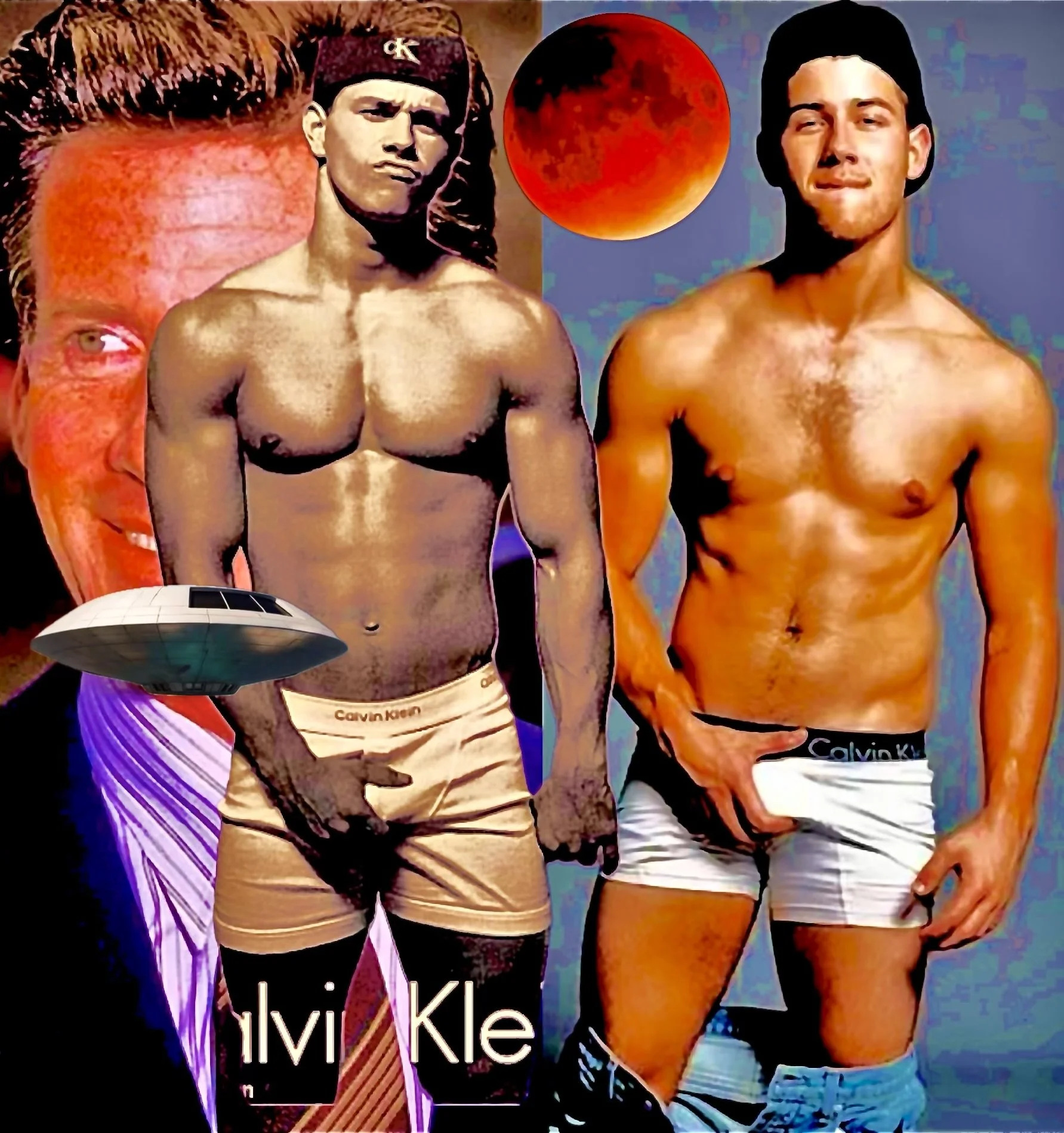
Digital Photo Collage Suite | 2026
Gay play is not a new invention. It is an advertising campaign.
This five-piece suite of collages documents a specific and ongoing practice: straight men, self-identified, entering and inhabiting gay cultural space to extract profit — through performance, through imagery, through insinuation — and then retreating to the safety of heterosexual identity when the transaction is complete. Gay culture serves as the concept. The campaign always ends the same way. The straight man walks away with the revenue. The gay community is left with the residue.
September 17, 1964: Darren Stevens and the Witch in the Closet
Darren Stevens was an advertising executive in New York City. That was the core structural premise of Bewitched, which premiered on ABC on September 17, 1964. It starred Elizabeth Montgomery as Samantha Stephens, a witch who marries a mortal and is required by her husband to hide who she is. Every episode turns on the cost of that concealment — the scrapes, the near-discoveries, the exhaustion of performing normalcy in a world not ready for the truth.
Montgomery confirmed in a 1992 interview with The Advocate what many had long understood: “Don’t think that didn’t enter our minds at the time. We talked about it on the set that this was about people not being allowed to be what they really are. If you think about it, Bewitched is about repression in general and all the frustration and trouble it can cause.”
The show was staffed accordingly. Dick Sargent, the second Darren, was a closeted gay man who came out publicly in 1991 — Montgomery co-marshalled the 1992 Los Angeles Pride Parade alongside him. Paul Lynde, Uncle Arthur, was openly gay in all but press release. Agnes Moorehead, Endora, was widely understood within the industry to be a lesbian. Maurice Evans, Samantha’s father, was gay. The series about hiding who you are was made largely by people who were hiding who they were.
Darren Stevens is not simply a character. He is a symbol. He is the straight man whose comfort requires the concealment of the person beside him. His job is to construct an image and sell an idea. The closet exists, in Bewitched, in direct service of his advertising career. Samantha hides so Darren can work. The mystique is the concept. The concealment is the campaign.
For centuries of European culture, gay people did not exist — officially, legally, ecclesiastically. They were erased, criminalized, silenced. And then, once that erasure became impractical, once gay culture became visible and vital and commercially attractive, a different strategy emerged. Not erasure. Exploitation. Not denial. Advertising.
Darren Stevens saw it coming.
March 13, 1993: Marky Mark, Calvin Klein, and the Male Odalisque
On March 13, 1993, a blizzard hit New York City. On a Times Square billboard, a young man in white Calvin Klein briefs stared down at the storm. The campaign had launched in 1992, but this was the moment it became undeniable — an image so arresting it stopped traffic, photographed against the snow, plastered across the cultural memory of a generation. Mark Wahlberg, then known as Marky Mark, had become the male odalisque of American advertising.
This was unprecedented. The gay male gaze, which had long existed underground — in physique magazines, in beefcake photography, in the coded imagery of mid-century Hollywood — was now on Times Square. It was now on the sides of buses. It was now selling underwear to everyone, including the gay community whose aesthetic it had borrowed wholesale. The campaign earned Wahlberg an estimated $20 million in endorsements. Calvin Klein underwear sales increased 300%. The gayplay* had worked.
And then, almost immediately, Wahlberg resented it.
Wahlberg reportedly resented the attention the ads drew from his new gay fan base. On a British talk show, he sat alongside rapper Shabba Ranks as Ranks declared that gays should be crucified — and said nothing. In 1993, he was accused of using a homophobic slur against a member of Madonna’s entourage. Calvin Klein eventually removed him from the campaign. He was ordered by a court to appear in anti-bias public service announcements. He complied. He moved on. His current net worth is estimated at $400 million. The Calvin Klein advertising campaign is where it began.
Kate Moss, who appeared in the same campaign, had not very good memories of the experience. She described Wahlberg as “very macho” and said it was all about him. She felt objectified, vulnerable, and scared. Calvin Klein himself, she said, loved that she was young and innocent. She was seventeen years old. In 2012, she told Vanity Fair she had a nervous breakdown after the shoot. “I couldn’t get out of bed for two weeks,” she said. “I thought I was going to die.”
When Wahlberg eventually learned of Moss’s account — apparently unaware she had spoken about it at all — his response was instructive. “I think I was probably a little rough around the edges,” he said in a 2020 Guardian interview. “Kind of doing my thing. I wasn’t very worldly, let’s say that.” No apology. No acknowledgment of harm. No amends. This is the standard posture of straight men in power when confronted with the damage they have caused: a vague acknowledgment dressed as innocence and surprise, as if the harm were a weather event rather than a choice.
Mark Wahlberg presents as a devoted conservative Catholic. He speaks publicly about his faith, his rosary, his 4am prayer routine. But a devoted conservative Catholic makes amends to the people he has harmed. He goes back. He apologizes directly. He does not describe a nervous breakdown as being a little rough around the edges. What Wahlberg presents as piety is the same performance as everything else in this story: an advertising campaign aimed at a specific audience, generating a specific return. Kate Moss has not received an apology. The gay community whose aesthetic launched his career has not received one either.
There is one more dimension to Calvin Klein that this essay cannot leave unexamined. The man who built a fashion empire on the gay male gaze — who launched the career of a man who sat silent while gays were said to deserve crucifixion — was himself in the closet throughout the campaign’s peak years. Klein was married twice to women: to Jayne Centre from 1965 to 1974, and to Kelly Rector from 1986 to 2006. It was only in 2006, the year his second marriage ended, that he publicly acknowledged his bisexuality. He told Vanity Fair in 2008: “I’ve experienced sex with men, with women. I’ve fallen in love with women. I’ve married women. And I have a family. I am for good or bad a real example of whatever I’ve put out there.”
The closet, then, was not only the condition of the community whose images Klein commodified. It was his own condition. He was running a gay advertising campaign from inside the closet.
The photographer behind Calvin Klein’s campaigns was Bruce Weber. Weber’s work for Calvin Klein in the late 1980s and early 1990s defined the visual language of the desirable male form in American advertising. He was the lens through which the male odalisque entered mass culture.
He was also, according to fifteen current and former male models who spoke to the New York Times in January 2018, a serial sexual predator.
Weber’s alleged demands often occurred during photo shoots and other private sessions. Models were asked to perform breathing exercises, to touch themselves and to touch Weber, moving their hands wherever they felt energy. Weber often guided the models’ hands with his own. Model Robyn Sinclair described his experience plainly: “A lot of touching. A lot of molestation.” In December 2018, five models filed a federal lawsuit calling Weber a “serial sexual predator” and invoking sex trafficking statutes. Weber denied all allegations. The cases were eventually settled.
Weber’s alleged abuse stretched back to 1982 — a full decade before the Marky Mark campaign. The advertising infrastructure that produced those images, that launched that career, that built that cultural moment, was operating on a foundation of alleged coercion and abuse throughout. Calvin Klein, as a company, employed Weber for decades. Calvin Klein, as a company, benefited from his work. Calvin Klein, as a company, did not ask the questions that might have interrupted the profit.
November 5, 2014: Nick Jonas and the Gay Advertising Blitz
On November 5, 2014, Dallas Voice — the Texas gay periodical — published an interview with Nick Jonas timed to the release of his self-titled solo album and the premiere of his television series Kingdom, in which he played a closeted gay MMA fighter. The interview documented, in Jonas’s own words, a deliberate and sustained campaign to enter and inhabit* gay cultural space for commercial purposes.
Jonas told Dallas Voice that in planning his solo rollout, he had made his intentions explicit to his team: he really wanted to make an effort to embrace the gay community as part of his audience. “I’ve known for a long time that it is a great part of the audience,” he said, “and I just never felt like we made all the effort we could to embrace them.”
One can argue this was more advertising strategy than allyship.
What followed was a sustained campaign of gayplay*. Jonas appeared at gay clubs across the country, regularly shirtless. He gave interviews to gay publications — Dallas Voice, OUT, Pride Source — discussing his gay friends, his comfort with the gay gaze, his excitement about playing gay* characters on television. He played a closeted gay MMA fighter on Kingdom and a gay frat boy on Scream Queens, simultaneously, while releasing music calibrated explicitly for gay male audiences. When Dallas Voice asked him to rate the gayness of a Nick Jonas show on the Kinsey Scale, he laughed and declined to answer: “I think I need to let it continue to evolve. It’s in the early stages here. Let’s see where we get in the next couple of months and then we’ll make that call.”
That is not the answer of an ally. That is the answer of a man who understands that evasion is an advertising strategy.
By 2014, the gay press and gay audiences were pushing back. Accusations of gay baiting circulated widely. Jonas dismissed them. “Everyone’s entitled to their own opinion. I think it’s unfortunate that some people have to find a negative in every situation. Clearly my heart is in the right place.” In 2016, when OUT magazine put him on the cover and critics renewed the charge, he called their concern “really quite sad.”
The campaign worked. His single “Jealous” sold over three million copies in the United States alone. His 2014 self-titled album debuted at number six on the Billboard 200. His net worth, estimated at $18 million by 2016, was built substantially on the foundation of gay cultural capital. He then executed a clean popndrop* — married Priyanka Chopra, settled into heterosexual celebrity, and moved on. The gay community that had been so carefully courted became a chapter in his career biography rather than an ongoing relationship.
This is gayplay* in its most refined form: targeted, deniable, profitable, and temporary.
The System and the Indictment
Nick Jonas. Mark Wahlberg. Bruce Weber. Calvin Klein.
Each of them entered and inhabited gay cultural space on their own terms and left it on their own terms. Each of them extracted something — celebrity, profit, imagery, career — and paid nothing back. Each of them, when questioned, retreated behind the same disclaimer: I’m straight. I was acting. I have gay friends. My heart is in the right place. It was a different time. I wasn’t very worldly.
What they were doing has a name. It is gayplay*. And gayplay* is not homage. It is not allyship. It is the use of gay identity as an advertising concept — a campaign that runs as long as it is profitable and ends the moment it is not. Gay presence was first denied in American culture, then when it became visible, it was immediately turned into an advertising idea. Not a life. Not a community. A concept to be deployed and withdrawn at will.
The popndrop* is the mechanism. The closet is the condition that makes it possible. As long as gay identity carries risk and shame, the performance of gayness by straight men retains its advertising value — transgressive enough to be interesting, deniable enough to be safe.
And spinetime* reminds us that this is not one story. It is many stories, unfolding across generations. To be gay in 1964 is not to be gay in 1993 or 2014. Each generation inherits a different world — sometimes better, never finished. The straight men in these collages moved through gay culture at specific moments in spinetime*, extracting what they needed and leaving before the bill came due.
The Closet Series does not offer a resolution. It offers a record. These five collages place specific men and specific moments inside the longer frame of that history — tracing the arc from the shadows of the military closet to the billboards of Times Square to the gay clubs of New York, where a young straight man took off his shirt and offered the pretense of love.
The pretense is the point. It always has been.
— Behan
Legend
gayplay* — the strategic performance of gay identity by straight men for commercial gain.
play gay* — to enter and inhabit gay cultural space temporarily and instrumentally, for profit, without authentic claim to that identity.
popndrop* — the pattern by which straight men court gay audiences for commercial purposes, then withdraw once the transaction is complete, leaving no accountability behind.
spinetime* — the understanding that time is the central axis of queer experience; that where you fall on the timeline determines, in large part, what your life is permitted to be.
*See The Closet Series Vocabulary: A Working Dictionary for full entries.
Sources
• Dallas Voice, Nick Jonas interview (November 5, 2014)
• OUT Magazine, Nick Jonas cover interview (May 2016)
• Refinery29, “Nick Jonas LGBT Issue” (May 2016)
• Flavorwire, “Nick Jonas Looked into the Abyss of the Gay Male Gaze” (June 2016)
• The Advocate, Elizabeth Montgomery interview (July 30, 1992)
• HuffPost, “Remembering Elizabeth Montgomery: 9 Queerest Moments of Bewitched” (2015)
• LGBTQ Nation, “The gay secrets behind the classic TV sitcom Bewitched” (March 2021)
• The New York Times, Bruce Weber and Mario Testino sexual misconduct investigation (January 13, 2018)
• Business of Fashion, additional Bruce Weber allegations (January 2018)
• Five male models v. Bruce Weber, federal lawsuit (December 2018)
• Kate Moss, Vanity Fair (2012); BBC Radio 4 Desert Island Discs (2022)
• Mark Wahlberg, The Guardian interview (2020)
• Attitude Magazine, “Mark Wahlberg’s alleged homophobic past revisited in Love Story” (February 2026)
• The Daily Beast, “Mark Wahlberg’s Hate Crime Past Dragged Back Into Spotlight by Ryan Murphy” (February 2026)
• Calvin Klein, Vanity Fair interview (March 2008)
• People Magazine, “Inside Calvin Klein’s Dating History” (2024)
• Getty Images: Marky Mark Calvin Klein billboard, Times Square, March 13, 1993
• Mark Wahlberg net worth: Parade, Celebrity Net Worth (2026)
• Nick Jonas net worth and album sales: AOL / Dick Dale (2016)