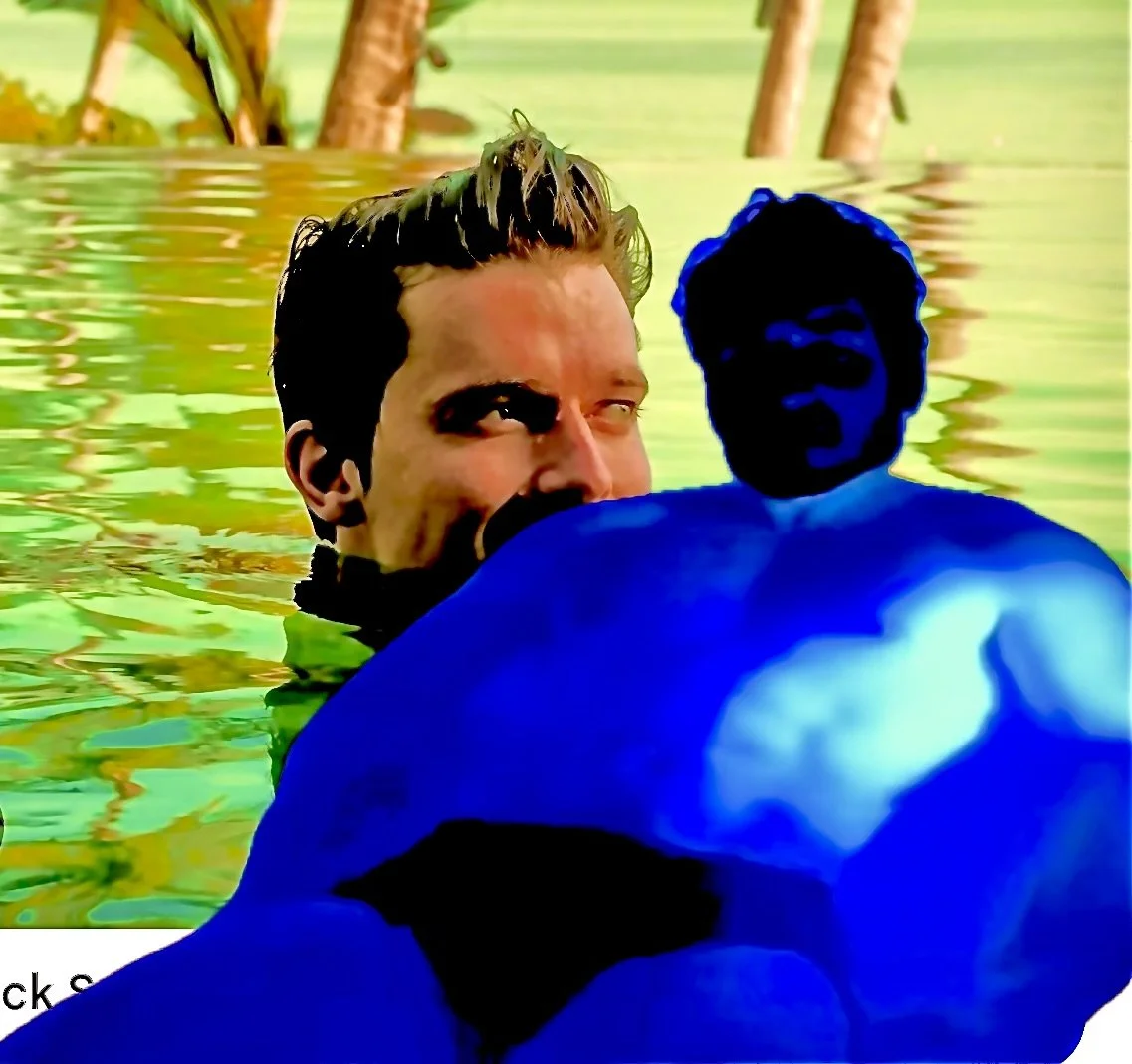
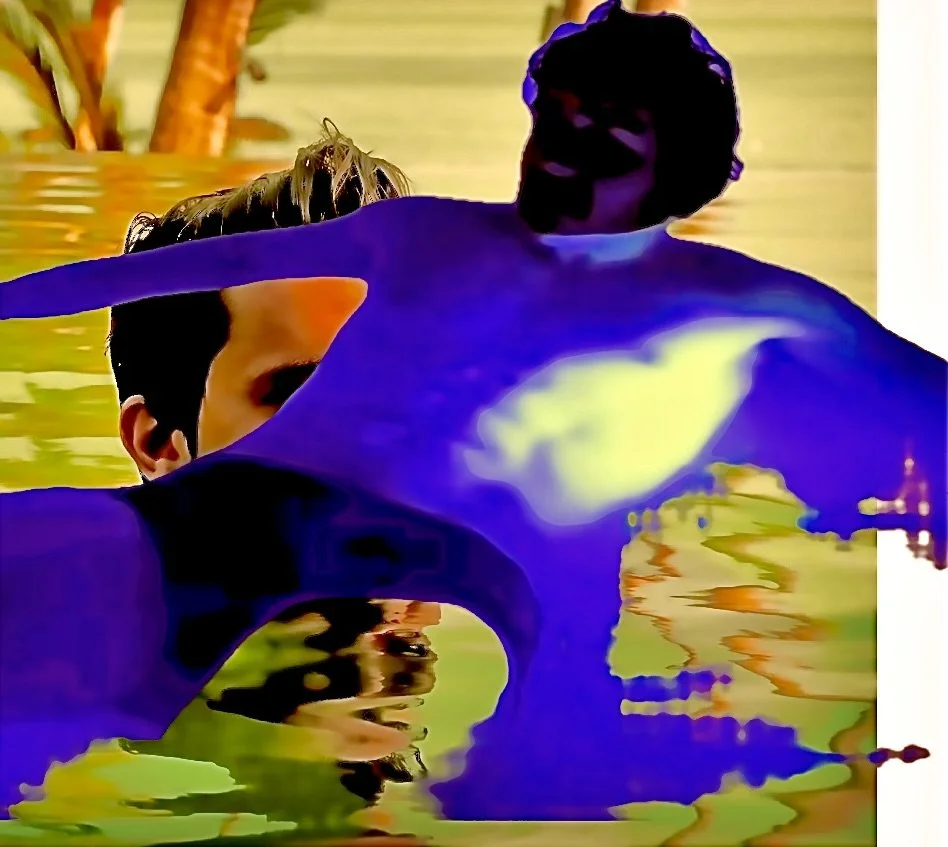
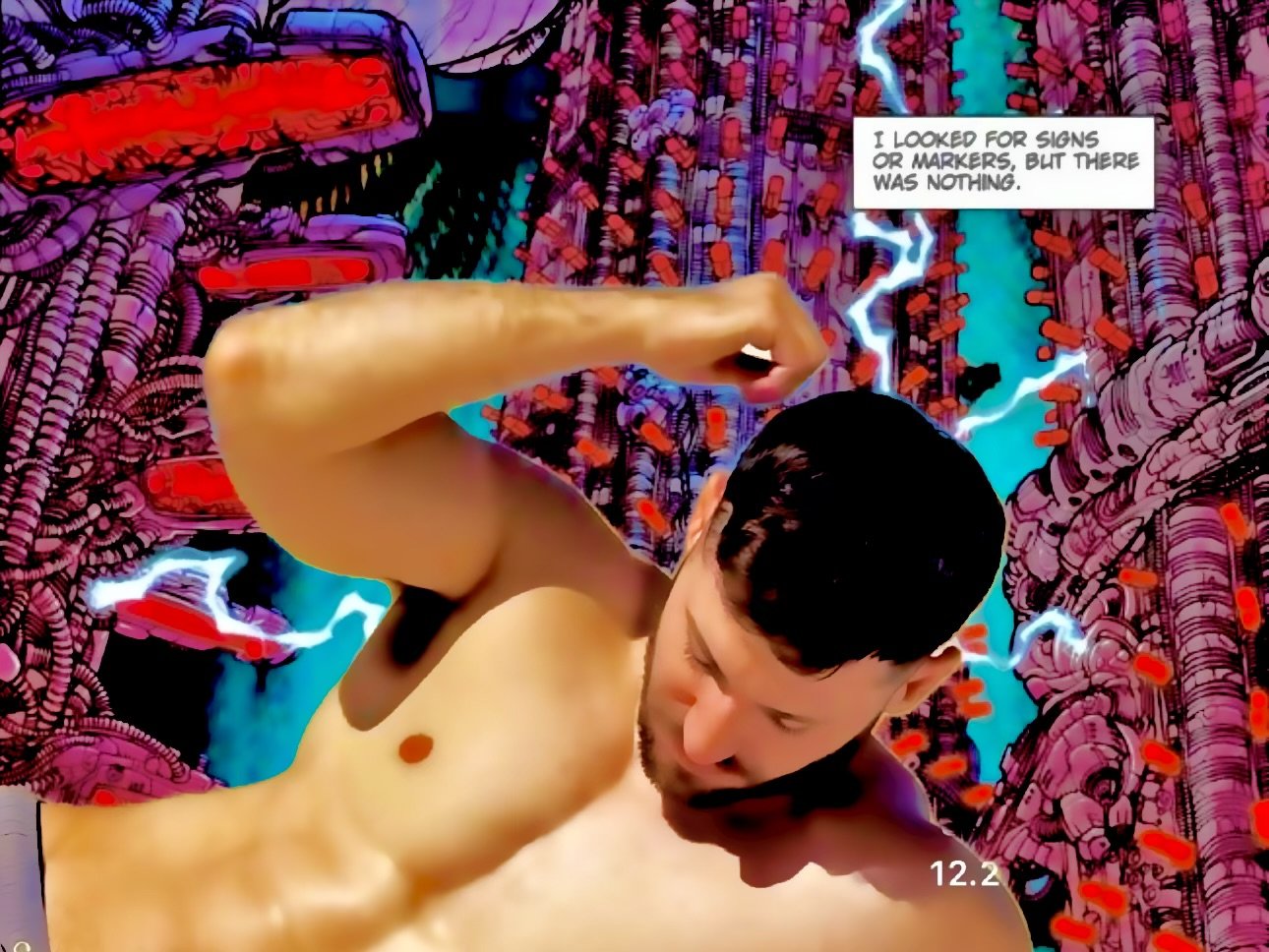
Colossus | Inside the Closet | 6 Pack | The Closet Series | The Subdivision | 2026 | Digital Photo Collage
The matrix has no name. That’s how it functions. A heteronormative culture has long known how to extract what it needs from gay people — the labor, the beauty, the taste, the wit, the genius — while maintaining the social fiction that those people don’t quite exist. The closet is not incidental to this arrangement. It is the arrangement. It is the mechanism by which a culture consumes a person while erasing them.
These six collages are not illustrations of that condition. They are its interior architecture. A figure dissolves into comic-book cosmology, lightning and viscera, claws and teal voids. A face floats severed from its body in an unbroken field of blue. Two men exist in water together, one rendered in cobalt silhouette, rendered beautiful and invisible in the same gesture. One panel carries text: “I looked for signs or markers, but there was nothing.” That is the closet speaking. That is what it sounds like from the inside. There are no signs because the system that built it does not post signs. It simply operates — drawing on your gifts while banking on your silence.
The numbers make the architecture visible in a different register. As of 2025, nine percent of U.S. adults identify as LGBTQ+, more than double the percentage recorded when Gallup first began measuring this population in 2012. Adults under thirty now identify as LGBTQ+ at a rate of twenty-three percent. And yet the closet persists in direct proportion to the stakes. Nearly one in five LGBTQ+ adults say they have never come out to anyone — approximately 2.7 million people who have never said the words out loud to a single human being, despite many perceiving that society has grown more inclusive. Approximately 5.5 million LGBTQ+ workers go to work every day without being who they are — not out of self-denial, but out of rational calculation. Fifty percent of LGBTQ+ respondents report having experienced some form of workplace discrimination or harassment in the previous year, and thirty-one percent report that discrimination has affected their ability to be promoted or earn what they are worth. Demographer Gary Gates defines those in the closet as people who are discordant with regard to recent behavior and identity, along with those who intentionally hide their identity — which means the closet includes not only those who have never come out, but the millions more who live in partial disclosure, calibrating visibility against risk in every room they enter.
Data scientist Seth Stephens-Davidowitz has noted that gay male internet behavior is nearly uniform across U.S. states — suggesting the actual prevalence of gay men does not vary by region, but that in states with stronger social stigma, far more remain in the closet than are out. The closet is not a personal failure or a private arrangement. It is a structural outcome. It is produced by culture and sustained by culture, and it serves culture — because a gay person managing their own visibility has less energy left over to challenge the conditions that made management necessary.
These collages operate at that threshold — the place where self-presentation becomes performance, where the body becomes both subject and object of a heteronormative gaze, where the figure inside the image is both seen and consumed. The blue field does not ask where the man went. It already knows. It built the room.
Leaving the closet, there are no guides, no Jupiter 3, no moon to light the way. It is a self-initiated act from the known to the unknown.
The Subdivision documents all those still in the process of making that decision.
— Behan
Sources: Gallup, LGBTQ+ Identification in U.S., 2025. Pew Research Center, The Experiences of LGBTQ Americans Today, 2025. Human Rights Campaign / Zippia, LGBTQ+ Workplace Discrimination Statistics, 2026. Center for American Progress, Discrimination and Barriers to Well-Being, 2022/2024. Seth Stephens-Davidowitz, Demographics of Sexual Orientation research. Gary Gates / Gallup, Counting the Closet, Contexts, 2017.