Dive in—The Sunscreen’s Fine
Gay Domestic | The Subdivision | Digital Photocollage | 2026
Being Gay is Often an Outdoor Sport—Stay Alert and Protected
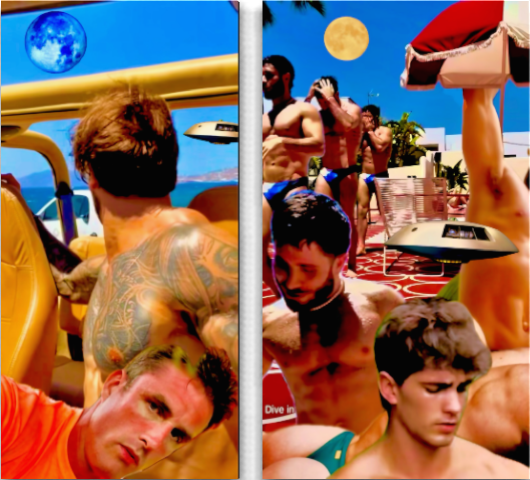
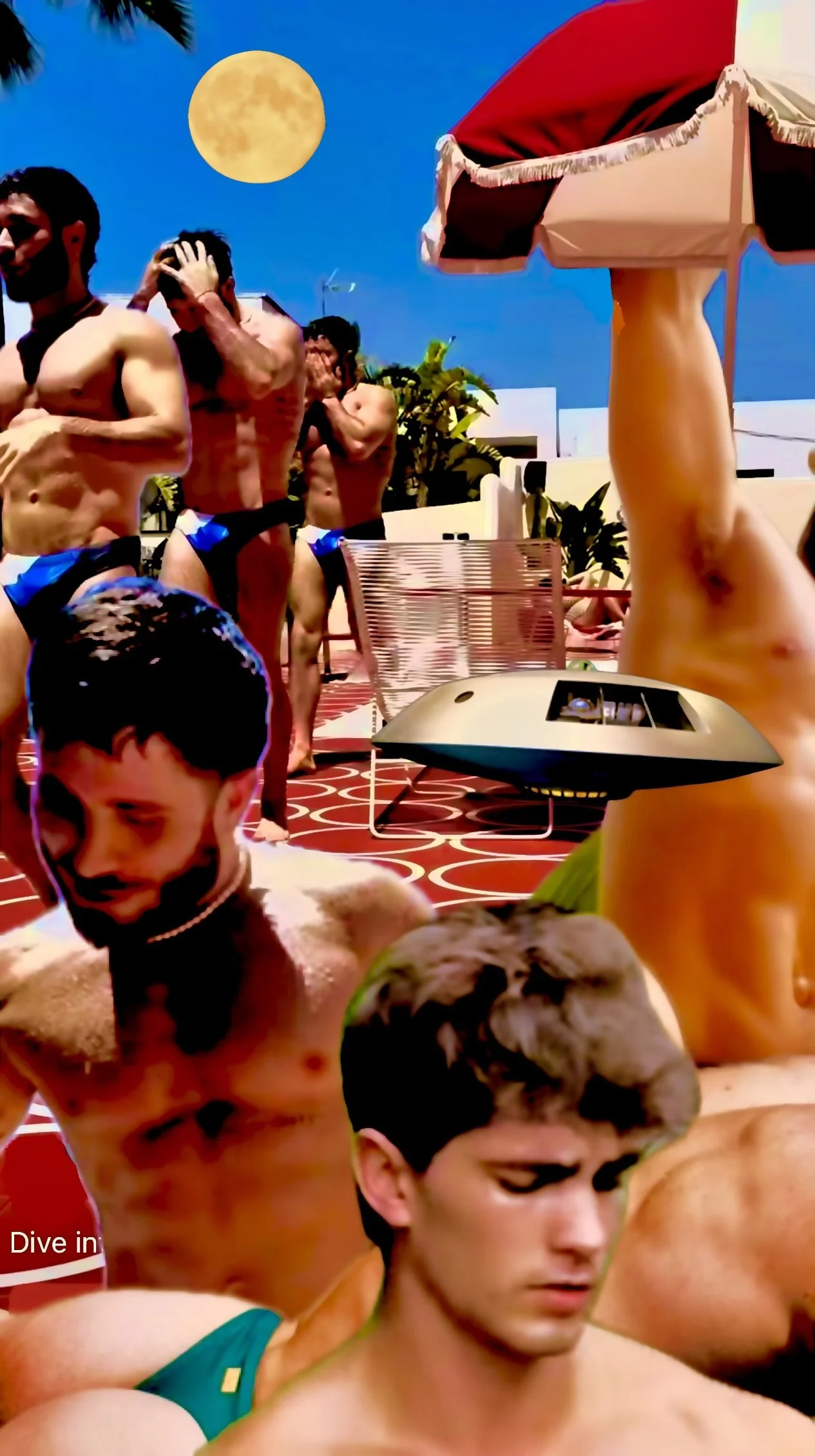
Poolside light does the flattering work: it catches oiled shoulders, blue Speedos, a hand raised into an umbrella’s shade. It is the most forgiving light there is, which is precisely the problem. The ozone layer thins every year, and the sun that made these bodies desirable is quietly becoming the thing that will age or endanger them.
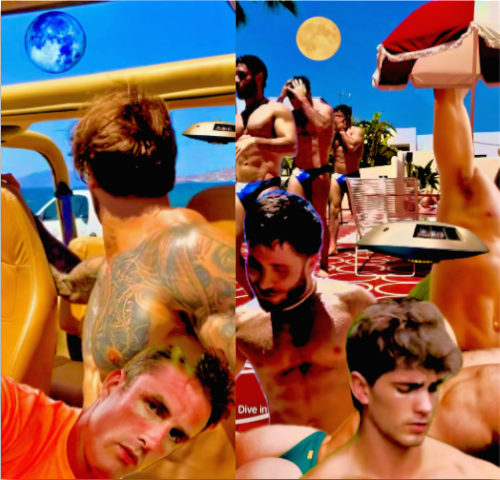
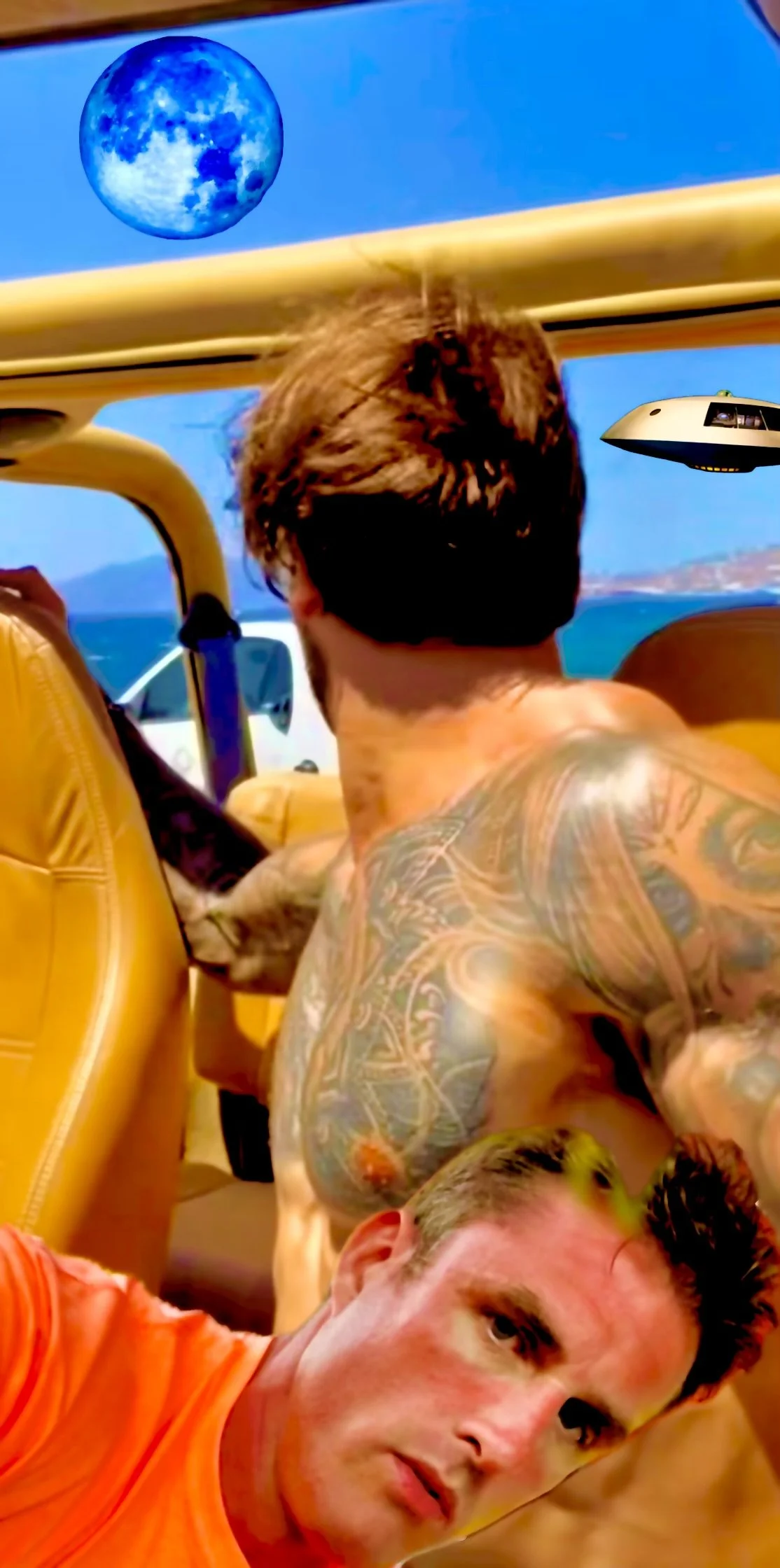
In the open air jeep a blue moon hovers overhead, tattooed chest turned toward the rear — decoration competing with exposure, clocking the cop on the motorcycle a short distance behind.
At the pool, a group of men towel off under a red umbrella while a saucer drifts past, unbothered, as if surveillance from above comes as expected as the cabana boy. “Dive in,” the image insists in its corner text, half invitation and half dare.
The tag for this diptych — Being Gay is Often an Outdoor Sport — is not an observation about athleticism. Gay social life has long happened outdoors: beaches, pool decks, cruising grounds, backyard parties, all spaces built around visibility and exposure by necessity as much as choice. That exposure was once mostly social risk. Now it is also literal — skin held up to a sky doing a worse job protecting it than it used to. The ozone layer’s decline is not new information, but it is easy to file away as abstract, a problem for polar ice and satellite data rather than a Saturday afternoon outing. Bottom line: stay protected, and eat your greens.
Now about the cops and outings. Outdoor exposure has always carried a second kind of risk for a targeted class, and the numbers back up what the figure on the motorcycle represents rather than invents. LGBTQ+ people are arrested at nearly 20% over their lifetime compared with roughly 13–14% of non-LGBTQ+ people, and transgender people are arrested at closer to 30%. Gay and bisexual men are reported to be roughly 30% more likely to be arrested than straight men, and one national analysis found LGBTQ+ people overall arrested at more than double the rate of straight people in a given year. LGBTQ+ people are also more likely to be stopped, searched, and held in custody than their non-LGBTQ+ peers — and, as a result, are less willing to call police for help when they need it.
Bottom line: cops historically have loved outing gay people, despite the closet’s social contract always being narrow but clear: no public displays, and the dominant culture leaves you alone. In 1953, seventy men gathered for a wedding inside a private home in Waco Texas— no street, no park, no public square. Police broke down that door anyway, arrested the men on vagrancy charges, and printed their names and addresses on the front page of the local paper. The state did not enforce the closet’s terms—it violated them — publicizing what had been kept private, costing these men not just their jobs but the protecting lie the culture demanded they live.
None of that is abstract to a body in a Speedo on a public pool deck. It’s always important, wherever you are, to stay aware and protected—like light chain mesh armor — from the sun, and from anyone else assigned to watch you.
— Behan
Sources: American Civil Liberties Union / NORC survey analysis (2024); Williams Institute, UCLA (2025); Prison Policy Initiative (2021); Safety and Justice Challenge (2025); general atmospheric science reference on ozone depletion and UV exposure.