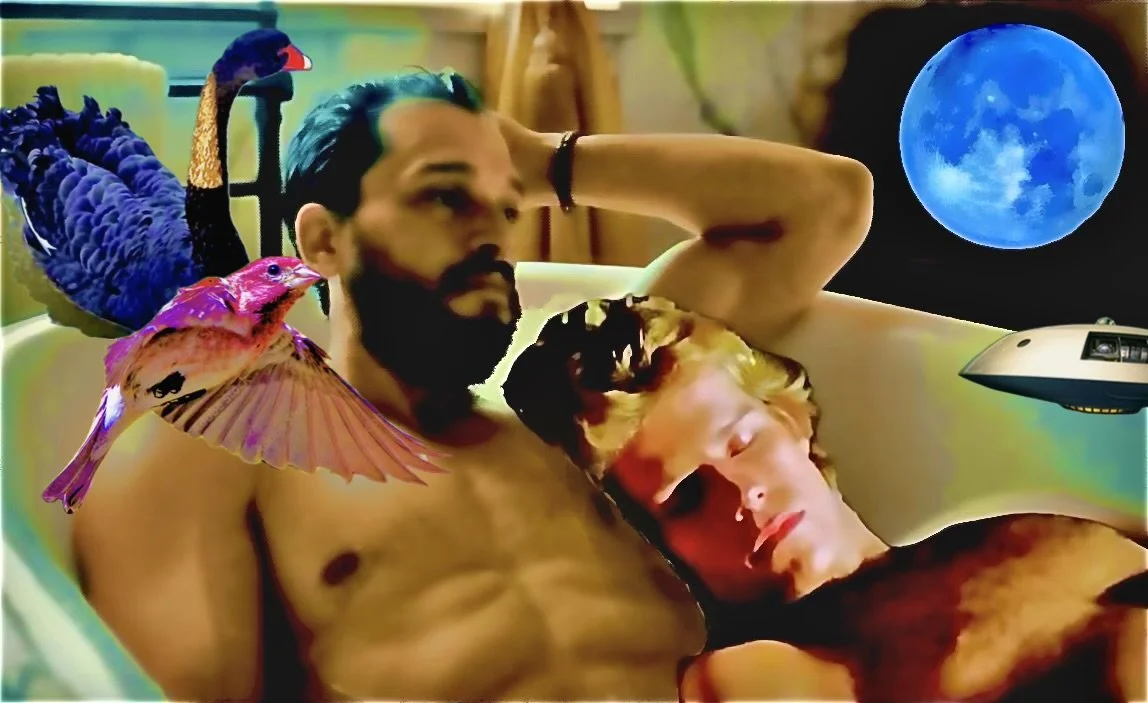
Al Corley and Steven Carrington Finally Have Their Moment | The Gay Gaze | The Subdivision | Dynasty Edition | Digital Photocollage | 2026
In 1981, ABC gives America Steven Carrington — one of the first gay series regulars in the history of American network television. Dynasty is, by design, a show about romance and conflict, about who is allowed to want whom and what it costs them. Steven wants men. The show never lets him have one.
The record of what American television actually permits, in the years around and after his debut, tells the story plainly. In 1972, That Certain Summer offers the first sympathetic gay portrayal on network TV, a divorced father hiding a relationship from his son — no kiss, no touch. In 1975, Hot l Baltimore puts a gay couple on screen together for the first time, still without physical intimacy. Steven arrives in 1981 into this vacuum, one of the earliest gay characters allowed a name and a story line, and the writers still cannot give him a lover. In 1991, L.A. Law airs what is considered the first same-sex kiss on American network television — between two women, largely remembered even by the actress involved as a ratings stunt. It takes until 2000, on Dawson’s Creek, for two men to kiss on American network television at all.
Nineteen years pass between Steven Carrington’s debut and the first time a man is allowed to kiss another man on the medium that made him famous.
Al Corley understood what was being asked of him in real time. Dynasty runs for nine seasons. Corley leaves after two, walking away from a hit show because the writers would not let Steven’s identity be more than implication. It is a quiet kind of protest, the kind that costs a career its momentum rather than making headlines. Jack Coleman inherits the role and inherits the same limitation — a character permitted to be gay in theory and never in scene.
This is the work of The Subdivision: to build a visual record of gay history that was never allowed to be recorded, and gay history that was never allowed to happen at all. Some of what appears in these collages is restoration:
— pulling a buried moment back into the light. Some of it is invention
— imagining the moment institutions refused to let exist in the first place. Both count as history here. Both are owed a place in the record.
Steven Carrington gets his moment in this collage:
— tender, unhurried, decades late, and entirely his own. Not a correction. Not a fictional addition. A completion of a debt due.
— Behan
Sources: Wikipedia, ABC News, LGBTQ Nation