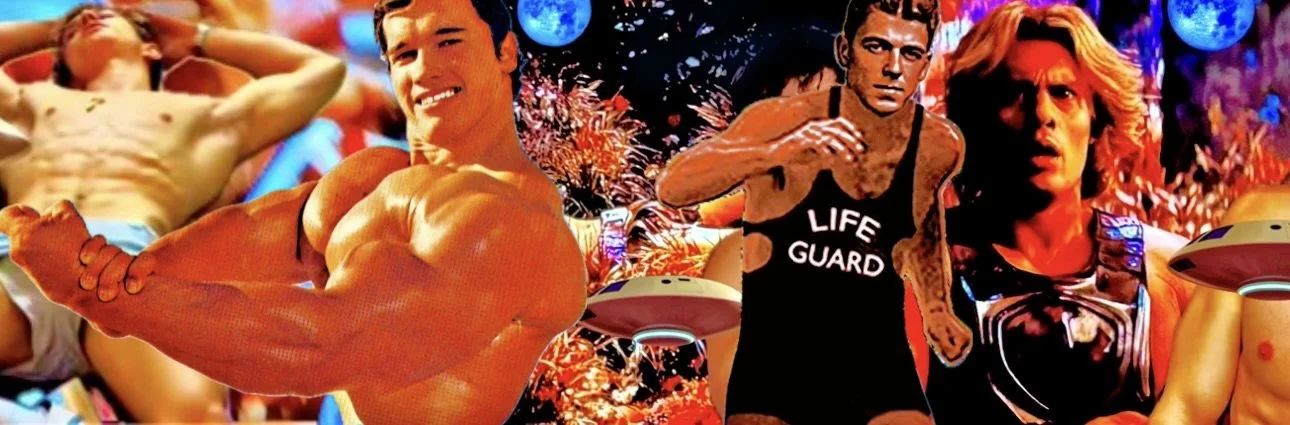
There’s a well-known image of Ronald Reagan as a young man: a lifeguard at Lowell Park on the Rock River in Dixon, Illinois, credited with pulling dozens of people out of the water over his summers there. He liked to tell that story for the rest of his life. It fit the persona he’d go on to build in Hollywood — the soldier, the hero, the steady man who shows up when someone is drowning. His film career ran on that image for years: the uniform, the square jaw, the man other men could count on.
And then his moment actually came, and he wasn’t there.
This is a post about betrayal.
By the time Reagan reached the presidency, a real emergency had already started, and it kept growing through his two terms in office. He didn’t publicly say the word “AIDS” until September 1985, four years into the epidemic. In July of that same year, his old friend from Hollywood, Rock Hudson, collapsed in Paris while trying to access an experimental treatment unavailable in the United States. Hudson’s people sent a telegram to the White House, asking for help cutting through the red tape to get him into a hospital that had turned him away. The answer came back: no. Hudson died three months later. The lifeguard didn’t go in the water for his own friend.
That refusal is small in one sense — a single phone call not made — and enormous in another, because it’s a perfect miniature of everything the administration didn’t do for everyone else. Thousands of men died in the years before Reagan ever said the word publicly. Tens of thousands more died in the years after, while funding lagged and research moved slowly and the disease was still spoken of, when it was spoken of at all, as something happening to other people. The undesirables. God’s rejects.
Running paradoxically with all of it was a culture obsessed with a very different picture of the male body. The garish, inflated, oiled, steroid-built men of eighties action movies and cartoons — Stallone, Schwarzenegger, Lundgren, Van Damme, Tarzan’s and He-Man’s and every animated variant of him — heteronormative on the surface and soaked in homoerotic subtext underneath. Audiences ogled these scantily clad men flexing and grappling and saving each other for two hours at a time, night after night, without ever having to admit what they were looking at. It was permitted, even celebrated, as long as it stayed fictional. The real men dying in hospital wards a few miles away got no such permission, and precious little help.
There were no American heroes in the 1980s. There were no valiant warriors coming in to save the day. There were only play-actors and cartoon villains and cartoon wannabe heroes, flexing on a screen while the real dying happened off it. And at the very top of that heteronormative nightmare food chain stood a man who used to be a lifeguard — who once ran into the water again and again to pull the drowning out by hand — now standing at the shore with his back turned to it, watching the tide come in with bodies in tow, calling it someone else’s trouble.
J'accuse.
Betrayal.