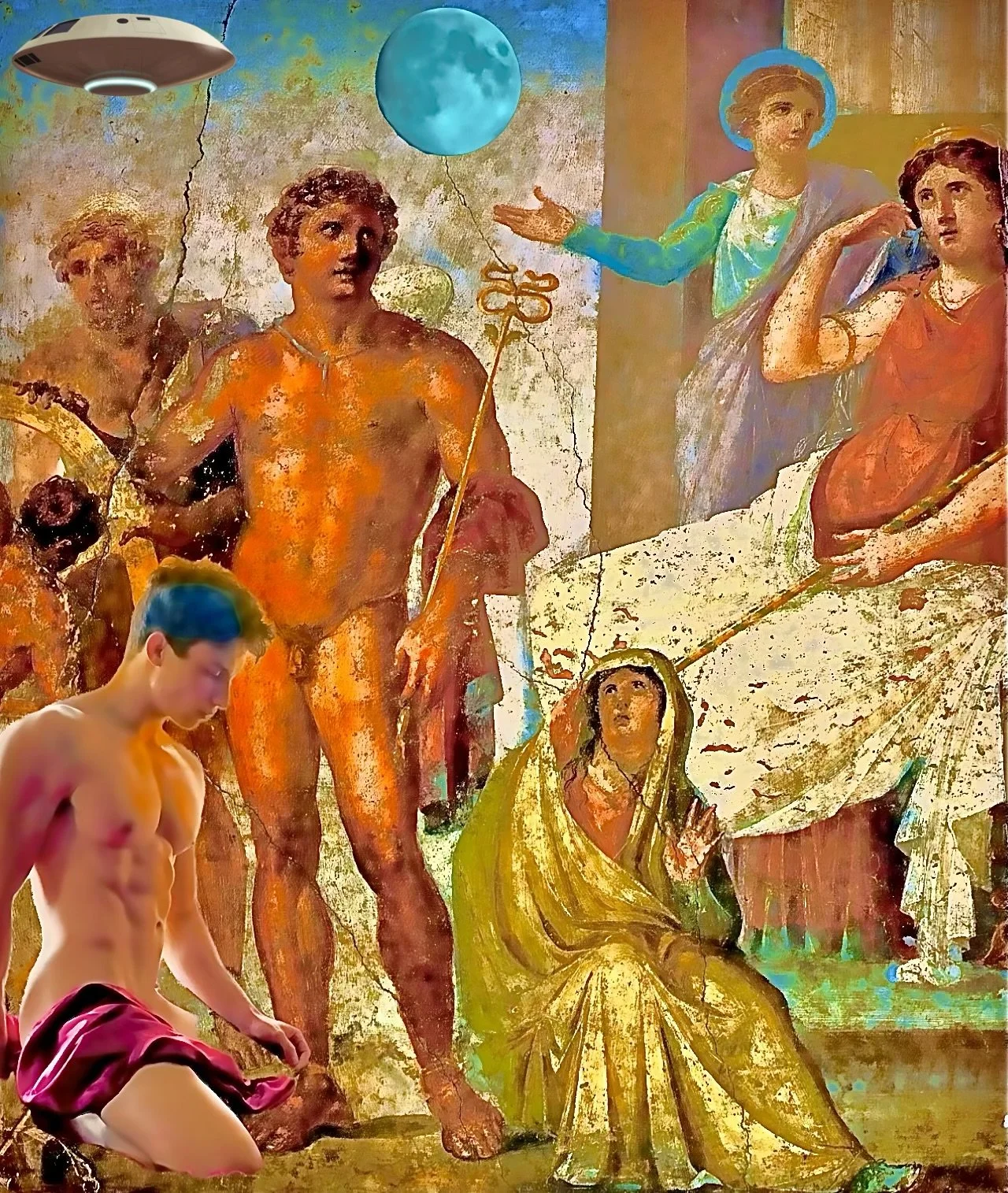
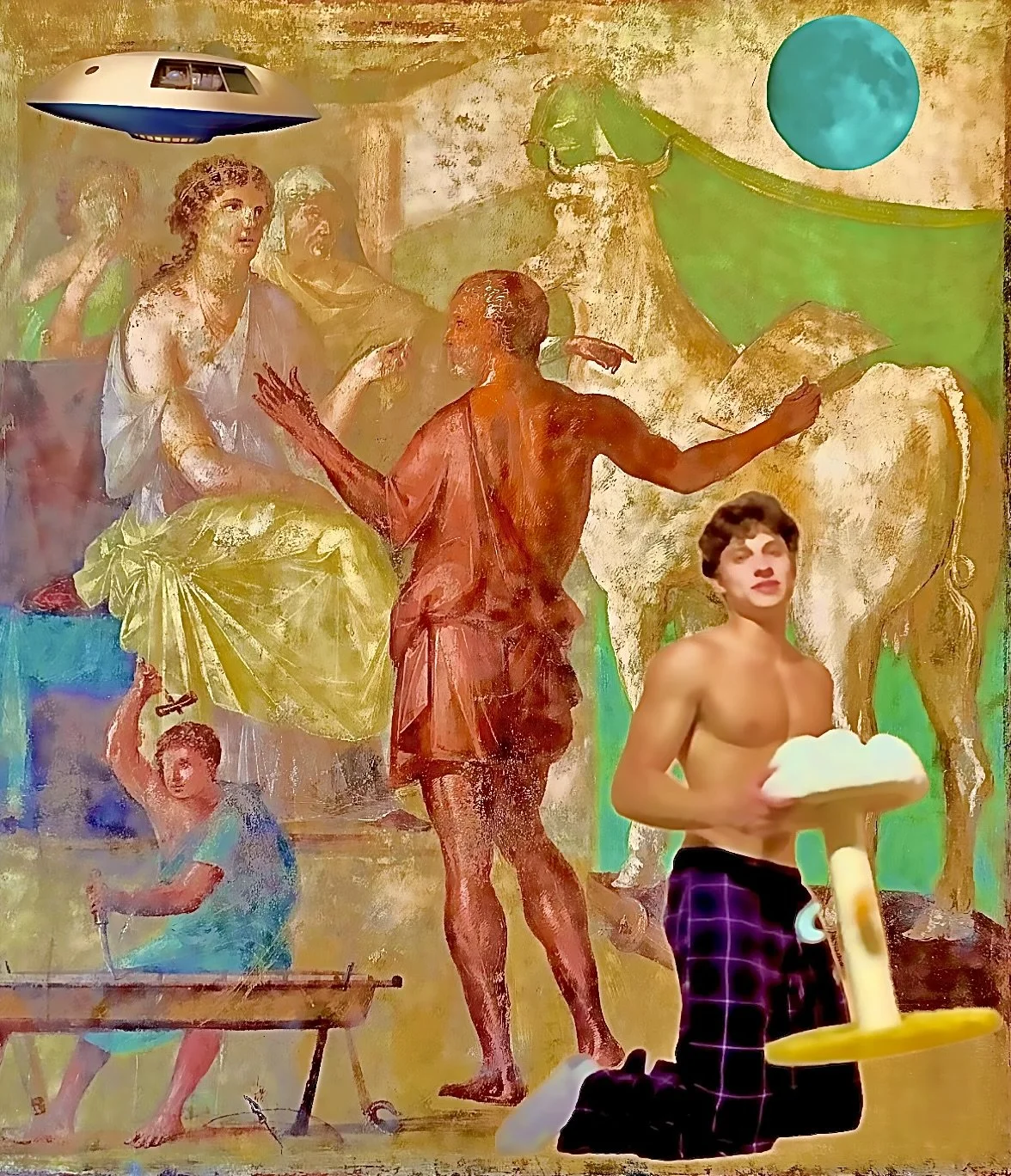
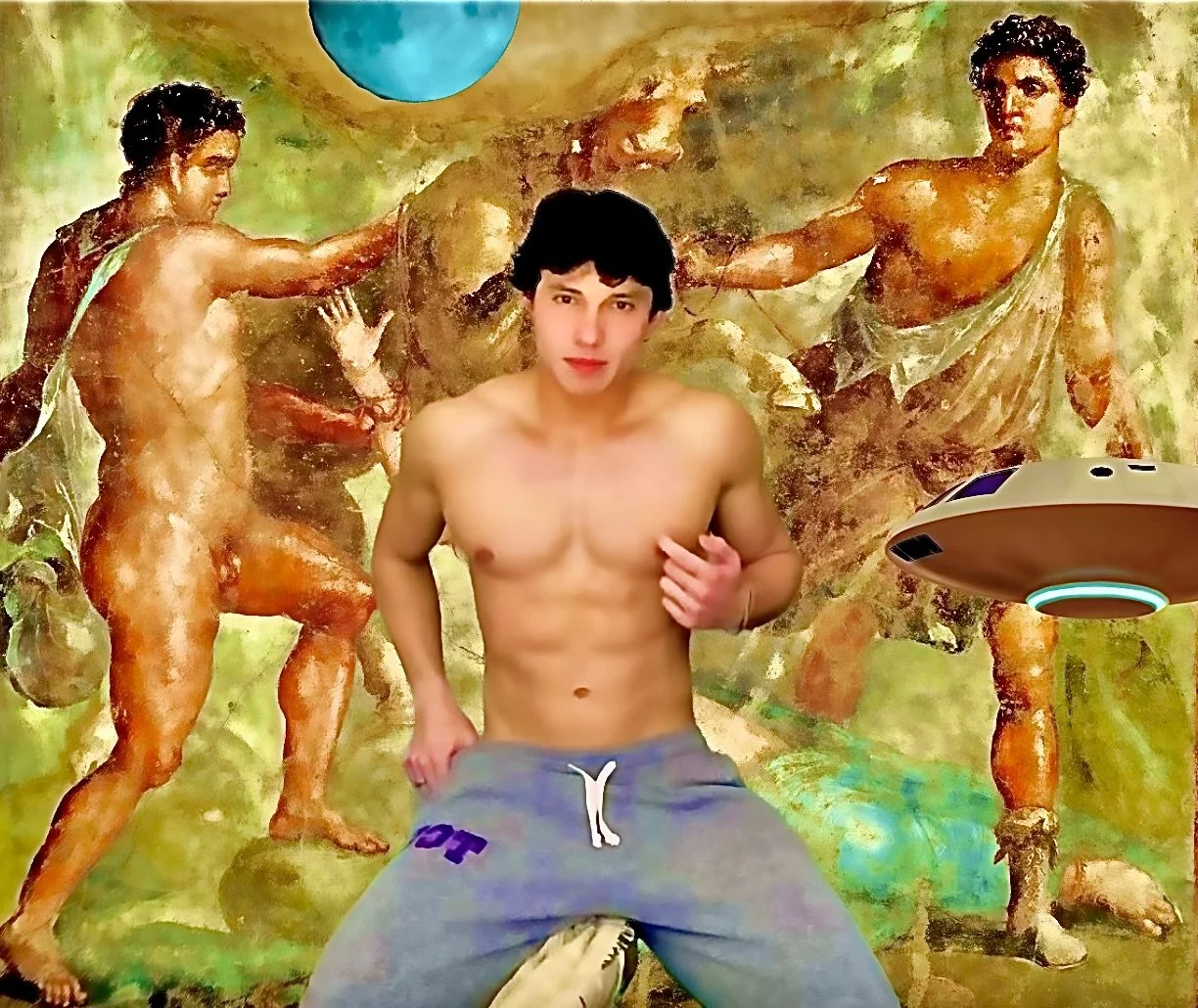
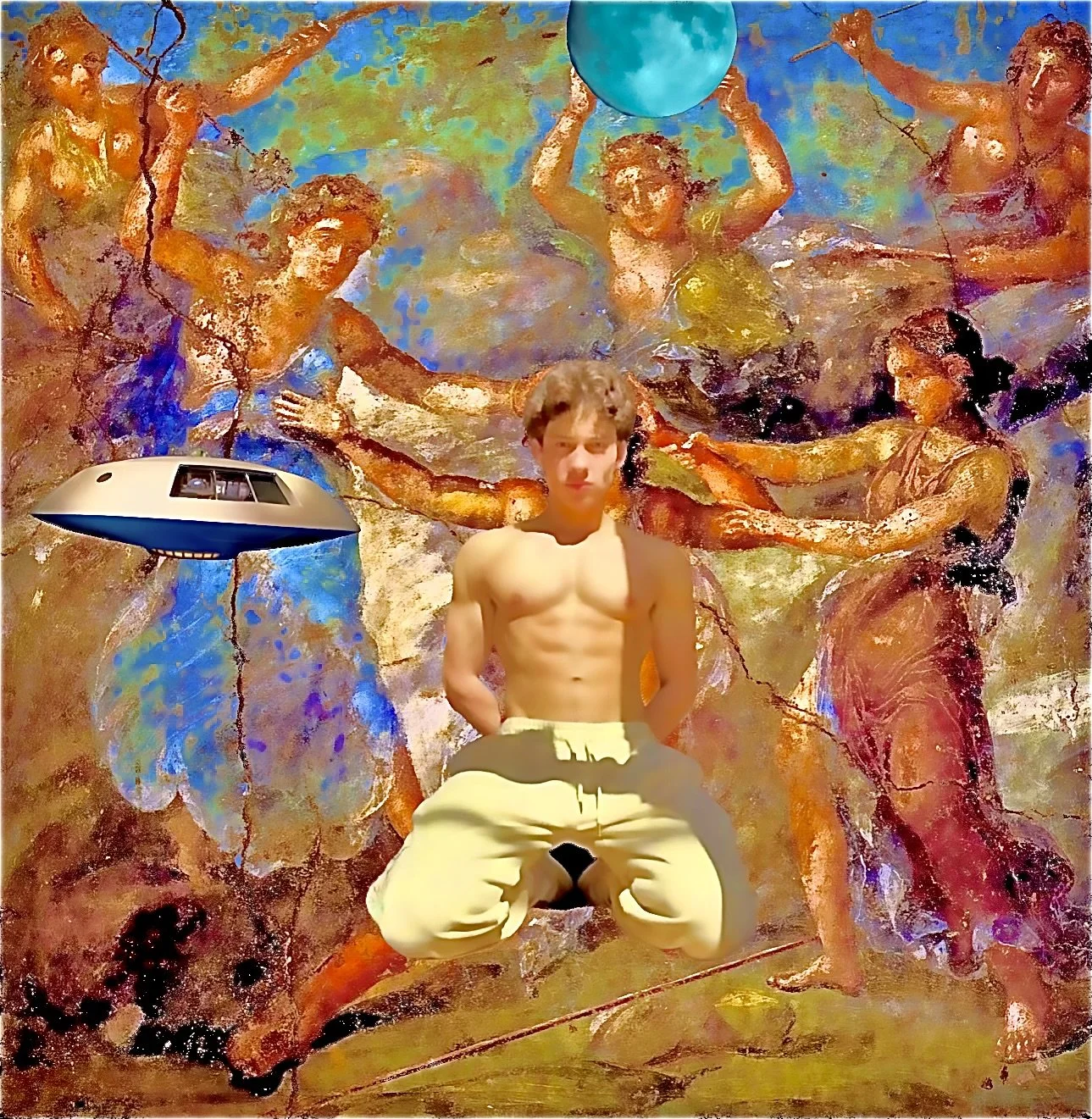
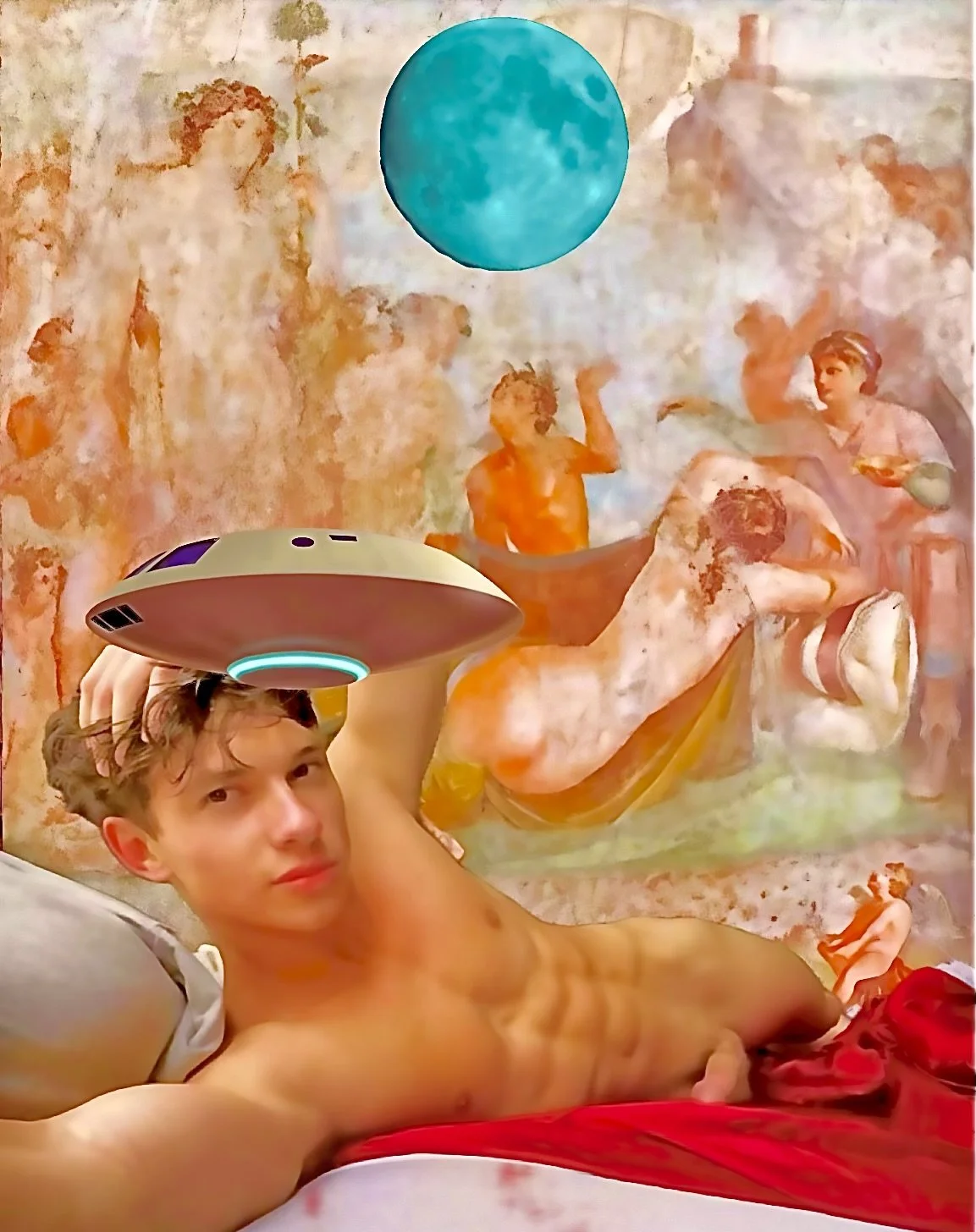
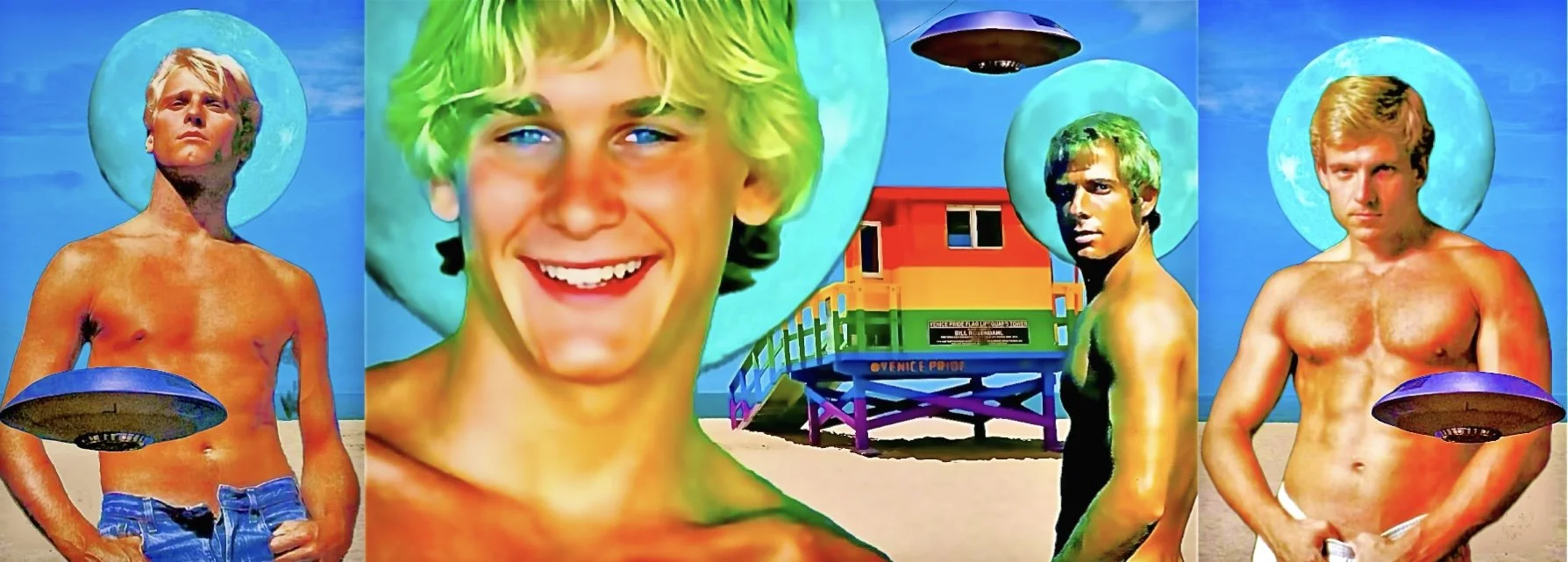
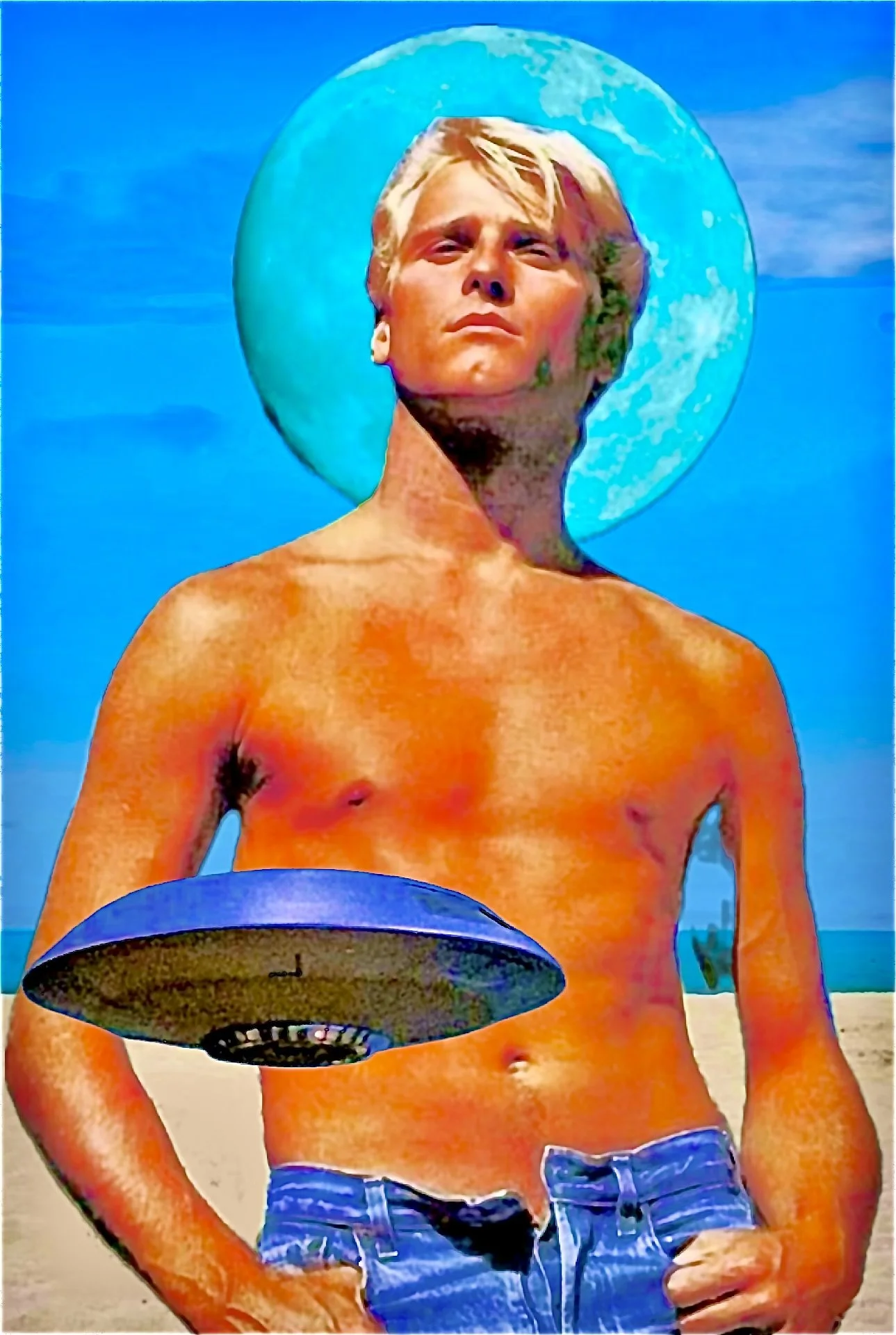
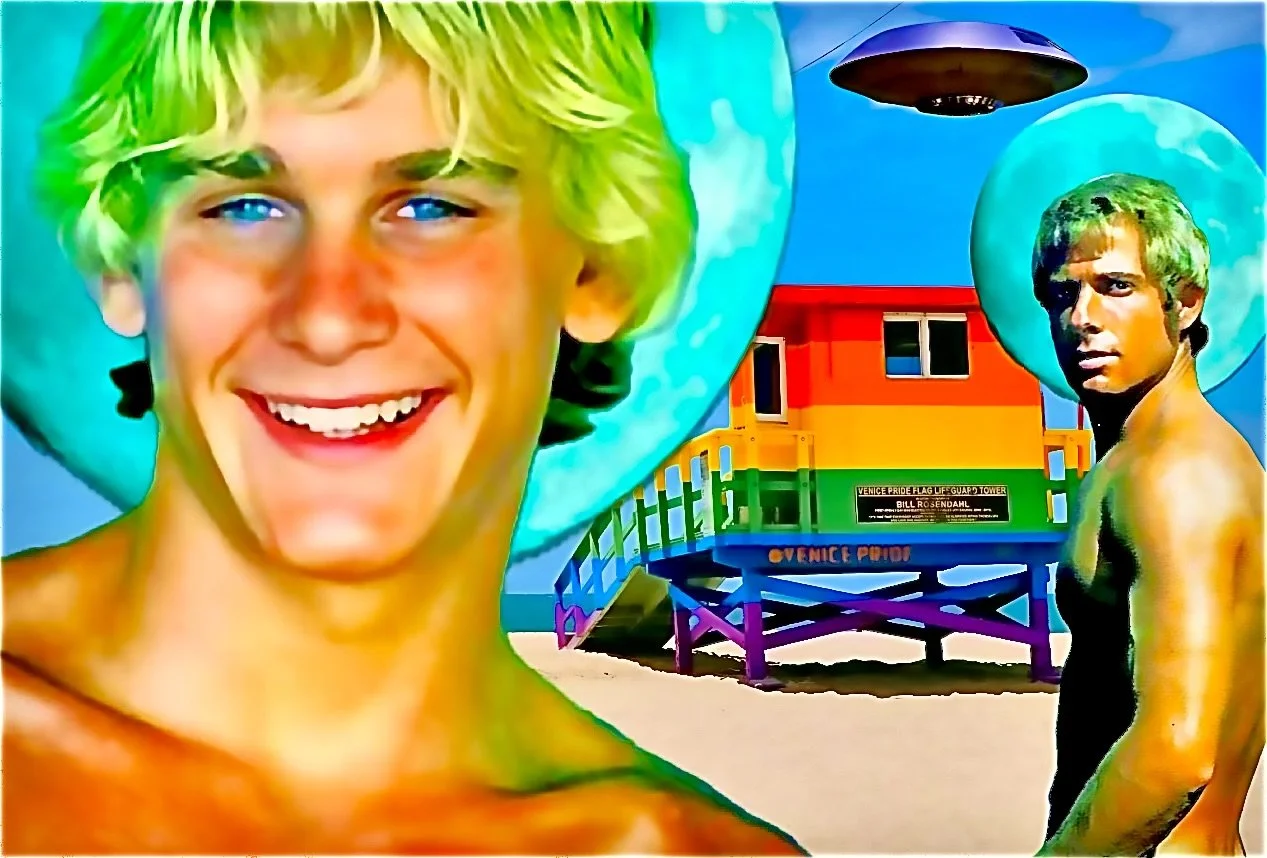
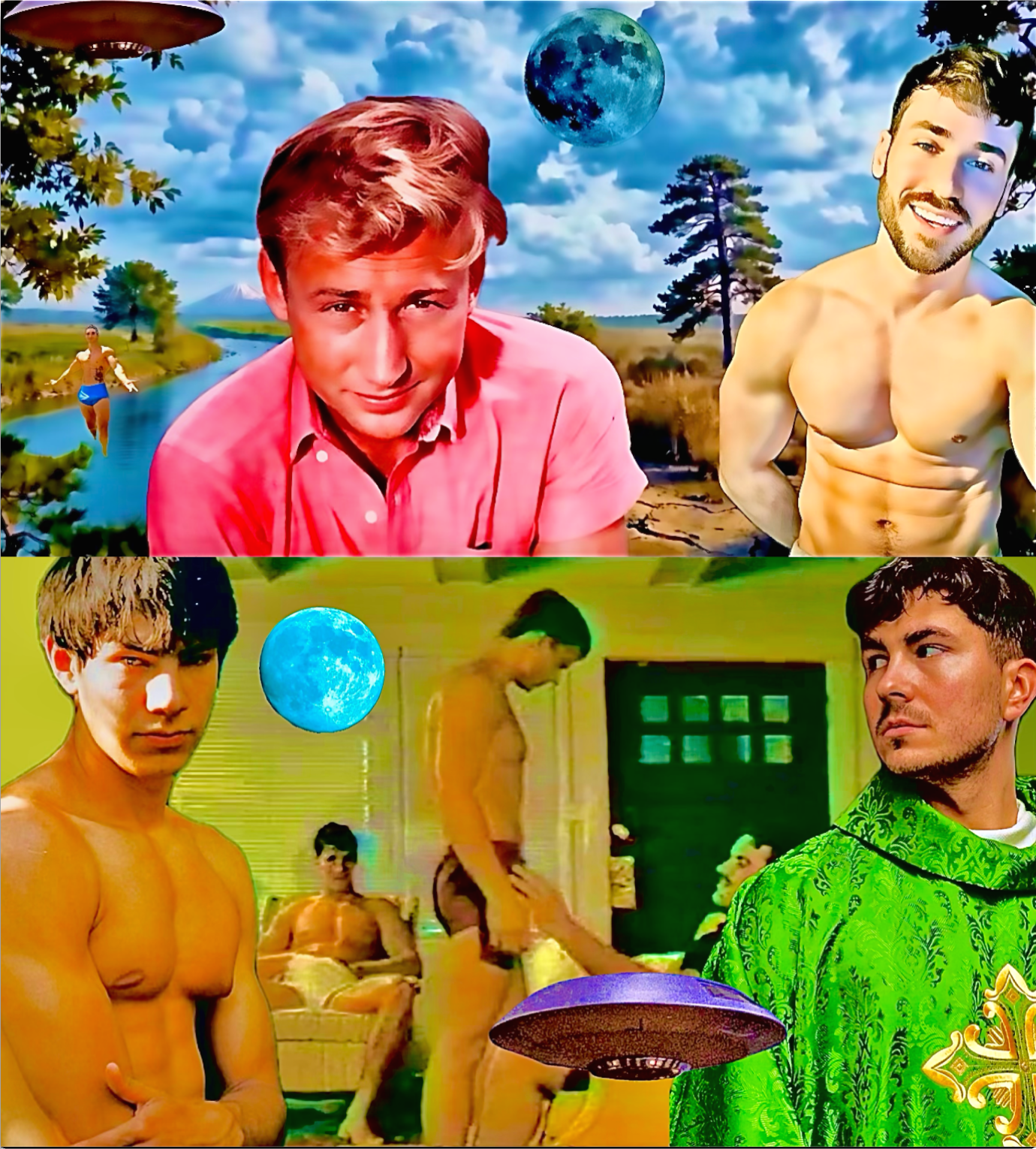
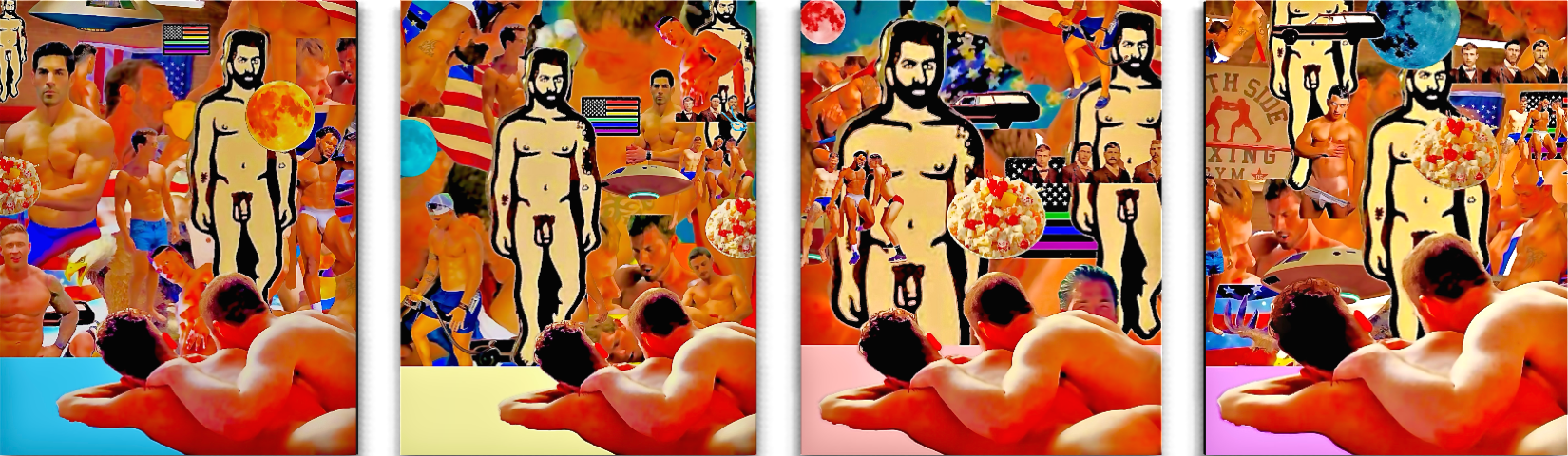
Closet Games

The Republican Party consistently opposes marriage equality, transgender rights, and LGBTQ+ protections at every level.

And yet.

• July 18, 2016 — Republican National Convention, Cleveland. Grindr records a 120% spike in users on opening night alone.

• July 15, 2024 — Republican National Convention, Milwaukee. Blank profile photos multiply by the hundreds.

• July 17, 2024 — Expelled Republican Congressman George Santos posts a video calling the RNC the “Grindr Super Bowl” and urges closeted conservatives to come out.

Sadly, the closet is alive and well in the Republican Party.

The Closet Series is gobsmacked.

Closet Games Digital Photocollage 2026 Behan

#TheClosetSeries #QueerHistory #GOPCloset #Grindr #PrideMonth #LGBTQ #BehanWorks

American Pie

The American Pie is (Once Again!) on a Ledge

Digital Photocollage Series, 2026

The American living room has always has a sofa where the family presents itself — to guests, to neighbors — with a version of itself it most wants to believe. It is where uncomfortable things are said and quickly recovered from, where the television plays and nobody quite watches, and where my father once told us that if people just didn’t talk, everything would be fine. The American living room is the public face of the private family. It is where performance happens.

The American bedroom is where this performance ends — where the truth of who you are exists without an audience, where there is no version to maintain.

Gay men have always known the distance between those two rooms intimately, the living room where we behave and the bedroom where we relax. The collages presented in this post as well as this essay live in both these rooms simultaneously.

Fury and wit have always been the gay man’s tools for survival: the wit to deflect, the fury to sustain. Both are present in these collages. Both are necessary for what follows: a timeline of the distance between the promise America made in 1776 and the promise it has actually kept for its gay sons and daughters.

A Queer Timeline

  • July 4, 1776 — The Continental Congress adopts the Declaration of Independence. All men are created equal. Gay men are not included.

  • 1778 — Baron Friedrich Wilhelm von Steuben, a gay Prussian general recruited by Benjamin Franklin, drills the Continental Army into a fighting force.

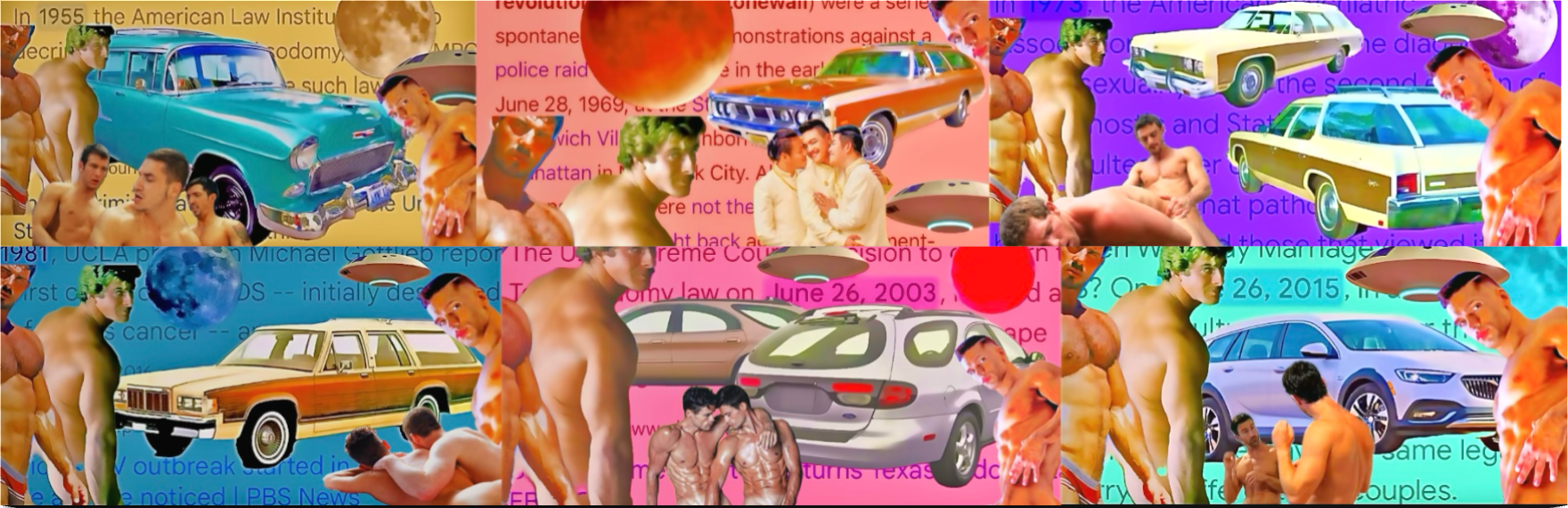
  • 1955 — The American Law Institute votes to remove consensual sodomy from the Model Penal Code. Most states ignore it. Gay men remain criminals.

  • February 3, 1959 — Buddy Holly, Ritchie Valens, and the Big Bopper die in a plane crash in Clear Lake, Iowa. The day the music died.

  • June 28, 1969 — Stonewall. Greenwich Village, Manhattan. A police raid. A riot. The modern gay rights movement begins.

  • October 24, 1971, Don McLean’s American Pie is released. Gays sing along to the slow collapse of the American promises

  • December 15, 1973 — The American Psychiatric Association removes homosexuality from the DSM. By a vote, a majority decides that desire is not a disease. America continues without acknowledging this enormous change.

  • July 4, 1976 — The bicentennial. Two hundred years. America throws a party. Gay men are still criminals in most states. They watch from the margins.

  • June 26, 2003 — Lawrence v. Texas. The Supreme Court strikes down sodomy laws. The body, at last, belongs to itself.

  • June 26, 2015 — Obergefell v. Hodges. Marriage equality, nationwide. The promise inches forward.

  • July 4, 2026 — The 250th anniversary. The promise has never been more threatened. An autocratic president dismantles democratic norms in plain sight. We do not know, with certainty, whether we will have a functioning democracy in two years. Fifty years after the bicentennial. Fifty years after American Pie. The music is in worse trouble than McLean imagined.

The Only King in America is a California King

Like every other marginalized group in the United States, gay men and women have always been in the room — in the fight, in the field, in the foundational work of this republic. We did not watch from the outside. We built the inside.

Baron Friedrich Wilhelm von Steuben, Washington’s Inspector General, was gay. Historians consider him second only to Washington himself in importance to winning the Revolution. He drilled the Continental Army into a fighting force at Valley Forge during the darkest winter of the war. He wrote the drill manual that the United States Army used for more than a century. He helped secure the promise of 1776. He was never invited to enjoy that promise himself.

He was not alone in that arrangement.

The White House — the house that the current administration occupies while dismantling the rights of everyone who is not white, straight, and wealthy — was built by enslaved people. Black men and women whose labor constructed the seat of American power were not considered citizens. Were not considered fully human under the law. Were property. The promise of 1776 did not apply to them either, and the men who wrote it knew it and did it anyway.

The indigenous peoples of this continent were here before the promise was written. They fought for America too — in every war this country has declared, including wars fought against their own nations. In World War II, Navajo Code Talkers developed an unbreakable code that the military used throughout the Pacific theater. Their language, which the United States government had spent decades trying to eradicate through forced assimilation and boarding schools, became one of the most valuable military assets America possessed. They saved lives. They won battles. They came home to a country that still did not recognize them as full citizens in every state until 1948.

Women have been in every war this country has fought, in roles that were systematically minimized, erased, or denied. Black soldiers fought in segregated units, came home to Jim Crow, and were told their sacrifice did not earn them equality. Japanese Americans were interned while their sons volunteered to fight for the country that imprisoned their families — the 442nd Infantry Regiment became the most decorated unit in United States military history.

Gay soldiers fought in every war too. Closeted, silent, under threat of dishonorable discharge if discovered, they served anyway. They served because this was their country too, whatever the country thought of them.

This is the American pattern. Every marginalized group has contributed to the construction and defense of this republic. Every marginalized group has been told, at various points and by various factions, that their contribution does not entitle them to the full promise. That they are welcome to build but not to belong. To fight but not to lead. To serve but not to marry. To exist but not to be equal.

Right now, in 2026, transgender Americans who want to serve their country in the military are being barred from doing so by executive order. Black generals and women up for promotion are being passed over by a racist executive branch that is systematically purging the military of anyone who does not reflect its narrow vision of who an American soldier should be. Immigrant communities are being terrorized by detention and deportation. The institutions built over two and a half centuries of painful, incremental progress toward the promise of 1776 are being dismantled with deliberate speed.

This is not new. It is a very old pattern wearing new clothes.

Von Steuben won the Revolution for a country that would not let him love openly.

The enslaved built the White House for presidents who would not free them.

The Navajo saved the Pacific theater for a government that had tried to eradicate their language.

The 442nd bled in Italy for a country that had locked up their families.

And gay men buried their dead during AIDS while the government looked away.

The Collages

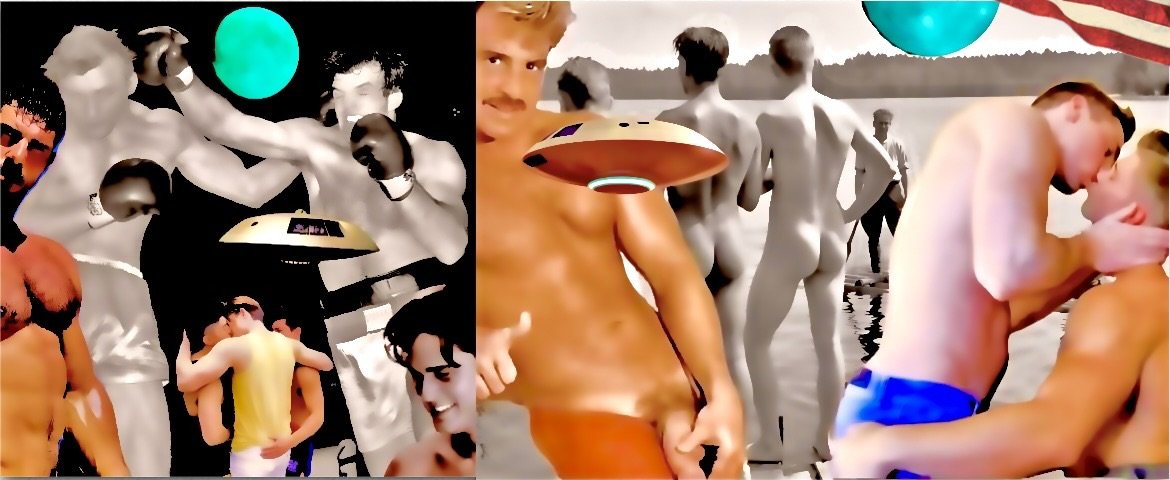
Color is prima facie. These are not quiet works. The public-facing collages — the station wagons, the eagle, the boxing ring — operate in a register of controlled chaos. Oranges and reds press against electric blues. American flags bleed into flesh tones. Figures from different eras and different visual registers are forced into the same plane at mismatched scales, their edges broken, their resolutions incompatible. Nothing quite fits. Everything insists on being present anyway.

The visible seams are part of the argument. Digital photocollage as a medium makes its construction legible — you can see where the pieces come from, where they don’t align, where the scale breaks down. In these works, that visibility is not a limitation to be overcome but a formal choice that carries meaning. The incompleteness of the surface reflects the incompleteness of the American project. A culture that has never fully resolved its own contradictions should not be rendered in smooth, unbroken surfaces.

The chaos is controlled, however. There is compositional effort underneath the noise — figures anchored at the center, moons and spacecraft placed with precision, the horizontal panoramic format of the multi-panel works creating a reading sequence that moves like a timeline across the eye. The disorder is organized disorder. You know, the American kind.

Against this, the private spaces are strikingly different in visual temperature. The bedroom triptychs and the intimate diptychs operate in cooler, quieter registers — blues and neutrals, softer light, figures at rest rather than in motion. The aquarian moon appears here, large and calm, presiding without judgment. Jupiter 3 hovers at the edge of the frame rather than cutting through it. The composition breathes. Where the public collages crowd the picture plane, the private ones allow space — between figures, between panels, between the viewer and the image.

This contrast is the formal argument of the series made visible. The chaos belonging to the public sphere and the calm belonging to the private sphere — gay men have always known this geography. These collages map it.

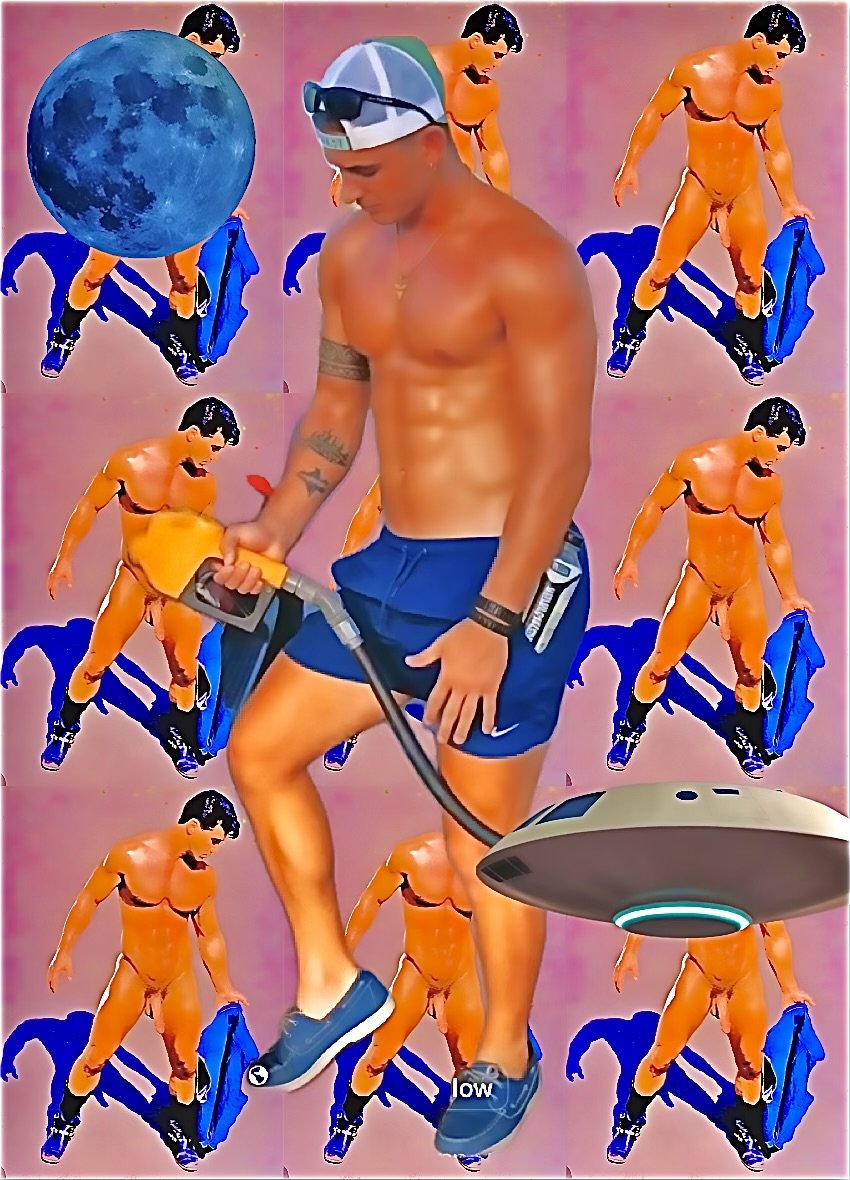
Repetition functions throughout as both rhythm and insistence. In the gas station work, a single figure multiplies across the surface — not quite wallpaper, not quite crowd, something between pattern and testimony. Repetition in visual art establishes comfort through familiarity. But when the repeated figure is one that dominant culture has historically criminalized or erased, the comfort curdles into something more complex. The eye settles into the pattern and then registers what the pattern is actually showing. That double response — ease and unease simultaneously — is exactly what the works are reaching for.

The diptych and triptych formats invoke the devotional tradition deliberately. These are secular altarpieces. The multi-panel structure asks for sustained attention, for the eye to move between panels and assemble meaning across the sequence.

The series questions and confirms simultaneously. It holds its contradictions in the same frame without resolving them — which is the most honest formal choice an American artwork can make right now. The bright colors celebrate. The broken edges mourn. Both are true. Both stay in the picture.

The American pie is still on the ledge, still a most precarious place to be. We are watching.

CJ in Pompeii

House of Clarke

A Series of Ten Digital Photo Collages, 2026

The walls of Pompeii were covered in graffiti. Male-for-male sexual encounters advertised openly in taverns and public spaces. The frescoes of the great houses depicted every configuration of desire without apology or classification. Two figures found embracing in the ash of Vesuvius — frozen in their final moment together — were labeled The Two Maidens for nearly two centuries. DNA testing recently confirmed they were both biological males, approximately eighteen to twenty years old. The argument about what that means has been going on ever since.

This series is dedicated to those two young men.

The ancient Romans did not organize sexuality around the gender of partners. They organized it around power and social class. The modern concept of being gay did not exist. What existed was desire — expressed on walls, in frescoes, in the graffiti of taverns, in the arms of another person as a volcano buried the city that had never thought to be ashamed of any of it.

When the excavations began in the eighteenth century, the sexually explicit artifacts of Pompeii were so numerous and so frank that archaeologists placed them in secret museums, accessible only to scholars and gentlemen of sufficient moral standing. The word pornography was coined specifically to classify them. The Romans had painted desire on their walls. The moderns invented a word to lock it away.

CJ Clarke is a contemporary content creator and OnlyFans star. Is he gay? Bisexual? Straight? The question follows him the way it follows every man who occupies this visual space — who makes his body the subject, who performs desire for an audience, who lives in the gap between what is shown and what is said. Our culture cannot stop asking.

For the Romans, this was never a question. The question is ours. So is the closet it came from.

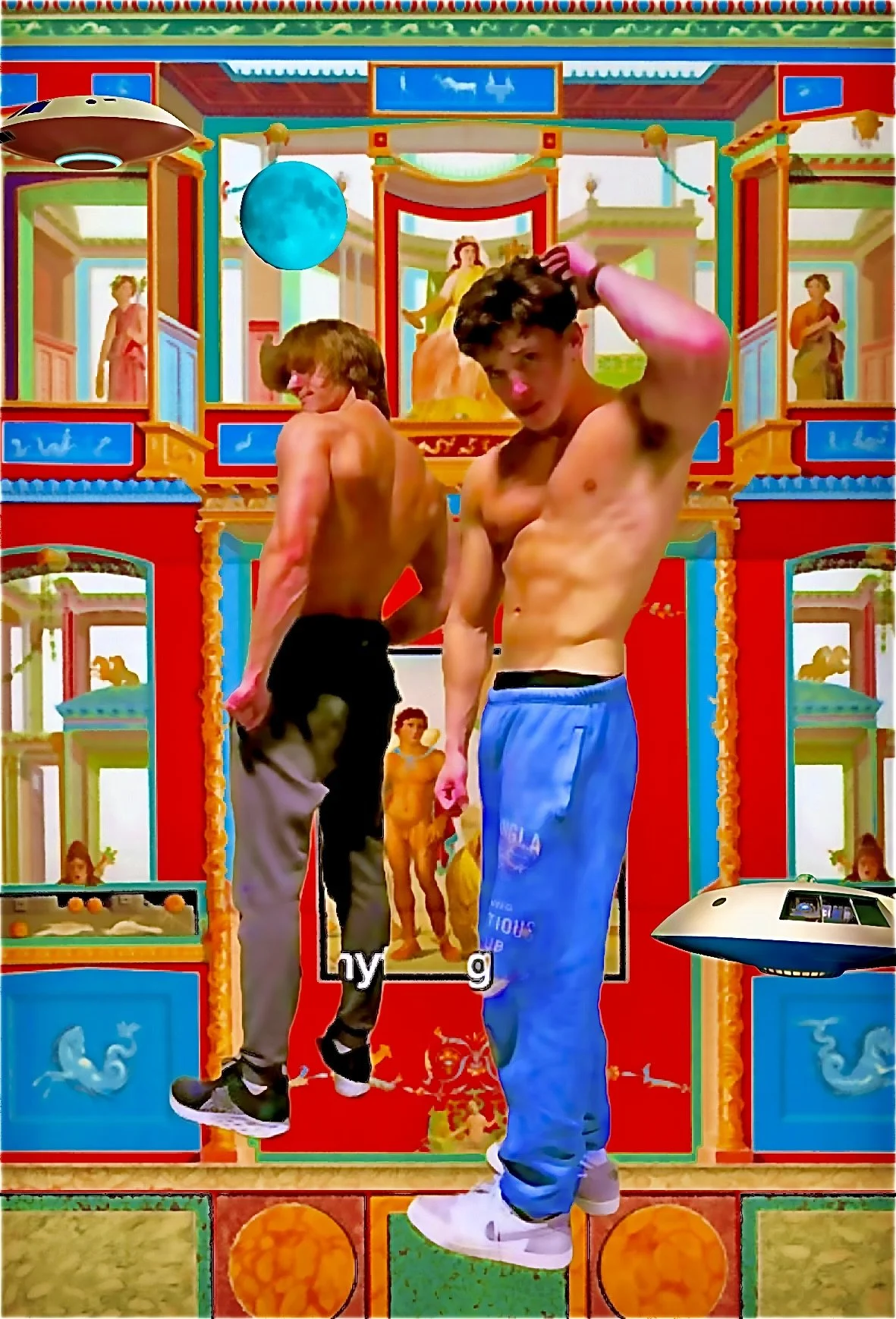
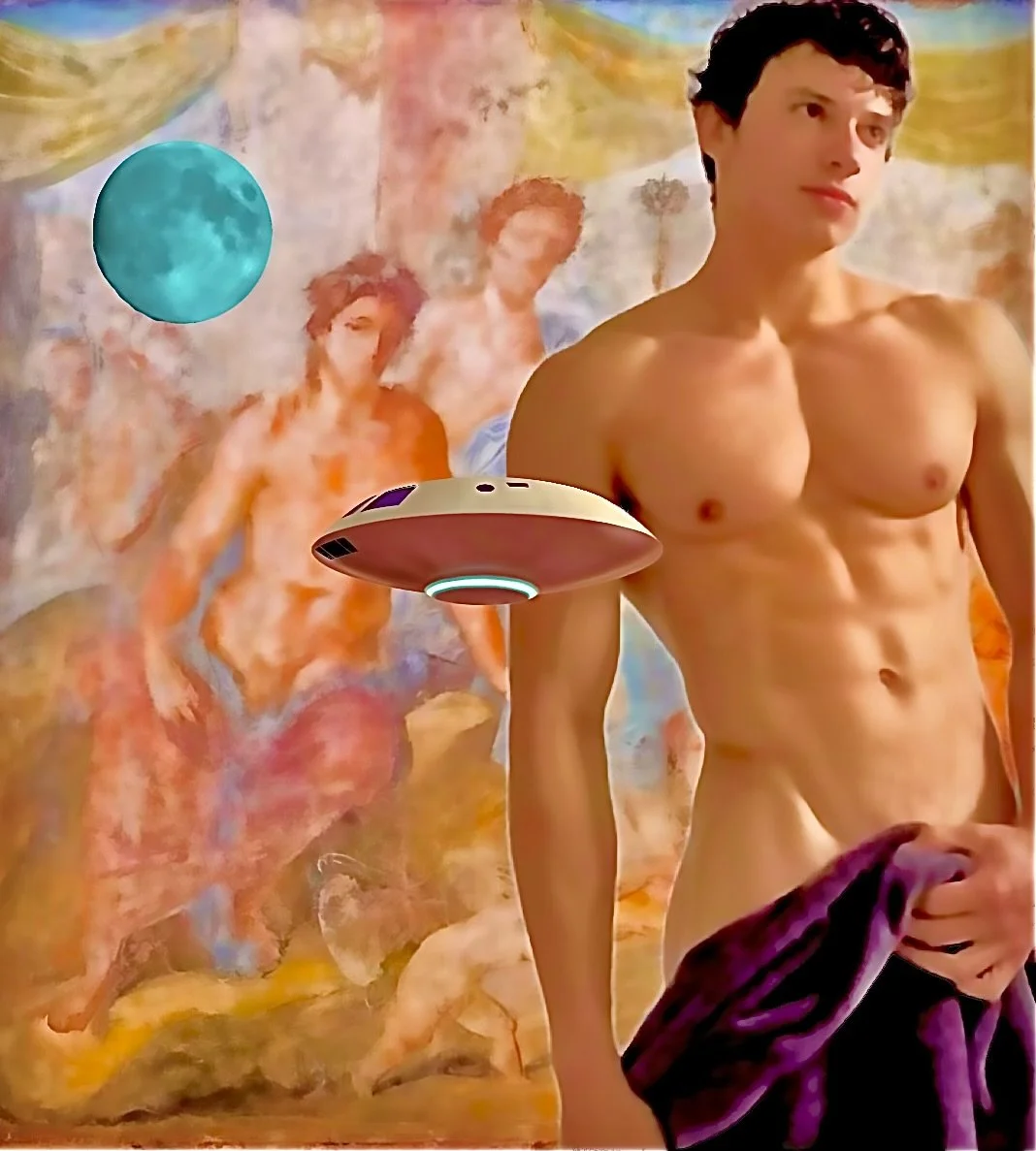
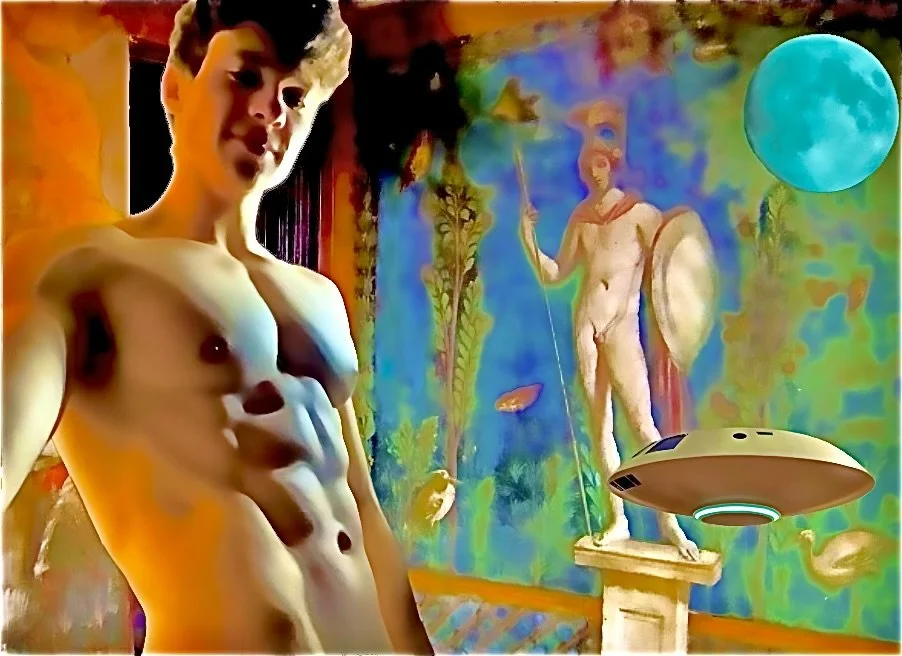
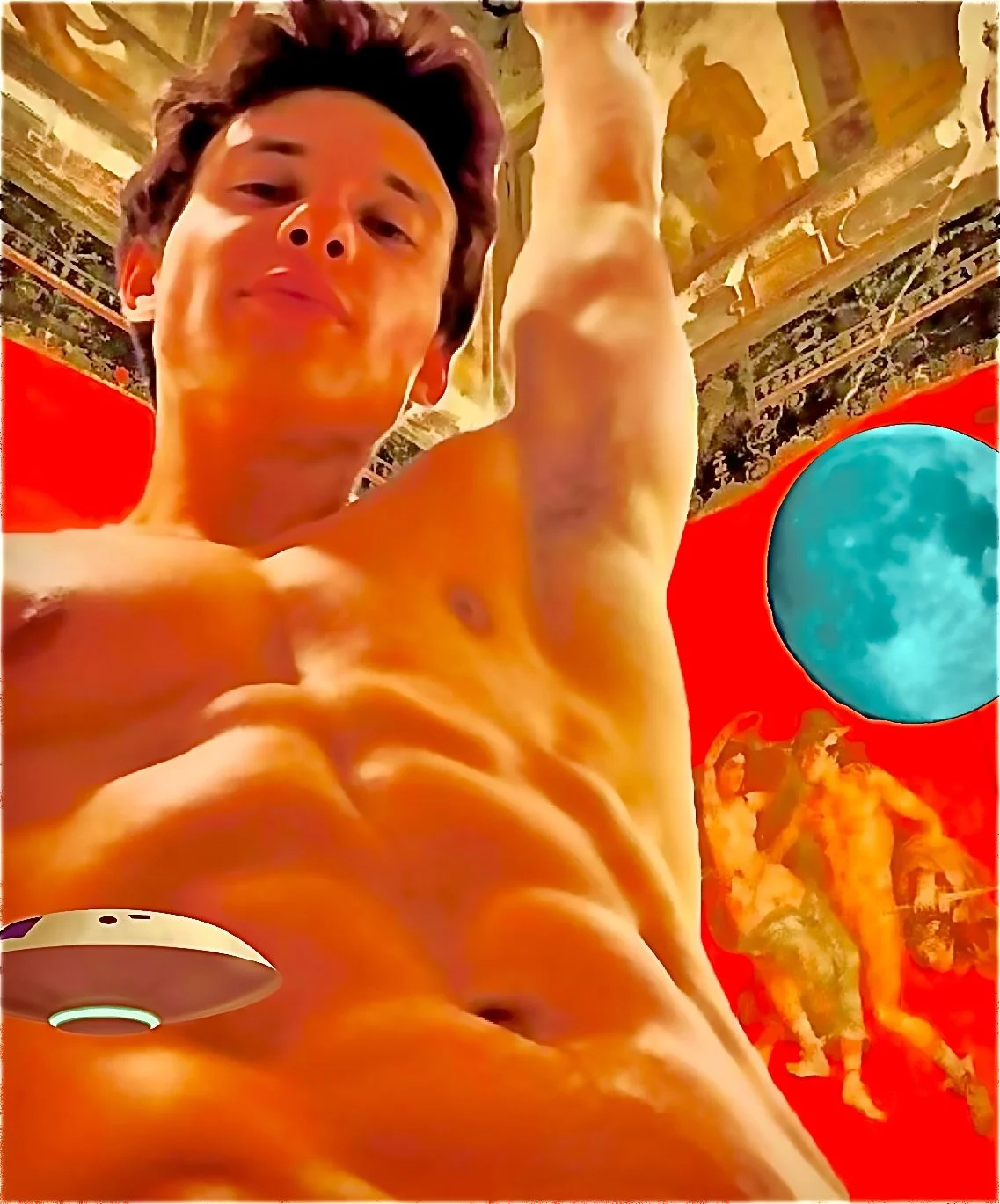
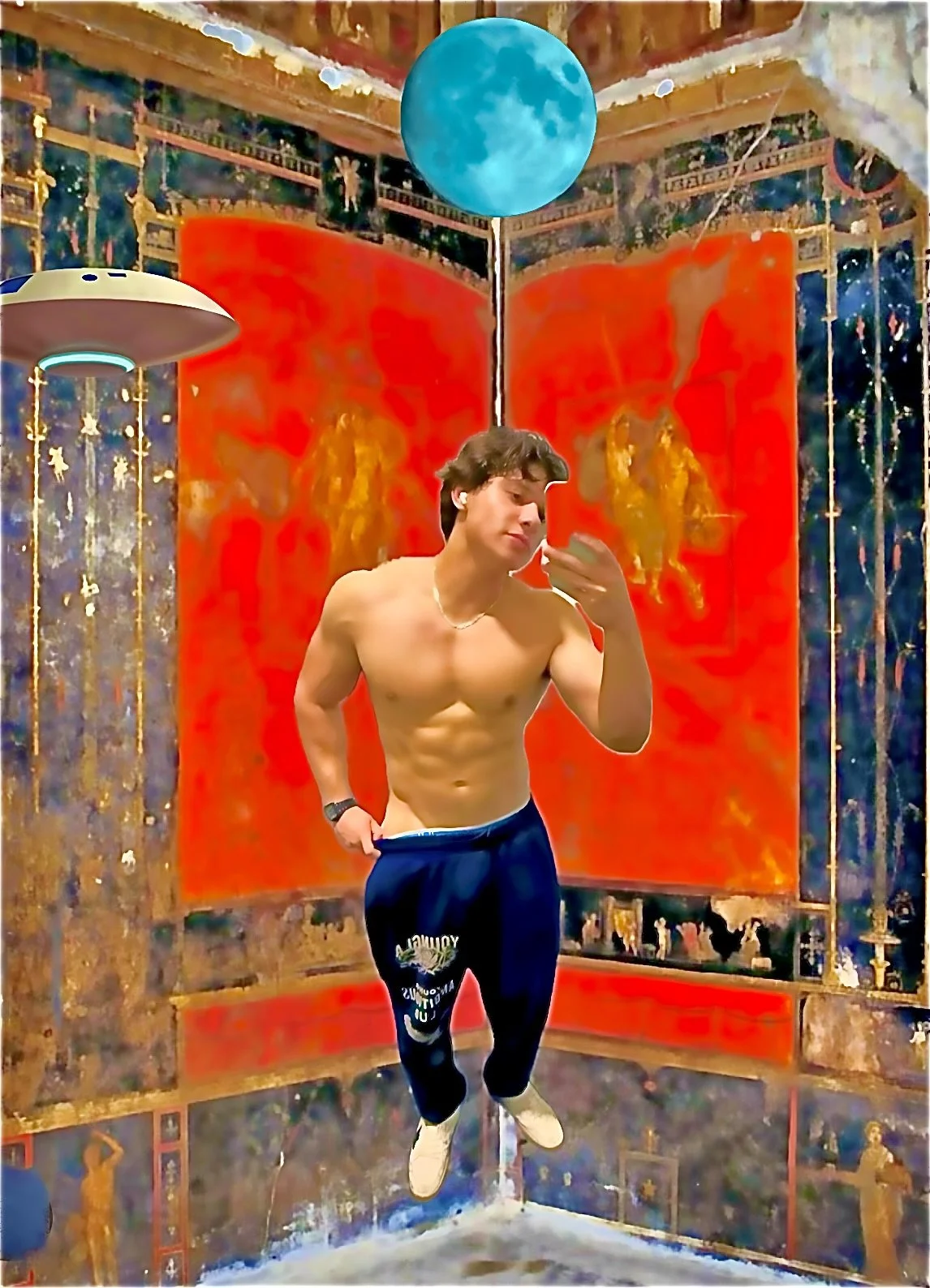
House of Clarke places CJ Clarke inside the frescoed rooms and erotic visual culture of Pompeii. Not as a joke. Not as a provocation. As a continuation. A furtherance of the humanity that was sealed under ash.

The bodies on those walls were never lost. They were locked away. They were invented new words to contain them. They were argued about, classified, purified, and explained. And they are still here.

Life is always happening.

This series is dedicated to the Two Unknown Young Men of Pompeii, found together in the ash, who have been argued about ever since. They know what they were.

— Behan

Blonde

Blonde Bombshell… The Golden Era

Let us put this to rest, now and forever.

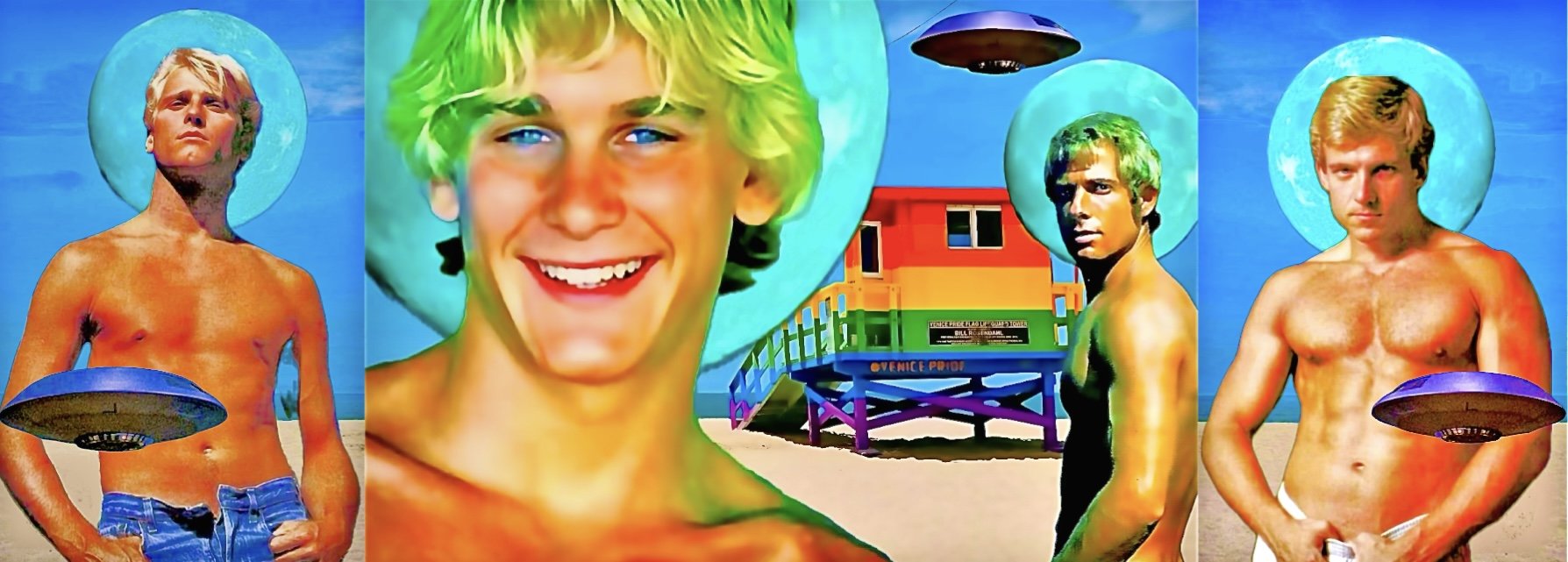
If the 1950s gave straight culture its blonde bombshells — Marilyn, Doris, Jane — then the 1980s gave gay men theirs. Eric, Lance, Leo, and Jack. Golden, physical, joyful, California-born and California-lit. They were not sinners. They were not cautionary tales. They were stars — and for gay men across America who had no other mirror, they were lifelines.

The golden era of gay adult filmmaking gave isolated men something the mainstream culture refused to: the sight of themselves, joyful and real. And when AIDS arrived, the industry did something the Reagan administration would not. It educated. It demonstrated. It insisted on visible protection at a moment when the government was actively blocking safer sex information from reaching the men who needed it most.

Gay adult films saved lives.

It connected men to a culture that sustained them. The rainbow lifeguard tower doesn’t stand on the beach by accident. It stands there because when the hospitals were afraid to help, the community showed up — lesbians nursing dying gay men, neighbors feeding the sick, strangers becoming family.

Princess Diana shook a gay man’s hand in 1987 when the world still believed you could catch AIDS from touch. That was an important moment. God, we miss her.

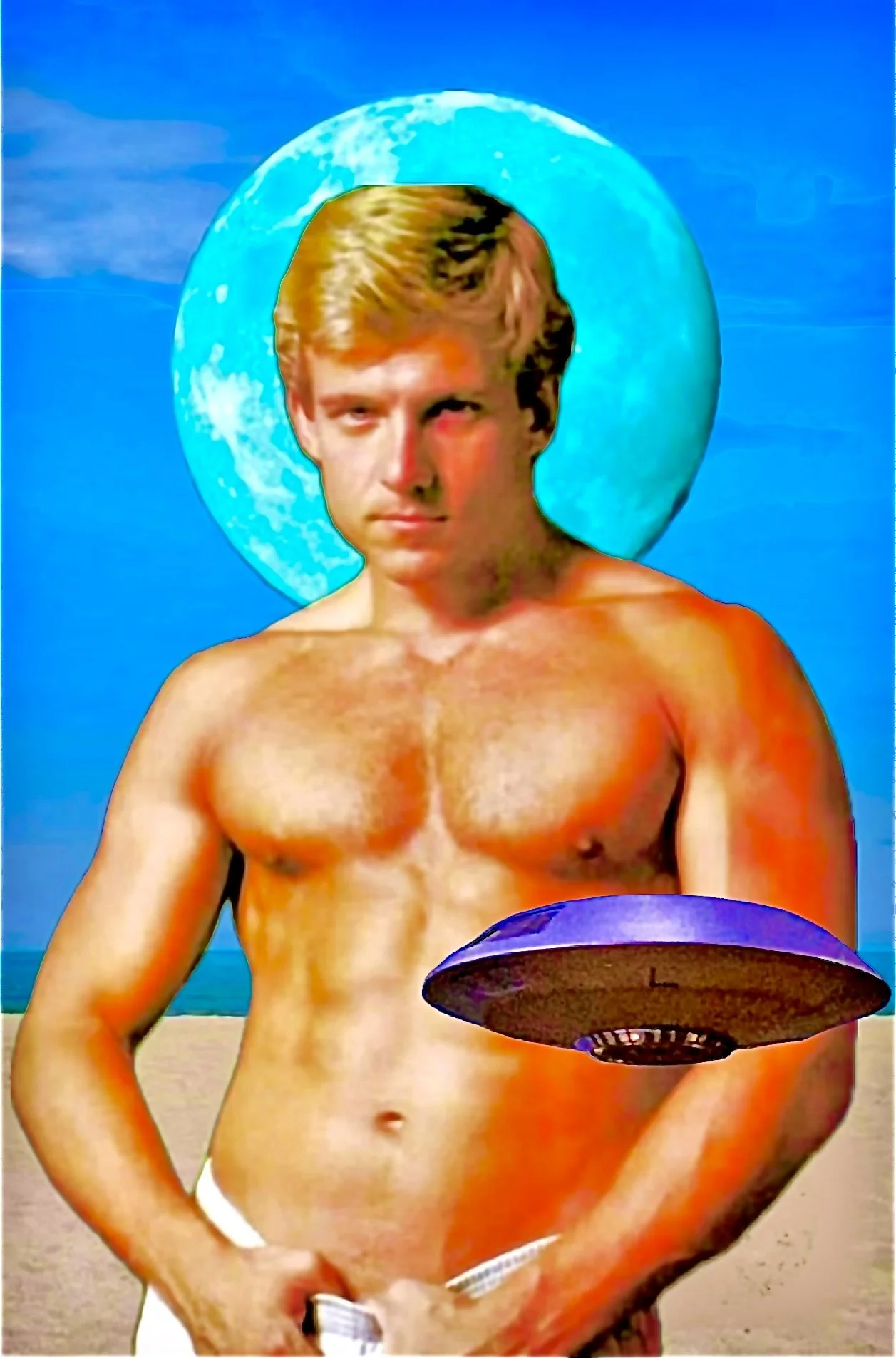
These men are saints of the era for the gay community. To impugn them is a sacrilege. The Aquarian moon knows it. Jupiter 3 agrees.

The Closet Series. 2026.

#TheClosetSeries #BlondeBombshell #GoldenEra #QueerHistory #LGBTQHistory #VenicePride #QueerArt #DigitalPhotocollage #SaintsOfTheEra #NeverGoingBack

Cali Blue 82

California Blue

On 1980s California Gay Culture, the AIDS Crisis, and the Films of William Higgins

Let us put this to rest.

At a legal and cultural level, gay adult film is neither sinful nor immoral. It is legal expression made by and for consenting adults, protected by the same constitutional framework that protects every other form of speech and creative expression in this country. The notion that homosexuality itself is sinful or immoral has equally no place in our laws or our dominant culture. It is entirely appropriate for a minority religious tradition to hold that view within its own walls. It is not appropriate — it is in fact a form of cultural aggression — to allow that view to shape legislation, public policy, or the social contract that governs all Americans regardless of faith. A religion that seeks to codify the diminishment of other people’s lives is not expressing faith. It is operating as a hate group. And hate groups, like any other destructive force, should be contained — not celebrated, not legislated, and not permitted to define the terms of a pluralist democracy for everyone else.

This essay is about a people being oppressed by an intolerant minority. And it is time to stop.

To understand why this argument is not abstract but urgent, you have to understand what was actually happening in California before AIDS arrived — what was being built, what was being lived, and what was taken. Because the people being judged were not abstractions. They were young men in the sun, building something that had never existed before in American life.

One man who lived through it in the Castro described that era in three words: party, party, party. Translated into the language of what it actually was: freedom, freedom, freedom.

The 1970s had delivered something genuinely new to American gay life: a geography of freedom. Gay men from across the country migrated to San Francisco’s Castro District, drawn by word of mouth, by the promise that a different kind of life was possible. By the summer of 1978 — what many recall as the high point of the Castro’s development — a new society had taken shape. Gay softball leagues. A gay chorus. Three gay and lesbian newspapers. Gay men building institutions, building community, building a world that had never existed before on American soil.

California was the backdrop and the metaphor. The state had always promised reinvention — the frontier, the Gold Rush, the movies, the counterculture. Now it was promising something else: the freedom to be exactly who you were, in full sunlight, without apology. The decade of the 1980s dawned on a San Francisco gay community with well-established political clout and a fully realized culture of sexual liberation. Gay Pride and Gay Power were in full bloom. Harvey Milk was in office.

And the sun was everywhere. The colors were neon and pastel and luminous. Ocean Pacific — OP — was selling its bright geometric sportswear out of Huntington Beach surf shops and into national chain stores, its designs moving from primary color stripes to bold neon shapes as the decade shifted. Izod Lacoste polos in every pastel shade defined the preppy aesthetic. The movies that captured California for the nation — Fast Times at Ridgemont High, Valley Girl, The Karate Kid, The Lost Boys — were drenched in that same saturated light, that same cheerful insistence that pleasure was the point and the coast was paradise. Don’t worry. Be happy. The tan will last forever.

The California Look

In this context, William Higgins was doing something that deserves to be understood as more than pornography. He was making documents.

Higgins founded Catalina Video in the late 1970s and spent nearly two decades producing gay adult films with what the industry called the “California Look” — sun-drenched, athletic, outdoors, unapologetically physical. Pacific Coast Highway. Sailor in the Wild. California Blue. Boys of Venice. These were not underground productions shot in shame and shadow. They were made in the same California light that lit every other film being made in the state — the rocks at Joshua Tree, the beaches of Malibu, the golden hills of the interior. Gay men as beautiful and physical and joyful as any other young Americans, doing what young Americans do in the California sun.

Higgins got into the pornography business, he said, because the gay films of the mid-1970s were “so bad” that he decided to start making them himself. He brought production values, narrative ambition, and a genuine aesthetic to a form that had been operating largely in the dark. His films won industry awards. They were distributed internationally. They gave the gay men who watched them something the mainstream culture systematically denied: the sight of themselves, at ease, at play, in their bodies, in their pleasure, without punishment.

This is not a small thing. For gay men across America — isolated in conservative towns and families, invisible in their schools and workplaces, told by their churches that their desire was an abomination — these films were lifelines. To judge these films, and this lifestyle, and the men they were made for — read the disclaimer at the start of any gay adult film, which has always been explicit about its intended audience — by the standards of any single religious tradition is to misunderstand what they were and what they did. No one denomination has the authority to determine the moral weight of a lifeline. All marginalized communities understand this dynamic: visibility is a necessity, not a luxury. The men who found themselves in those images — recognized, present, joyful, real — were not sinning. They were surviving and thriving.

There is a persistent and revealing irony in the straight male relationship to gay male culture. Straight comics have long mined gay men for material — but the laughter has always had an undertow of something else. Envy. The freedom is visible. The happiness is visible. The comfort in the body, the ease with pleasure, the absence of the particular straight male terror of being seen wanting something — all of it visible, and all of it apparently infuriating to men who have been told that desire must be managed, hidden, performed only in the right contexts with the right people. Some straight men have said openly that they wish they were gay — and the laughter that follows is the laughter of a contradiction that the culture cannot resolve. The oppressive sentiment and the secret wish occupy the same man at the same time.

And then there is gay for pay — straight men appearing in gay adult films because, as they will tell you directly, the pay is better. Which it is. The straight man who will perform desire for another man on camera for money, while insisting on his heterosexuality, is perhaps the most complete expression of the contradiction. The culture says one thing. The body, and the bank account, say another. Clark sits at the breakfast table. The oatmeal goes cold. He hates it cold.

This essay references collages that draw directly on this tradition. The central figure — striped shirt, director’s chair, California sun, the Aquarian moon watching overhead and Jupiter 3 hovering nearby — is the man at the center of the decade. Comfortable in his body. Comfortable in his desire.

And Then the Light Changed

The initial clusters of a rare pneumonia and an unusual cancer appeared in Los Angeles’s gay community in 1981. By 1982 and 1983, the virus was moving through San Francisco’s Castro District with devastating speed. San Francisco General Hospital pioneered what became known as the San Francisco Model — patient-centered, compassionate care delivered in dedicated AIDS wards that became a global standard. The community organized with extraordinary speed and courage: hospices, legal support networks, grassroots education campaigns, organizations like Project Open Hand delivering meals to the sick. The AIDS Memorial Quilt, conceived by activist Cleve Jones in 1987, grew to become the largest community folk art project in American history — each panel a name, a life, a person the culture had been prepared to forget.

The federal government watched in silence.

Ronald Reagan did not make his first public speech on AIDS until 1987 — six years into the epidemic, by which time more than 20,000 Americans had died. In 1982, his press secretary laughed when a journalist asked whether the president was tracking the spread of the disease. When Reagan’s close friend Rock Hudson was dying of AIDS in 1985, Nancy Reagan declined to intervene on his behalf. Senator Jesse Helms amended a federal appropriations bill to prohibit AIDS education that might “encourage or promote homosexual activity” — meaning, in practice, education that might save lives. The administration that preached traditional values and family strength looked at a generation of young men dying and chose silence. It chose it deliberately, repeatedly, and for years.

Dr. Marcus Conant, one of the first physicians to confront AIDS as it moved through the San Francisco gay community, lobbied the Reagan administration in 1982 for an emergency public education campaign. The president waited five more years to publicly mention the crisis. “Ronald Reagan and his administration committed a crime,” Conant said later, “not just a sin.”

The Cruelty of the Outing

Among the many devastations AIDS visited on gay men, one of the cruelest and least discussed was the forced outing it produced on a massive scale. Young men who had built lives in California — who had moved west for exactly the freedom the Castro and the beach culture and the films of William Higgins represented — suddenly found their private lives exposed in the most brutal way imaginable. A diagnosis was not just a medical event. It was a revelation. It told families, employers, communities, churches, everything they had not been told and had not been invited to know. Men who had been navigating the closet with care and courage for years were stripped of that navigation in an instant, at the moment of greatest vulnerability, with no preparation and no choice.

Conservative families who had managed not to know — who had perhaps suspected but had not been required to confront — were suddenly confronted. And many of them responded not with love but with the theology of judgment. AIDS was God’s punishment. The diagnosis was confirmation of everything they had feared and condemned. Young men died rejected by the people who were supposed to love them most, outed by a virus into a family that had decided, on religious grounds, that their lives had been a sin. This is among the most complete cruelties in the history of the American family. It deserves to be named as such.

The Families

The conservative families who saw AIDS as God’s judgment were not an abstraction. They were real, and they were numerous, and they were the reason many gay men died alone. Young men who had come to California for freedom, who had built lives in the Castro and on the beaches and in the sun, found themselves sent home to die in communities that had always regarded them as aberrations. Or they died in San Francisco, surrounded by a chosen family that the official culture refused to recognize, mourned by people who had no legal standing and no institutional support and built everything from scratch anyway because what else do you do when the world abandons you.

The gay euphoric delirium of the 1970s was replaced by the sobering crisis of the 1980s. But AIDS, which had the potential to destroy the gay liberation movement, in fact brought the community closer than ever before. It created new solidarities — between gay men and lesbians, between the sick and the healthy, between those who had been politically active and those who had never been before. It produced ACT UP, Shanti, Project Open Hand, the Coming Home Hospice, the Quilt. It produced a generation of activists who had learned, at catastrophic cost, that silence equals death.

What the Collages Hold

What Behan’s collages hold is the whole of it — the joy and the danger, the sunlight and the reckoning. The bodies in motion on the California rocks and beaches, caught in the specific golden-orange light of Higgins’s films. The Aquarian moon witnessing. Jupiter 3 hovering.

The era the films document was real. The men in them were real. The freedom they were experiencing — briefly, fiercely, in full California light — was real. And what ended it was not nature. It was not God’s judgment. It was a government that decided, for reasons of ideology and political convenience and moral cowardice, that some Americans were not worth saving.

And so we return to where we began.

At a legal and cultural level, gay adult film is neither sinful nor immoral. Homosexuality is neither sinful nor immoral. These are not opinions. They are the settled conclusion of every major medical, psychiatric, and legal institution in the developed world. The view that they are sinful belongs to a minority religious tradition and should remain there — contained within its own walls, practiced among its own faithful, and stripped entirely of its ambition to govern the lives of people who do not share its faith. When that ambition escapes those walls and enters the legal system, the school system, the hospital, the family — when it is permitted to determine who receives care and who does not, who is protected and who is expendable — it ceases to be religion. It becomes a hate group with a tax exemption.

This essay is about a people being oppressed by an intolerant minority. The California sun is still there. The freedom is still worth fighting for. And it is time to stop.

The Closet Series has been watching. The Aquarian moon knows. Jupiter 3 was never lost in space. — Behan.
Someone Get the Door Please

Domesticity and Other Rituals

Digital Photo Collage 2026 James Behan

Domesticity is the great fiction of the postwar American century — the idea that the home was a settled, knowable space with settled, knowable people in it.

Mid-century modernism disagreed. It rejected Victorian ornament, historical precedent, the weight of the old world.

Clean lines.

Open plans.

New materials.

New ways of living.

Its argument was not merely aesthetic — it was social and philosophical. The open floor plan dissolved the hierarchy of rooms and the hierarchy of people within them. The rejection of inherited ornament was also a rejection of inherited social codes.

The mid-century modern home was built for the new at the expense of the old. And the new in the twentieth century was women’s rights, civil rights, gay rights, Latino rights, Asian rights.

That is what the dominant culture did not anticipate when it bought into the carport and the efficient U-shaped kitchen. It thought it was purchasing an aesthetic. It was purchasing a social revolution.

It is not a surprise that gay men and women have always loved mid-century modern architecture. They recognized what it was saying before the dominant culture did. They preserved it, restored it, and lived in it — most visibly in Palm Springs, where the gay community literally saved the buildings the mainstream had abandoned.

The architecture spoke to people who understood its actual argument. The house was ready for them before the culture was.

Someone get the door please.

Peter, Jan, and James Collab

Earthly Paradise and the Spring of Man

A Collaboration: Peter Paul Rubens, Jan Brueghel the Elder, and James Behan. 1615–2026.

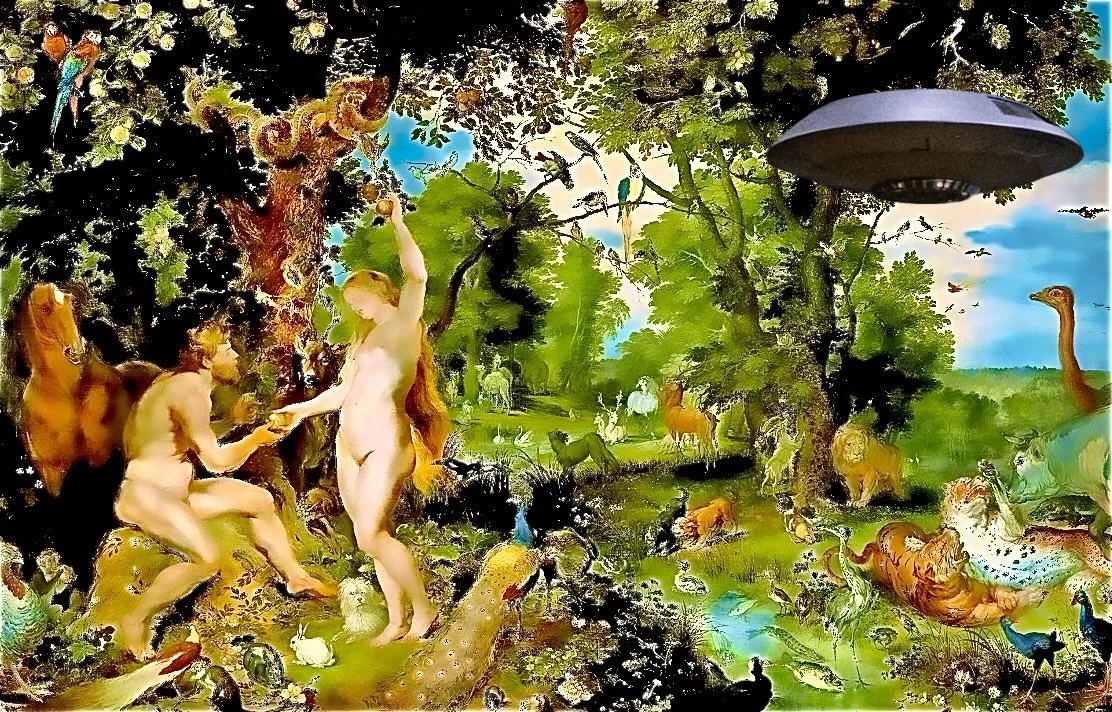
In 1615, Peter Paul Rubens and Jan Brueghel the Elder collaborated on a painting of the Garden of Eden — the moment before the fall, or perhaps during it, the fruit already in hand, the animals assembled in impossible abundance, the light falling on every creature with equal generosity. They painted paradise. That is what artists do. They go to paradise and they stay there.

The Church took the Garden of Eden and made it the architecture of shame — original sin, the fall, expulsion, damnation. Cover the body. Name the desire. Punish both. The painters looked at the same garden and saw something else entirely. They saw color. They saw abundance. They saw bodies that deserved to be painted, animals that deserved to be named, light that deserved to fall on everything without exception.

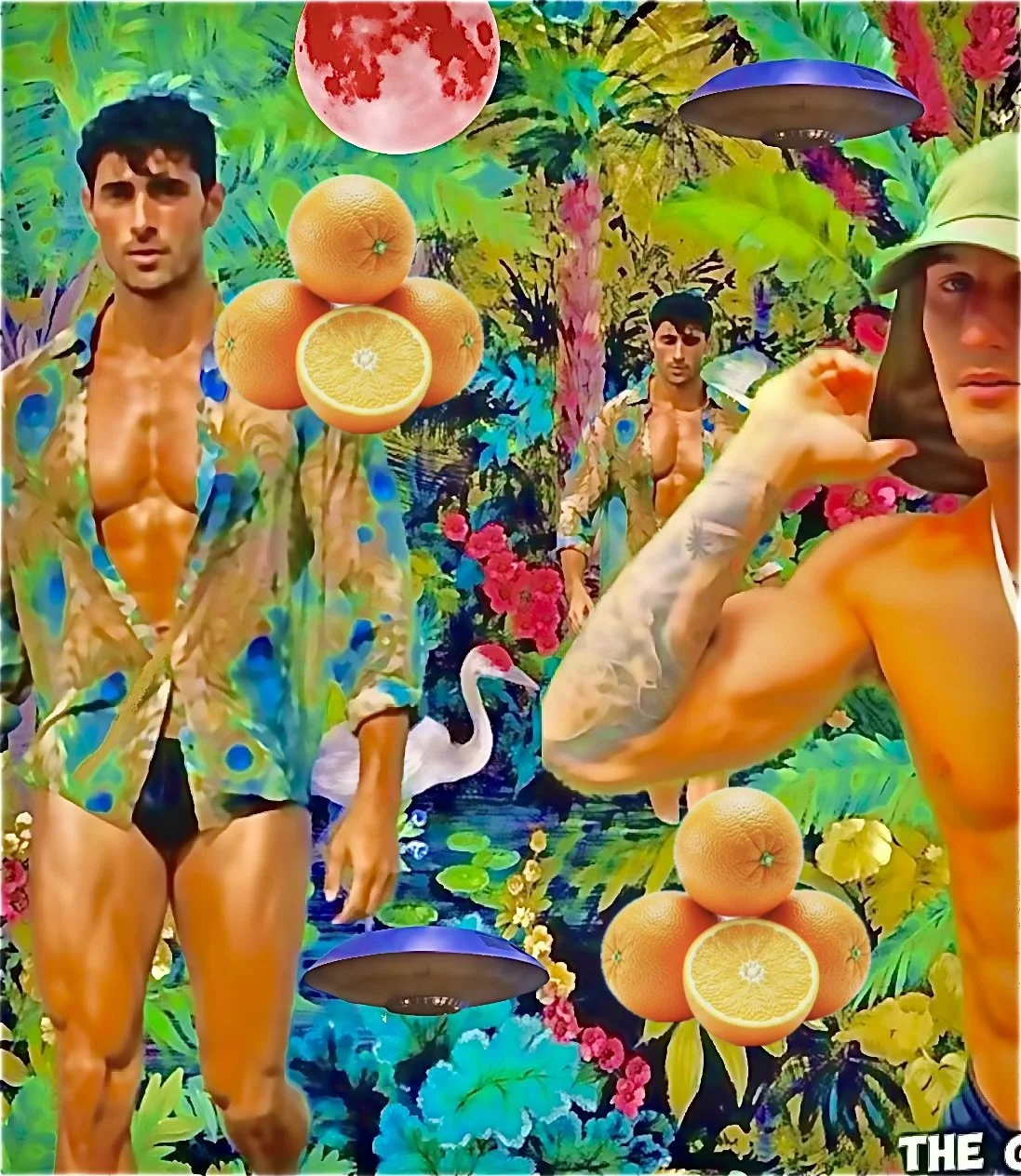
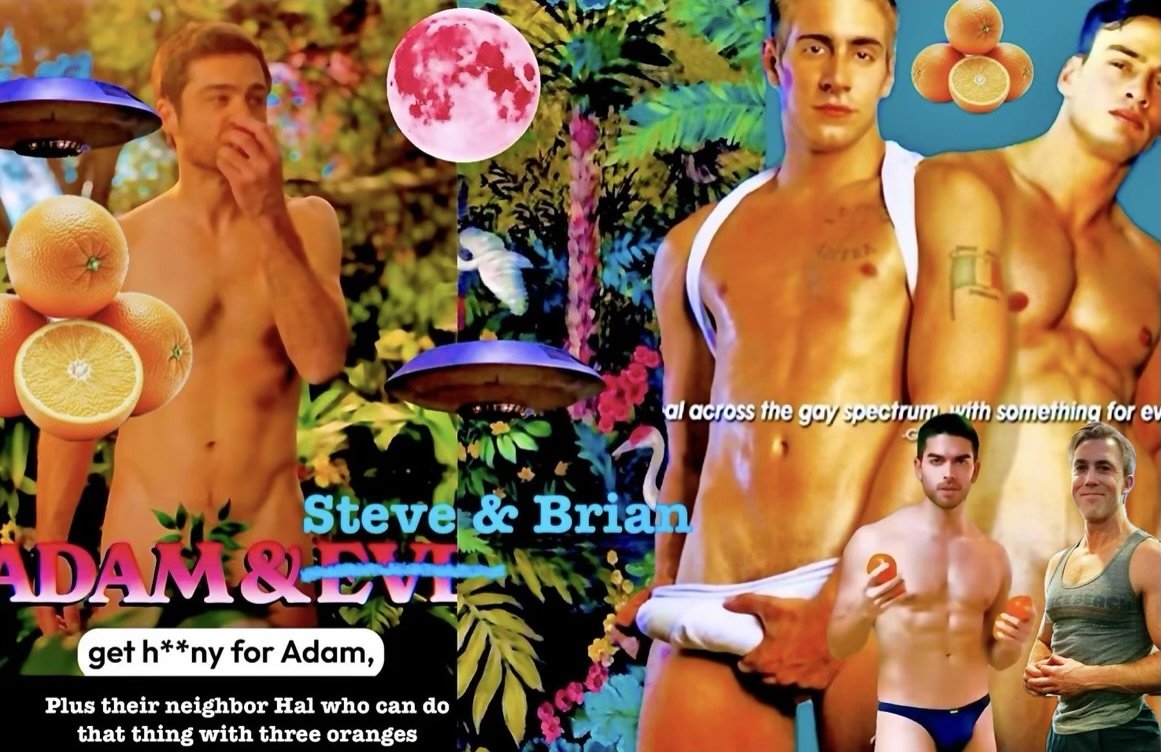
Four hundred and eleven years later, Jupiter 3 has landed in the garden. The pink moon is rising. The oranges — the new forbidden fruit, sweeter and more honest than any apple — are stacked in the foreground. Steve and Brian, not Eve, are here. So is their neighbor Hal, who can do that thing with three oranges. The flamingo stands where the peacock stood. The egret holds the place of the dove. The lush impossible tropical abundance of Brueghel’s botanical imagination has been translated into digital color pushed past its own limit — Mongo-bright, unrepentant, alive.

This is not a commentary on the Rubens and Brueghel. It is a continuation of it. The same paradise, the same unashamed bodies, the same insistence that this world is beautiful and the people in it belong here. The Church said the garden ended with the fall. The artists never left.

Four hundred and eleven years of uninterrupted paradise. Hallelujah.

— Behan

Golden

Friends and Lovers: From Film to Digital, 1985–2025

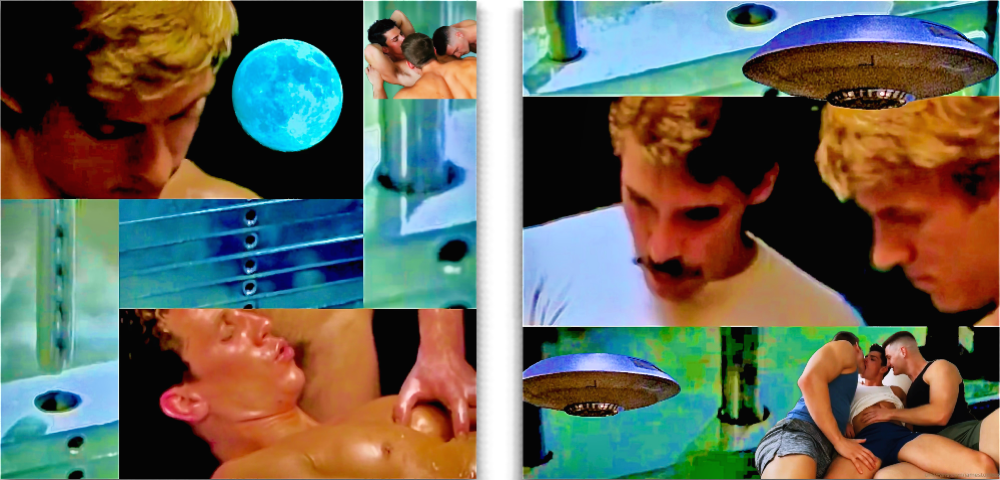
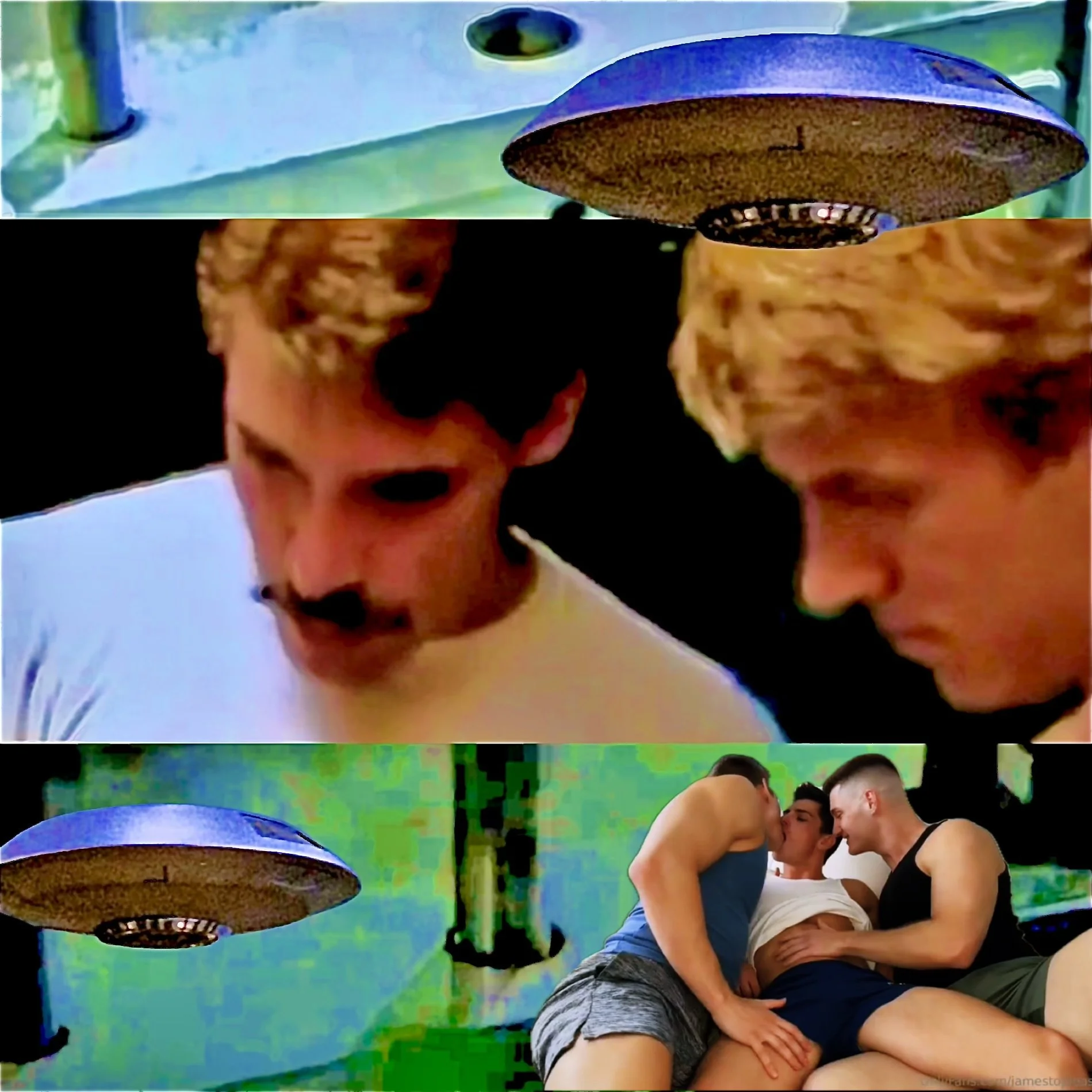
In 1985, a filmmaker named Ron Pearson (1959–2001) produced, directed, and starred in a gay adult film called Friends and Lovers. The film followed two boyfriends through a day at a spa and gym, documenting the romantic and sexual encounters they had along the way. Director of photography Tom Howard shot it with genuine cinematic intention — careful framing, considered lighting, a visual vocabulary that understood the difference between documentation and filmmaking. Running through the film as a recurring visual metaphor was the weight machine at the gym — its bars and counterweights and mechanical resistance standing in for the rhythms of sex and desire without ever needing to announce itself. That is the work of a cinematographer and a director who understood what images can carry when you trust them.

Friends and Lovers was not unusual for its era. The golden age of gay adult cinema — roughly 1970 through the late 1980s — produced filmmakers with genuine aesthetic signatures. Wakefield Poole. Peter de Rome. William Higgins. Arthur Bressan Jr. These were directors who brought narrative structure, visual design, and thematic intention to work the dominant culture classified as pornography and refused to take seriously. For gay men in that era, these films were not pornography in the pejorative sense. They were the only cinema in which gay men appeared as full human beings — desiring, loved, present, alive. Hollywood was not making those films. The mainstream was not making those films. Ron Pearson was making those films, in a gym, with a cinematographer, and a weight machine that knew exactly what it was saying.

Forty years later, Seth Peterson (1997–2026) was one of the most prominent gay adult content creators working. He rose through Helix Studios, earned multiple industry award nominations, and eventually expanded to OnlyFans, where he produced, directed, and starred in his own work. He could play an entire Beethoven Sonata from memory — not a casual piece, but one of the most technically demanding works in the piano repertoire, requiring years of serious study. That detail matters. It tells you something about the range of creative intelligence and artistic hunger that lived inside a person the dominant culture filed under a single reductive category. What else might he have made, had he lived.

The tradition passes the way traditions always pass — not through conscious inheritance but through the accumulated weight of everyone who did the work before you. Pearson didn’t know Peterson. Peterson almost certainly knew Pearson’s work, or the world that work helped make possible. One man founded his own production house in San Francisco in the 1980s so he could control his own image. Forty years later another man opened an OnlyFans account for exactly the same reason, with different tools, in a world the Ron Pearsons had quietly helped build. That is how a tradition moves forward. Not handed. Carried.

The arc from Ron Pearson to Seth Peterson is forty years. It is also the arc from film to digital, from crew to iPhone, from cinematographer to content creator, from 16mm to OnlyFans. What was gained in that arc is real — autonomy, accessibility, volume, the ability for any gay man anywhere to produce and distribute his own image without a studio, without a distributor, without a gatekeeper. The democratization of the image is not nothing.

What was also lost is worth naming. The collective artistic ambition. The cinematographer in the room. The understanding that the apparatus of filmmaking — the frame, the light, the edit — could itself carry meaning. Ron Pearson used a weight machine as a visual metaphor for sex. That required a director of photography who understood the assignment and a director who trusted the image to do the work without explanation.

The Closet Series archives both men. The collages built from Friends and Lovers place the weight machine, the Aquarian Moon, and Jupiter 3 in conversation with footage from Peterson’s work — traditional filmmaking and digital content creation in the same frame, forty years apart, the same impulse, different apparatus, different world.

From film to digital. From crew to creator. From 1985 to 2025. The tradition continues. The men in it deserve to be seen and acknowledged.

— Behan

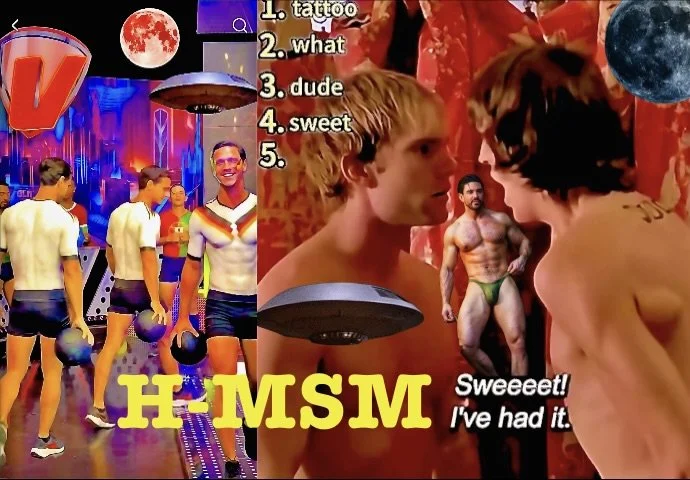
H-MSM Part 2 / Digital Photo Collage / 2026

Still heterosexual-identified and still having sex with men. Still bowling on Thursdays.

Sweeeeet.

And Now a Word from our Sponsor

State of the Strait

Digital Photo Collage 2026

Totally straight and emotionally unavailable? Straight acting and appearing but deeply embedded in the closet? Gay for pay? Gay baiting? Anti-gay politically and pro-gay on the apps? Straight men are all over the place. Sloppy.

Research confirms what gay men have always known from lived experience. Studies estimate that between 0.5% and 3.5% of men who identify as heterosexual are also having sex with men — a population researchers now formally classify as H-MSM, heterosexual-identified men who have sex with men. Many of these men associate bisexuality with confusion and weakness, equate identifying as gay with vulnerability, and maintain their straight identity primarily to comply with social expectations around family and masculinity. Meanwhile a 2023 longitudinal study found that sexual identity change is bi-directional and ongoing across a lifetime — people move toward and away from LGBTQ+ identities throughout their lives. The emerging diverse sexual world is not a crisis for gay people. It is a crisis for straight men who were told the map was simple and are discovering, app by app, that it never was.

— Behan

You’re the Top

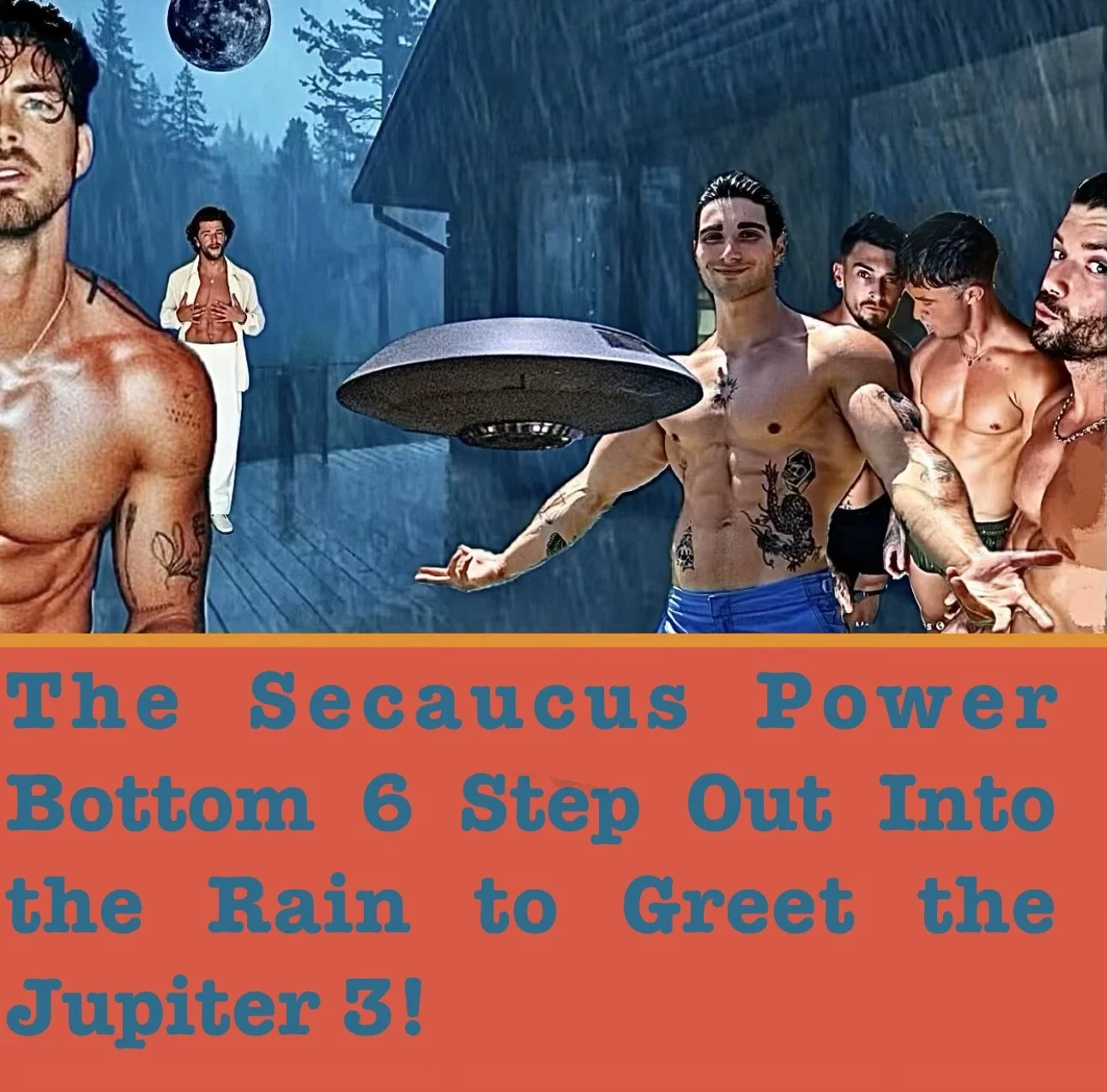
Summer 1978 — The Secaucus Power Bottom 6 step out into the summer rain to greet the Jupiter 3. Chic is considered top tier talent by the guys. He’s coming in for a landing and is going to have his hands full. Only a 10 minute transit to Port Authority and every peep show you could imagine on 42nd Street — Chic and the gang are going to have a fantastic weekend.

Summer 1980– I was there. Just graduating from high school and the world opening up. Everything seemed possible. I can’t ever adequately describe the difference between 1980 and 1981. It was a pandemic earthquake.

Timeline

Three Men Before the Camera

1955: Nick Adams arrived in Hollywood with ambition, charm, and a secret he would carry to his grave. Multiple biographers identified him as gay or bisexual. He never said so publicly.

1985: Bill Henson was one of the top gay adult film stars from the Golden Age of gay adult cinema, which was also the age of AIDS. He gave gay men images of themselves in the one space visibility was permitted.

2025: Yoav Even is an Israeli fashion and fitness model with millions of social media followers. He has publicly and openly identified as bisexual on his own platforms. He posts. He is seen. He does not hide.

Three men before the camera. Three different relationships to the same question — who are you and are you allowed to say so. One who shouldn’t. One who could but only in a space the world used against him. And then one who says it freely without apology to the world.

The distance between Nick Adams and Yoav Even is seventy years. It is also everything.

— Behan

Enter Nick

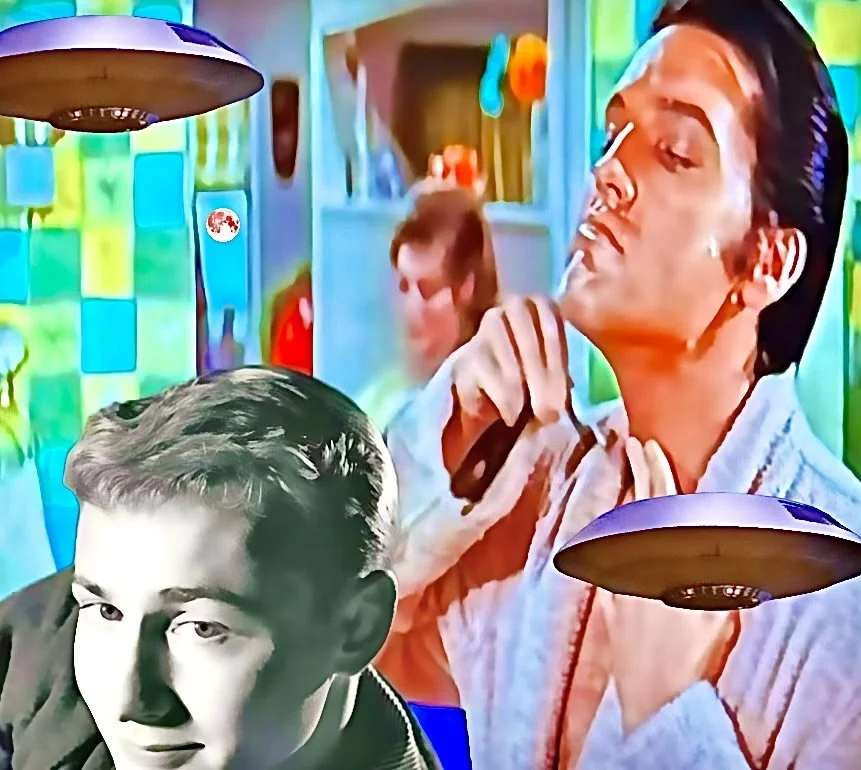
Mirror Time | Digital Photocollage | 2026 | The Closet Series — Behan

Nick Adams — born Nicholas Adamschock on January 10, 1931 — was a diminutive, blond actor who worked the edges of mid-century Hollywood with considerable skill and considerable hunger. He played neurotic types, aggressive types, comic sidekicks. He starred in the ABC television series The Rebel. He showed up in successful films throughout the 1950s and 1960s and made himself indispensable to the people who mattered.

He was also, by most accounts, bisexual — and operating in a Hollywood that had no tolerance for that information becoming public.

He shared an apartment with James Dean when both were young and broke and trying to break in. What exactly happened between them depends on who is telling the story. Sal Mineo told a biographer in 1972 that Nick had confided in him about a significant affair with Dean. John Gregory Dunne confirmed that Dean was bisexual, as were Adams and Mineo. Biographers noted that Adams was one of many studio-era stars who dated women or entered sham relationships to cover their true sexualities — the standard operating procedure of the time.

His friendship with Elvis Presley was equally intense and equally subject to rumor. Biographers noted they may have “swung both ways” together. Elvis’s former fan mail secretary and multiple other sources made similar observations. Adams later overdubbed some of Dean’s lines in Giant after Dean’s death in 1955, and dated Natalie Wood — which one historian drily noted was roughly equivalent to being “a good friend of Liz Taylor’s.”

At the time of his death in 1968, Adams was thirty-six years old. He was, at the time, rumored to be the lover of a fellow movie actor.

His story is, as one historian wrote, a virtual template of mid-century Hollywood closeted life.

This collage puts him in the bathroom with Elvis — domestic, intimate, ordinary. Two men jostling over the mirror. The blood moon watches from the corner, small but present. Jupiter 3 hovers, patient as always.

The closet engulfs everyone—-straight, bi, or gay. And that’s terrible.

Honey + Percy 4 Ever

Hobey

On Hobey Baker, Percy Rivington Pyne II, and the photograph that was never taken

I am getting so tired of hearing about really good friends.

Hobart Amory Hare “Hobey” Baker was born in 1892 in Bala Cynwyd, Pennsylvania, into a prominent Philadelphia family, and by the time he graduated from Princeton in 1914 he was the most celebrated amateur athlete in America. He was the first American star in ice hockey — one of the first nine inductees into the Hockey Hall of Fame when it was founded in 1945, the only American among them. He was also inducted into the College Football Hall of Fame in 1975, the only person ever to appear in both. F. Scott Fitzgerald, who spoke to him once at Princeton, was so dazzled he based a character on him. The whole country knew his name.

After graduation he worked at J.P. Morgan Bank, enlisted in the United States Army Air Service when America entered the First World War, flew with the 103rd and 13th Aero Squadrons, was promoted to Captain and named commander of the 141st Aero Squadron, and was awarded the Croix de Guerre by the French government. He died in France on December 21, 1918, when a plane he was test-piloting crashed — hours before he was due to leave for home. He was twenty-six years old.

None of that is the part that got buried.

What got buried was Percy. Percy Rivington Pyne II was a wealthy New York socialite, ten years older than Hobey, who had also attended St. Paul’s School and Princeton. They met after graduation and became inseparable. Percy invited Hobey to live with him at his house at 263 Madison Avenue, which Hobey did for two years. They traveled together, moved in the same social circles, and by every available account built their lives around each other. Percy was known, quietly, to be gay. The historical record notes this and then moves efficiently along.

The official record calls them really good friends.

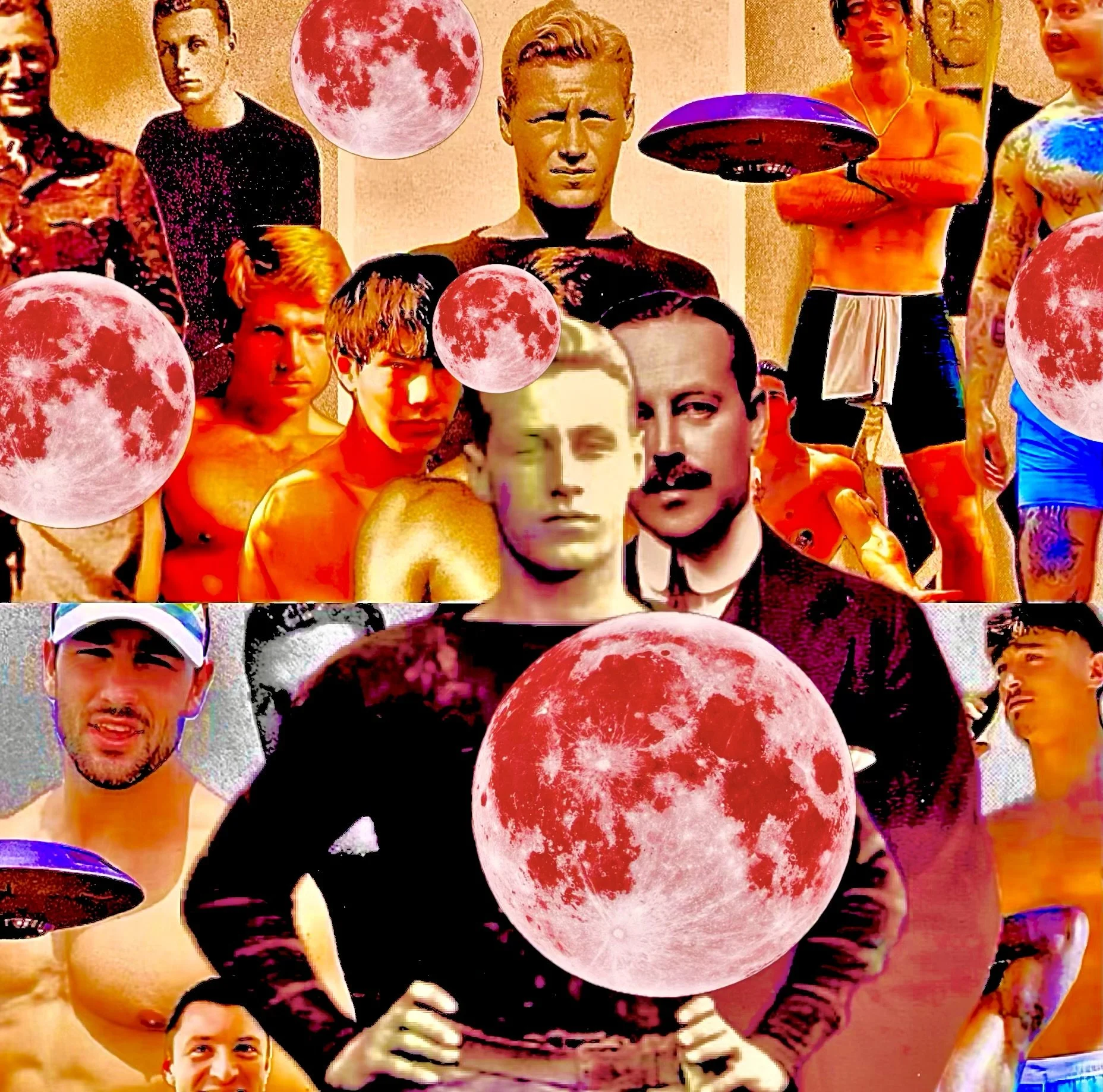
One of the most quietly devastating consequences of the closet is what it did to photography. The nineteenth and twentieth centuries saw the emergence of the photograph as a technology of love — the impulse to be pictured with the one you love as a fuller understanding of yourself, as evidence that you existed together, that your love was real and had a face. Straight couples understood this instinctively. Gay men were not allowed it. There is no photograph of Hobey and Percy together. The archive does not contain them in the same frame. What this collage does is put them there — finally, a century late, together in the center of the image where they belong, surrounded by the pink moons that mark what the dominant culture cost them, witnessed by Jupiter 3 who has been watching all along.

The collage is composed in an X format — the eye moves across and through the frame, drawn to the center where Hobey and Percy finally occupy the same space. It is a deliberate compositional choice. The X marks the spot where history buried something. The Closet Series digs it up.

Someone wrote this about Hobey after he died. Whoever wrote it knew exactly who he was:

You who seemed winged, even as a lad,

with that swift look of those who know the sky.

I think some day you may have flown too high,

so that immortals saw you and were glad,

watching the beauty of your spirit’s flame,

until they loved and called you, and you came.

That is not about hockey.

These stories litter the landscape. Hobey and Percy. Jerry and Rob and Diggy. Men who loved each other with everything they had, whose love was recorded in letters and private journals and architectural silences and the particular way a life is built around another person — and then handed to the archive, which called it friendship and moved on.

I fell over this story. That is the only way to describe it. And I am getting so tired of falling over stories like this. There are so many of them. They are everywhere. And every single one of them deserves to be put back together, put back in the same frame, given the photograph that was never taken.

That is what The Closet Series is for.

On Green

“Three Nineteenth Century Men with an Acknowledged Intense Friendship That Got Absorbed by the Closet and the Dominant Culture’s Penchant for Burying Queer Love and Expression Through a Skewed Historical Lens”

Digital Photocollage 2026

Three Men in the Green Ferment

Jerry (Gerard Manley Hopkins, 1844–1889)

He was a poet and a Jesuit, a man whose senses were so finely tuned to the physical world that every blade of grass was a theological event. He recorded in his private Oxford journals an obsessive, guilt-ridden preoccupation with male beauty — what he called, with anguished precision, “imprudent looking.” He struggled. He prayed. He converted to Roman Catholicism in 1866, took his vows, and redirected the whole force of his desire into God and nature. Literary critics have spent a century calling this sublimation. The closet has another word for it.

Diggy (Digby Mackworth Dolben, 1848–1865)

He was an Anglo-Catholic poet, younger than Jerry by several years, handsome and emotionally intense, the kind of young man who writes poems that are, as one scholar put it plainly, homoerotic. He was besotted with a classmate named Marchie Gosselin who barely noticed him. Jerry was besotted with Diggy. The whole arrangement was a perfect Victorian triangle of longing and misdirection. Diggy drowned in 1865 at the age of nineteen, before anything could be named or resolved. He took his portion of the story with him into the water.

Rob (Robert Bridges, 1844–1930)

He was a fellow Oxford student who became Britain’s Poet Laureate and the primary reason Hopkins’s poems survived at all. Their friendship lasted twenty-six years, right up until Jerry’s death in 1889. It was Rob who kept the poems. It was also Rob who, after Jerry died, had all of his own letters to Jerry returned and destroyed — so that whatever he had written, whatever he had felt, whatever passed between them in twenty-six years of correspondence, is gone. He kept Jerry’s poems for twenty-nine years before publishing them. When he finally did, he attached a preface that left readers wondering why he had bothered. The closet, by then, was firmly in charge of the archive.

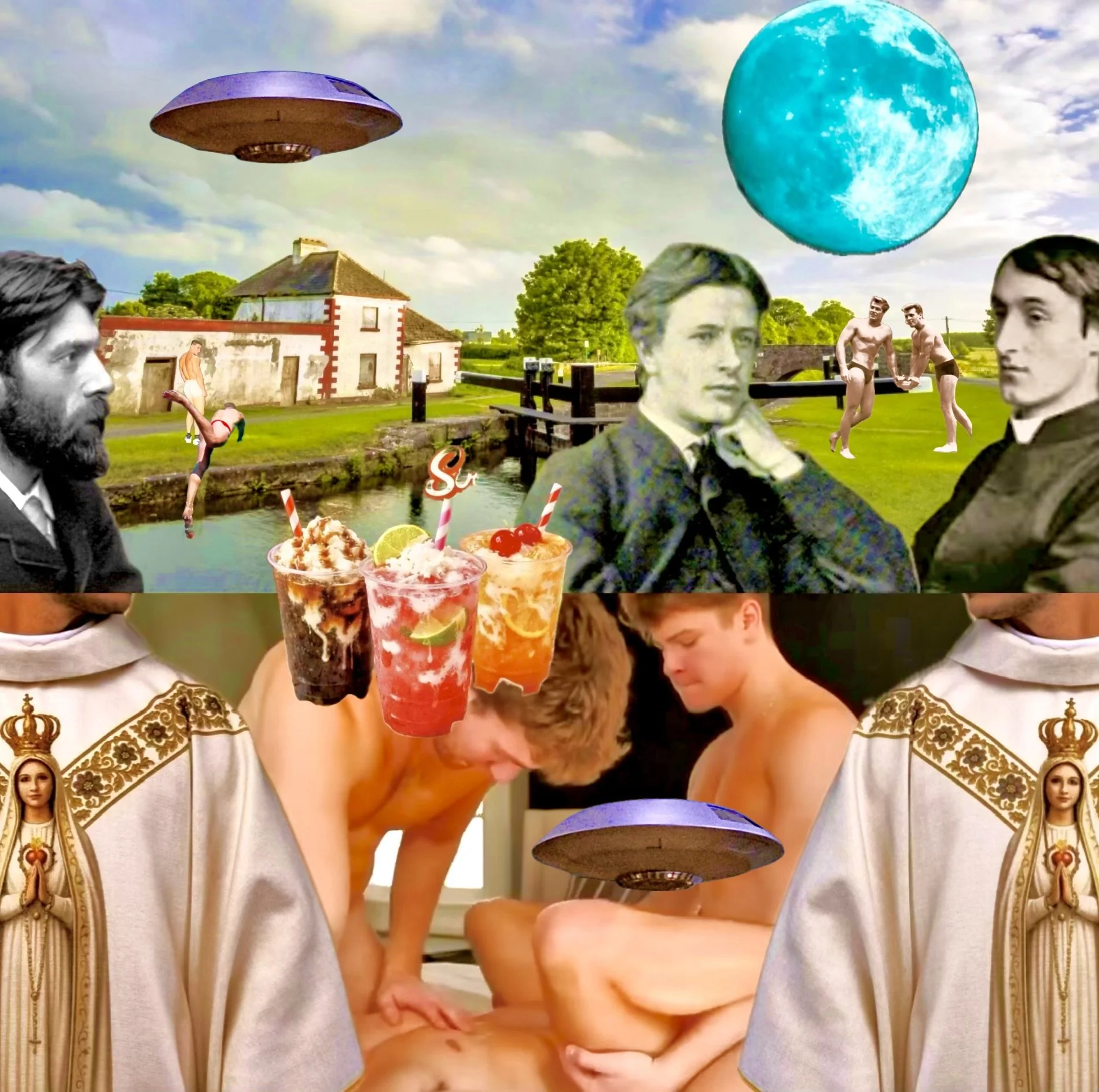
Together, Jerry, Rob, and Diggy inhabited a world of intense male friendship that Victorian culture permitted only so long as it remained unnamed. They frolicked — and that word is chosen deliberately — in the idyllic green landscape of Monasterevin, Ireland, in what one might fairly call the last innocent moment before society arrived with its categories and its consequences. The green ferment embraced their sweet love for one another. The canal ran quietly beside them. The sky was the color of everything possible.

And then Society Intervened

Letters were burned. Identities suppressed. Poems withheld. The history was not destroyed so much as carefully rearranged — passed through the skewed lens of a dominant culture that had no language for what these three men were to each other, and no intention of finding one.

The Collage as Reclamation

No archive contains a photograph of Jerry, Rob, and Diggy together. No biographer assembled them in the same frame. The historical record kept them separate — individual entries, individual footnotes, individual tragedies. What this collage does is refuse that separation. It puts the three men back together in the landscape they shared, back in the green ferment of Monasterevin, back where they were before society arrived with its categories. That act of assembly is itself the argument. The Closet Series does not illustrate history. It corrects it.

A Personal Note from the Artist

My grandmother was born and raised in Monasterevan at the turn of the twentieth century. I visited there in 1982 and walked under the thatch roof of the hundred year old family homestead. So this collage and this story of these three literary men who spent time in Monasterevin is very close to me. For example, I have two grand uncles, two brothers of my grandmother, who were born in the 1890s, who lived together as ‘confirmed bachelors’ their entire lives in that family home. During my visit I remember the window over the sink piled high with tea cups stained black from years of living. So this is personal to me — and sadly it’s reflective of an ongoing personal family history of generational repression of queer identity and expression.

Final Thought

What The Closet Series does with Jerry, Rob, and Diggy is what it does with all its subjects — it restores the expansive reading. It does not speculate beyond the evidence. It simply refuses the restrictive one. These were three nineteenth century men with an acknowledged intense friendship that the historical record has consistently underread, understated, and in Rob’s case literally incinerated. The poems survived. The love survived, encoded in every line. The Aquarian moon was watching then as it watches now — witness and truth, patient across centuries, waiting for someone to say what the archive was always trying to say.

The Closet Series 2026 James Behan

Boy Girl Boy Girl

Boy Girl Boy Girl

Digital Photocollage 2026

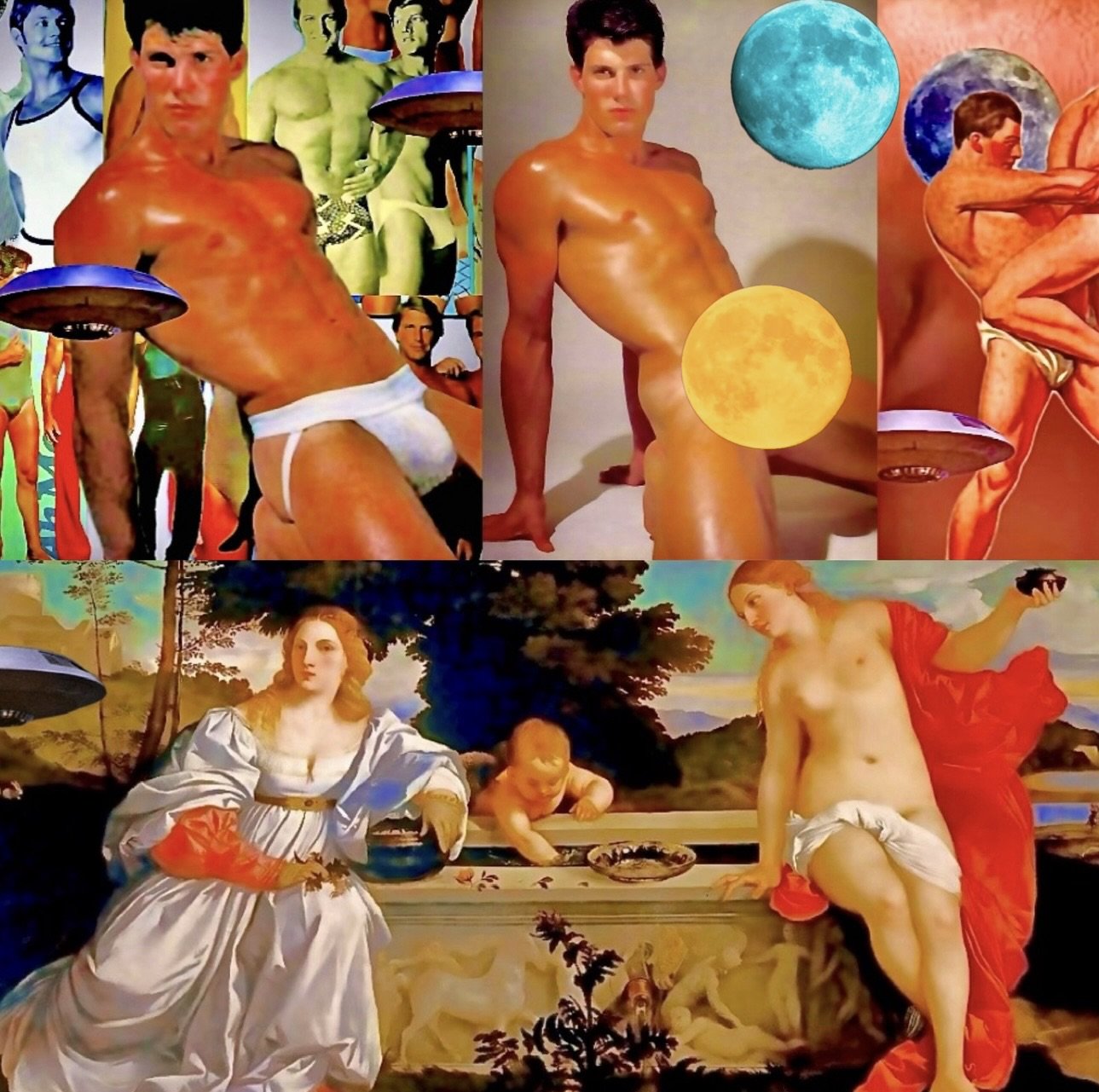
In 1514, Titian painted two women seated on either side of a stone sarcophagus. One is clothed, elaborately dressed in the fashion of the Venetian court. The other is unclothed, serene, holding a flame. He called it Sacred and Profane Love. Five centuries of art historians have argued about which figure represents which. The clothed woman — is she the sacred, modest and contained? Or is the unclothed figure the sacred, closer to God, unencumbered by worldly decoration? Titian never answered the question. The ambiguity was the point.

Mike Henson — born Kenneth John Seymour, October 4, 1963 — was a premier star of the golden age of gay adult cinema. He was known for his clean-cut, boyish looks and his double image became one of the defining gay portraits of the 1980s. The front VHS cover: the jock strap, the matinee idol pose, the public face of desire. The back cover: the same person, same pose, now unclothed, fully revealed. You could never see both at once. The act of flipping—a threshold of transformation— a private moment, as if the figure was disrobing before you, and back again. One side was what you could know. The other was what you would wish for. Sacred and profane, separated by the simple act of turning something over in your hands.

The collage collapses the four figures (Boy Girl Boy Girl) onto a single plane — the clothed and the unclothed, the public and the private, male and female, all at once.

Titian’s question remains. Which is the sacred? Which is the profane?

The Aquarian Moon knows but isn’t saying.

Throuple Zone

In Three We Trust

On Throuples and Gay Culture

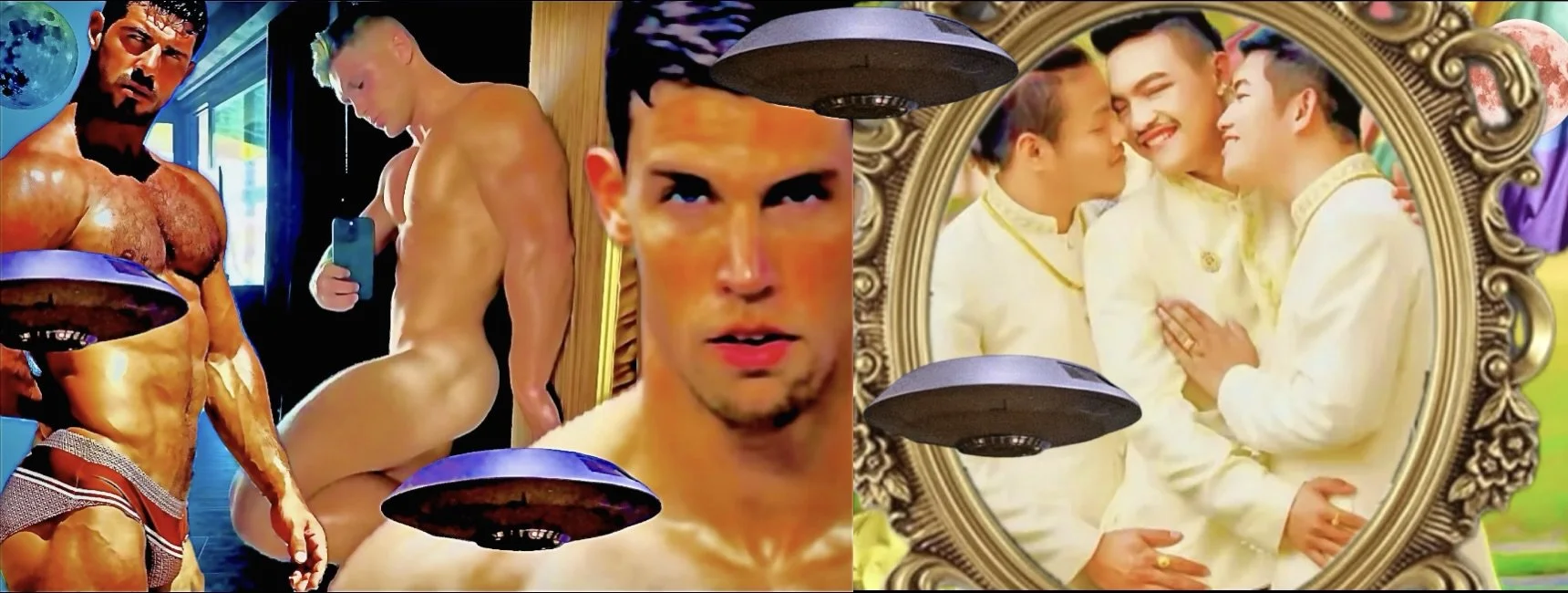
A throuple — a committed, three-way romantic relationship operating on non-hierarchical equality — holds a particular and visible place in gay male culture. Because the queer community has historically challenged heteronormative relationship scripts, gay men have long been more likely than their straight counterparts to build relationships outside the conventional dyad. The throuple is one of the most visible expressions of that broader project.

In 2015, three men from Thailand — known publicly as Joke, Bell, and Art — made global headlines when they held a highly publicized symbolic Buddhist wedding ceremony, becoming one of the first globally recognized gay throuples to formalize their commitment in a public event. The images traveled everywhere. Three men in white, hands clasped, smiling. The world wasn’t entirely sure what to do with it. Gay culture knew exactly what it was looking at.

The dynamics of a successful throuple require what researchers and community members describe as non-hierarchical equality — all three partners sharing an emotional and often sexual bond without any one member being treated as secondary or temporary. The language that has emerged from within polyamorous gay communities is precise about this: there is no “third.” There is no unicorn. There is a triad, and each of the four relationships within it — A and B, B and C, A and C, and the collective bond of all three — requires its own time, attention, and maintenance to thrive.

Some throuples operate as closed triads, or polyfidelitous relationships, in which the three men date and are intimate exclusively with each other. Others function within the broader culture of open relationships, where all three partners may pursue connections outside the triad by mutual consent. What both models share is a rejection of the assumption that love is a finite resource — that commitment to one person necessarily diminishes commitment to another.

This is not a new idea in gay culture. It is, in many ways, one of gay culture’s oldest and most radical contributions to the broader human conversation about love — the insistence that intimacy does not have to look the way the dominant culture says it must. Gay men, having already been told that their love was impossible, illegal, sick, or sinful, were perhaps uniquely positioned to reimagine what love’s architecture could be.

Jupiter 3 has been watching. It isn’t surprised.

On Pride

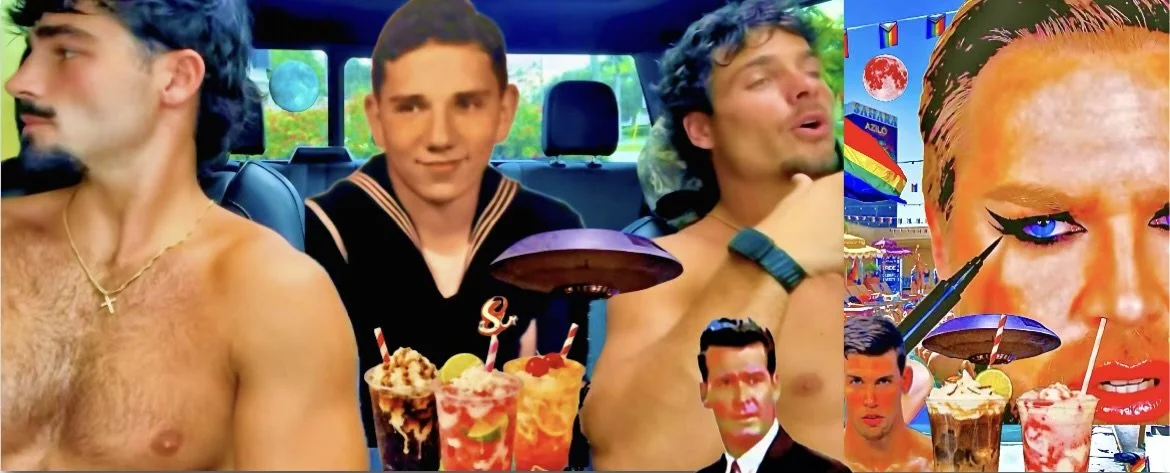
On the Way to Pride: In Las Vegas, a Deeply Closeted Film Industry Celebrity Prepares to Meet His Grindr Date and Advertised James Garner Look-Alike; While in San Francisco, a Navy Man Is Reunited with His Gay Self After Being Forever Separated from His Beloved in World War II

Two men. Two eras. One journey.

In the backseat, a World War II Navy man rides toward the life he was never allowed to live — flanked by his people, the Aquarian moon in the window, Jupiter 3 overhead, the drinks already poured. He’s smiling. He made it.

Across the frame, a deeply closeted film industry celebrity stands at the edge of a Las Vegas Pride pool party, eyeliner coming at him like a reckoning, the blood moon watching, the rainbow flags snapping in the desert heat. He ordered the drink. He’s almost there.

The first Gay Pride parade marched up Sixth Avenue on June 28, 1970 — two thousand people, one year after Stonewall, calling it Christopher Street Liberation Day. Eight years later, Gilbert Baker unfurled the rainbow flag at San Francisco’s Gay Freedom Day Parade — hand-stitched, hand-dyed, eight colors for sex, life, healing, sun, nature, magic, serenity, and spirit. Harvey Milk had asked for something beautiful. Baker gave the world something permanent.

That was 1978. Today, 793 anti-LGBTQ bills are moving through 43 states. The Navy man already knows how this works. He lived through one version of it. He’s still smiling.

The Closet Series has been watching. The Pink winks knowingly. Jupiter 3 isn’t surprised. — Behan.
#TheClosetSeries #Pride #OnTheWayToPride #QueerHistory #LGBTQRights #RainbowFlag #Stonewall #QueerArt #DigitalPhotocollage #NeverGoingBack

Gay Play

It Can Only Be Pantomime

Digital Photocollage, 2026

Queer as Folk arrived in Britain in 1999 and in America in 2000. For many gay men, it was the first time they had seen themselves reflected on television — not coded, not tragic, not comic relief. Actually seen.

And yet. Most of the men playing those roles were straight. Charlie Hunnam. Aidan Gillen. Gale Harold. Hal Sparks. Skilled actors, all of them. Allies, some of them. But straight men performing gay life from the outside in — which means, however gifted, working from observation rather than memory. From research rather than survival. These series aired at the exact moment the community was still counting its dead. The subtext of every scene, every kiss, every bed — was the dying. The friends who didn’t make it. The lovers buried before the medications arrived. That subtext was not available to a straight actor in 1999 or 2000, because dominant culture had spent two decades constructing a wall between who AIDS happened to and who it didn’t. Straight men walked through that period largely untouched by it. Gay men did not. You cannot research your way into that grief. You cannot perform it from the outside.

Russell T. Davies, who created the British original, eventually arrived at the only honest conclusion: that casting a straight actor in a gay role produces pantomime. Not because straight actors lack craft, but because gayness is not a set of behaviors you can study and replicate. It is a life. It is the specific weight of a closet. It is the particular quality of desire that has been told it does not exist.

And still today, in 2026, nothing has fundamentally changed. Wentworth Miller came out as gay in 2013. His run as a major Hollywood leading man was over. He eventually walked away from Prison Break entirely, saying he was done playing straight men — because straight men were the only roles available to him. Jonathan Bennett, the heartthrob of Mean Girls, came out in 2017. He works. He does Hallmark Christmas movies. That is what the industry offered him.

Meanwhile, straight men who play gay collect awards for their “courage.” Tom Hanks won the Academy Award for Philadelphia in 1994 — playing a gay man dying of AIDS while actual gay men dying of AIDS were invisible to Hollywood. The industry called it “brave.” “Brave” is a word they reserve for straight men doing gay men a favor. Gay actors don’t get cast in those roles. They don’t get the gay roles. They don’t get the straight roles. They don’t get the roles.

Ben Whishaw said it plainly: gay actors must read as straight to achieve mainstream success. The closet is not just something gay men build for themselves. Hollywood builds it for them, finances it, and then gives awards to straight men for visiting it briefly and leaving.

It can only be pantomime.

The Closet Series has been watching. The blood moon knows. Jupiter 3 isn’t surprised. — Behan.

A Gay Life

This post documents four significant developments in US gay culture that occurred in my lifetime. Each alone would be life changing and significant. Altogether they created a cultural shift that reverberate through today.

December 15, 1973

I was 12 years old. The American Psychiatric Association votes to remove homosexuality from the Diagnostic and Statistical Manual of Mental Disorders. A majority decides that love is not a disease. I remember reading this in the newspaper before I understood how much this would impact me.

June 5, 1981

I was 19 years old. The CDC publishes a report describing a rare lung infection in five young gay men in Los Angeles. Two are already dead. Nobody has a name for it yet. Gay men read about it in local papers, in newsletters, in whispers. What followed was the worst years in the community’s memory — and also some of its most fierce. ACT UP. Vigils. Funerals. The sense of abandonment from the dominant culture was profound.

June 26, 2003

I was 41 years old. The Supreme Court strikes down sodomy laws in Lawrence v. Texas. What gay men did in private was no longer a crime. For the first time in my life the closet was not a necessity, but coming fully out of the closet would take many years.

June 26, 2015

I was 53 years old. Obergefell v. Hodges produces marriage equality nationwide.

Recognition. Legitimacy.
I remember being shocked by this change, also concerned about the reaction that would surely come from the right. I was also aware as now a senior citizen, my own chance for marriage was remote.

The Collage

In my collage, four gay men from four generations, 1960’s, 1980’s, 2000’s, and 2020’s, represent these epoch events that gays experienced in the transition from the 20th to 21st century. From my own view, there is a cumulative sense of freedom and growth, but also an unmistakable awareness of lost time.

It’s about time.