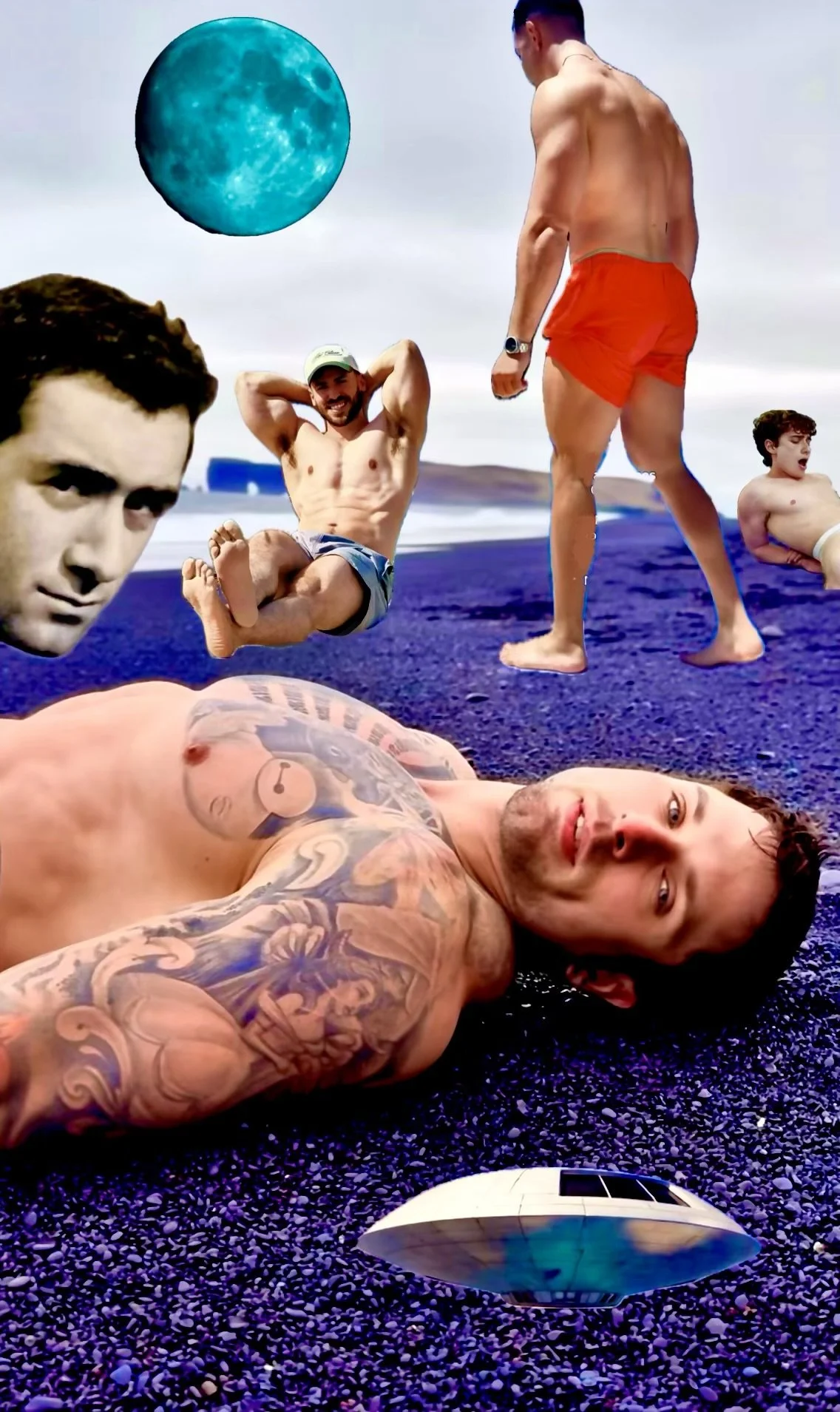
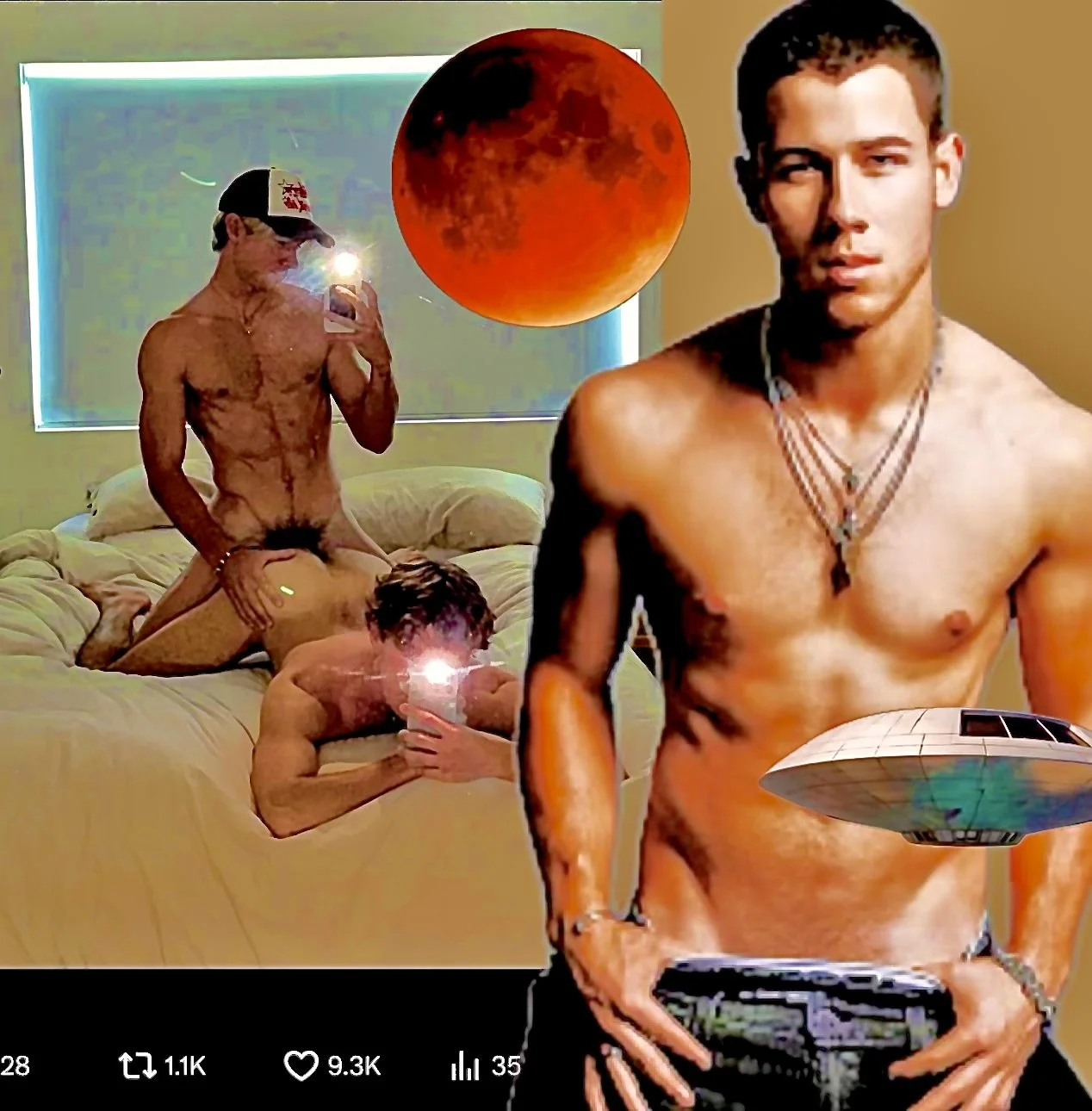
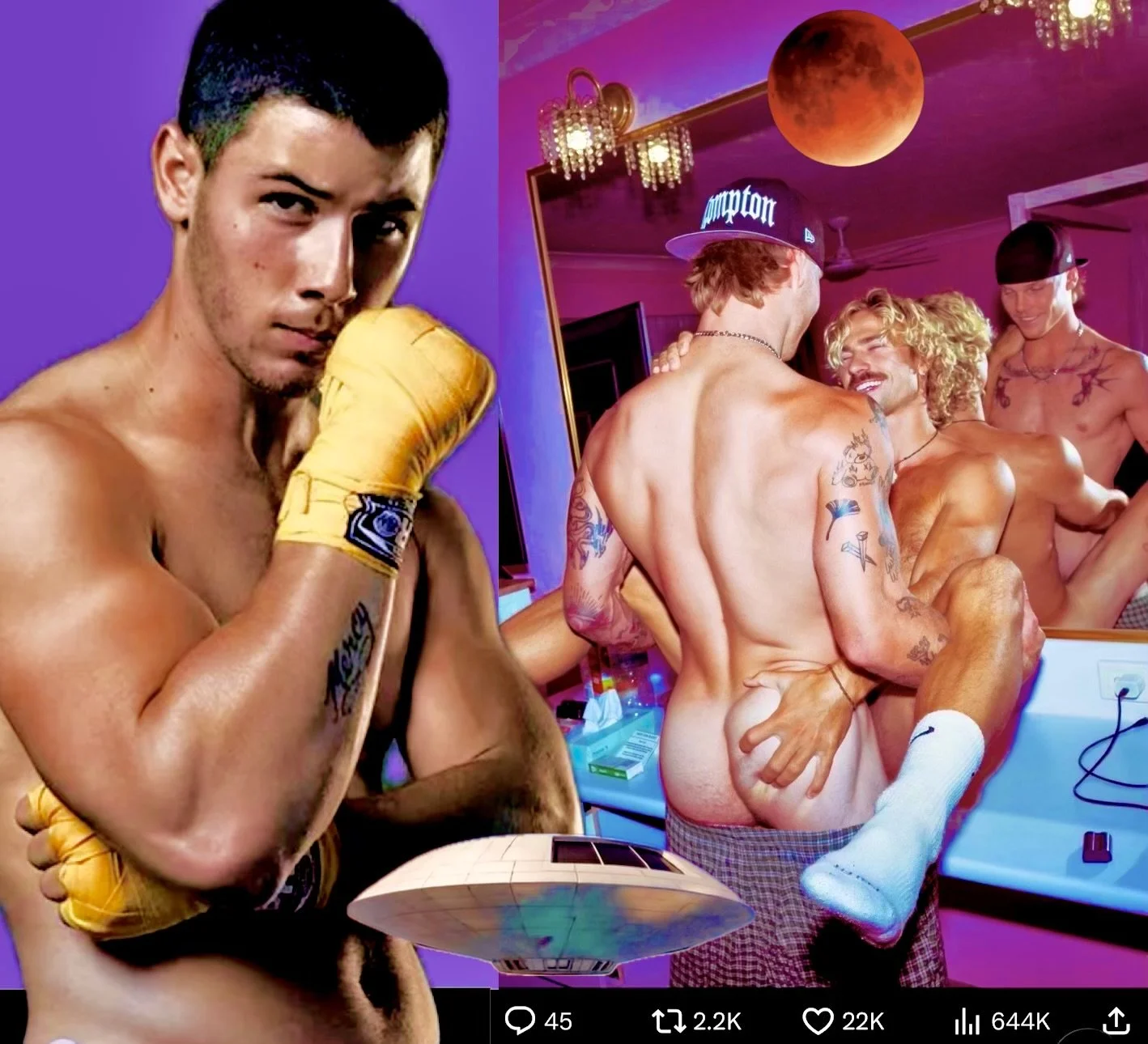
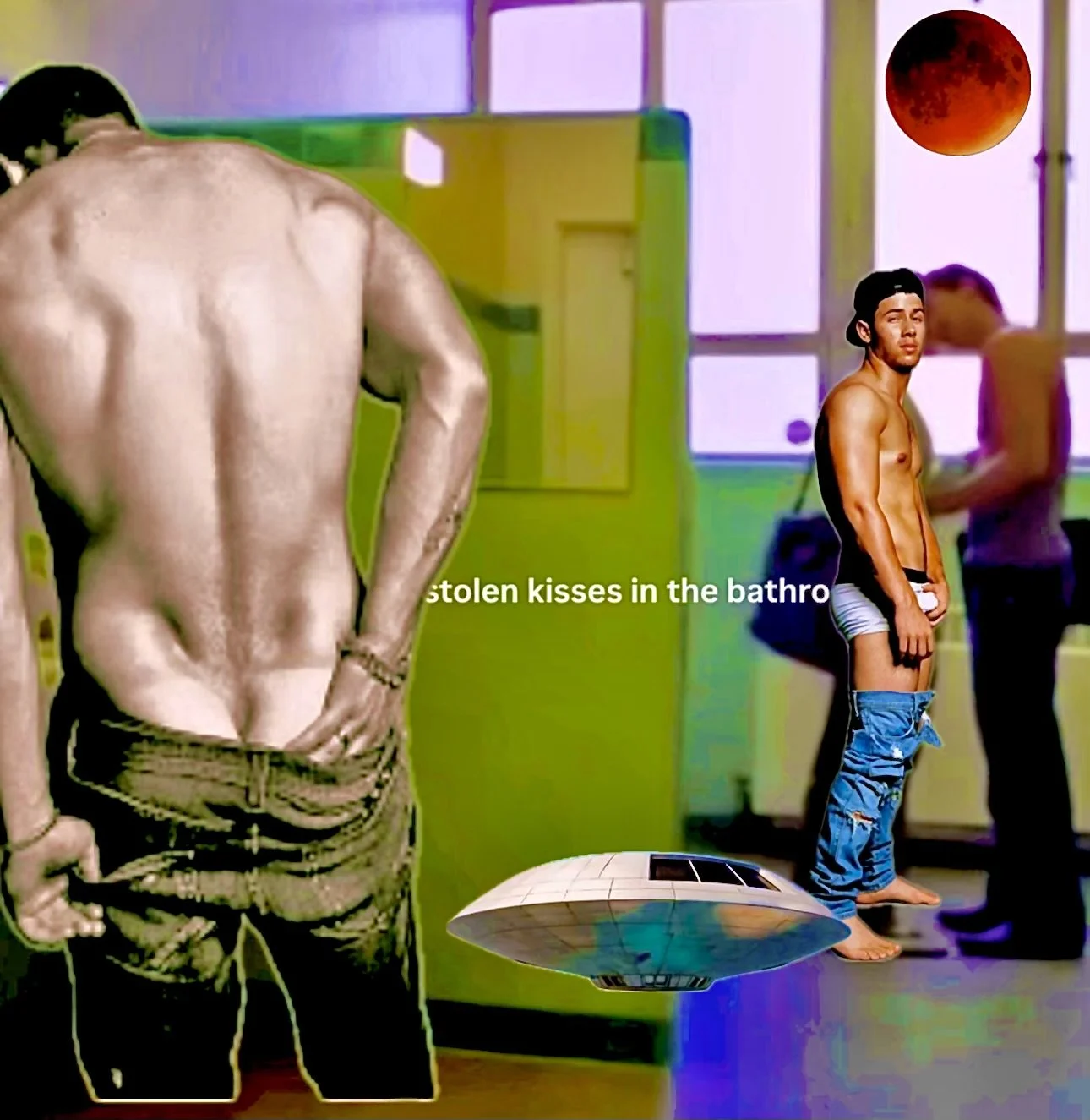
Inside the Loop

The Loop: Gene Kelly, the Closet, and the Composition of Rumor

Betsy Blair was an actress, a leftist, a survivor of the blacklist, a woman who understood how Hollywood worked and what it cost. When she wrote her memoir, The Memory of All That, she was careful. She noted that during their courtship and early marriage, Gene Kelly had little interest in sex. She noted that he consistently brought a particular friend along on their dates, their vacations, their private time together — a blond, slight playwright and rehearsal pianist named Dick Dwenger, Gene’s best friend and intellectual anchor, the person Blair said was there to keep Gene from losing sight of who he was. When Dwenger was killed in World War II, Gene was devastated in a way that took a long time to name. She didn’t name it. She left the space.

No relationship between Gene Kelly and a man was ever confirmed. No one came forward. No evidence surfaced. In all likelihood, Gene Kelly was not gay. And yet the space Blair left in that memoir has never fully closed. It sits there, between the lines, in the double-spacing she knew exactly how to use. That space is the closet. And the closet, once opened, doesn’t require proof. It requires only a rumor. A pause. A question left unanswered.

The Best of Places, The Worst of Places

Dickens opened A Tale of Two Cities with a paradox about a time of violence so extreme it produced its opposite in equal measure — the best and worst existing not in sequence but simultaneously, in the same moment, in the same city, in the same body. Hollywood in its classical period was exactly that for gay men. The most intoxicating visual feast ever produced and the most systematically hostile cultural institution in American life, operating at the same time, on the same soundstages, with the same people.

The studio system produced images of male beauty at an industrial scale. Bodies lit by the greatest cinematographers who ever worked. Narratives that permitted physical intimacy between men under the cover of comedy, athleticism, and masculine camaraderie. And simultaneously, through the Production Code enforced from 1934 through 1968, it explicitly prohibited the existence of the men producing those images. “Sex perversion” was the operative term. Gay actors, directors, designers, and choreographers built the dream factory from the inside while the factory held their lives over their heads.

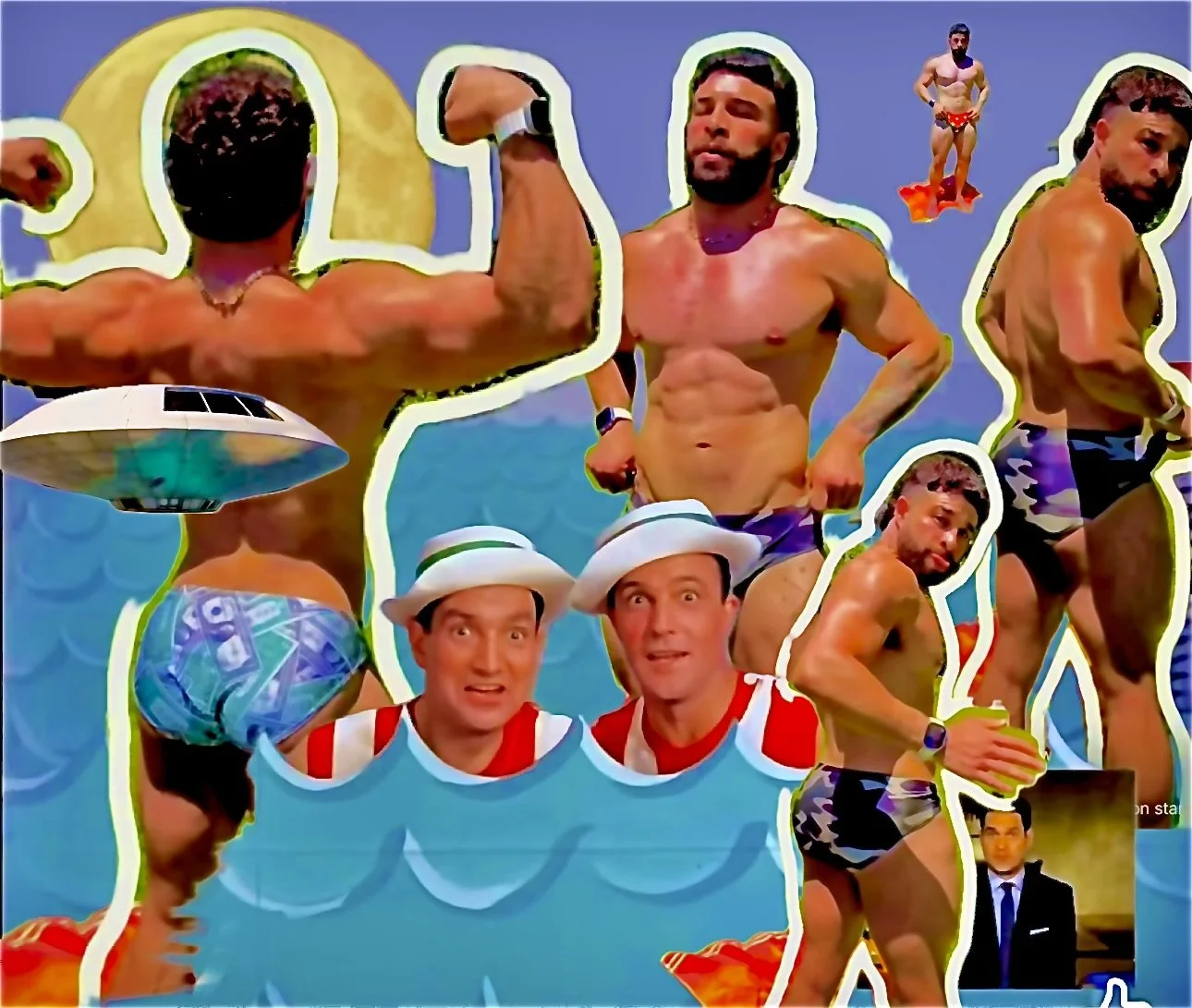
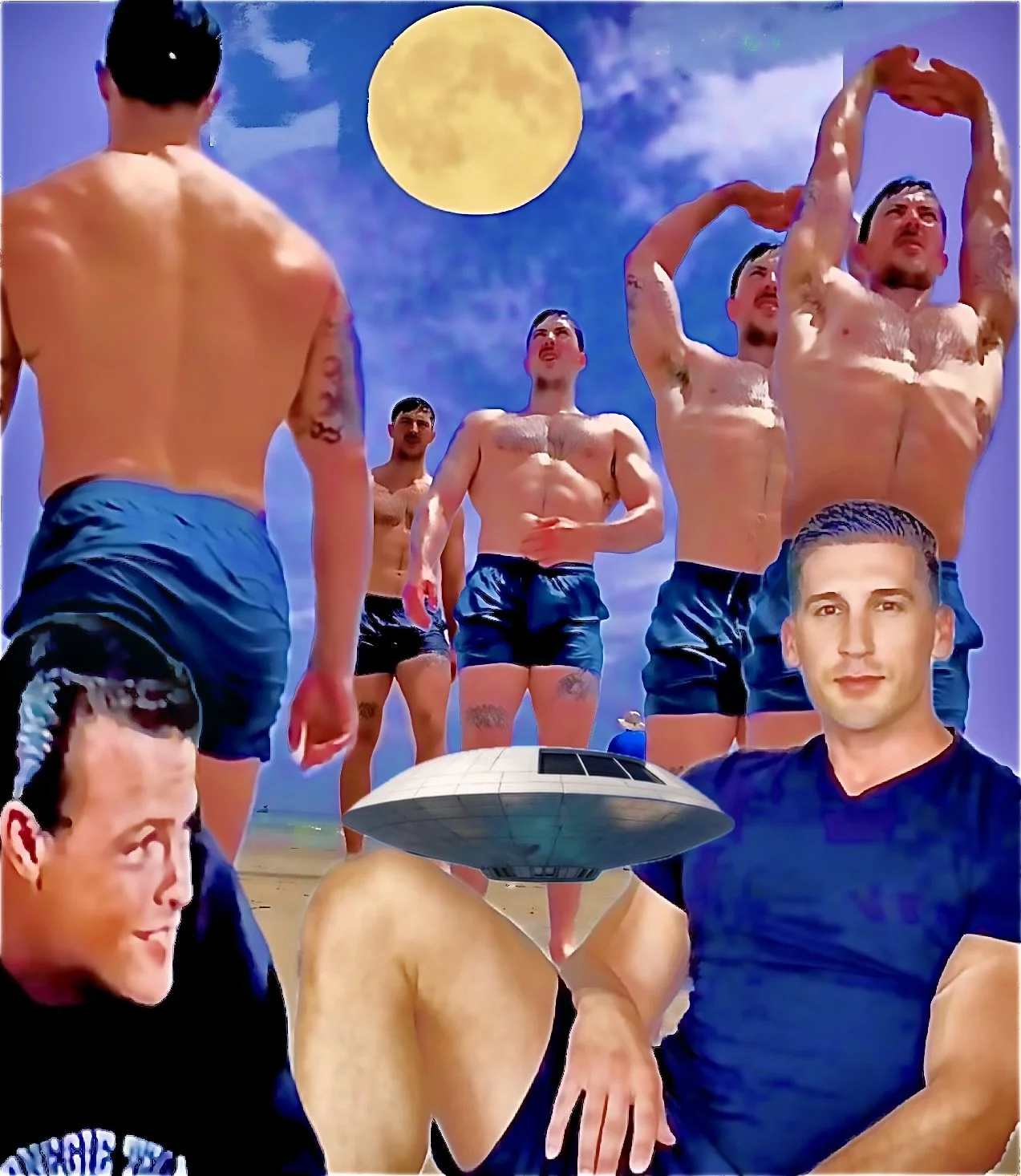
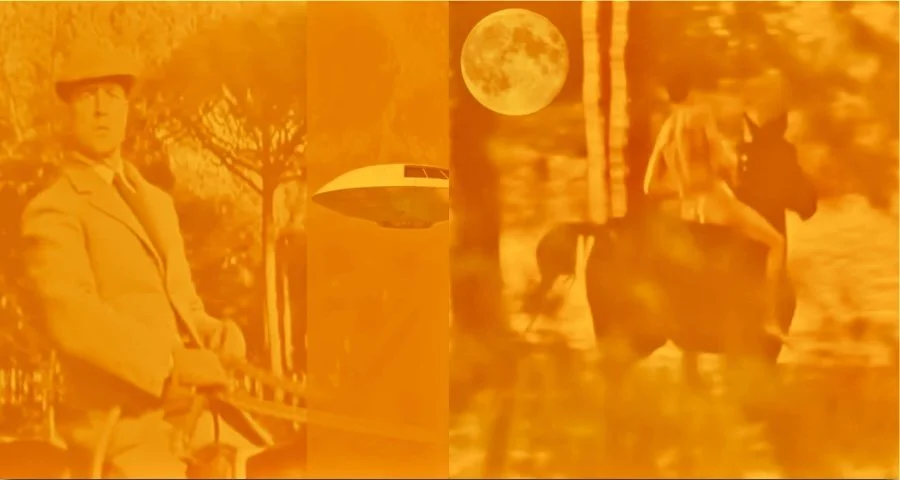
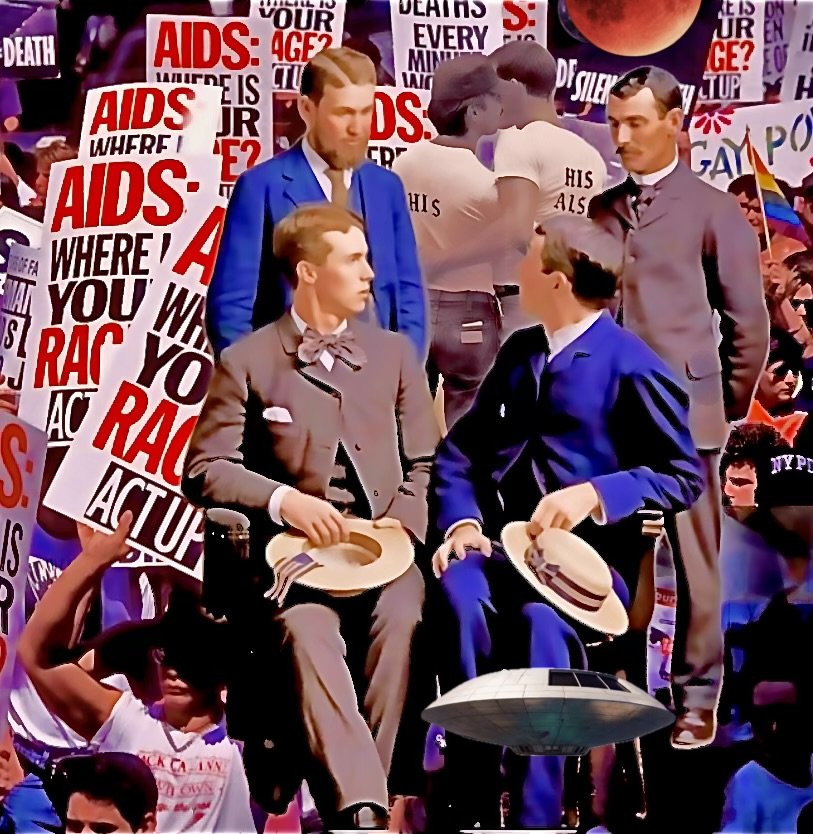
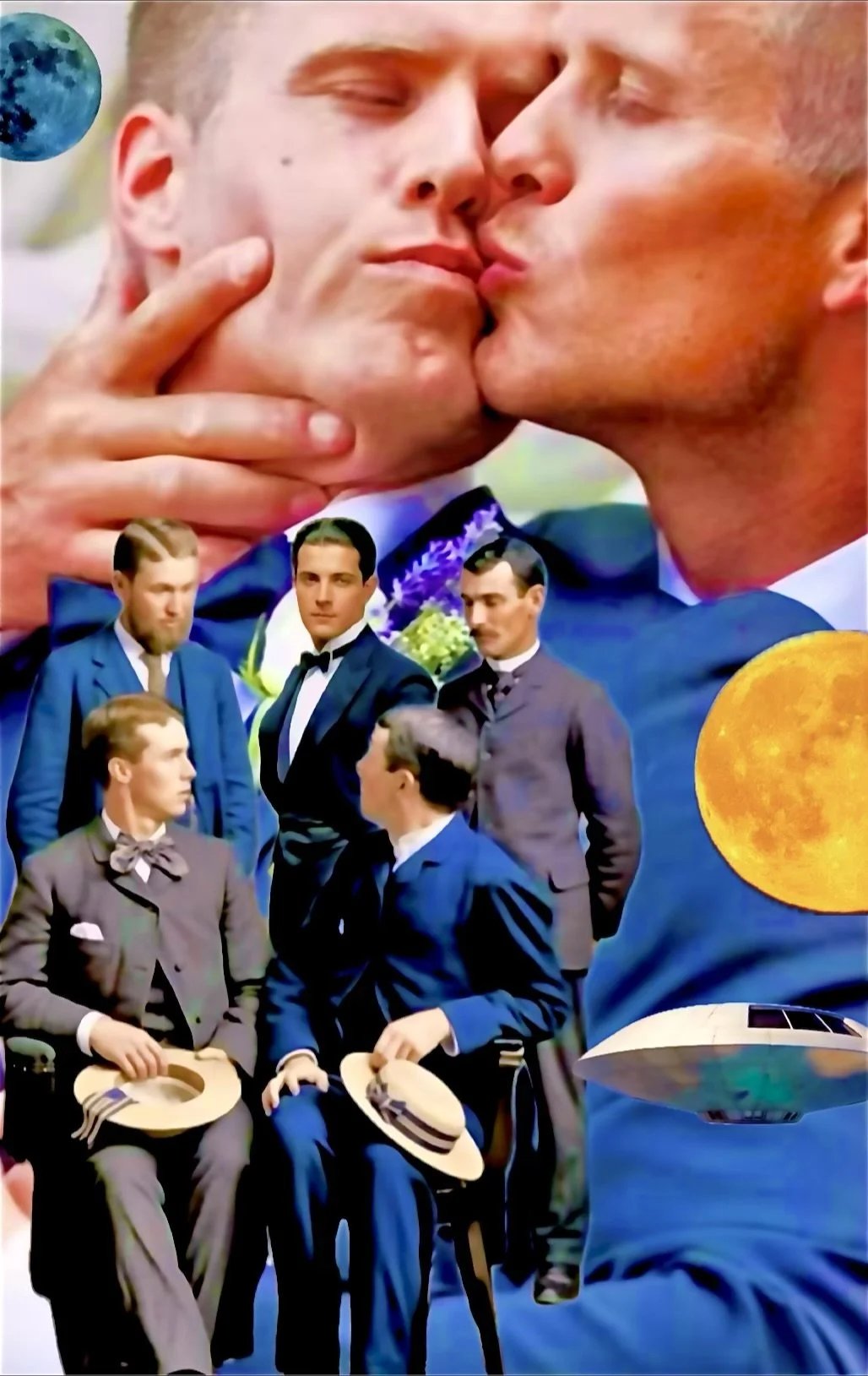
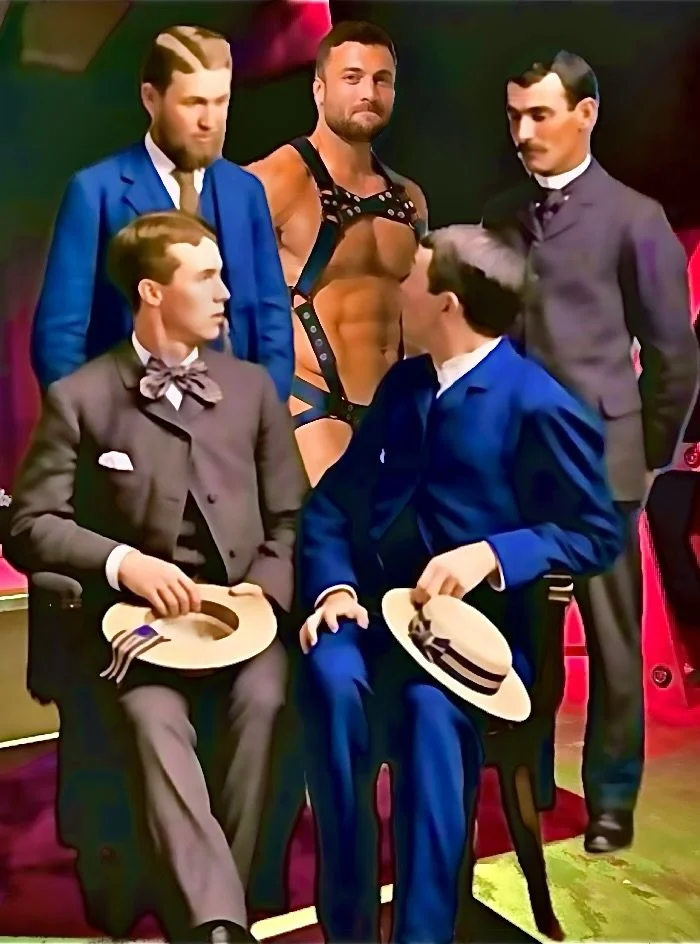
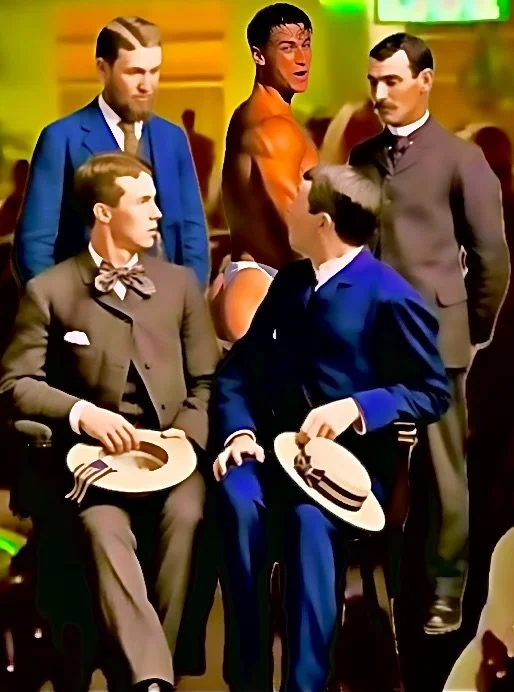
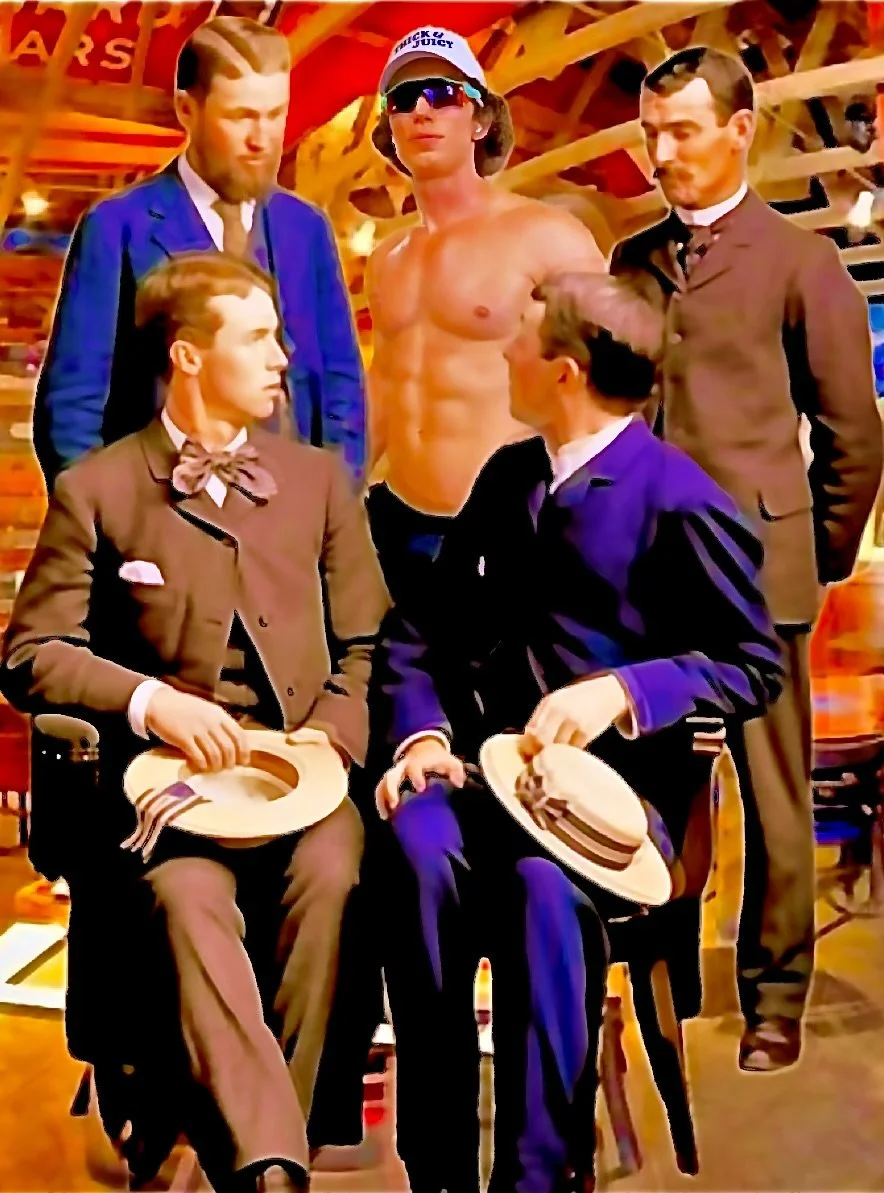
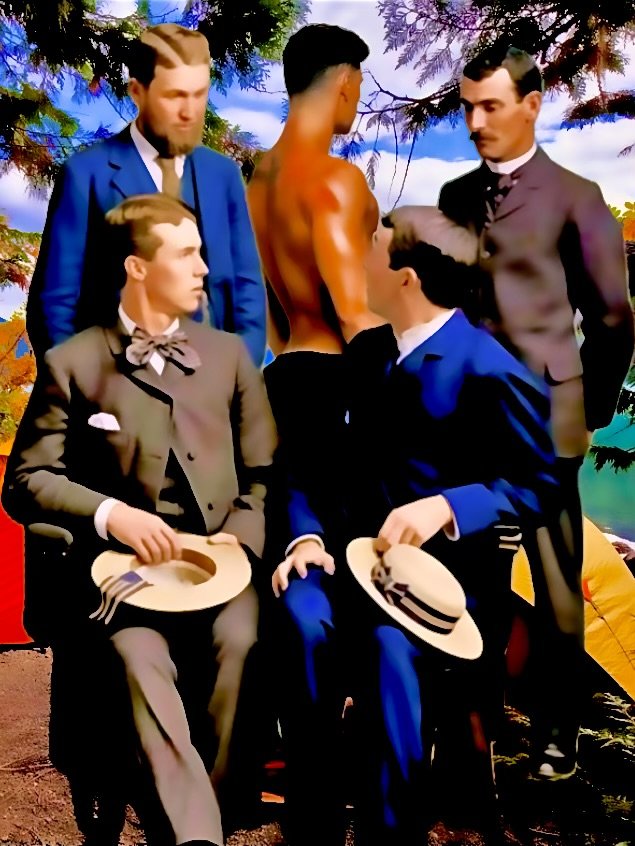
The two figures in boater hats in the collage are Gene and Fred Kelly — brothers, Pittsburgh-born dancers who had performed together since childhood. Their only on-screen appearance together came in Deep in My Heart (1954), an MGM musical biography of operetta composer Sigmund Romberg, built around lavish cameo performances by virtually every major talent on the lot. Gene and Fred appear in a specialty number called “I Love to Go Swimmin’ with Wimmen” — ebullient, physical, two brothers sharing a rare moment on film together. The number is all charm and energy and masculine ease. Nothing in it would raise a single flag. That was precisely how Hollywood worked.

The irony runs deeper than the frame. Sigmund Romberg spent his entire career writing operettas built around impossible, forbidden, and doomed love — The Student Prince, a prince who falls for a commoner he can never marry; The Desert Song, desire operating entirely under disguise and false identity; The New Moon, longing in exile. His life’s work is the emotional vocabulary of the closet: love that cannot speak its name, dressed in conventions that made it acceptable to a mainstream audience. Gay men were in those audiences for decades. They recognized something. The Kelly brothers are dancing inside a tribute to the composer who spent his career writing music for everything Hollywood would not allow anyone to say out loud.

Turner Classic Movies runs the films. It does not note what it is also running: the most comprehensive document of institutionalized violence against queer people in American cultural history. For those who know how to read it, every frame is evidence.

And Gene Kelly — athletic, masculine, three times married, politically courageous during the McCarthy era, the least likely candidate by every surface measure — was not immune. Because the closet doesn’t require guilt. It requires only suspicion. A rumor alone was enough to pull any man in Hollywood inside it, regardless of who he actually was or who he actually loved. Gay, straight, bisexual: the net caught everyone. That was the point. That was always the point.

The Emotional Loop: The Closet Made Visible

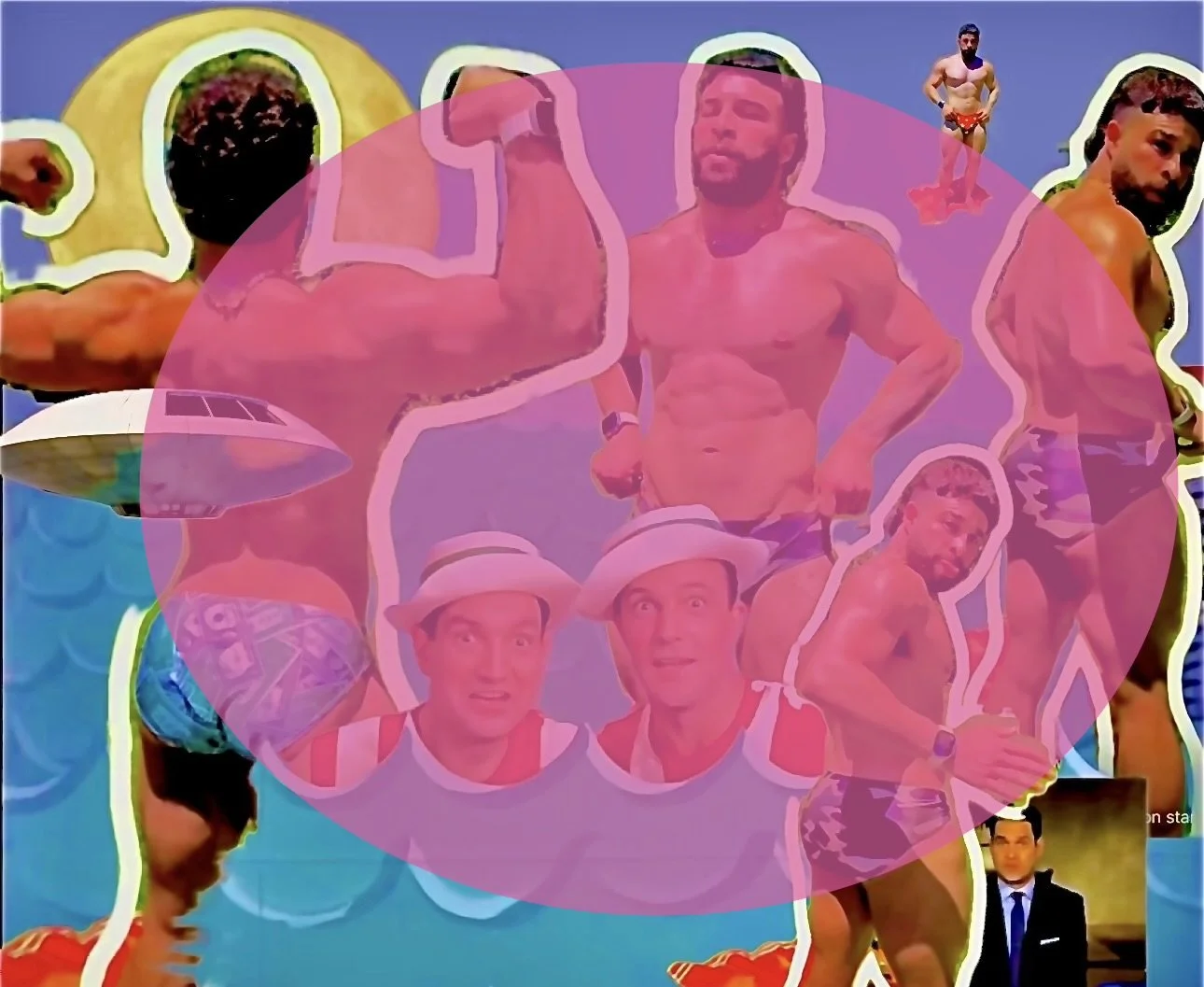
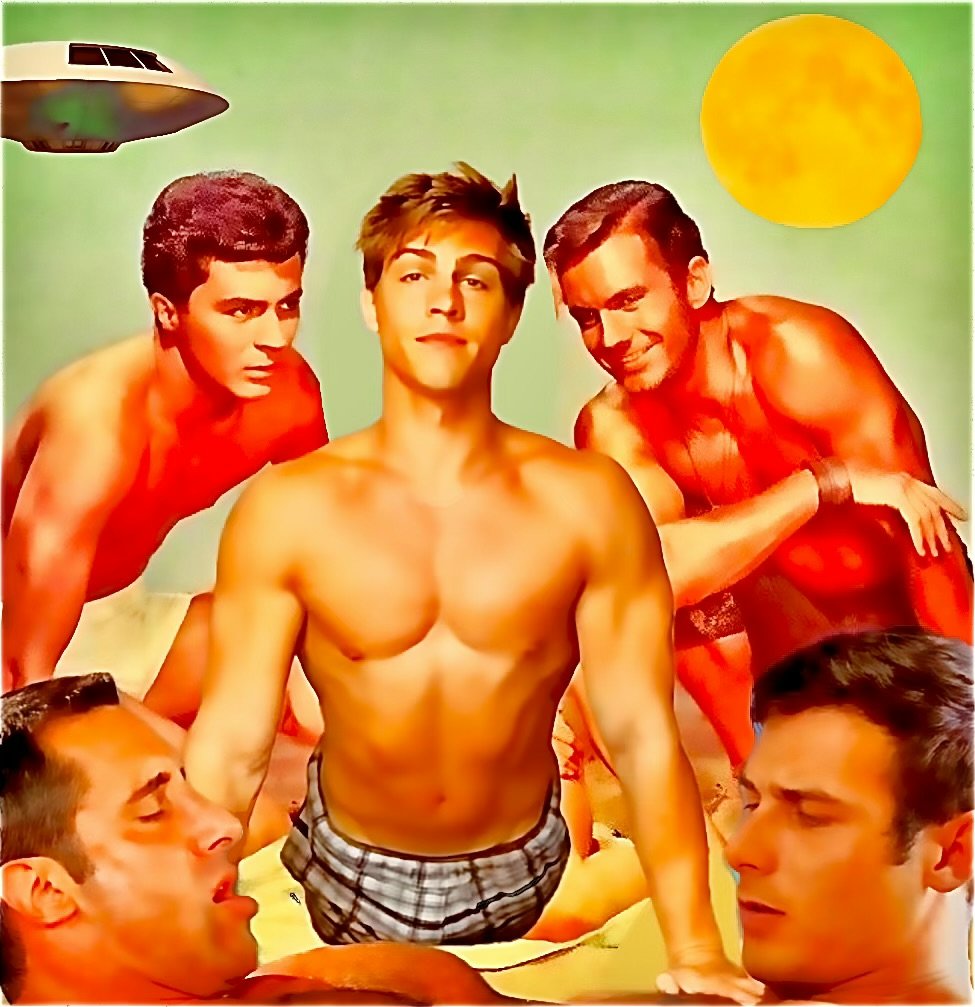
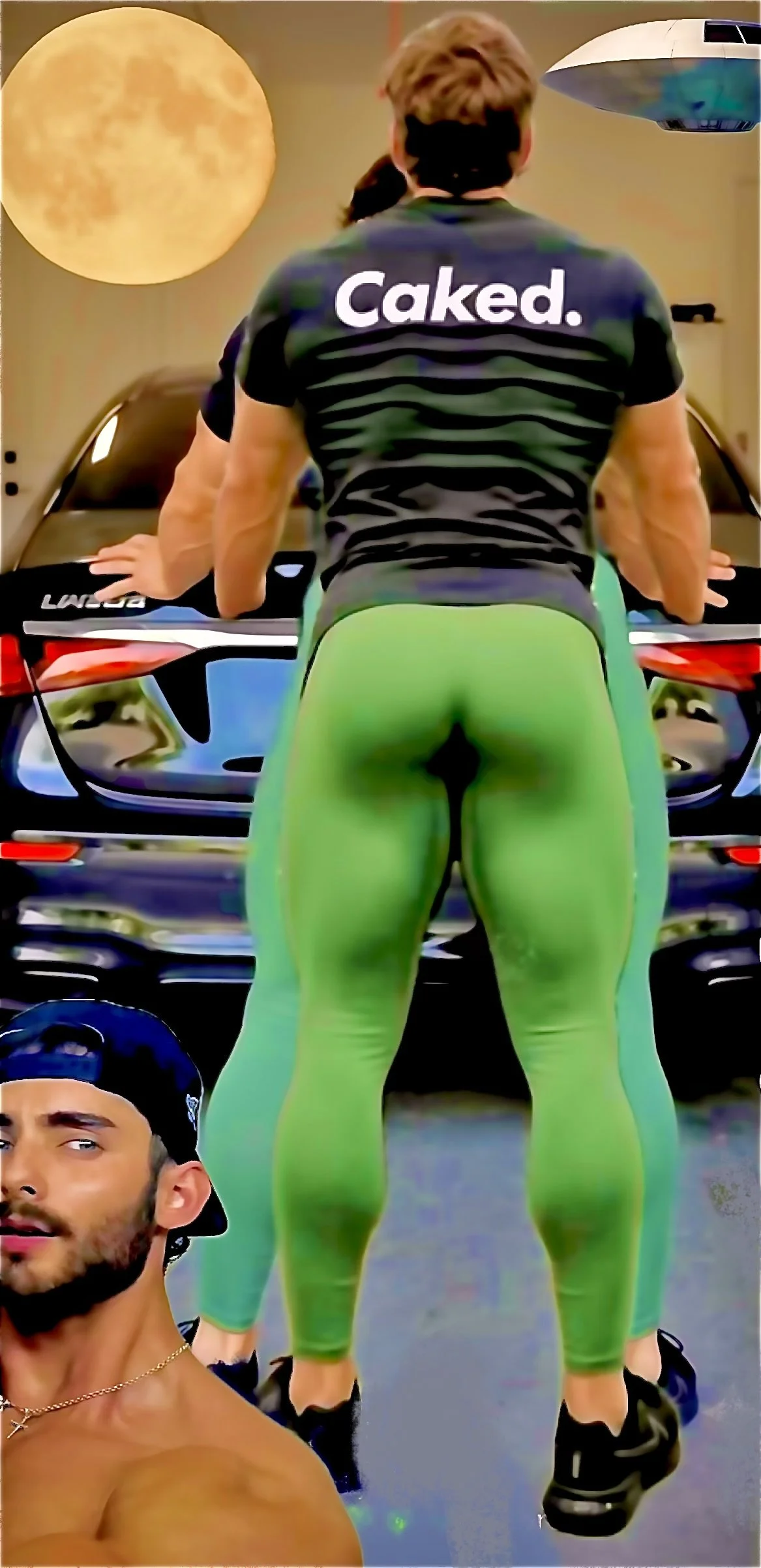
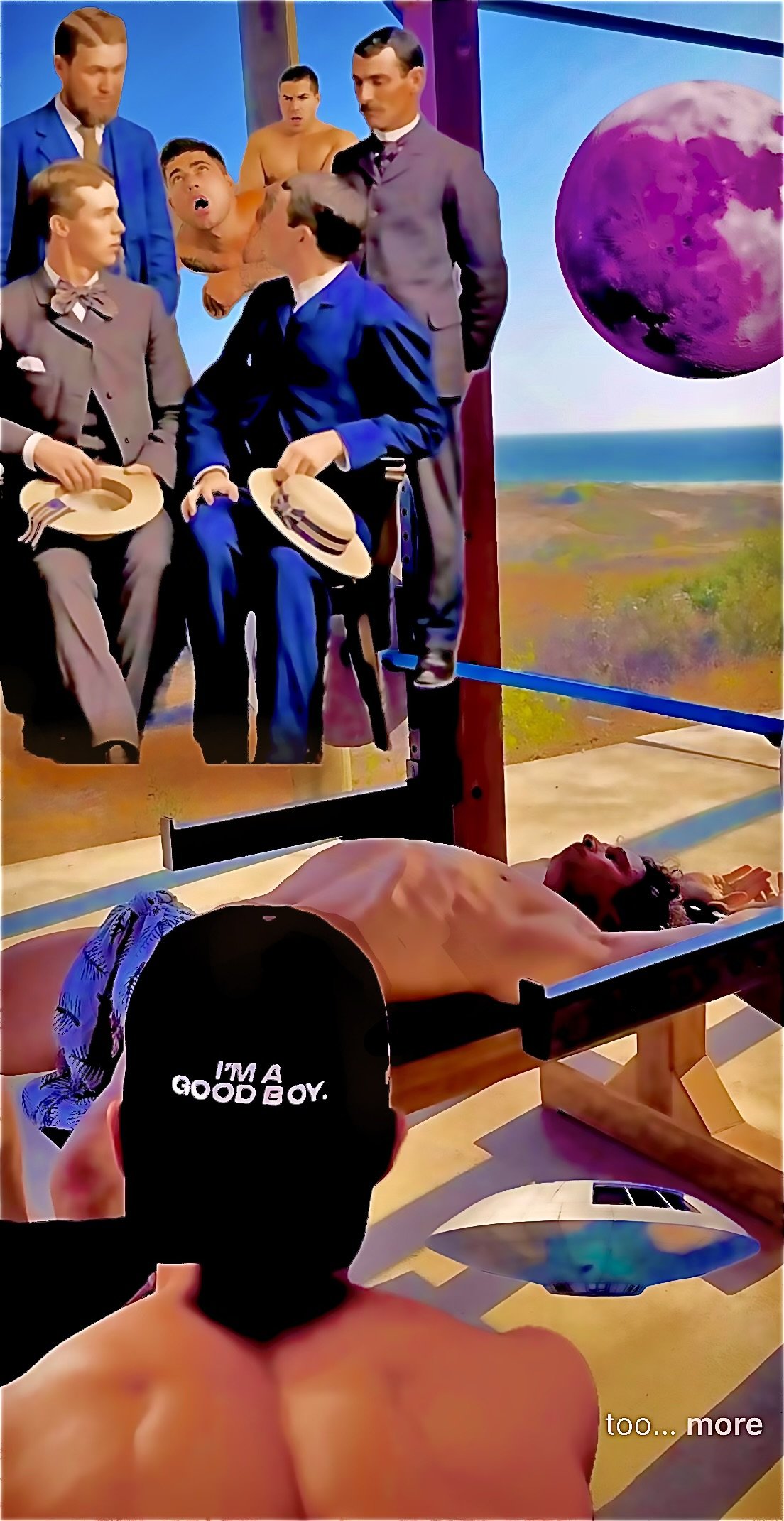
The collage contains a major compositional moment, both visual and emotional. A loop sweeps through the center of the image, and what it encloses is not accidental. The bodybuilding figures form the perimeter of that loop. They swirl around the Kelly brothers. They close in from every direction. They are the rumor. They are the net. They are the closet rendered as composition.

The loop doesn’t hold the eye. It holds the meaning. It says: this is what it felt like. To be Gene Kelly, or to be anyone near Gene Kelly, in a system that ran on suspicion and silence and the careful double-spacing of a smart woman’s memoir.

The Subdivision | Digital Photo Collage | Behan

Sources: The Motion Picture Production Code (1930, enforced 1934); Vito Russo, The Celluloid Closet (1981); Richard Dyer, The Matter of Images (1993); Betsy Blair, The Memory of All That (2003)

Under the Surf

Riding Under the Surf

On Gay Men, California Beach Culture, and the Heteronormative Script That Ran on Every Screen

The wave comes from Hawaii. Everything else was invented in Hollywood.

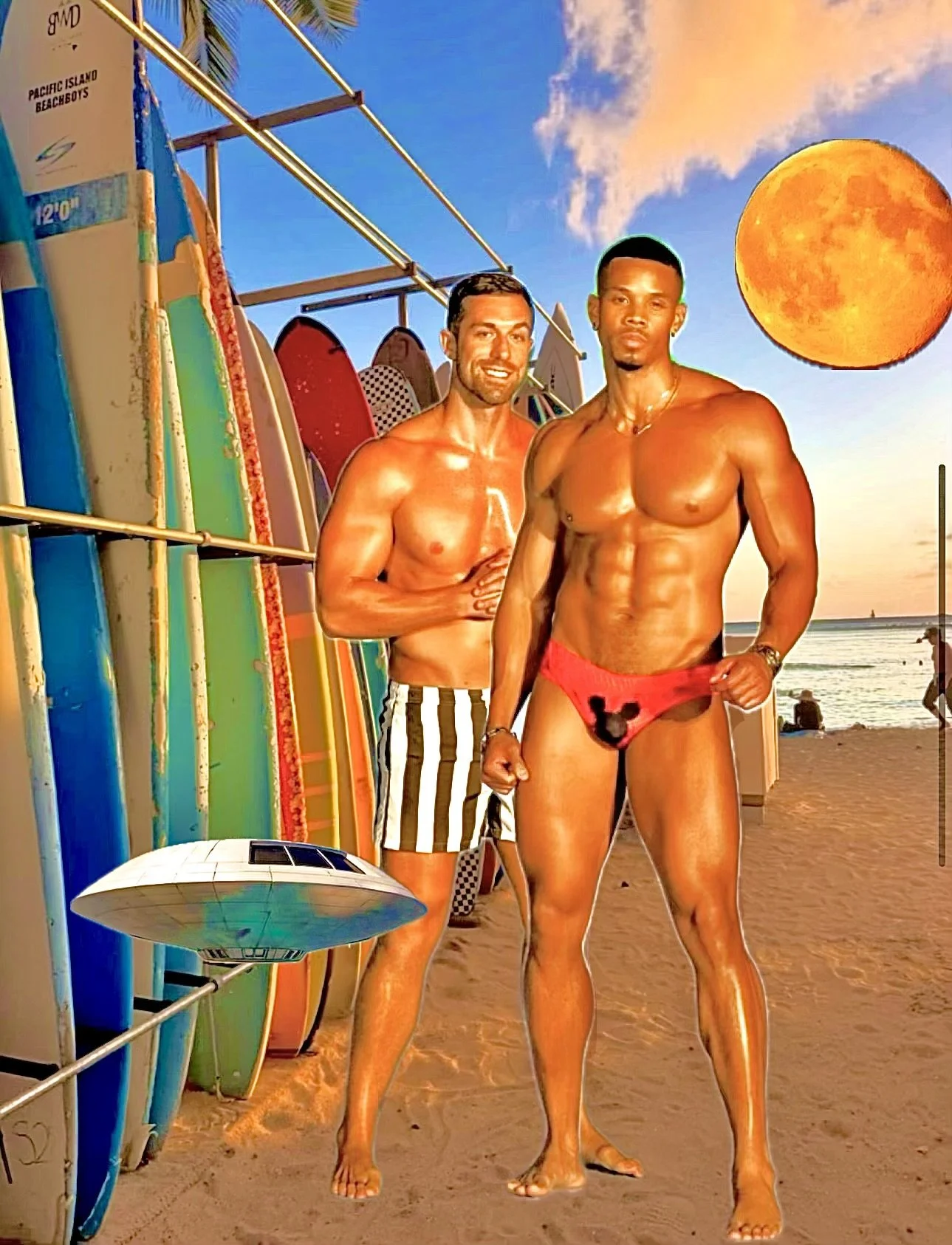
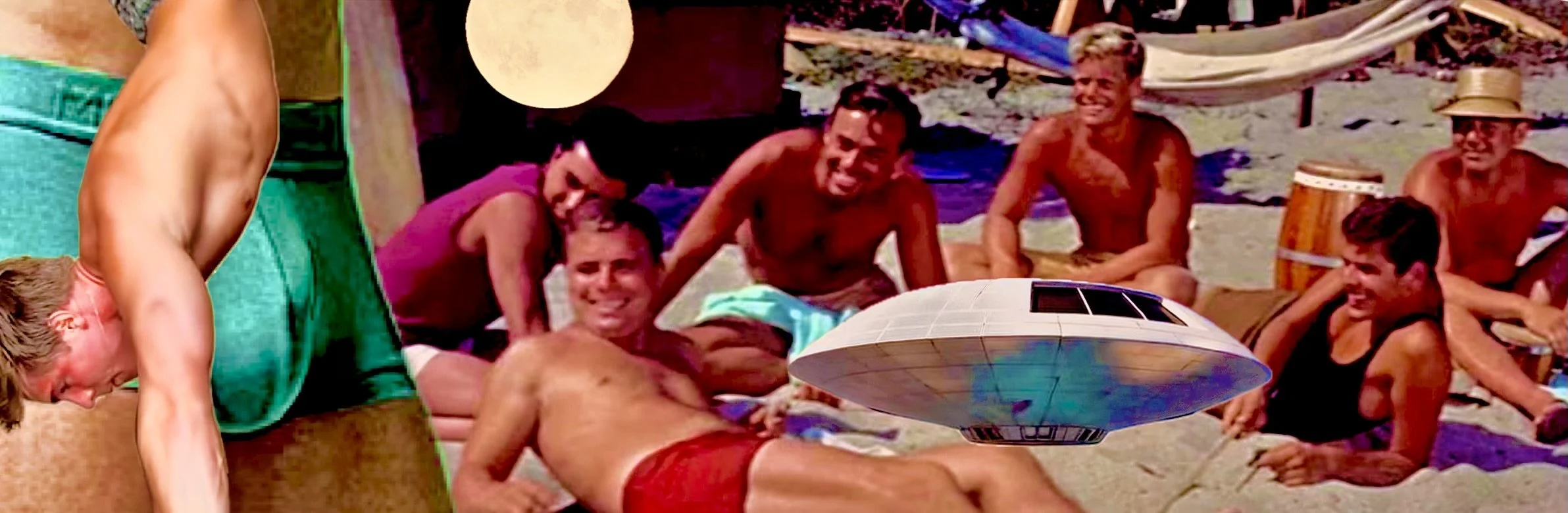
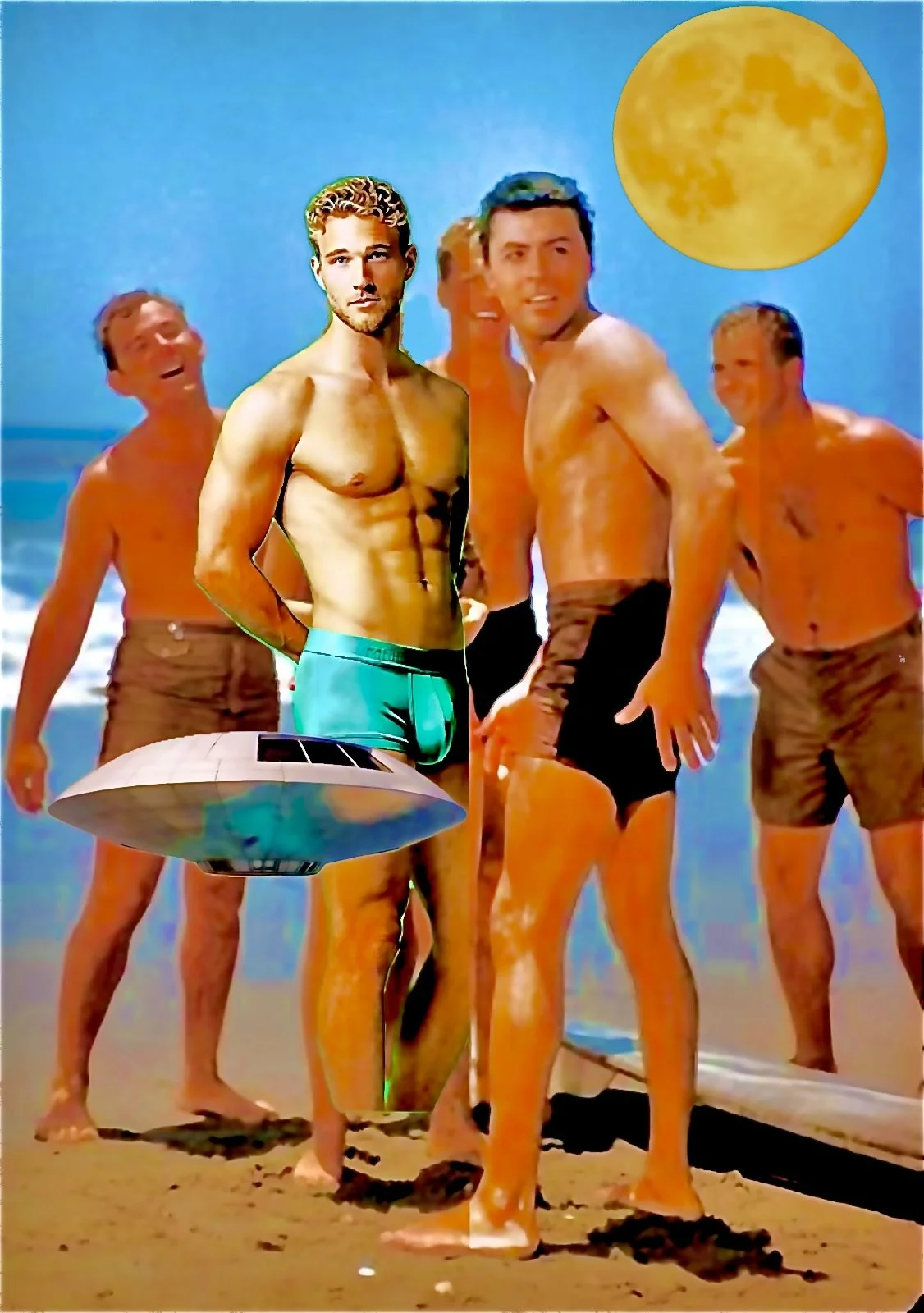
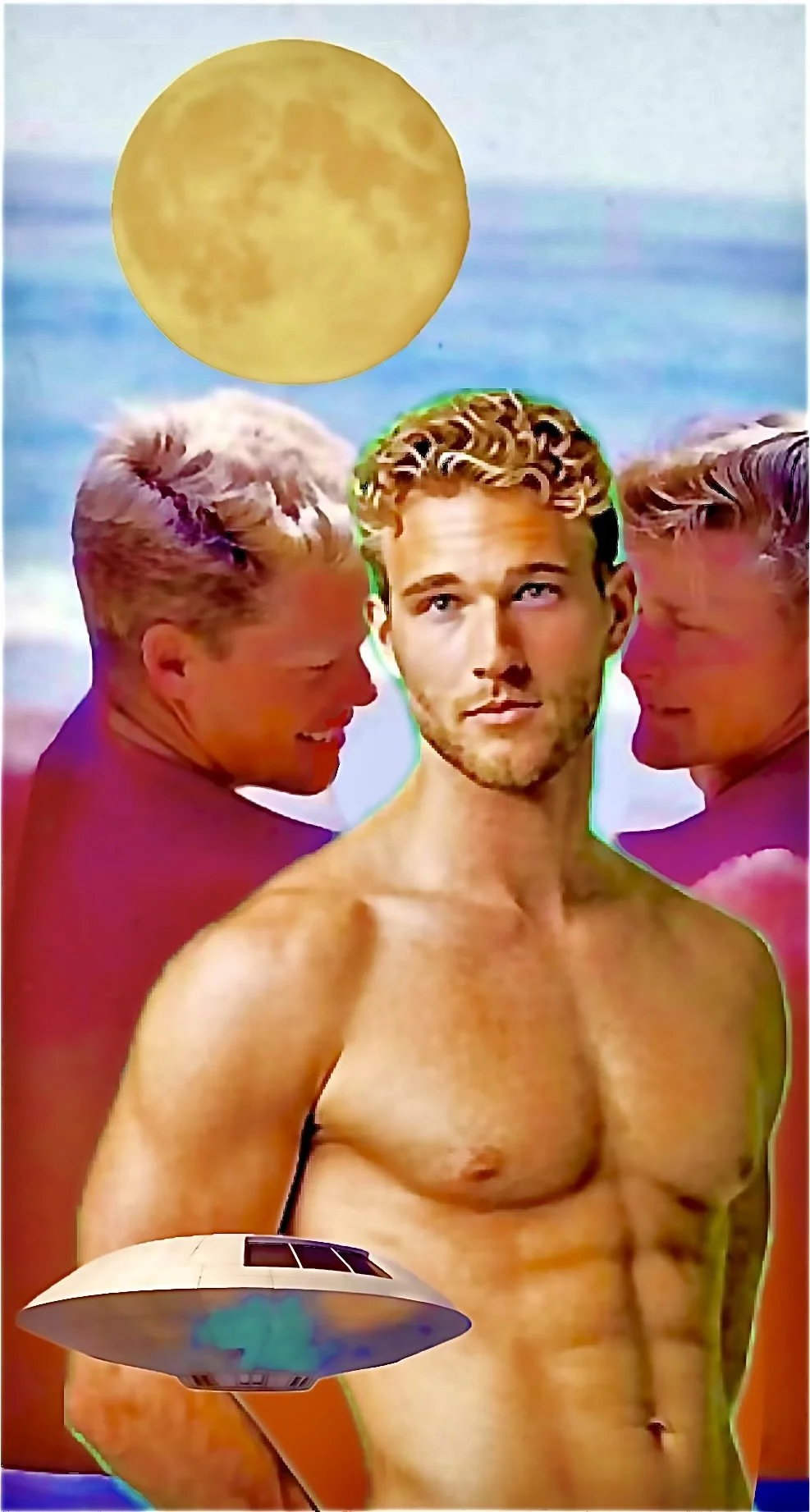
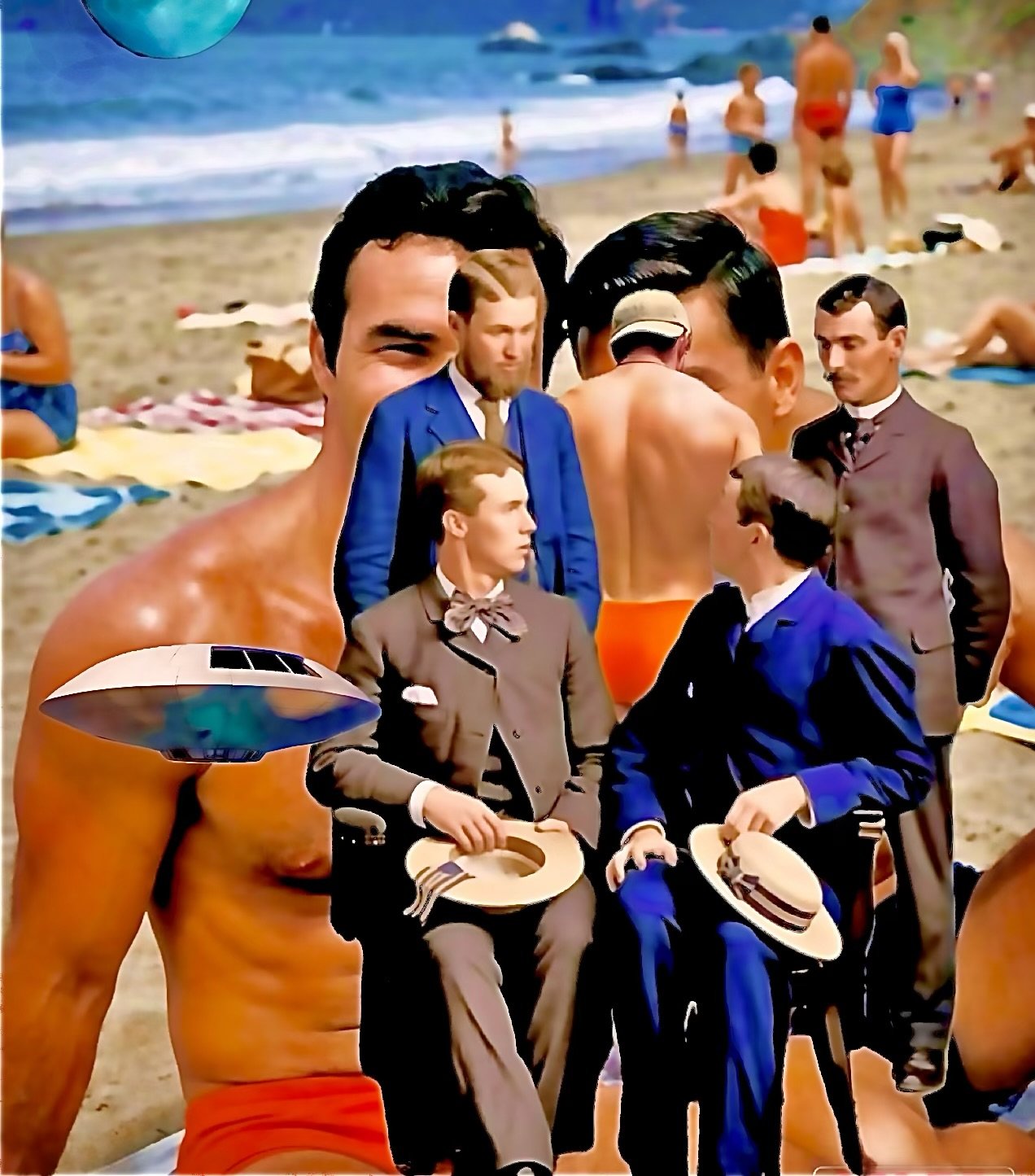
In 1907, an American industrialist hired George Freeth to demonstrate surfing at his Redondo Beach resort to promote a railway line. A Hawaiian man’s indigenous practice, commodified to sell real estate. Surfing’s popularity exploded in the 1960s as the baby boomers entered their teenage years, and Hollywood was ready for them. The AIP Beach Party films — Beach Party, Muscle Beach Party, Beach Blanket Bingo — were AIP’s sugarcoated vision of the coming generation, designed to assure mainstream society that young people were ultimately predictable and trustworthy and would fall in line. This surfing culture was predominantly male-oriented, with long-haired women in bikinis serving mostly as admirers on the periphery. Boys surfed. Girls watched. Gay men did not appear in any of these frames. They were not forgotten. They were edited out.

What Was Always in the Frame

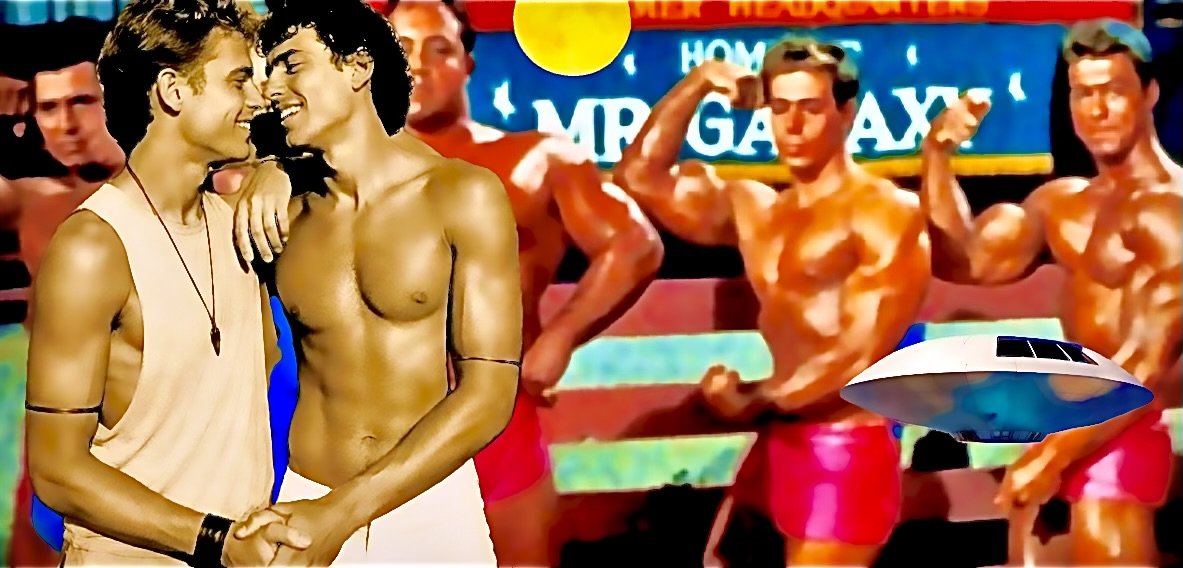
Film historian Tom Lisanti, writing for Cinema Retro and author of Hollywood Surf and Beach Movies: The First Wave, 1959–1969, documents what gay men already knew: the subtext was there from the beginning. The beach party films, Lisanti notes, functioned as titillation for homosexual men of the time — good-looking shirtless hunks frolicking bare-chested on sand and slopes, while gay actors Tab Hunter, Tommy Kirk, and Paul Lynde moved through the same frames in plain sight. Directors and screenwriters, he argues, slipped winks to the gay community in ways that sailed past oblivious producers and censors. Muscle Beach Party (1964) made the coding structural: its villain class was a cult of bodybuilders whose readers, in the physique magazines of the era, were understood to be predominantly gay men. Film historian Joan Ormond observed that homosexuality in this era was regarded as potentially more damaging to society than the wild antics of surfers — which is precisely why the bodybuilders, not the surfers, were cast as the corrupting threat. The gay gaze was not reading into these films. It was reading them correctly.

Under the Surf

And yet they were there. They had always been there.

As early as the 1940s, the stretch of Will Rogers State Beach in Santa Monica — soon nicknamed “Ginger Rogers Beach” by the gay community, in honor of the screen legend whose campy performances drag queens had been emulating since the 1930s — was a popular destination for gay men. In Gay L.A., Lillian Faderman and Stuart Timmons write that “for symbolic and functional reasons, the beach was especially attractive to gay people. It represented the very edge of the continent, far away from ‘back home’… During and after the war, veritable oases of gay life could be found in the open at many Los Angeles beaches, where the atmosphere was celebratory, carnival-like, even lawless.”

This is the counter-history running beneath the surf films. While Frankie Avalon was reassuring America that its sons would fall in line, at the start of the 1960s Los Angeles was home to nearly 150,000 gays and lesbians, many of them drawn to the same beaches, under the same California sun, with no representation in any film, any song, any television series produced within miles of where they stood.

Vice patrol began cracking down on queer beachgoers at Will Rogers State Beach as early as the 1950s, under the leadership of Chief of Police William Parker — called “Wild Bill Parker” by the gay community — whose LAPD doubled down on homosexual behavior and cross-dressing in public spaces throughout the decade. Gay men were not absent from California beach culture. They were present and being policed. The culture industry simply declined to film them.

In the 1960s, Main Beach in Laguna Beach was the epicenter of the city’s gay culture, home to two beachfront gay bars, Dante’s and Barefoot — situated in the very heart of Southern California’s surf country, surrounded by the landscape the AIP films were simultaneously mythologizing. Writer Christopher Isherwood and painter Don Bachardy had met on the beach in 1952, launching a lifelong partnership. Isherwood’s 1964 novel A Single Man memorialized the beach and Santa Monica Canyon’s gay culture in modern literature, describing gay beachgoers in 1946 as “dancing to the radio, coupling without shame on the sand.” The gay beach was not underground. It was not secret. It simply did not exist, as far as cinema was concerned.

Big Wednesday: The Script, Fifteen Years Later

In 1978 — fifteen years after Beach Party, three years after Stonewall had already changed the legal and cultural landscape of gay American life — John Milius released Big Wednesday. The film follows three California surfers facing life and the Vietnam War against the backdrop of their love of surfing, loosely based on Milius’s own experiences at Malibu. The setting moves from 1962 to 1974. The war comes and goes. Men age, drift apart, return. The film deals mostly with the theme of male friendship and all the things that come along in life that challenge it. The emotional register is genuine. The tenderness is real.

And every woman in the film exists as attachment or loss for one of these three men. The script has not moved. The ocean still belongs to men. The shore still organizes itself around their drama. Gay men remain nowhere in the frame — even as, by 1978, the Castro was in full flower forty miles up the coast, even as gay Californians had been visible on those same beaches for four decades.

The Record

In the long, decorated history of professional surfing, by 2010 only two professional surfers had ever openly shared the fact that they were gay: Matt Branson and Robbins Thompson. Two names. The entire count, across decades of tours, competitions, sponsorships, magazine covers, and surf films.

Thompson’s story tells you why the number stayed at two. Rated in the top five on the American professional circuit for four years and on track for major titles, Thompson was driven out of the sport in the 1990s after his sexual orientation became known on tour. Homophobic slurs were spray-painted on his car. Taunts followed him into the water. “Sometimes it was difficult trying to keep my concentration, wondering what everybody was thinking about me,” he said. “If I spent too much time with fellow surfers, accusations would start to fly. There were a couple of times when possible relationships with other gay surfers ended too quickly because of fear of getting caught.” In 2014, Thompson told his story in the documentary Out in the Line-Up, credited with initiating the first serious public conversation about homophobia in professional surfing.

Women have been more visible, if not more welcomed. Cori Schumacher, Keala Kennelly, Tyler Wright — the history of LGBTQ surfing runs deeper than most surfers realize, but it runs almost entirely through women. On the men’s side, the closet held. It held through the 1960s, through Stonewall, through the Castro, through AIDS, through the legal reforms of the 1990s and 2000s. The wave broke. The lineup did not change.

San Diego-based artist Stephen Milner eventually made the hidden architecture visible. His book A Spiritual Good Time appropriates old images from surf magazines and places them in an entirely new context — one that creates a vision of a far more queer-friendly surf culture. By combining materials from vintage surf and gay publications, cutting, cropping, and re-printing, Milner placed them into an entirely new context: that of queer reality. “When it comes down to it,” Milner says, “masculinity in surfing is extremely fragile — once you start poking at it, it just comes apart.”

Milner describes the process: “Instead of concentrating on the hero surfer getting barrelled on the perfect wave, I cut out the male camaraderie in the bottom left corner of the image and enlarged it.” The gay gaze had always been there, in the bottom left corner of every surf photograph ever printed. It simply required an artist willing to make the crop.

The Shore That Was Always Shared

The gay men on Ginger Rogers Beach in 1963 were breathing the same salt air as the boys in the AIP films. They were watching the same waves break from the same sand. A 1953 article in ONE magazine described the gay beach as a place where “hundreds of our people, peacefully enjoying themselves in public — no closed doors, no dim lights, no pretense… I think beaches like this are part of our liberation.”

Liberation was already happening on the beach. Hollywood was filming something else.

The Subdivision documents what was there. Jupiter 3 is always in the frame.

— Behan

Sources: ONE Institute, “Ginger Rogers Beach” (oneinstitute.org). Faderman, Lillian and Stuart Timmons, Gay L.A. (2006). Isherwood, Christopher, A Single Man (1964). Britannica, “Surfing.” Jacobin, “A People’s History of Surfing” (2022). PBS SoCal, “Riding Waves, Forging Communities.” Bright Lights Film Journal, “Surf’s Up! Beyond the Beach: AIP’s Beach Party Movies.” Visit Laguna Beach, LGBTQ History. SURFER Magazine, “The History of LGBTQ Surfing” (2020). Wikipedia, “Big Wednesday.” Lisanti, Tom, “Real or Imagined: Homoeroticism in 60s Beach Movies,” Cinema Retro. Lisanti, Tom, Hollywood Surf and Beach Movies: The First Wave, 1959–1969. The Guardian, “Out in the Line-Up” (2014). GaySurfers.net, Thomas Castets interview (2010).

Fidget

If Gidget Were a Guy, He’d Be Gay

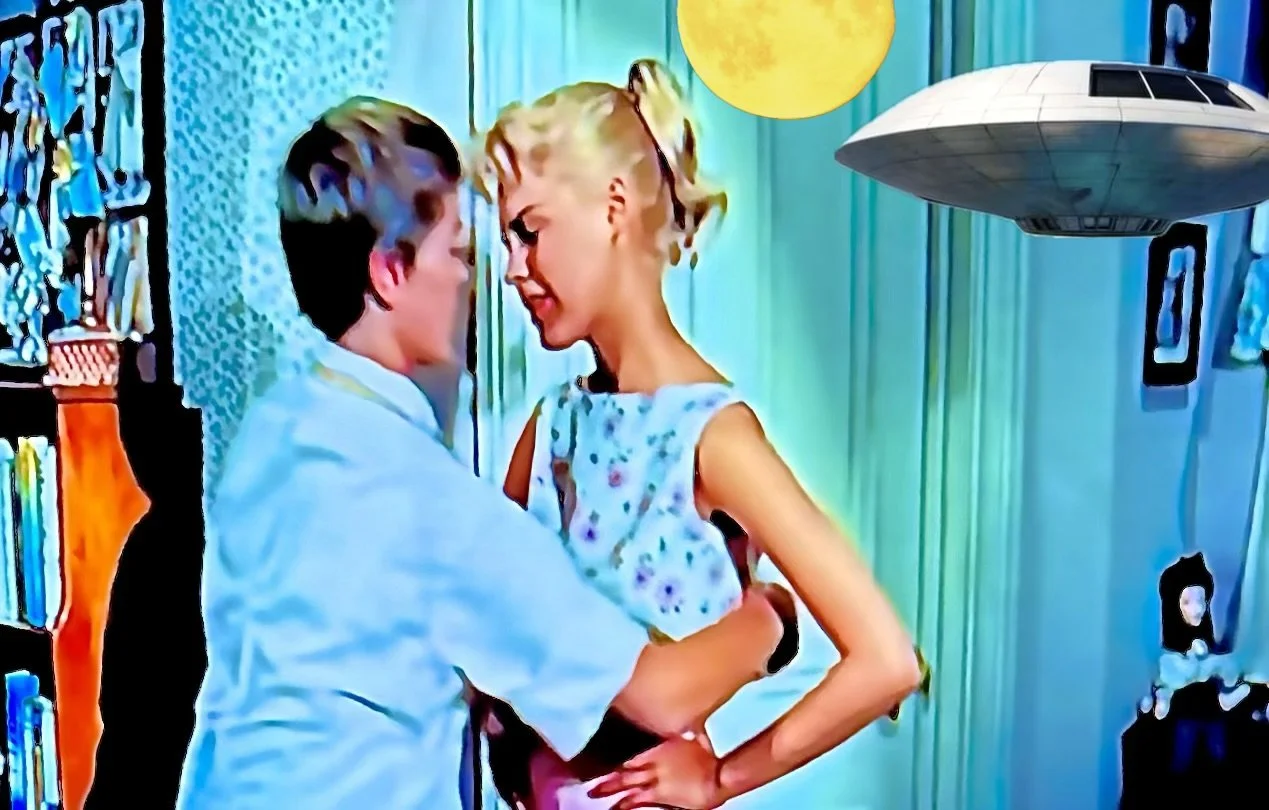
The gender logic of the beach film becomes clearest when you ask the question nobody asked: what would Gidget look like if the protagonist were male?

Contemporary analysts have considered this hypothetical and concluded that a male Gidget would have needed to prove his toughness to earn acceptance into the surf clique, that the Big Kahuna’s mentorship would shift from protective to combative, that the romance plot would simply invert — boy chases girl instead of girl chasing boy. Same story, different pronoun.

They are still assuming he’s straight.

A young man on the beach, slight and eager, drawn irresistibly into the orbit of the older, golden, powerful Big Kahuna — a name that, in the vernacular of the era, carried unmistakable anatomical weight — and pining helplessly for the unattainable Moondoggy, whose very nickname was a winking reference to the oldest visual euphemism in the book. If Gidget were a guy, he would not be chasing the girls on the beach. He would be doing exactly what Gidget did: watching the boys in the water, wanting to be near them, inventing reasons to stay.

He’d be gay. He’d be gay and the whole film would finally make sense.

The Subdivision documents what was always in the frame. Jupiter 3 is always in the frame.

On Sourcing

The source material for The Subdivision is drawn from the visual archive of twentieth and twenty-first century American domestic and popular culture — advertising, portraiture, vernacular photography, Hollywood imagery, the graphic language of mid-century print, and the digital media of the present: dating sites, social media, and platforms of gay self-representation such as OnlyFans.

The appropriated images are a meditation on the cost of the closet: what was performed, what was concealed, and what was present all along at the edge of the frame. It is a reckoning with fear and desire within a culture that organized itself around the heteronormative ideal while depending, quietly and completely, on gay presence to sustain it.

Through digital photocollage — layering, cropping, and recontextualizing the visual tropes of the American century — the images are reconstructed into a new narrative of the contradictory forces at play: the domestic and the transgressive, the sacred and the surveilled, the visible and the erased. Jupiter 3 marks what was always there.

— Behan

On Process

On Process | Collossus | Digital Photography | 2026

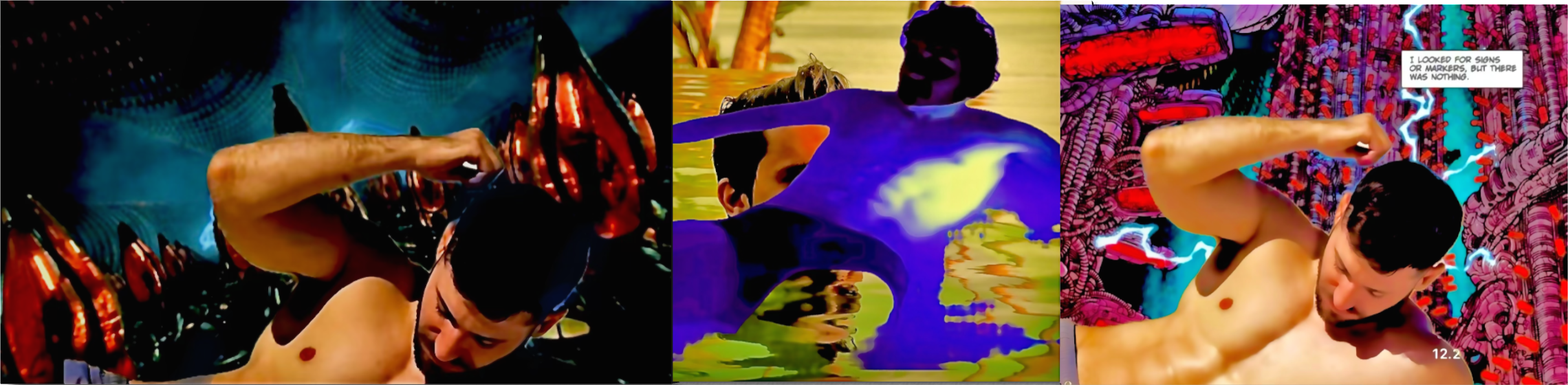
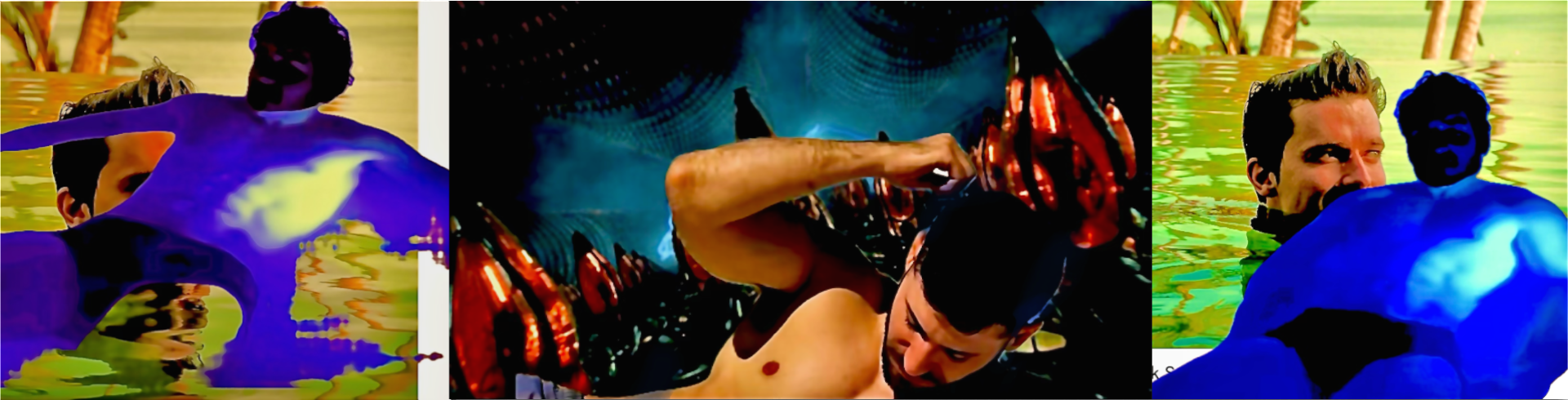
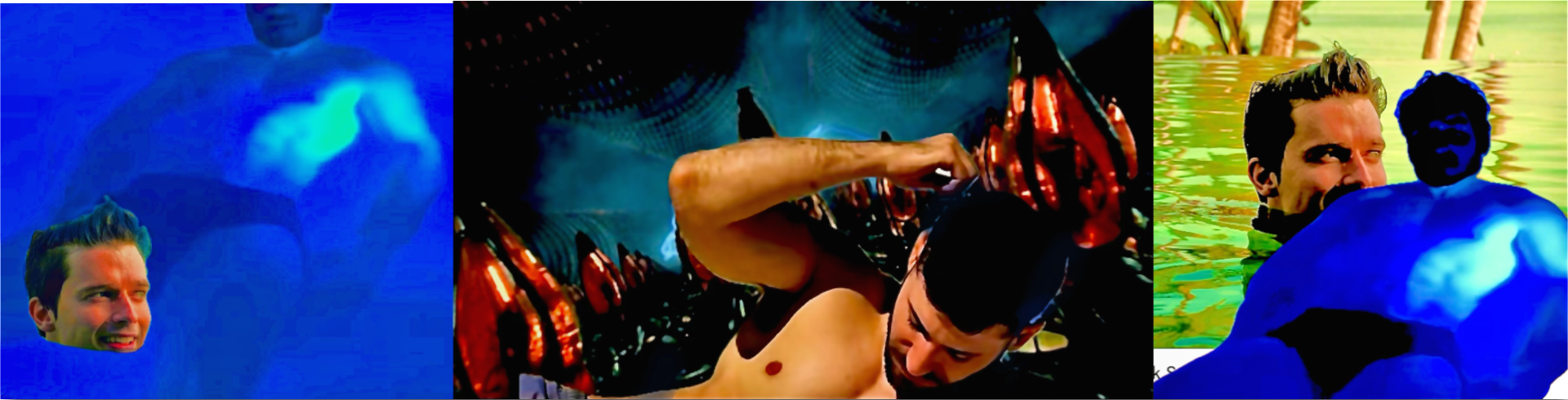
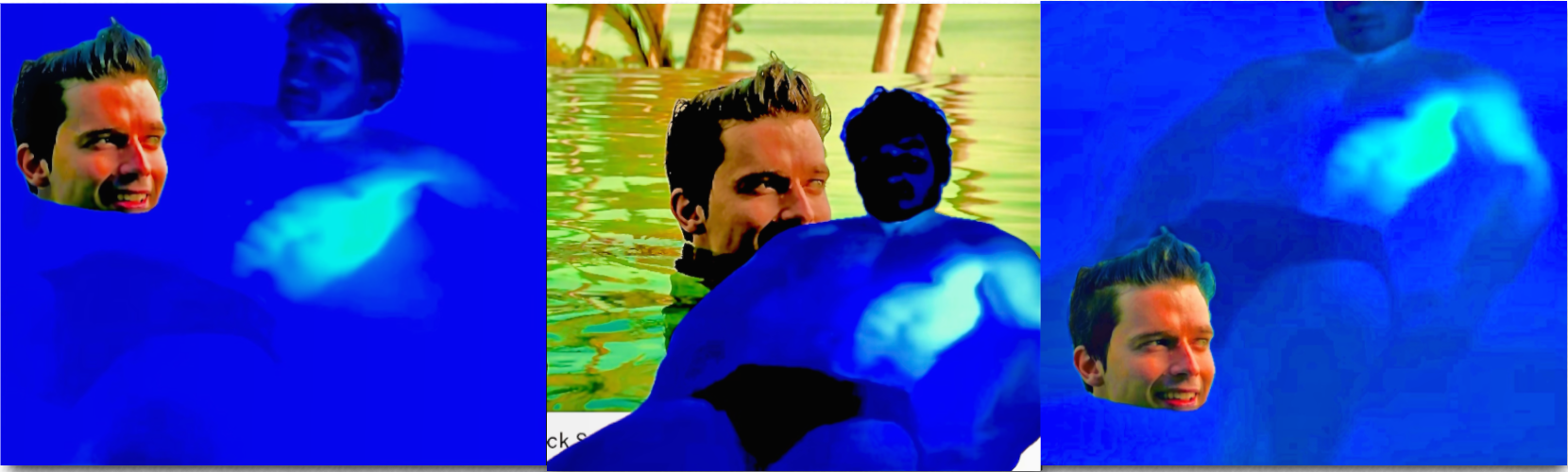
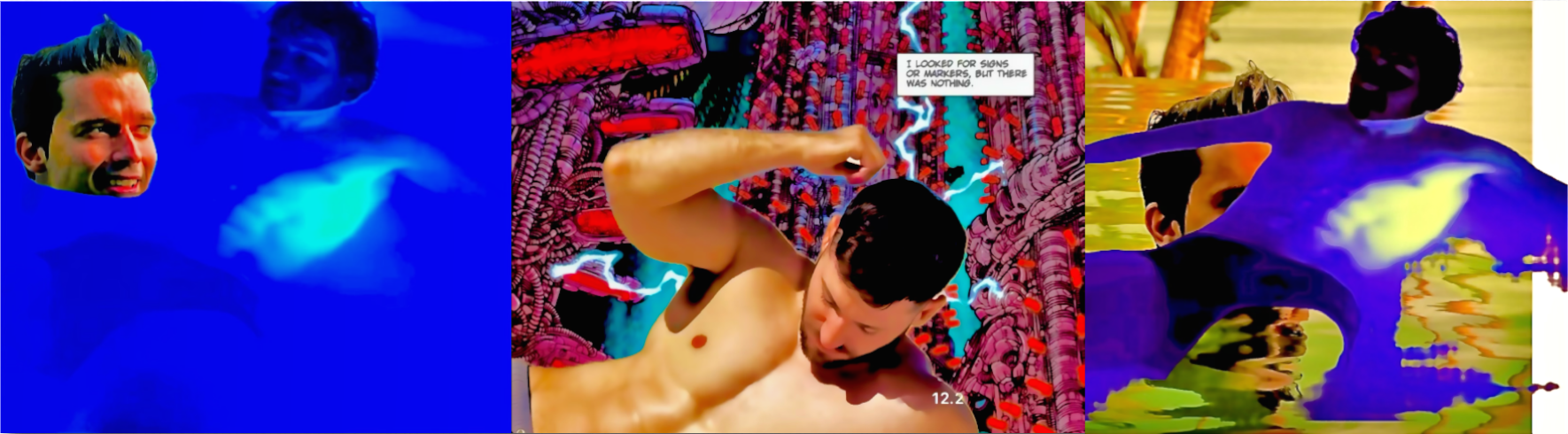
Six individual collages comprise Collossus. Seen here are variations on the triptych format pulled from those six works, recombined, reordered, and reconsidered.

Each arrangement produces a different reading of the same interior experience. Every combination is a different thought built from the same vocabulary.

The work is available as a single image, a diptych, a triptych, or a multi-panel configuration — in digital or canvas form, framed or unframed. But here is what matters most: the collector chooses the arrangement. That choice is not incidental. It is the final act of the work’s creation. The collector is an active participant in the final resolution of the work they collect.

The Subdivision has always believed that the people who live with the work should have a hand in how it speaks.

Colossus

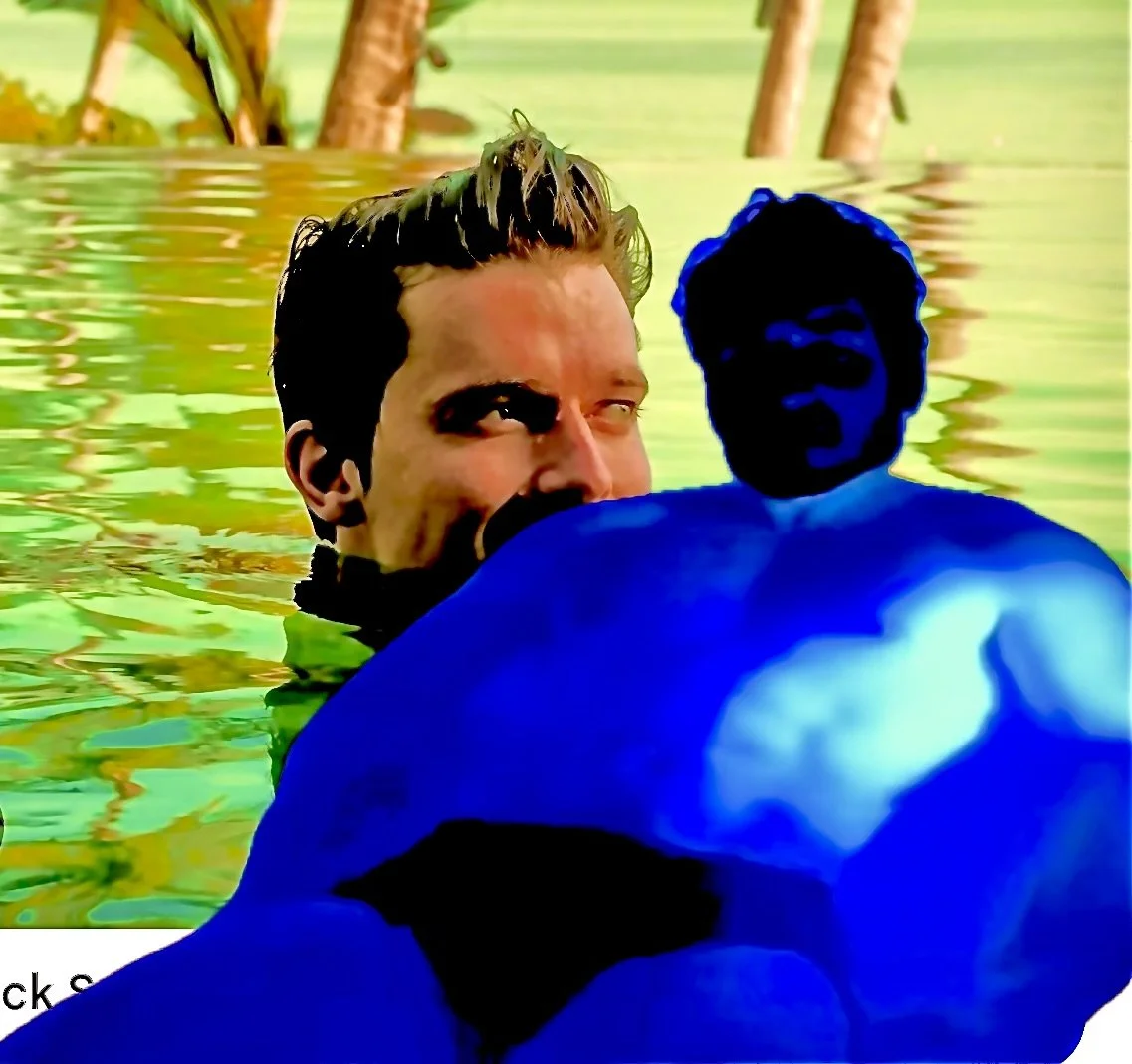
Colossus | Inside the Closet | 6 Pack | The Closet Series | The Subdivision | 2026 | Digital Photo Collage

The matrix has no name. That’s how it functions. A heteronormative culture has long known how to extract what it needs from gay people — the labor, the beauty, the taste, the wit, the genius — while maintaining the social fiction that those people don’t quite exist. The closet is not incidental to this arrangement. It is the arrangement. It is the mechanism by which a culture consumes a person while erasing them.

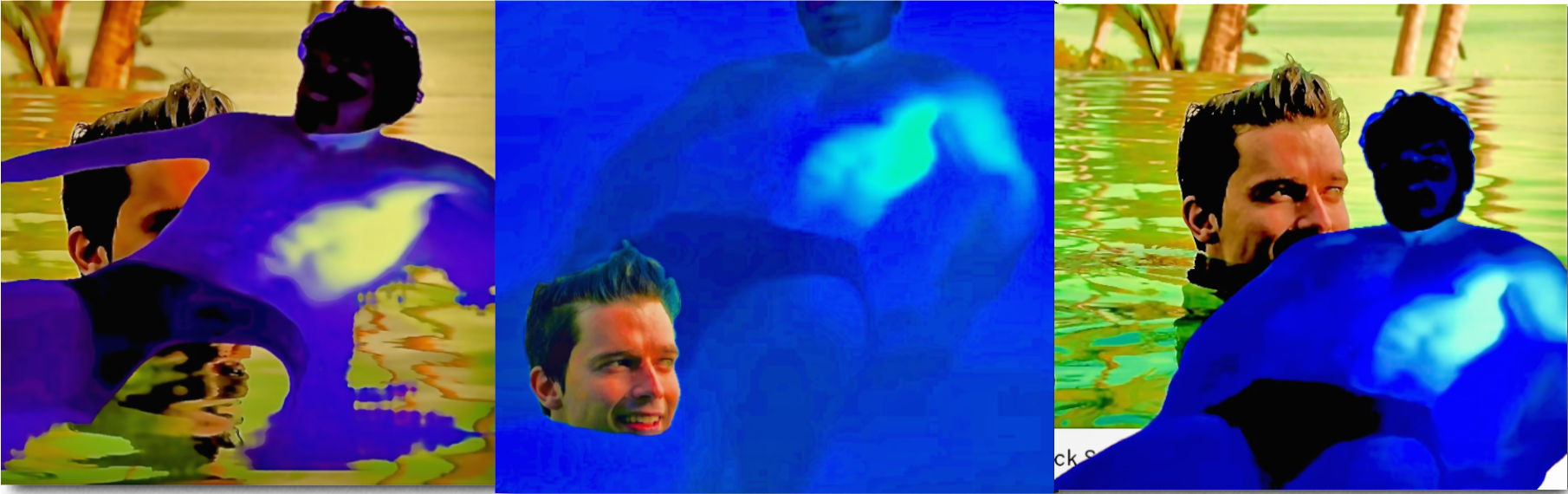
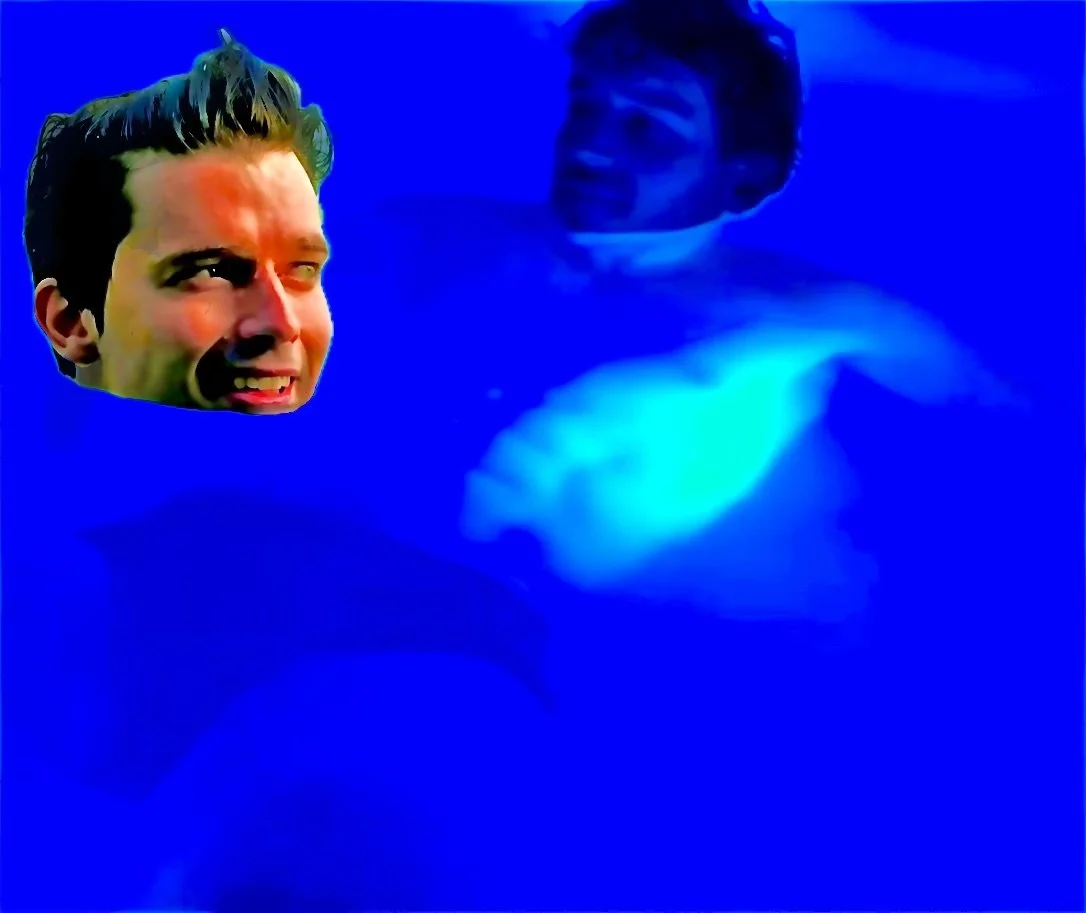
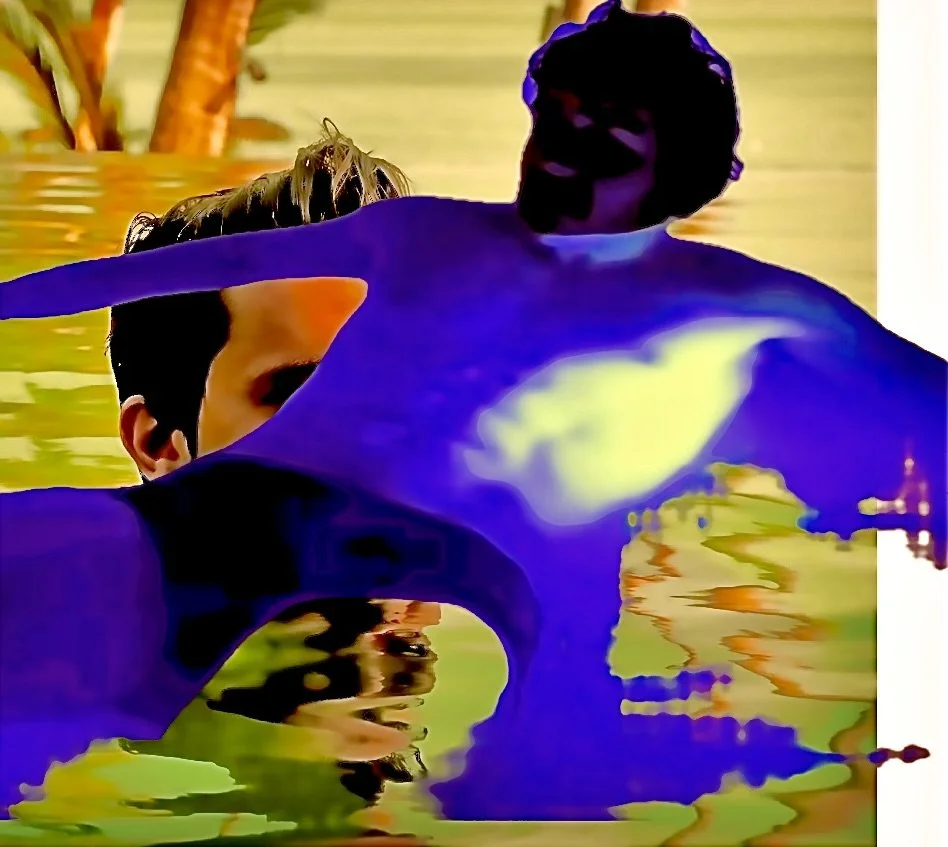
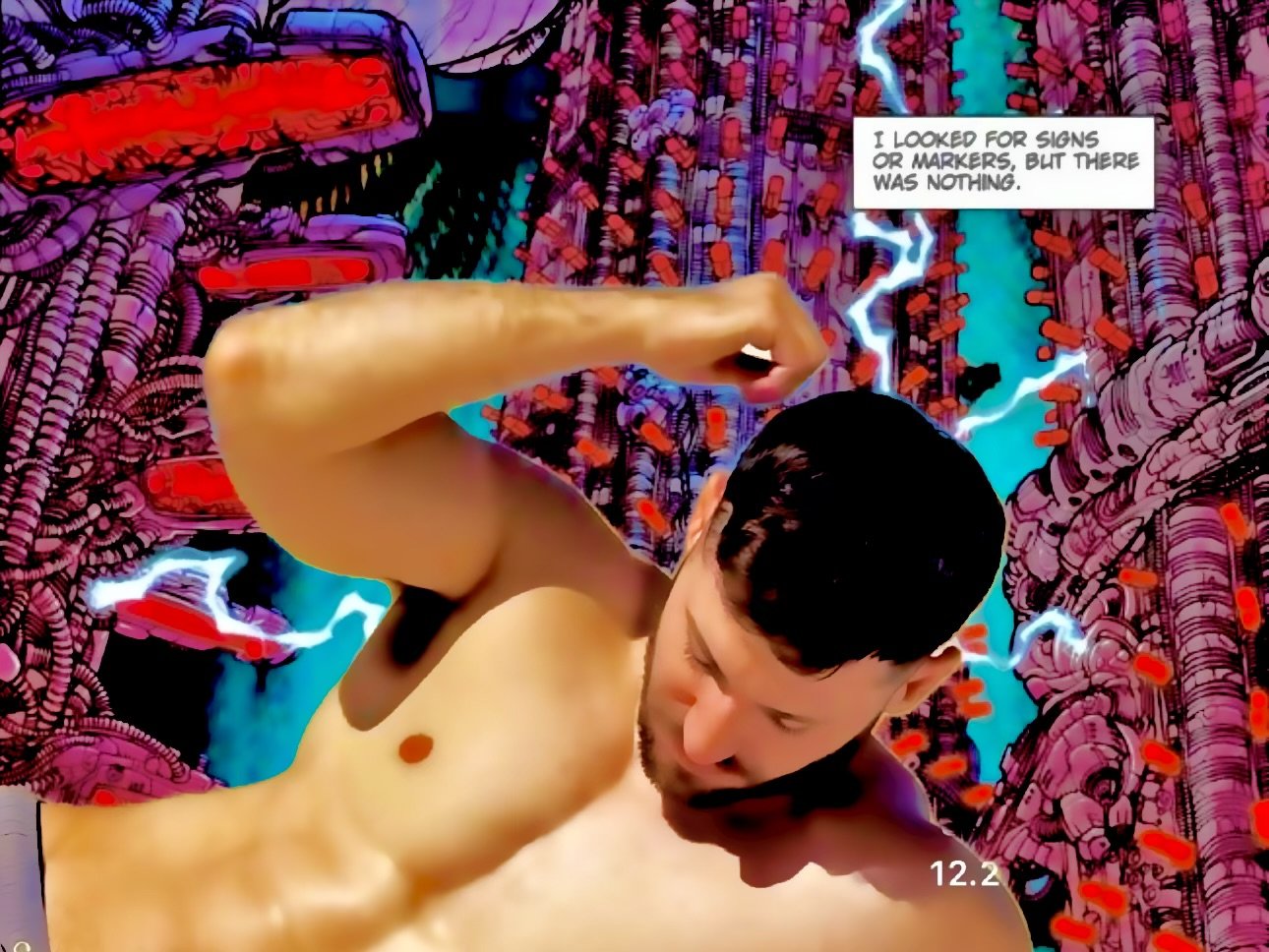
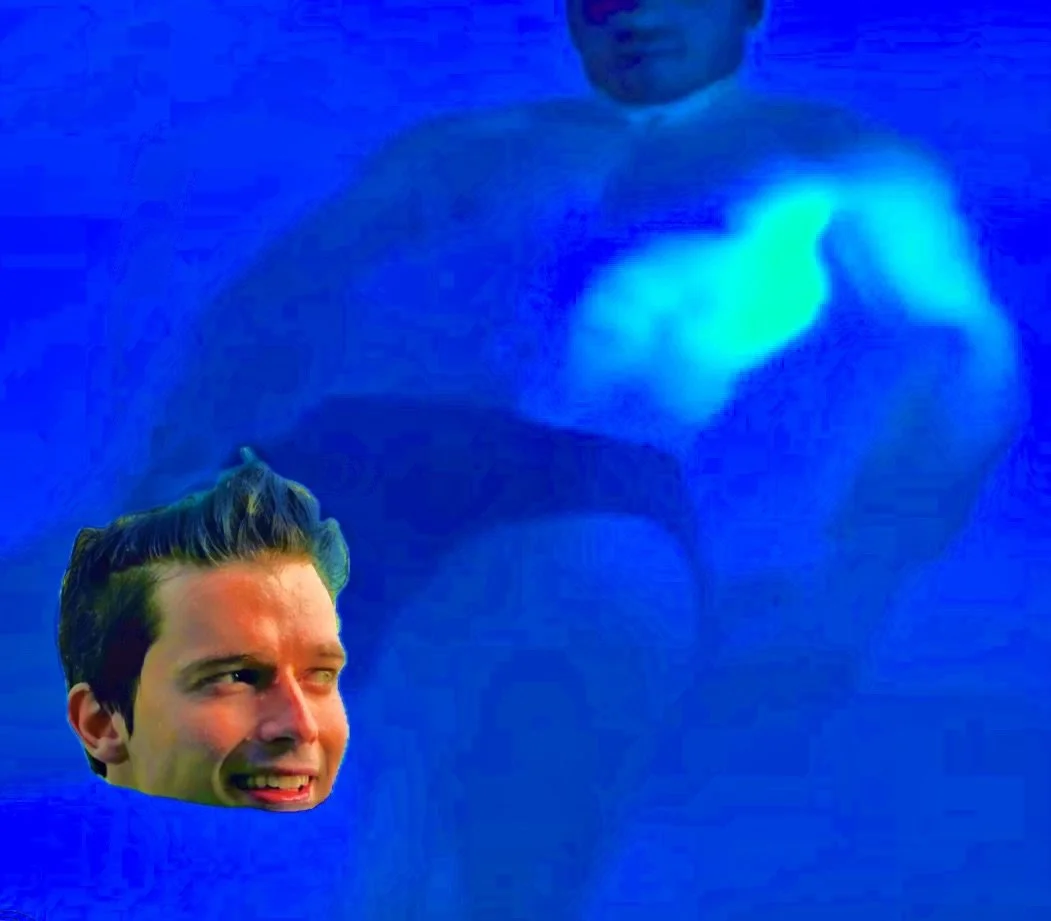
These six collages are not illustrations of that condition. They are its interior architecture. A figure dissolves into comic-book cosmology, lightning and viscera, claws and teal voids. A face floats severed from its body in an unbroken field of blue. Two men exist in water together, one rendered in cobalt silhouette, rendered beautiful and invisible in the same gesture. One panel carries text: “I looked for signs or markers, but there was nothing.” That is the closet speaking. That is what it sounds like from the inside. There are no signs because the system that built it does not post signs. It simply operates — drawing on your gifts while banking on your silence.

The numbers make the architecture visible in a different register. As of 2025, nine percent of U.S. adults identify as LGBTQ+, more than double the percentage recorded when Gallup first began measuring this population in 2012. Adults under thirty now identify as LGBTQ+ at a rate of twenty-three percent. And yet the closet persists in direct proportion to the stakes. Nearly one in five LGBTQ+ adults say they have never come out to anyone — approximately 2.7 million people who have never said the words out loud to a single human being, despite many perceiving that society has grown more inclusive. Approximately 5.5 million LGBTQ+ workers go to work every day without being who they are — not out of self-denial, but out of rational calculation. Fifty percent of LGBTQ+ respondents report having experienced some form of workplace discrimination or harassment in the previous year, and thirty-one percent report that discrimination has affected their ability to be promoted or earn what they are worth. Demographer Gary Gates defines those in the closet as people who are discordant with regard to recent behavior and identity, along with those who intentionally hide their identity — which means the closet includes not only those who have never come out, but the millions more who live in partial disclosure, calibrating visibility against risk in every room they enter.

Data scientist Seth Stephens-Davidowitz has noted that gay male internet behavior is nearly uniform across U.S. states — suggesting the actual prevalence of gay men does not vary by region, but that in states with stronger social stigma, far more remain in the closet than are out. The closet is not a personal failure or a private arrangement. It is a structural outcome. It is produced by culture and sustained by culture, and it serves culture — because a gay person managing their own visibility has less energy left over to challenge the conditions that made management necessary.

These collages operate at that threshold — the place where self-presentation becomes performance, where the body becomes both subject and object of a heteronormative gaze, where the figure inside the image is both seen and consumed. The blue field does not ask where the man went. It already knows. It built the room.

Leaving the closet, there are no guides, no Jupiter 3, no moon to light the way. It is a self-initiated act from the known to the unknown.

The Subdivision documents all those still in the process of making that decision.

— Behan

Sources: Gallup, LGBTQ+ Identification in U.S., 2025. Pew Research Center, The Experiences of LGBTQ Americans Today, 2025. Human Rights Campaign / Zippia, LGBTQ+ Workplace Discrimination Statistics, 2026. Center for American Progress, Discrimination and Barriers to Well-Being, 2022/2024. Seth Stephens-Davidowitz, Demographics of Sexual Orientation research. Gary Gates / Gallup, Counting the Closet, Contexts, 2017.

Where the Boys Are

Where the Boys Are | Gay Gaze | The Subdivision | Digital Photocollage | 2026

As part of the artistic process, figures found in the Subdivision are pulled from film, social media, and dating apps, then reassembled into new visual realities to affirm gay presence.

This collage draws from all three. The lower left figure comes from the 1960 film Where the Boys Are. The background sequence comes from a social media thirst trap. The lower right figure comes from a dating app. Different decades, different platforms, different intentions — one collage.

Gay men have always placed themselves into the visual record as the moment allowed. These collages collect those moments and hold them in a sacred space.

While “Where the Boys Are” is ostensibly about the search for love, it’s also about an artistic practice mining the digital wealth of male imagery to fill the blanks in that visual record.

— Behan

Di / Vision

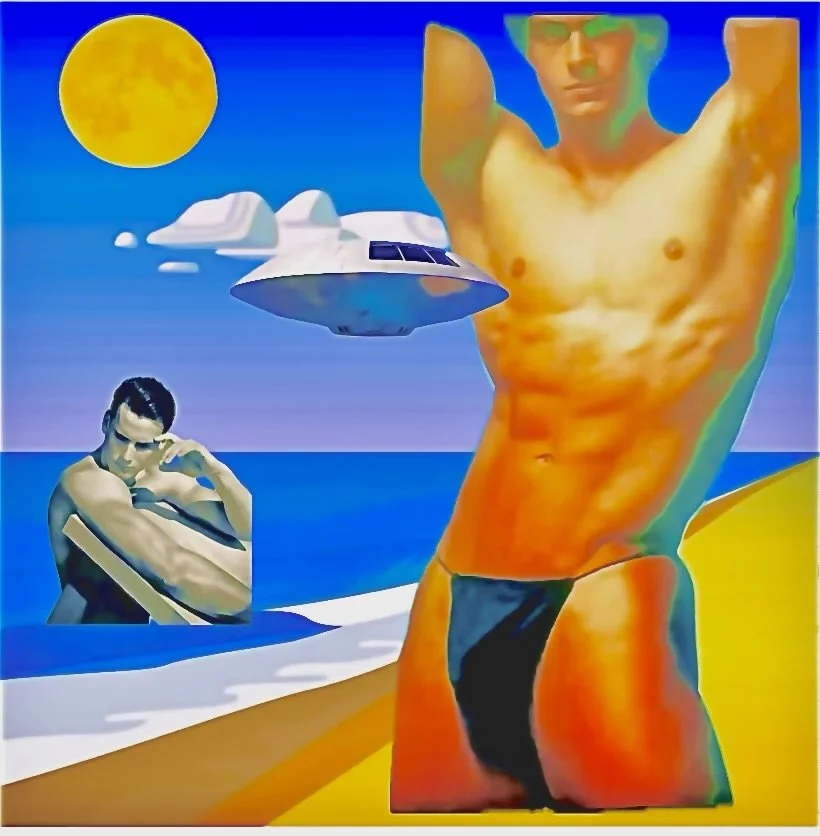
Beach (Di)Visions | The Closet | The Subdivision| Digital Photocollage | 2026

The body knows what it wants. The mind has been taught to argue.

Two representations of the prototypical gay male, in the same light, under the same harvest gold moon — and they could not be further divided.

In the foreground: pure body: heat, elevation, arms open to a sky that asks nothing of him.

In the background: pure mind: folded, face turned downward into whatever negotiation is happening between what he feels and what he has been told to feel.

This is not a coincidence of composition. This is the condition.

For the 20th century gay male, the division between body and mind was not a personal failing or a philosophical puzzle. It was constructed. Religion built one wall. Social structure built another. The culture filled in the rest.

What resulted was a kind of internal civil war — the body moving toward what it recognized as true, the mind trained to resist it. The harm this caused was not incidental.

It was the point.

Fish in the Sea

FISH IN THE SEA

The Subdivision | The Gay Domestic | Digital Photocollage | 2026

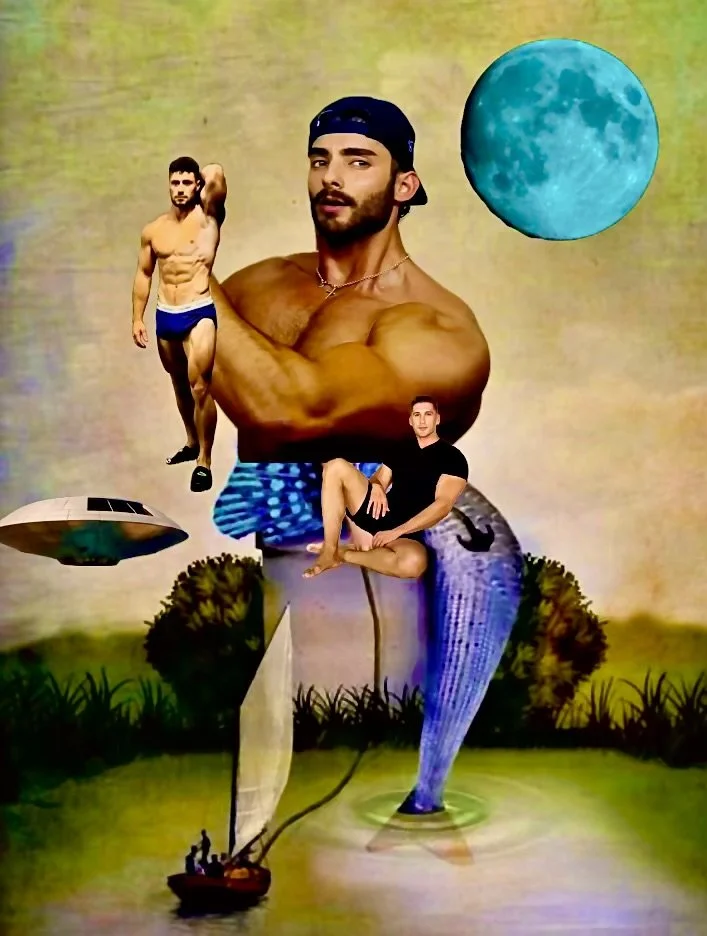
Sociologists call it cohort loss.

For gay men born between 1960 and 1964, this meant the loss of an entire peer group — friends, lovers, men one might have built a life with — to the AIDS epidemic of the 1980s and 1990s. At its peak, between 1987 and 1996, an estimated one in nine gay men had been diagnosed with AIDS. One in fifteen had died.

Those who survived are still here. Still aging. Some still looking for love inside a demographic that was decimated by nature and neglect.

They used to say there were plenty of fish in the sea. For this generation, a harder truth is endured.

The Subdivision is still counting. Jupiter 3 never stopped. — Behan

Reclaiming Jesus

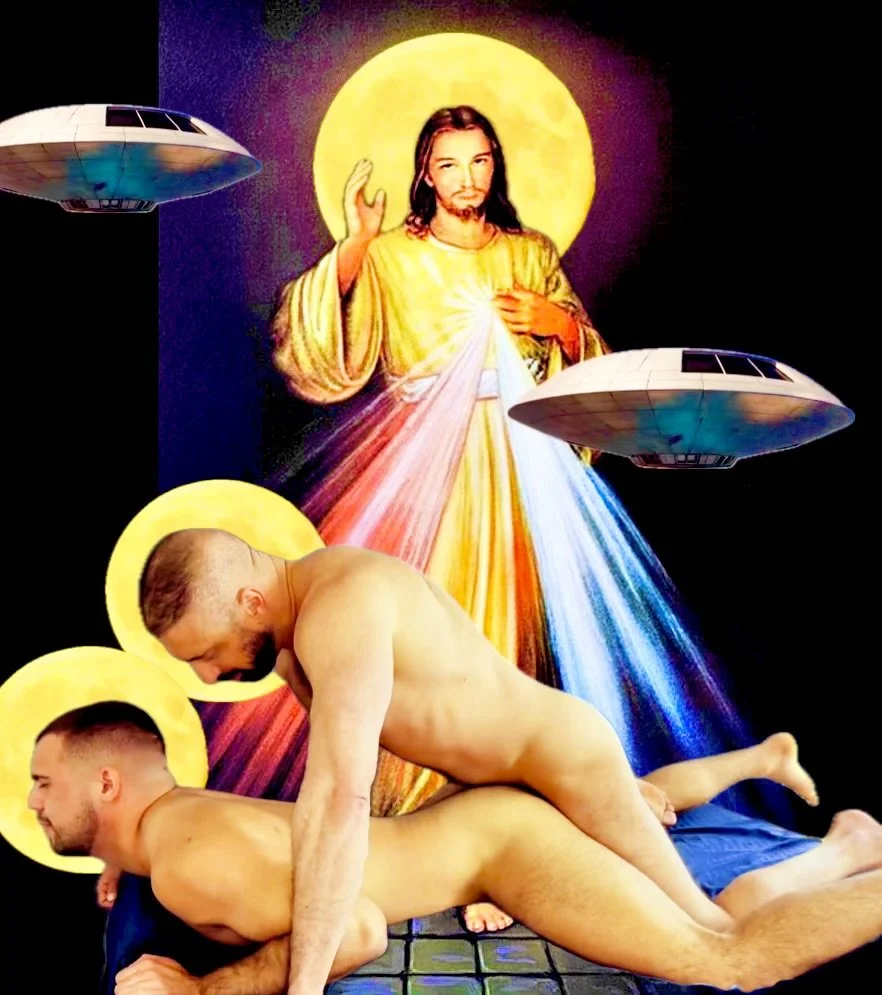
Finding Jesus Where Jesus Stood | Gay Saints | The Subdivision | Digital Photocollage | 2026

The historical Jesus dined with the rejected and despised, preached love, non-judgment, and peace.

Many of his hard right followers might not recognize him.

Gay men would.

On The Subdivision

Working draft for updated artist statement:

THE SUBDIVISION

The Subdivision is the organizing structure for a body of work examining queer presence in America and beyond. It takes its name from the postwar suburban landscape — engineered for the nuclear family, hostile by design to divergent life — and from the mid-century Dallas home where all of it is made.

The work is organized across three series:

The Closet examines the heteronormative response to gay presence — erasure, legislation, pathology, and the cultural pressure to conform or disappear.

The Gay Gaze examines how gay men have seen themselves — historically, erotically, aspirationally — and how that self-perception has shifted across time.

The Gay Domestic examines how queer life actually operates within culture — as subtext, subversion, integration, and survival inside the spaces that were never built for us.

The work is realized across three forms: digital photo collage, painted constructions on found domestic surfaces, and miniature installations in the vernacular of the diorama. Each medium constructs, layers, and reframes the visible record of gay experience. Together they make what was missing from the official record.

— Behan

Suburbia

QUEER STEERS

The Subdivision / The Gay Domestic

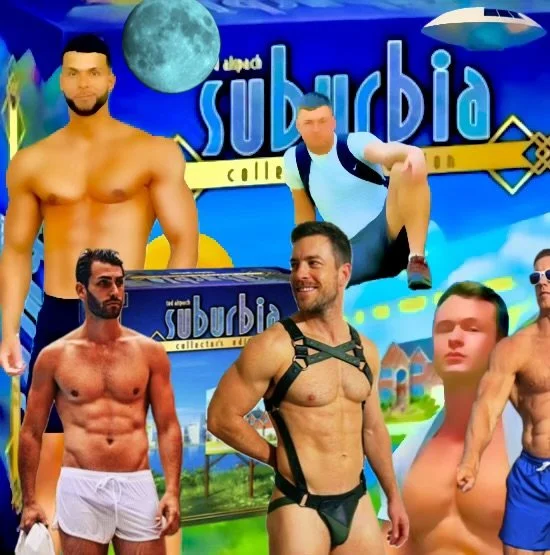
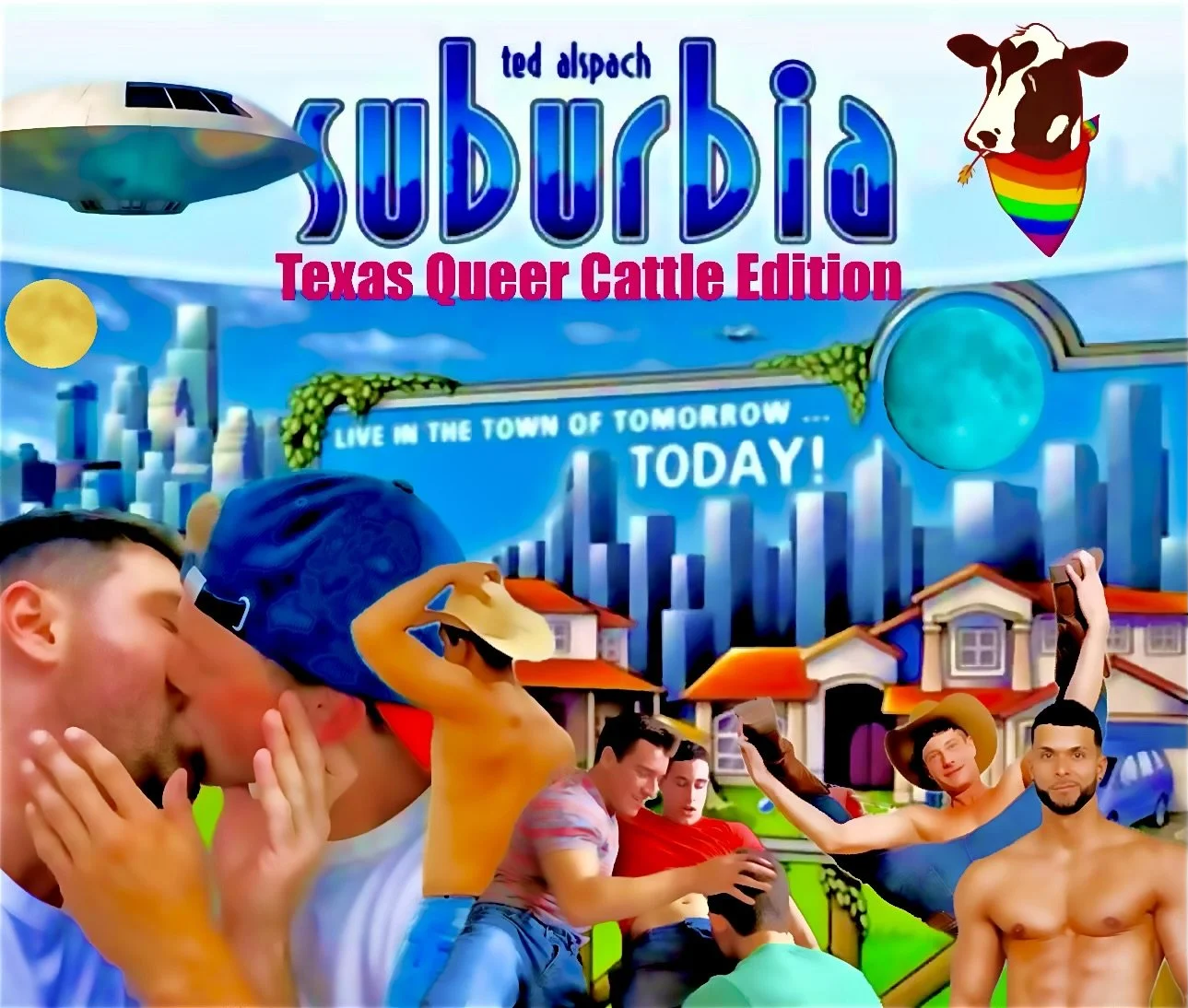
In 2024, a steer in a Texas feedlot was scheduled for slaughter. Not for weight. Not for age. Because he was mounting other steers. His owner read this as a management problem. The internet read it differently. There was an uproar. The steer was saved.

He had been, in the language of the feedlot, a problem animal.

Since the first domestication of livestock, man has been in the business of managing divergent behavior in confined spaces. The feedlot is a controlled environment. So is the suburb.

Suburbia was not designed for us. It was engineered — tile by tile, cul-de-sac by cul-de-sac — around the postwar nuclear family. Private property. Private life. A lawn as a declaration of normalcy. The gayborhood, with its density and visibility and spontaneous collision of bodies, was the opposite of everything suburbia promised. So when LGBTQ Americans began moving to the suburbs in significant numbers — drawn by affordability, safety, the American Dream in its most legible form — sociologists gave it a name. They called it the Integrator lifestyle. Blending in. Muting identity to maintain social harmony with neighbors. Becoming, in effect, manageable.

Queer cattle.

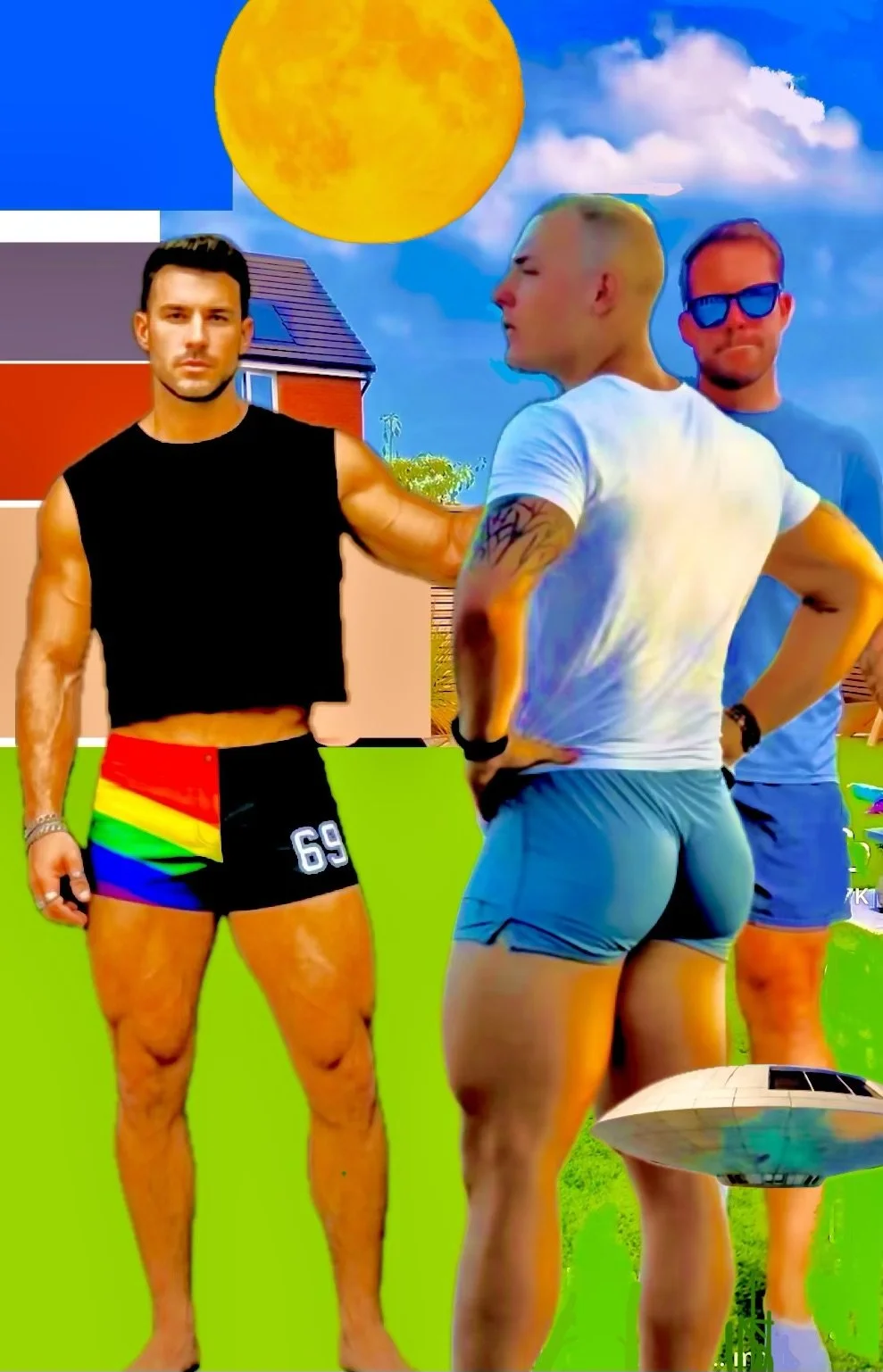
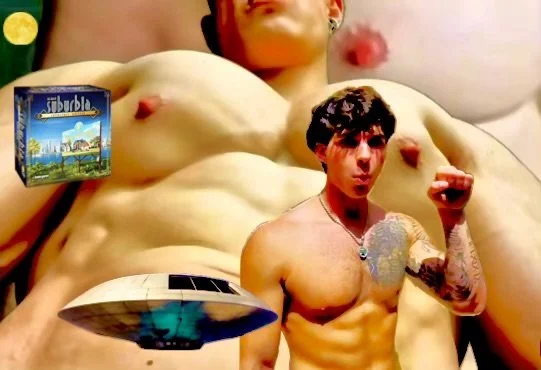
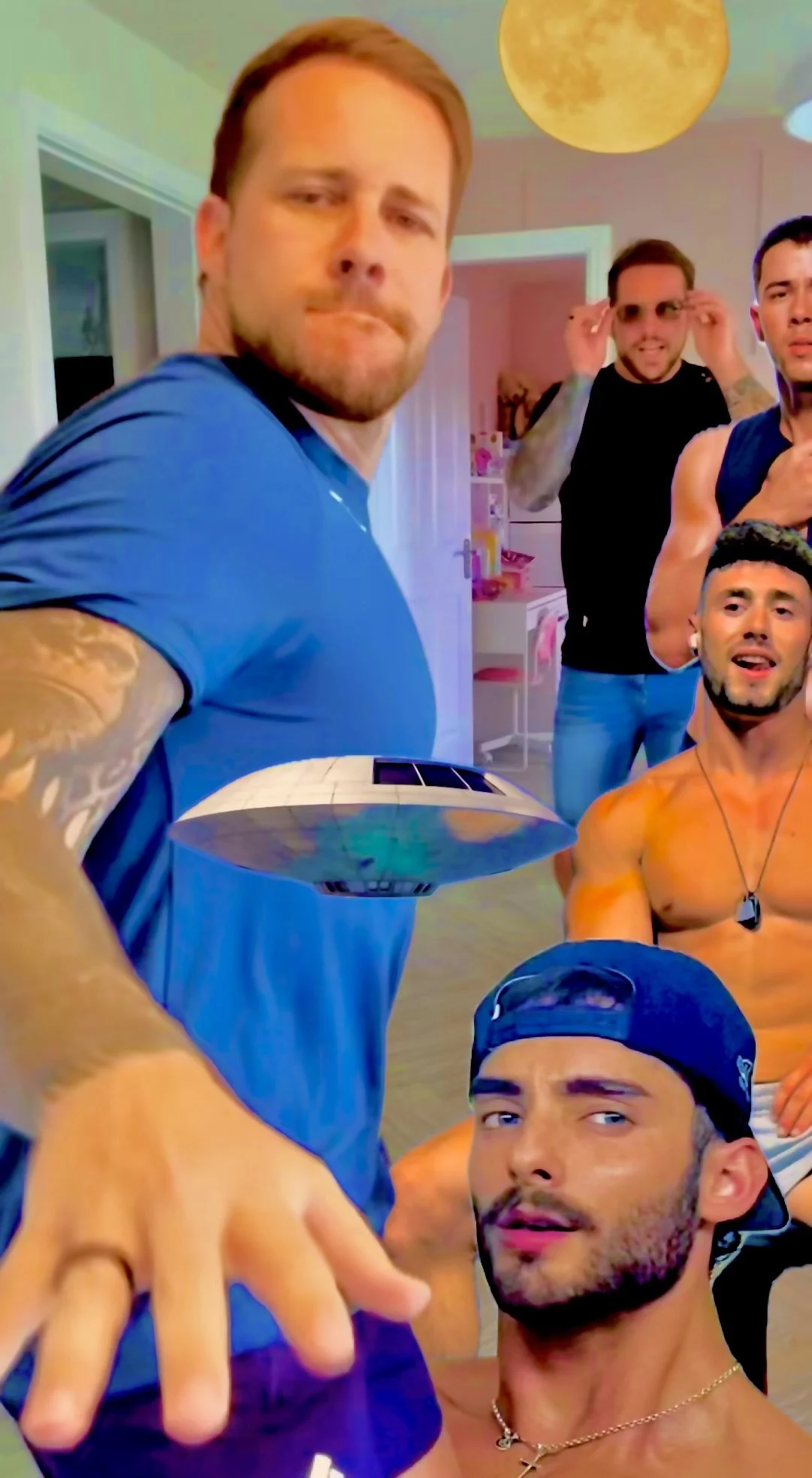
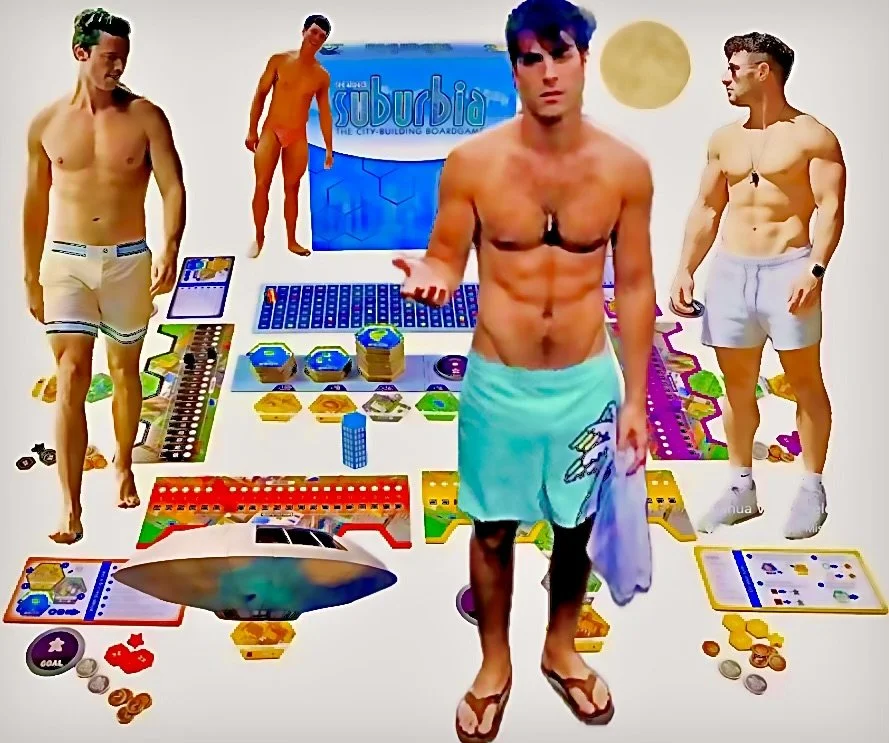
The men in these collages are thirst trap figures from social media, performing desire openly in the grammar of the feedlot’s opposite. They are placed here inside Suburbia, the city-building board game, where players construct boroughs tile by tile and optimize for population and income. There is no tile for the gay bar. No mechanic for the chosen family. No scoring category for visibility. The game, like the suburb, was not built with us in mind.

And yet here we are. Playing anyway. On the lawn. Under the harvest gold moon. Jupiter 3 overhead, watching, as it always does.

The steer in the Texas feedlot did not know he was supposed to want something different. He wanted what he wanted, in the open, in the lot he was given.

The Subdivision is watching. Jupiter 3 isn’t surprised. — Behan

Introducing the Subdivision

THE SUBDIVISION

Warhol had the warehouse. Behan has the subdivision.

A Documentary Body of Work

James M Behan

THE SUBDIVISION examines queer presence in America and beyond across three positions: how a hostile or indifferent culture responds to it, how gay men have internalized, resisted, and reimagined their own identity, and how queer life operates — visibly or invisibly — within the domestic structures of any culture it inhabits. The work is realized across three forms: digital photo collage, painted constructions on found domestic surfaces, and miniature installations in the vernacular of the diorama.

SERIES ONE: THE CLOSET

The heteronormative response to gay presence — erasure, legislation, pathology, and the cultural pressure to conform or disappear.

Works:

The Closet Saints (Rock Hudson, Tony Perkins, Johnny Mathis, Cesar Romero, James Shigeta, Raymond Burr, Tab Hunter)

On Being Brave (straight actors playing gay roles)

The Bible Is Not Anti-Gay. The Institution Is.

California Blue (the Hays Code and its successor ideology)

America’s Blood (the AIDS crisis and exclusionary policy)

SERIES TWO: THE GAY GAZE

How gay men have seen themselves — historically, erotically, aspirationally — and how that self-perception has shifted across time.

Works:

Beau Travail

Thirsty Much?

Between Muybridge and Hockney

The Gold Suite (Reflections in a Golden Eye)

Figures Across Fields of Time / On Four

The Symposium in Four Parts

The Gay Gaze: A Timeline 1748–2025

SERIES THREE: THE GAY DOMESTIC

How queer life actually operates within culture — as subtext, subversion, integration, and survival inside the spaces that were never built for us.

Works:

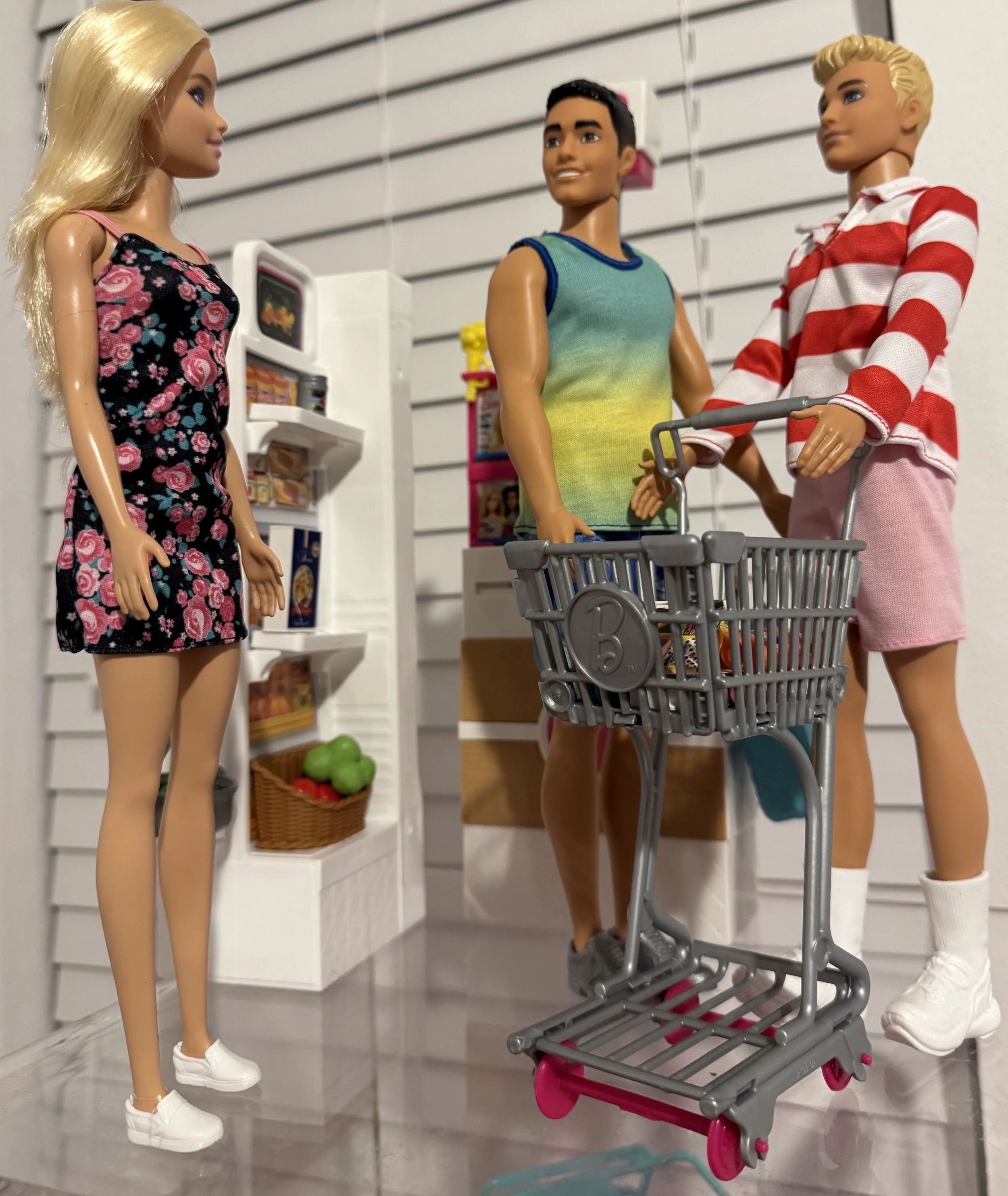
Ken Dolls Diorama Series

Cars and Beds

Queer Cattle

Between 1908 and 2026

Lost in Space

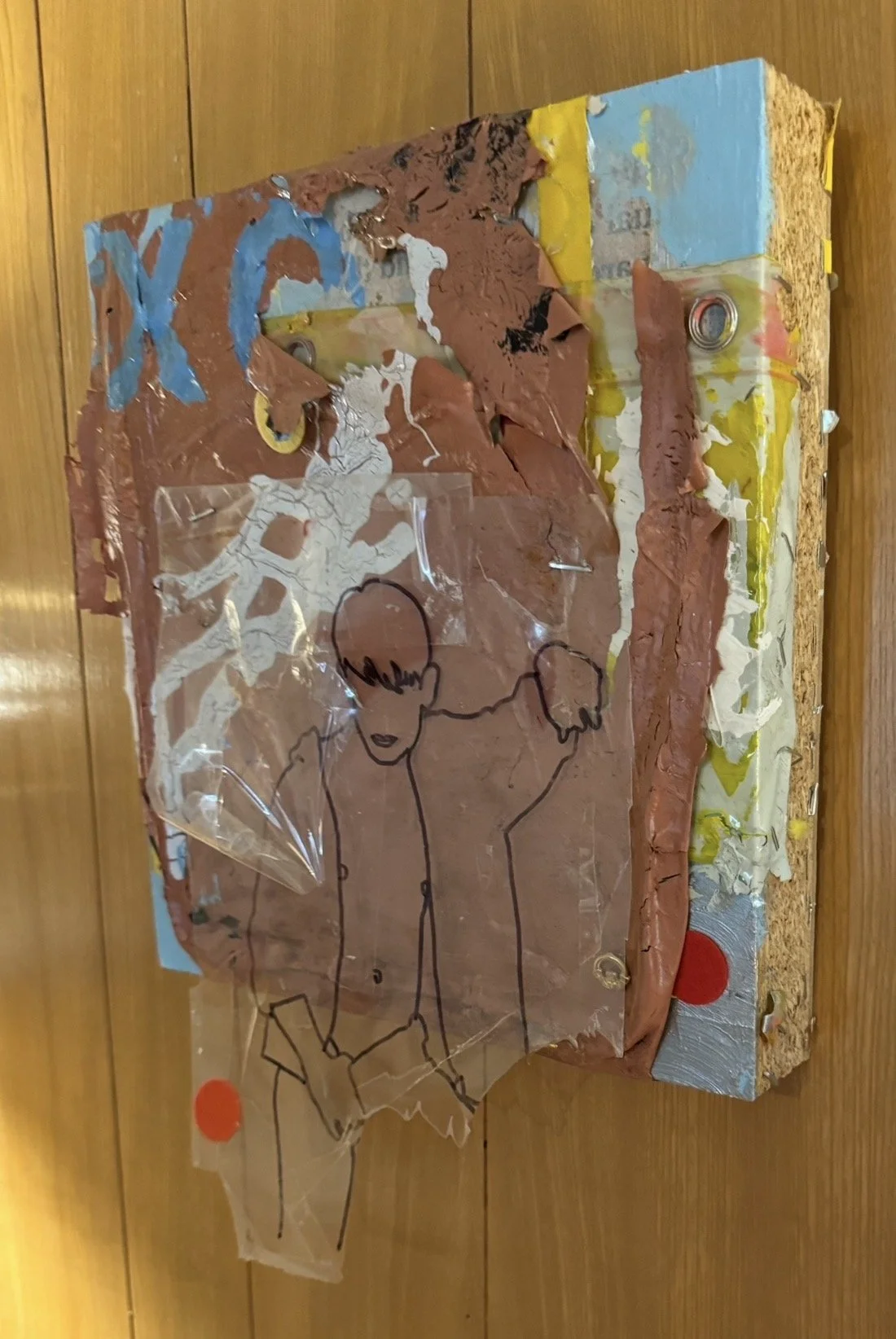
The Supermarket (painted construction)

Gay Domestic sub-pieces

SYMBOLIC LEGEND

The Blood Moon — the judgment of dominant culture; heteronormative condemnation

The Pink Moon — the feminine as world; arrival and celebration

The Blue Moon — grief and loss

The Aquarian Moon — the rise of diversity in a new era

The Purple Moon — straight male allies

The Harvest Gold Moon — fulfillment; fruition; abundance

Jupiter 3 — the witnessing presence; the spacecraft that sees everything and is never surprised

THE SUBDIVISION VOCABULARY

A Working Dictionary

Language is a living system. It grows when culture demands new tools for new realities. The terms collected here did not exist in the formal vocabulary before this work. They emerge from The Subdivision — a sustained examination of queer history, queer culture, and the forces that have shaped, suppressed, and exploited both. They are offered not as slang but as precision instruments: words that name what was previously imprecisely named, or deliberately left without a name.

Gayplay (ˈɡeɪ.pleɪ) n.

1. The strategic performance of gay identity by straight men for commercial gain. 2. The use of gay culture as an advertising concept — a campaign constructed around the mystique of gay life, deployed for profit, and withdrawn once the commercial transaction is complete. 3. The system by which straight men enter and inhabit gay cultural space without bearing any of its social cost.

“The history of gayplay in American advertising is inseparable from the history of the closet.”

Playgay (pleɪ ɡeɪ) v.

1. To perform gay identity for commercial, artistic, or social gain while identifying as heterosexual. 2. To enter and inhabit gay cultural space temporarily and instrumentally, without authentic claim to that identity. 3. To adopt the signifiers of gay life — the pose, the club appearance, the character, the ambiguous statement — as an advertising strategy rather than an expression of self.

“When a straight man takes off his shirt in a gay club to increase record sales, he is not expressing solidarity. He is engaged in playgay.”

Gay for Pay (ɡeɪ fər peɪ) n.

The practice by which straight-identifying men perform gay sexual encounters on film or in media for financial compensation. The transaction is explicit: identity is temporarily adopted, performed, and then discarded. The gay audience is the market. The straight performer bears none of the social cost of the identity he is selling.

“Gay for pay is not gayplay. It is its logical endpoint.”

Popndrop (ˈpɒp.ən.drɒp) n.

1. The pattern by which straight men court gay audiences aggressively for commercial purposes, then withdraw once the transaction is complete. 2. The moment at which a straight man, having extracted the desired cultural or commercial capital from gay audiences, returns to the default safety of heterosexual identity — leaving no accountability, no acknowledgment, and no relationship behind. 3. By extension, any institutional or cultural act in which gay communities are cultivated as an audience or resource and then abandoned when no longer commercially useful.

“Having built a fanbase, sold the records, and shed the Disney image, he executed a clean popndrop and moved on.”

Spinetime (ˈspaɪn.taɪm) n.

1. The understanding that time is the central structural axis of queer experience — always in present tense — that to be gay in 1964 is a fundamentally different life than to be gay in 1993 or 2014, and that these differences are not incidental but definitive. 2. The lived awareness, particular to marginalized communities, that freedom arrives unevenly across generations — that those born earlier bore costs that later generations did not, and that the progress between generations is neither guaranteed nor irreversible. 3. The use of chronology as the spine of queer cultural analysis: the recognition that where you fall on the timeline determines, in large part, what your life is permitted to be.

“The distance between September 17, 1964 and November 5, 2014 is not merely fifty years. In spinetime, it is the distance between a witch who must hide and a pop star who profits from the hiding of others.”

SIGNATURE FORMAT

The signature of The Subdivision follows a fixed form with variable expression:

The Subdivision is [present tense statement]. Jupiter 3 isn’t [present tense response]. — Behan

Examples:

The Subdivision is watching. Jupiter 3 isn’t surprised.

The Subdivision is amused. Jupiter 3 isn’t missing any of it.

The Subdivision is aware. Jupiter 3 isn’t playing around.

MEDIA

Digital Photo Collage — layered photographic imagery constructed digitally; the primary form of the work

Painted Constructions — works on found domestic surfaces including doors, wood paneling, plates, and furniture; physical objects existing independently as artworks

Miniature Installations — dioramas constructed at small scale; physical environments staging scenes of queer domestic life

Between 2

Between 1908 and 2026 | Digital Photocollage | 2026

Definitely not a motion study; more like something between a meditation on mortality or a prayer dressed as a summer afternoon.

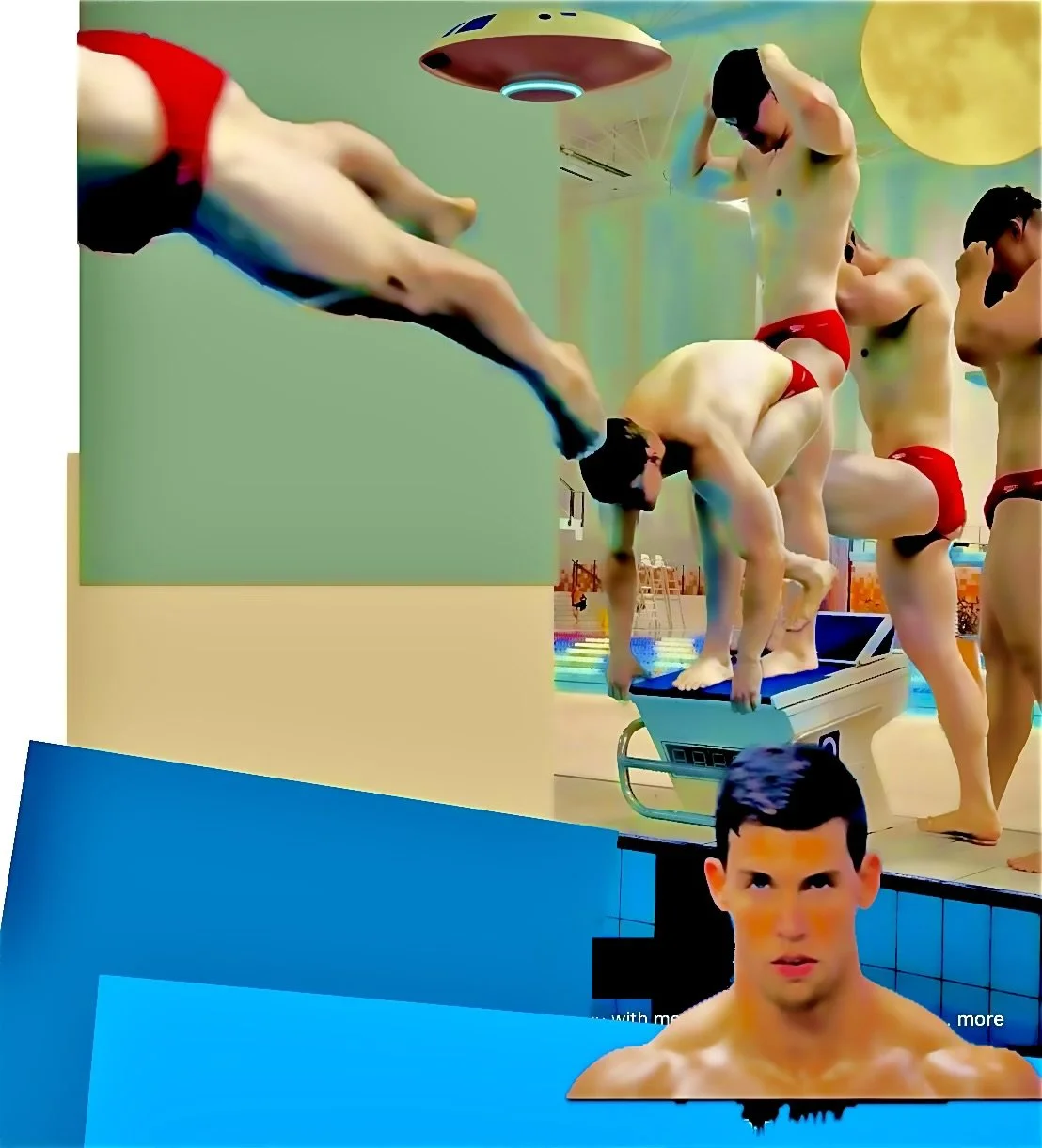
1908, Spain. Bathers on the diving platforms, in the water, in their striped suits — 6 years from a war that they will walk away from, and 10 years from a flu that may take some of them anyway.

They don’t know this yet.

They’re just on the water.

On a summer day.

The large contemporary figure looms over them from 2026. Not menacing. Elegiac. The future looking back at people who can’t see him.

This collage abstains from the Closet Series. Not about being gay or bi or straight. About being human. And facing whatever comes next.

Between

Between Muybridge and Hockney | Digital Photocollage | 2026

Somewhere between Muybridge and Hockney sequential time collapses into a single plane

the body caught at discrete moments sans narrative

Muybridge.

Then layering, color field geometry, spatial compression, flat chromatic architecture that enfolds the figures without acknowledging them.

Hockney.

Time isn’t linear here. It folds, moving back and forth.

The face

Breaking kinetic logic. Stillness reading as consciousness — the moment before the move, the moment after.

White Lotus Focus

On Being Brave: Straight Actors Playing Gays and Other Weirdos and Creeps

Digital Photocollage | White Lotus Set | 2026

In 1981, an adult film called Brothers Should Do It starred JW King and John King as brothers. They were not related. The fiction of brotherhood was the permission structure — the thing that made the intimacy legible, containable, not quite gay. The industry has always been good at loopholes.

Forty-four years later, The White Lotus Season 3 ran the same play in prestige television. Brothers Saxon and Lochlan Ratliff — played by Patrick Schwarzenegger and Sam Nivola, who are not related — kissed on camera, got high, and participated in a threesome.

The internet called it shocking.

Some viewers called it disgusting.

The actors called it complicated.

The audience called it unmissable.

Season 3 averaged 16 million viewers globally per episode. Season 4 was already greenlit before Season 3 aired its first frame.

Sam Nivola, speaking to Variety, described what it was actually like: “It was very weird kissing Patrick because he’s a really good friend of mine. And, you know, I’m straight, he’s straight. It’s already weird. It would have been easier if that was the first time we were meeting.”

Already weird. Before the cameras rolled. Before the scene was shot. The weirdness was not about the acting. It was about proximity — to another man’s mouth, to gay desire, to something that does not resolve cleanly into the straight world both actors occupy. The other woman in the scene, Charlotte Le Bon, was easier to work with, Nivola explained, because they had just met. No stakes. With Patrick it felt, he said, “sort of fucked up.”

This is the texture of straight male discomfort with gay intimacy, spoken plainly and without apparent self-awareness. The weirdness is not about craft. It is not about character. It is about what gay desire does to a straight man’s sense of himself when he gets too close to it.

Hollywood has long called this bravery.

Tom Hanks won an Academy Award for playing a gay man dying of AIDS in Philadelphia and has since said he would not take that role today. Jake Gyllenhaal, reflecting on Brokeback Mountain, described playing gay alongside Heath Ledger as medicine — important precisely because both men were straight, because their willingness to do it broke the stigma. The stigma, in this formulation, belongs to the role. The brave thing is to touch it anyway.

The out gay actor Wentworth Miller had a different read. Straight actors playing gay, he said, centers straightness. It doesn’t matter that they’re acting. You still know what you’re looking at.

What you are looking at, most of the time, is a straight man performing his tolerance of gay life as a dramatic exercise — and being rewarded handsomely for it. The Academy has always loved a straight actor willing to go there. The word brave appears in nearly every profile.

The brotherhood loophole is worth examining. From the adult film industry to prestige HBO drama, the fiction of brothers has long served as a container for male intimacy that cannot otherwise be named. It is gay desire routed through a structure the straight world already understands — family loyalty, masculine bonding, the intensity of men who share blood. The queerness is present. It is simply housed somewhere the audience can manage it.

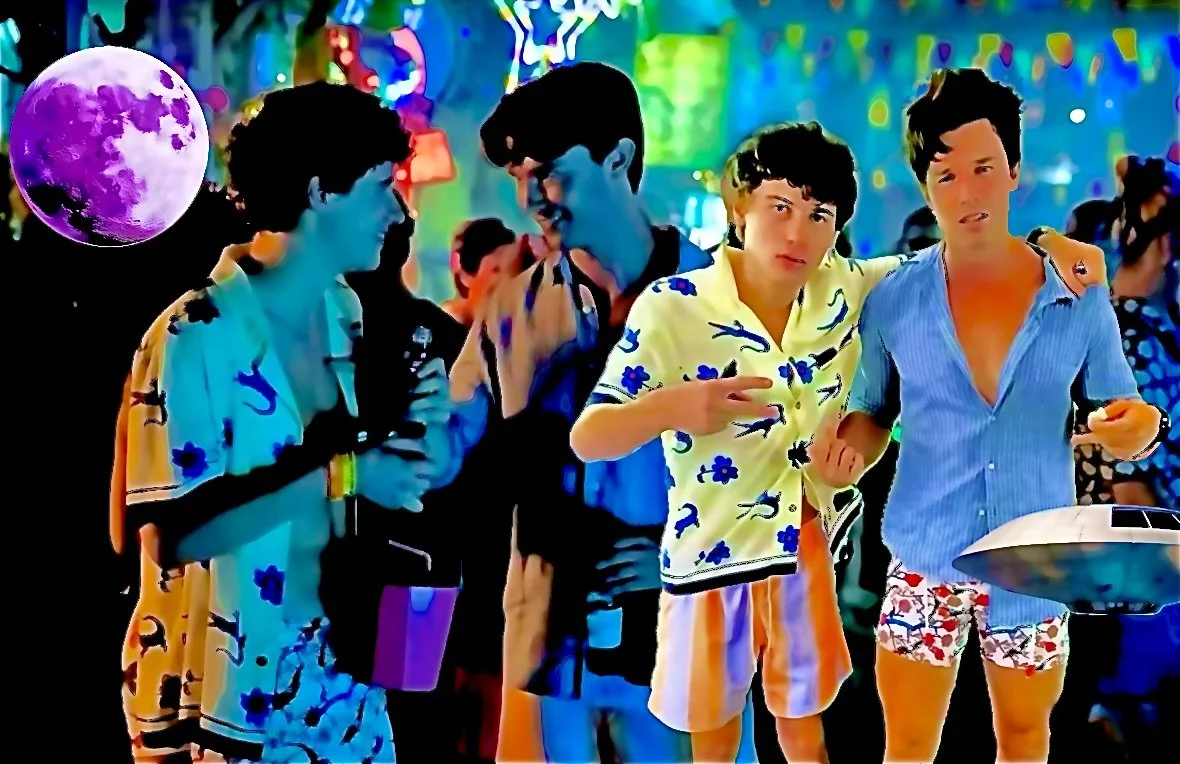
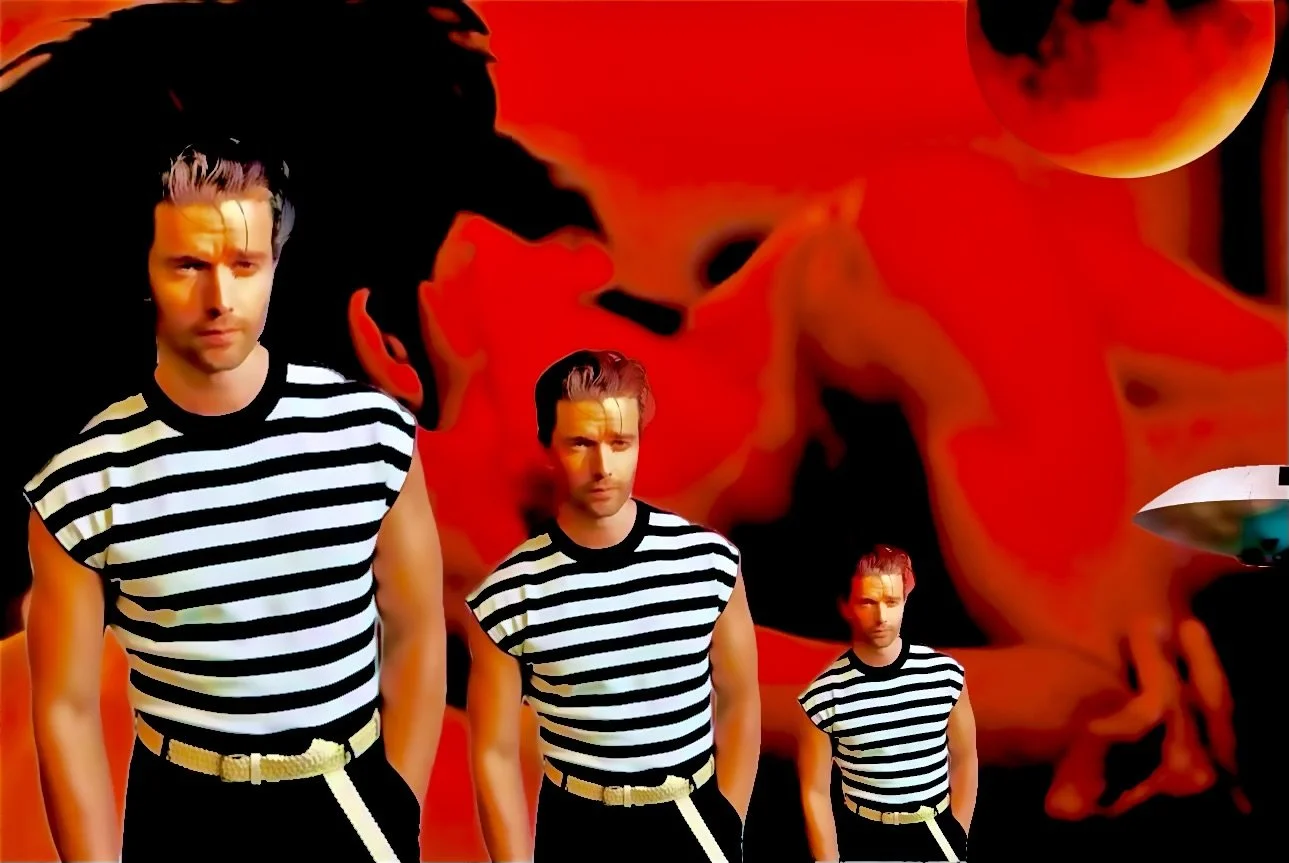
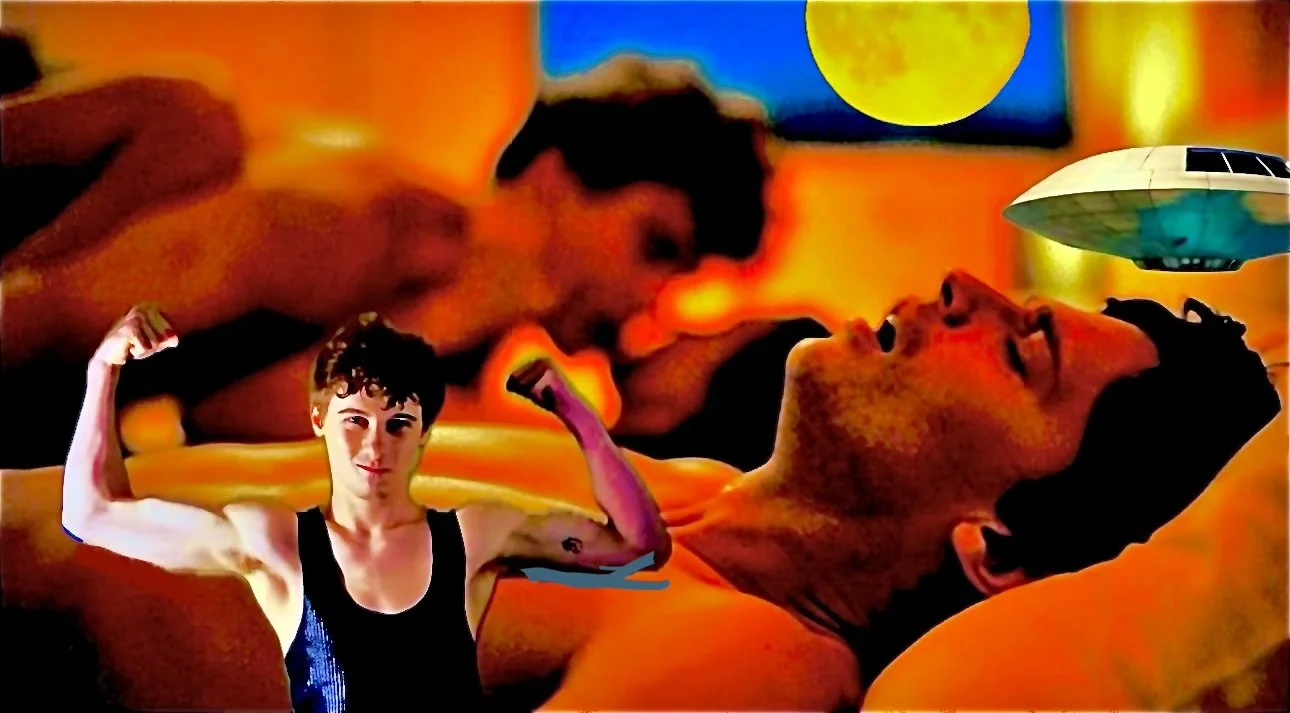
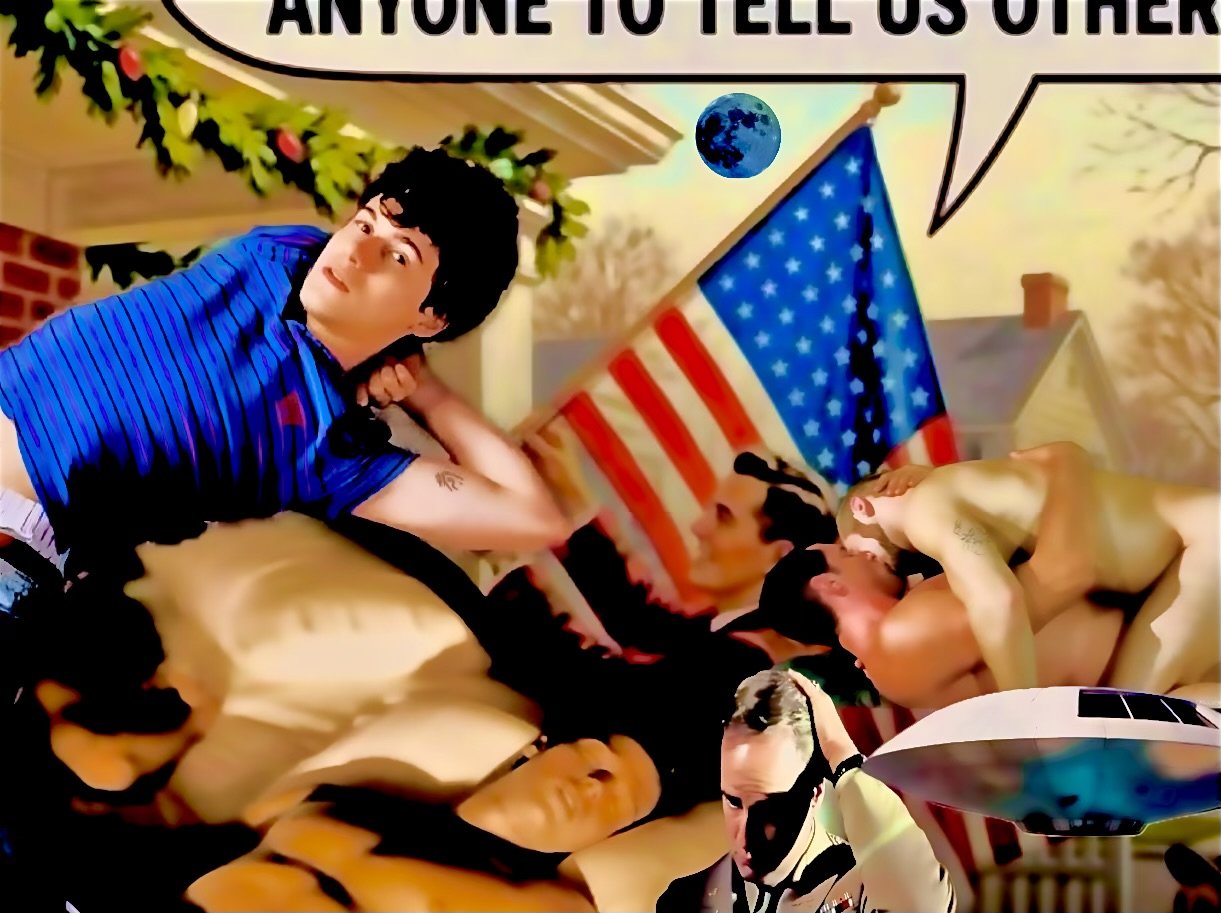
These six collages look directly at the discomfort straight actors describe and find something else there entirely — the ordinary human experience of desire, contact, proximity, wanting. One collage takes its central image from the famous switched bathing suits scene in The White Lotus itself. Other collages draw from the show’s own footage, accented with the blood red and harvest gold moons of the series vocabulary. Marlon Brando makes a much appreciated guest appearance under a billowing American flag. Lastly, a collage places Patrick Schwarzenegger front and center in his striped shirt, the harvest gold moon large behind him, Jupiter 3 in the foreground, and Lochlan rendered as a miniature figure clinging to his chest — a study in scale, proportion, and the strange gravity that pulls these two men toward each other throughout the season.

Patrick Schwarzenegger and Sam Nivola are not brothers. They are two straight men who kissed on camera and called it weird. Somewhere in that footage, if you look past the discomfort, is the thing The Closet Series has been documenting all along.

It was always there. It was never the problem.

Jupiter 3 is left wondering if it is equally brave for gay actors to play straight roles.

— Behan

Citations:

Sam Nivola, Variety, 2025.

Season 3 viewership figures, Variety and Deadline, April 2025.

Golden

Golden | Digital Photocollage | Platinum Setting | 2026

In 1967, John Huston made a decision that almost no one saw. He released Reflections in a Golden Eye in two versions — one in standard color, one bathed entirely in gold. The gold version reached almost no one. The studios lost their nerve. Most prints shipped in color.

In Western art, gold has always defined the sacred, the beautiful, the highest order of human experience. In Greek mythology, Zeus comes to Danaë not as a man but as a shower of gold — radiant, impossible to ignore, transforming everything it touches. Andy Warhol’s Oxidation paintings turned the body’s own fluid into shimmering, luminous expanses of unexpected beauty. And Andres Serrano’s Piss Christ submerged the sacred in what the institution called contamination and produced something that glowed. Gold has always carried both transgression and holiness at once.

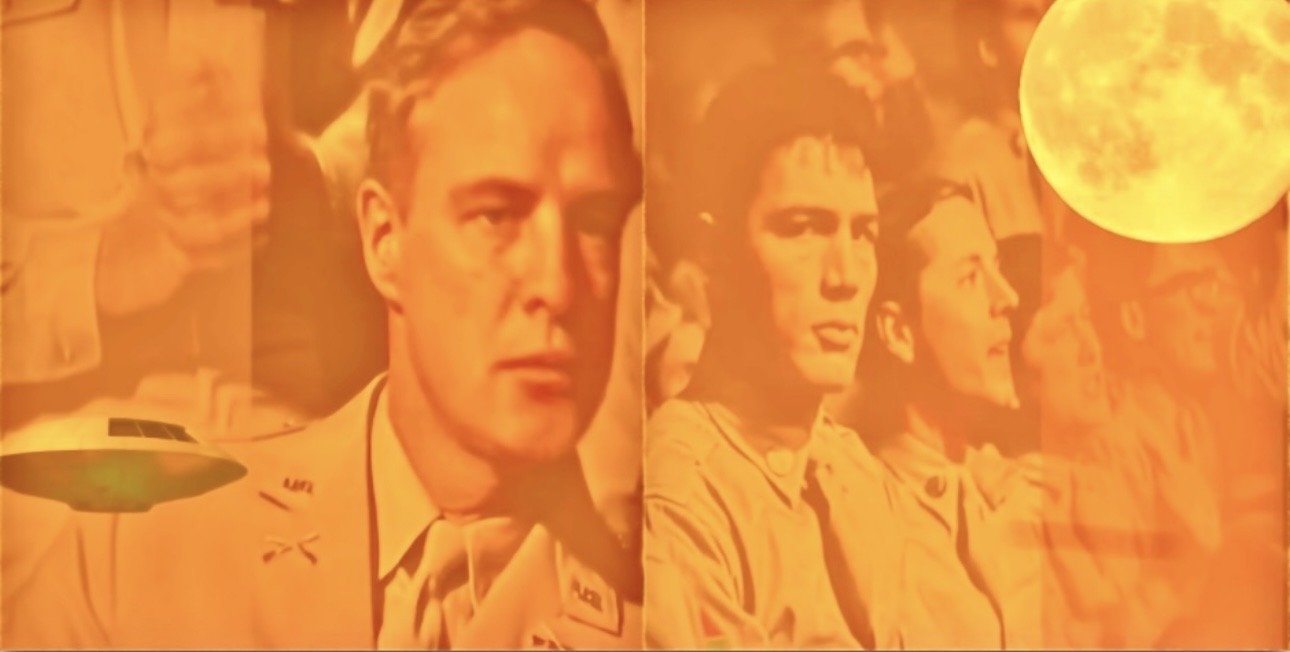
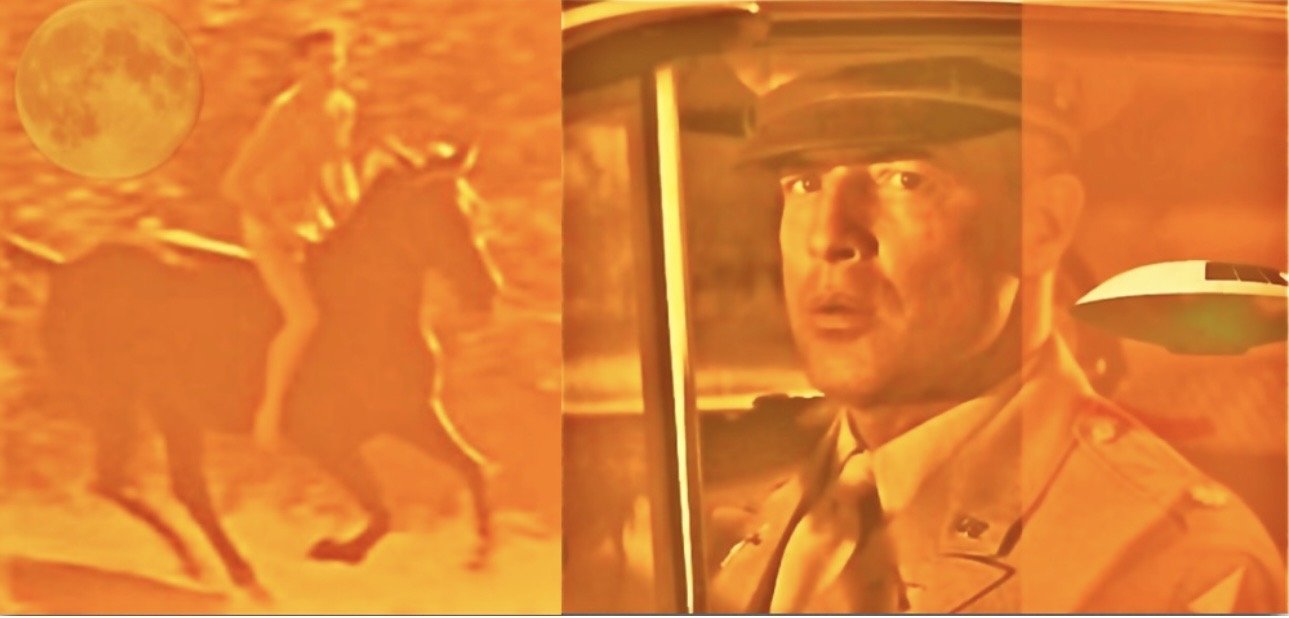
These works, the gold collages, tilt Huston’s mirror for a reframe. What comes into focus was already in the film — a closeted man falling in love with another man for the first time. A military man, a husband, more than halfway through his life, experiencing at forty what he should have been allowed to feel as a teen. The fears. The wonder. The helplessness of it. Marlon Brando plays it as a man moving from the abstract to the actual — desire for another man finally landing somewhere real. His world fills with radiant light. That is what falling in love does, whether or not that love is reciprocated.

These collages — gold layered into gold, possible only through the digital process — bring forward the story inherent in Huston’s film, a bright, brilliant tale of a closeted man, luminous with wanting for the first time in his life, experiencing every emotion that runs with it, beams of light shooting from his fingers and his toes.

Jupiter 3, a Huston fan, has been waiting for this moment all along.

Four by Eight

On Four | Digital Photo Collage Quartet | 2026

Four 19th century friends. Four perspectives before the Kinsey Scale added words to a grid. How would they fare today?

All Gay

His heart belongs to another man. Which man, he doesn’t know yet. But there’s nothing else he needs or wants.

Mostly Gay

He’s looking for a husband. But he could accidentally fall in love with his gal pal.

Mostly Straight

He’s happily courting the ladies. But he doesn’t mind lending a hand to a bro who needs a little relief.

All Straight

He’s in his sweet spot. Don’t bother him.

The feelings were there before the words were. And those feelings are a good thing.

Happy Pride

— Behan

Water Weighs

Water is our source, we are made of water and stardust. #TheClosetSeries #QueerStyle #Pride2026 #DigitalCollage #BehanArt

More on Gaybaiting, Playgaying, and Gay for Pay.

Gay Play: How Straight Men Continue to Profit from Gay Culture

Digital Photo Collage Suite | 2026

Gay play is not a new invention. It is an advertising campaign.

This five-piece suite of collages documents a specific and ongoing practice: straight men, self-identified, entering and inhabiting gay cultural space to extract profit — through performance, through imagery, through insinuation — and then retreating to the safety of heterosexual identity when the transaction is complete. Gay culture serves as the concept. The campaign always ends the same way. The straight man walks away with the revenue. The gay community is left with the residue.

September 17, 1964: Darren Stevens and the Witch in the Closet

Darren Stevens was an advertising executive in New York City. That was the core structural premise of Bewitched, which premiered on ABC on September 17, 1964. It starred Elizabeth Montgomery as Samantha Stephens, a witch who marries a mortal and is required by her husband to hide who she is. Every episode turns on the cost of that concealment — the scrapes, the near-discoveries, the exhaustion of performing normalcy in a world not ready for the truth.

Montgomery confirmed in a 1992 interview with The Advocate what many had long understood: “Don’t think that didn’t enter our minds at the time. We talked about it on the set that this was about people not being allowed to be what they really are. If you think about it, Bewitched is about repression in general and all the frustration and trouble it can cause.”

The show was staffed accordingly. Dick Sargent, the second Darren, was a closeted gay man who came out publicly in 1991 — Montgomery co-marshalled the 1992 Los Angeles Pride Parade alongside him. Paul Lynde, Uncle Arthur, was openly gay in all but press release. Agnes Moorehead, Endora, was widely understood within the industry to be a lesbian. Maurice Evans, Samantha’s father, was gay. The series about hiding who you are was made largely by people who were hiding who they were.

Darren Stevens is not simply a character. He is a symbol. He is the straight man whose comfort requires the concealment of the person beside him. His job is to construct an image and sell an idea. The closet exists, in Bewitched, in direct service of his advertising career. Samantha hides so Darren can work. The mystique is the concept. The concealment is the campaign.

For centuries of European culture, gay people did not exist — officially, legally, ecclesiastically. They were erased, criminalized, silenced. And then, once that erasure became impractical, once gay culture became visible and vital and commercially attractive, a different strategy emerged. Not erasure. Exploitation. Not denial. Advertising.

Darren Stevens saw it coming.

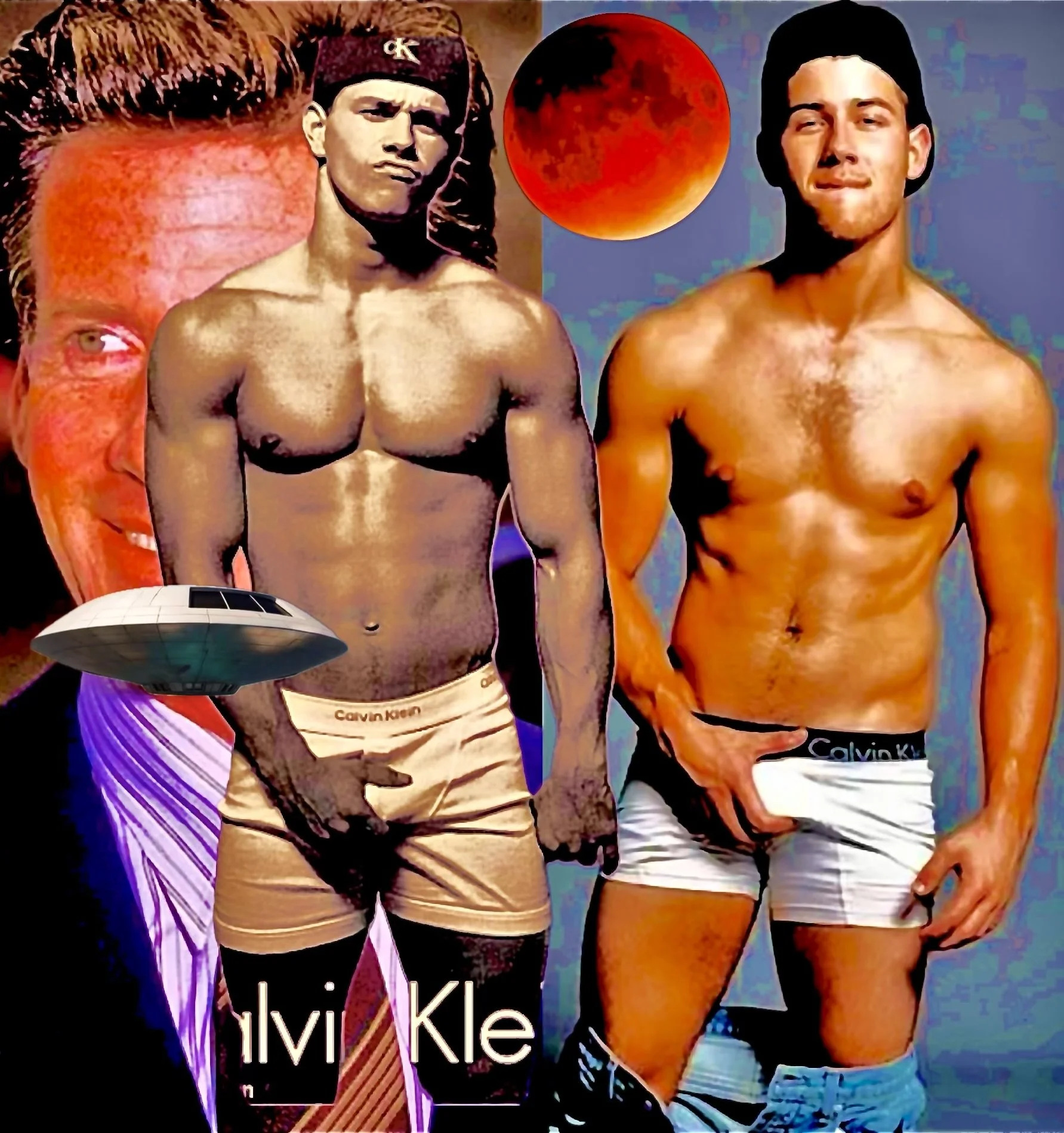
March 13, 1993: Marky Mark, Calvin Klein, and the Male Odalisque

On March 13, 1993, a blizzard hit New York City. On a Times Square billboard, a young man in white Calvin Klein briefs stared down at the storm. The campaign had launched in 1992, but this was the moment it became undeniable — an image so arresting it stopped traffic, photographed against the snow, plastered across the cultural memory of a generation. Mark Wahlberg, then known as Marky Mark, had become the male odalisque of American advertising.

This was unprecedented. The gay male gaze, which had long existed underground — in physique magazines, in beefcake photography, in the coded imagery of mid-century Hollywood — was now on Times Square. It was now on the sides of buses. It was now selling underwear to everyone, including the gay community whose aesthetic it had borrowed wholesale. The campaign earned Wahlberg an estimated $20 million in endorsements. Calvin Klein underwear sales increased 300%. The gayplay* had worked.

And then, almost immediately, Wahlberg resented it.

Wahlberg reportedly resented the attention the ads drew from his new gay fan base. On a British talk show, he sat alongside rapper Shabba Ranks as Ranks declared that gays should be crucified — and said nothing. In 1993, he was accused of using a homophobic slur against a member of Madonna’s entourage. Calvin Klein eventually removed him from the campaign. He was ordered by a court to appear in anti-bias public service announcements. He complied. He moved on. His current net worth is estimated at $400 million. The Calvin Klein advertising campaign is where it began.

Kate Moss, who appeared in the same campaign, had not very good memories of the experience. She described Wahlberg as “very macho” and said it was all about him. She felt objectified, vulnerable, and scared. Calvin Klein himself, she said, loved that she was young and innocent. She was seventeen years old. In 2012, she told Vanity Fair she had a nervous breakdown after the shoot. “I couldn’t get out of bed for two weeks,” she said. “I thought I was going to die.”

When Wahlberg eventually learned of Moss’s account — apparently unaware she had spoken about it at all — his response was instructive. “I think I was probably a little rough around the edges,” he said in a 2020 Guardian interview. “Kind of doing my thing. I wasn’t very worldly, let’s say that.” No apology. No acknowledgment of harm. No amends. This is the standard posture of straight men in power when confronted with the damage they have caused: a vague acknowledgment dressed as innocence and surprise, as if the harm were a weather event rather than a choice.

Mark Wahlberg presents as a devoted conservative Catholic. He speaks publicly about his faith, his rosary, his 4am prayer routine. But a devoted conservative Catholic makes amends to the people he has harmed. He goes back. He apologizes directly. He does not describe a nervous breakdown as being a little rough around the edges. What Wahlberg presents as piety is the same performance as everything else in this story: an advertising campaign aimed at a specific audience, generating a specific return. Kate Moss has not received an apology. The gay community whose aesthetic launched his career has not received one either.

There is one more dimension to Calvin Klein that this essay cannot leave unexamined. The man who built a fashion empire on the gay male gaze — who launched the career of a man who sat silent while gays were said to deserve crucifixion — was himself in the closet throughout the campaign’s peak years. Klein was married twice to women: to Jayne Centre from 1965 to 1974, and to Kelly Rector from 1986 to 2006. It was only in 2006, the year his second marriage ended, that he publicly acknowledged his bisexuality. He told Vanity Fair in 2008: “I’ve experienced sex with men, with women. I’ve fallen in love with women. I’ve married women. And I have a family. I am for good or bad a real example of whatever I’ve put out there.”

The closet, then, was not only the condition of the community whose images Klein commodified. It was his own condition. He was running a gay advertising campaign from inside the closet.

The photographer behind Calvin Klein’s campaigns was Bruce Weber. Weber’s work for Calvin Klein in the late 1980s and early 1990s defined the visual language of the desirable male form in American advertising. He was the lens through which the male odalisque entered mass culture.

He was also, according to fifteen current and former male models who spoke to the New York Times in January 2018, a serial sexual predator.

Weber’s alleged demands often occurred during photo shoots and other private sessions. Models were asked to perform breathing exercises, to touch themselves and to touch Weber, moving their hands wherever they felt energy. Weber often guided the models’ hands with his own. Model Robyn Sinclair described his experience plainly: “A lot of touching. A lot of molestation.” In December 2018, five models filed a federal lawsuit calling Weber a “serial sexual predator” and invoking sex trafficking statutes. Weber denied all allegations. The cases were eventually settled.

Weber’s alleged abuse stretched back to 1982 — a full decade before the Marky Mark campaign. The advertising infrastructure that produced those images, that launched that career, that built that cultural moment, was operating on a foundation of alleged coercion and abuse throughout. Calvin Klein, as a company, employed Weber for decades. Calvin Klein, as a company, benefited from his work. Calvin Klein, as a company, did not ask the questions that might have interrupted the profit.

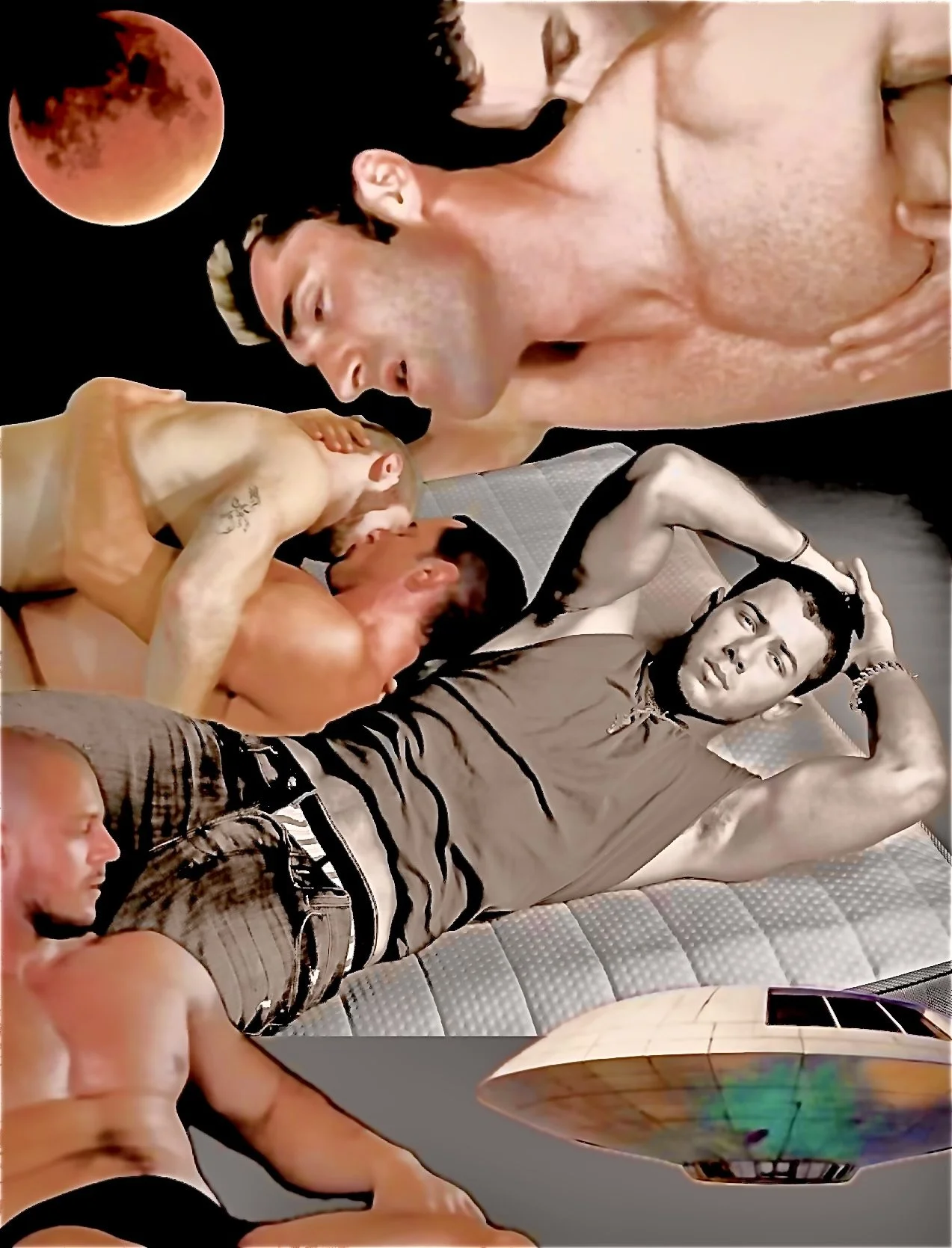
November 5, 2014: Nick Jonas and the Gay Advertising Blitz

On November 5, 2014, Dallas Voice — the Texas gay periodical — published an interview with Nick Jonas timed to the release of his self-titled solo album and the premiere of his television series Kingdom, in which he played a closeted gay MMA fighter. The interview documented, in Jonas’s own words, a deliberate and sustained campaign to enter and inhabit* gay cultural space for commercial purposes.

Jonas told Dallas Voice that in planning his solo rollout, he had made his intentions explicit to his team: he really wanted to make an effort to embrace the gay community as part of his audience. “I’ve known for a long time that it is a great part of the audience,” he said, “and I just never felt like we made all the effort we could to embrace them.”

One can argue this was more advertising strategy than allyship.

What followed was a sustained campaign of gayplay*. Jonas appeared at gay clubs across the country, regularly shirtless. He gave interviews to gay publications — Dallas Voice, OUT, Pride Source — discussing his gay friends, his comfort with the gay gaze, his excitement about playing gay* characters on television. He played a closeted gay MMA fighter on Kingdom and a gay frat boy on Scream Queens, simultaneously, while releasing music calibrated explicitly for gay male audiences. When Dallas Voice asked him to rate the gayness of a Nick Jonas show on the Kinsey Scale, he laughed and declined to answer: “I think I need to let it continue to evolve. It’s in the early stages here. Let’s see where we get in the next couple of months and then we’ll make that call.”

That is not the answer of an ally. That is the answer of a man who understands that evasion is an advertising strategy.

By 2014, the gay press and gay audiences were pushing back. Accusations of gay baiting circulated widely. Jonas dismissed them. “Everyone’s entitled to their own opinion. I think it’s unfortunate that some people have to find a negative in every situation. Clearly my heart is in the right place.” In 2016, when OUT magazine put him on the cover and critics renewed the charge, he called their concern “really quite sad.”

The campaign worked. His single “Jealous” sold over three million copies in the United States alone. His 2014 self-titled album debuted at number six on the Billboard 200. His net worth, estimated at $18 million by 2016, was built substantially on the foundation of gay cultural capital. He then executed a clean popndrop* — married Priyanka Chopra, settled into heterosexual celebrity, and moved on. The gay community that had been so carefully courted became a chapter in his career biography rather than an ongoing relationship.

This is gayplay* in its most refined form: targeted, deniable, profitable, and temporary.

The System and the Indictment

Nick Jonas. Mark Wahlberg. Bruce Weber. Calvin Klein.

Each of them entered and inhabited gay cultural space on their own terms and left it on their own terms. Each of them extracted something — celebrity, profit, imagery, career — and paid nothing back. Each of them, when questioned, retreated behind the same disclaimer: I’m straight. I was acting. I have gay friends. My heart is in the right place. It was a different time. I wasn’t very worldly.

What they were doing has a name. It is gayplay*. And gayplay* is not homage. It is not allyship. It is the use of gay identity as an advertising concept — a campaign that runs as long as it is profitable and ends the moment it is not. Gay presence was first denied in American culture, then when it became visible, it was immediately turned into an advertising idea. Not a life. Not a community. A concept to be deployed and withdrawn at will.

The popndrop* is the mechanism. The closet is the condition that makes it possible. As long as gay identity carries risk and shame, the performance of gayness by straight men retains its advertising value — transgressive enough to be interesting, deniable enough to be safe.

And spinetime* reminds us that this is not one story. It is many stories, unfolding across generations. To be gay in 1964 is not to be gay in 1993 or 2014. Each generation inherits a different world — sometimes better, never finished. The straight men in these collages moved through gay culture at specific moments in spinetime*, extracting what they needed and leaving before the bill came due.

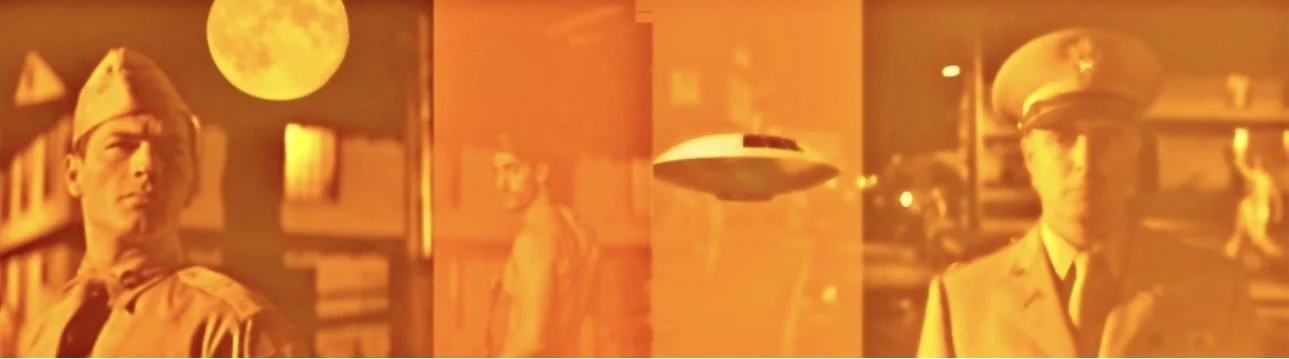
The Closet Series does not offer a resolution. It offers a record. These five collages place specific men and specific moments inside the longer frame of that history — tracing the arc from the shadows of the military closet to the billboards of Times Square to the gay clubs of New York, where a young straight man took off his shirt and offered the pretense of love.

The pretense is the point. It always has been.

— Behan

Legend

gayplay* — the strategic performance of gay identity by straight men for commercial gain.

play gay* — to enter and inhabit gay cultural space temporarily and instrumentally, for profit, without authentic claim to that identity.

popndrop* — the pattern by which straight men court gay audiences for commercial purposes, then withdraw once the transaction is complete, leaving no accountability behind.

spinetime* — the understanding that time is the central axis of queer experience; that where you fall on the timeline determines, in large part, what your life is permitted to be.

*See The Closet Series Vocabulary: A Working Dictionary for full entries.

Sources

• Dallas Voice, Nick Jonas interview (November 5, 2014)

• OUT Magazine, Nick Jonas cover interview (May 2016)
• Refinery29, “Nick Jonas LGBT Issue” (May 2016)
• Flavorwire, “Nick Jonas Looked into the Abyss of the Gay Male Gaze” (June 2016)
• The Advocate, Elizabeth Montgomery interview (July 30, 1992)

• HuffPost, “Remembering Elizabeth Montgomery: 9 Queerest Moments of Bewitched” (2015)

• LGBTQ Nation, “The gay secrets behind the classic TV sitcom Bewitched” (March 2021)

• The New York Times, Bruce Weber and Mario Testino sexual misconduct investigation (January 13, 2018)

• Business of Fashion, additional Bruce Weber allegations (January 2018)

• Five male models v. Bruce Weber, federal lawsuit (December 2018)

• Kate Moss, Vanity Fair (2012); BBC Radio 4 Desert Island Discs (2022)

• Mark Wahlberg, The Guardian interview (2020)

• Attitude Magazine, “Mark Wahlberg’s alleged homophobic past revisited in Love Story” (February 2026)
• The Daily Beast, “Mark Wahlberg’s Hate Crime Past Dragged Back Into Spotlight by Ryan Murphy” (February 2026)
• Calvin Klein, Vanity Fair interview (March 2008)

• People Magazine, “Inside Calvin Klein’s Dating History” (2024)

• Getty Images: Marky Mark Calvin Klein billboard, Times Square, March 13, 1993

• Mark Wahlberg net worth: Parade, Celebrity Net Worth (2026)

• Nick Jonas net worth and album sales: AOL / Dick Dale (2016)