On Percentage

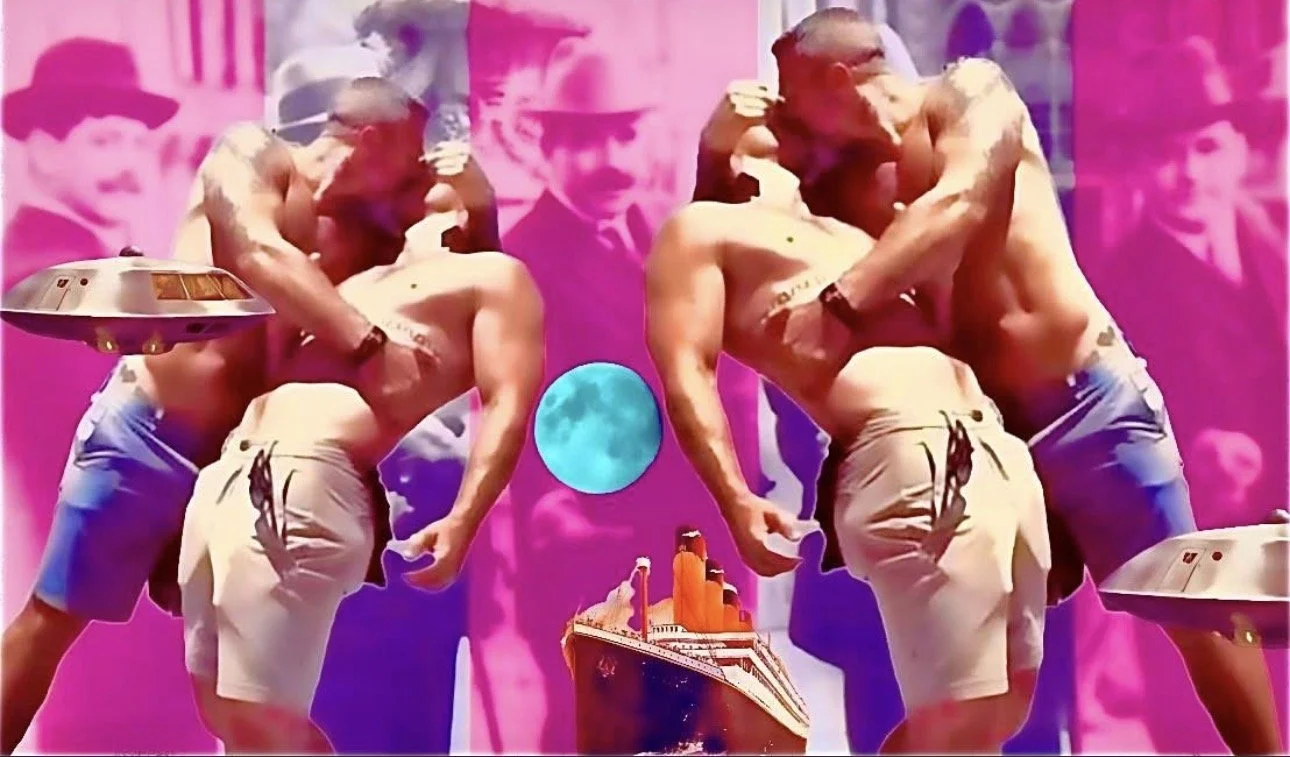
Interrupted Lives, Interrupted Voyage | Digital Photo Collage | 2026

Historians estimate that between 110 and 220 of the roughly 2,200 people aboard the Titanic would have had same-sex attractions. We know seven names.

Frank Millet, American painter. Major Archibald Butt, military aide to two American presidents. They shared a house for years and are widely believed to have been romantically involved.

Ella Holmes White and Marie Grice Young, who shared First Class stateroom C-32 and lived their lives together.

Thomson Beattie, Thomas McCaffry, and John Hugo Ross — the Three Musketeers of Winnipeg, bon vivants, possible Edwardian throuple, inseparable to the end.

All lost. April 15, 1912.

Because coming out in the modern sense was not an option in 1912 for legal reasons alone, biographical details are the only clues history left us.

Seven names.

Hundreds of stories we will never know.

Ramón

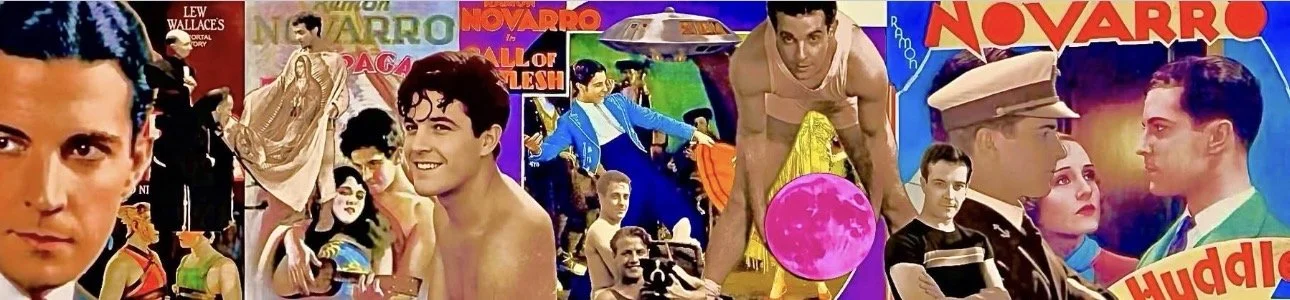
Yes, Silent Film Star Ramón Novarro and Argentine Olympic Swimmer José Caraballo Were Lovers in the 1930s | Digital Photo Collage | 2026

Ramón Novarro.

Mexican-born.

Ben-Hur.

Hollywood’s Latin Lover.

One of the most handsome and highest paid Hollywood stars of the 1920s and 1930s.

Gay his entire life. In the closet his entire life.

MGM marketed him as a straight romantic lead while studio executives privately knew the truth. He struggled to reconcile his sexuality with his devout Catholic faith and the brutal homophobia of his era.

In 1934 he met José Caraballo, a 19-year-old Argentine Olympic swimmer, in Buenos Aires and brought him back to California. They were lovers for a year and a half. He cast José as the lead in his 1935 film Contra la corriente.

Then they parted.

That contradiction — a life lived fully in private, carefully erased in public — defined everything. His hidden life coming into the light only at the very end thru antigay violence.

Prelude

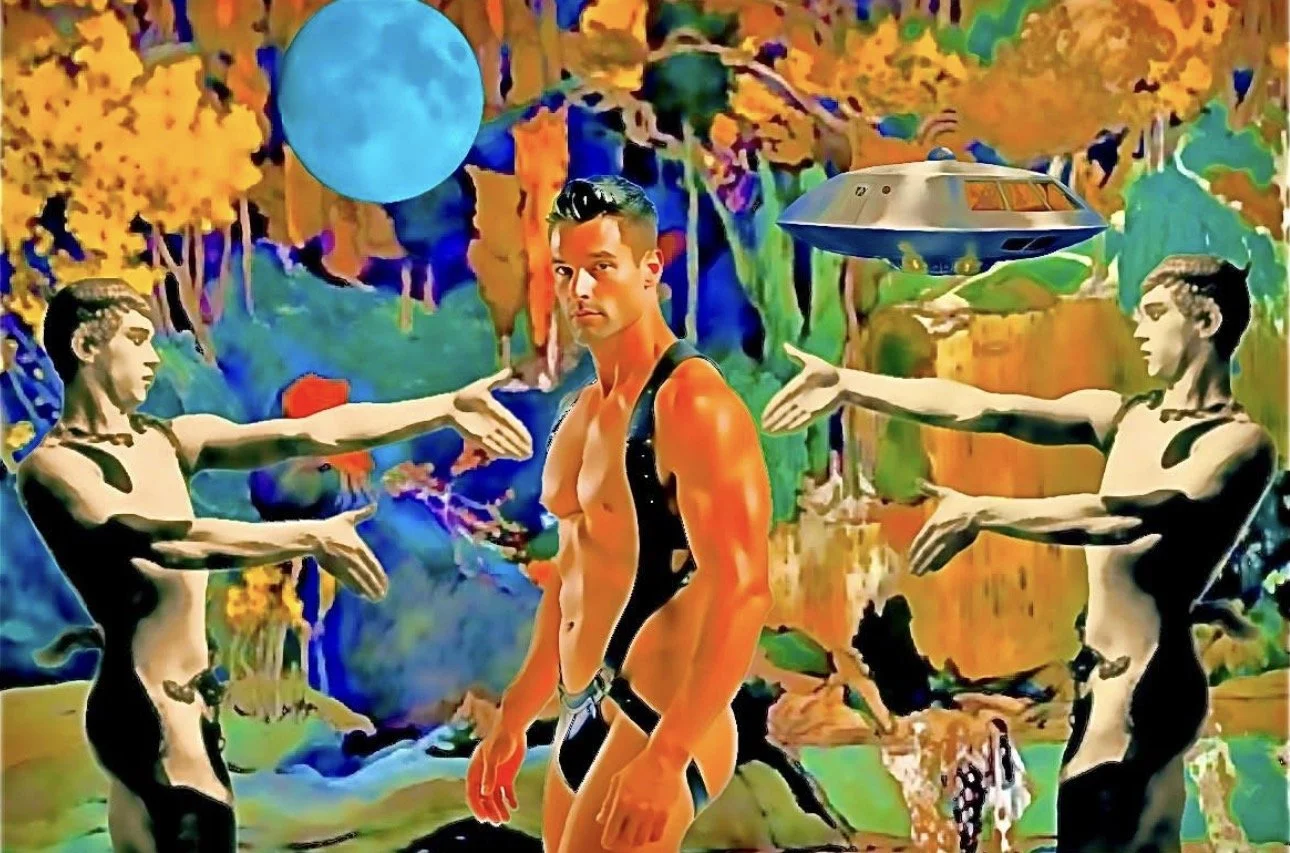
Prelude to the Afternoon of a Faun | Digital Photo Collage | 2026 | The Closet | The Subdivision

In 1912 Vaslav Nijinsky choreographed and performed Prélude à l’après-midi d’un faune for the Ballets Russes, causing an international scandal with its frank, unapologetic sensuality.

Nijinsky was bisexual. His lover and patron was Sergei Diaghilev, director of the Ballets Russes.

The desire was always there. Everyone saw it. Nobody named it.

The fauns in this collage are Nijinsky himself — his own image from the original 1912 production, doubled, reaching from across 113 years toward a man from 2025, against the original ballet’s backdrop.

The Crown

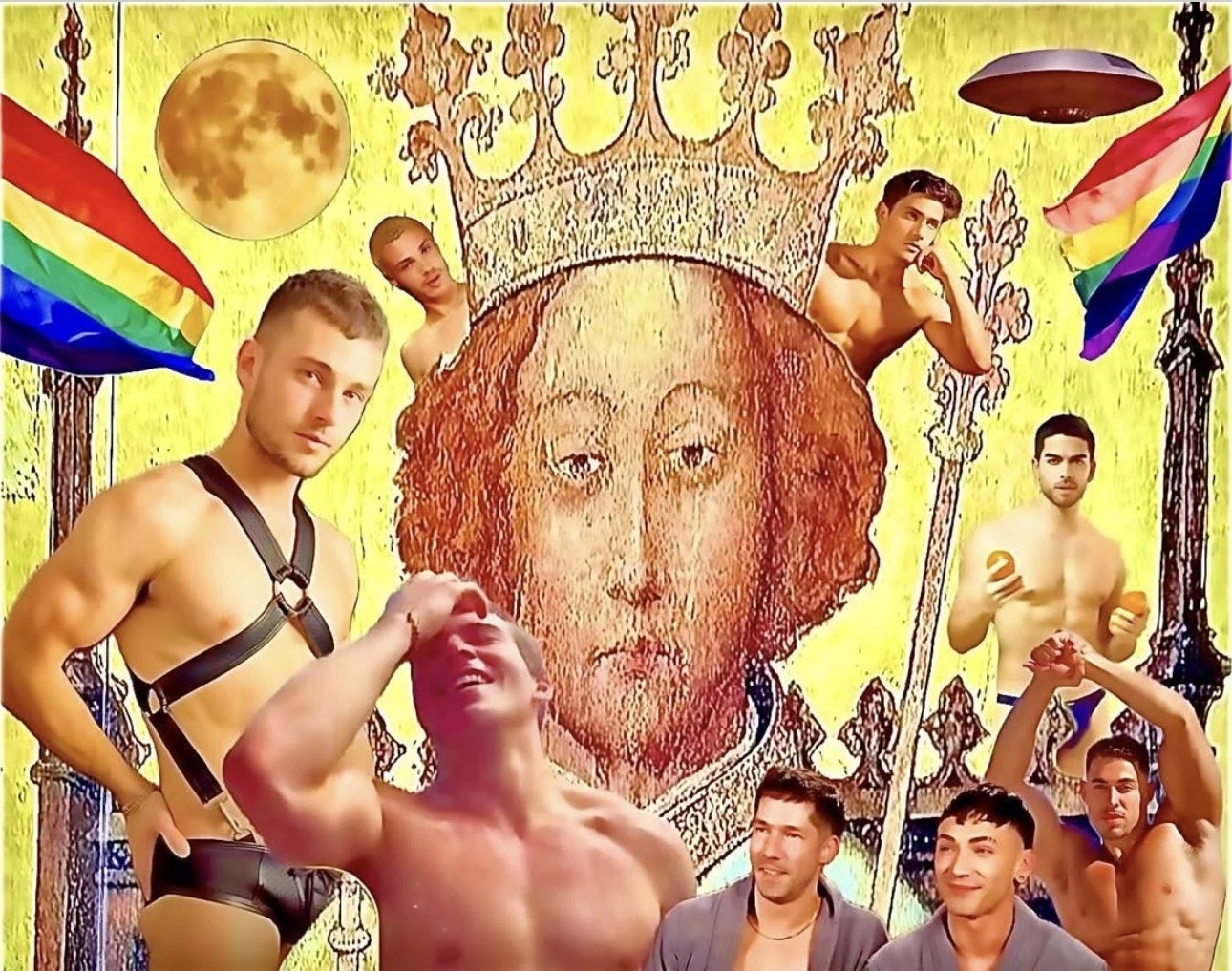
Crown | Digital Photo Collage | 2026 | Gay Domestic | The Subdivision

Marriage is the crowning achievement of humanity — the triumph of partnership, the art of long conversation, the continuous practice of choosing each other.

Gay people have always known this.

Gays didn’t fight for the right to marry because it was convenient. Gays fought for it because they understood its value.

The crown belongs to all.

Orange You Glad

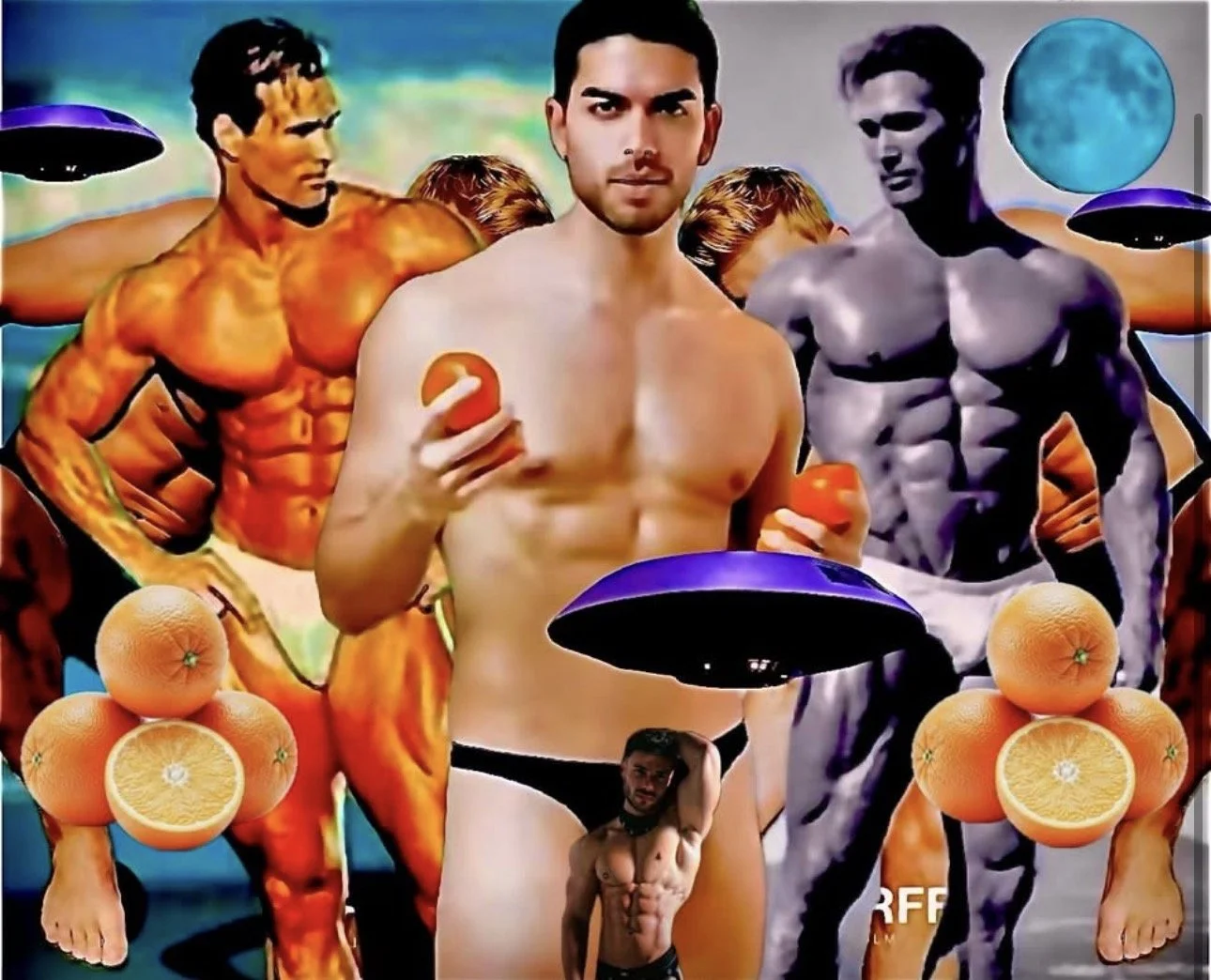
Orange You Glad | Digital Photo Collage | 2026 | The Closet Series — Behan |

Married adults live 1.5 to 2 years longer than their unmarried peers.

Married men have a 46% lower rate of cardiovascular death.

Married individuals engage in preventive care at higher rates than unmarried adults.

Married adults report shorter hospital stays, fewer doctor visits, and less need for nursing home care.

Married adults are 16 percentage points more likely to rate their lives as thriving.

Millennial and Gen Z married adults report 15-16% better mental health than their single counterparts.

The science is not ambiguous — marriage is good for you.

That is why it should belong to everyone.

Perfect

Perfect Fit | Digital Photo Collage | 2026 | The Closet | The Subdivision

Spotted in the Wild:

The Closeted, Preening Gay Peacock. Jeremy has Married Sally, and they are Looking for a New (Old) Home to Purchase.

Their Agent is Jax, Jeremy’s Best Friend, Best Man, and Best Camping Bud. Jax is Bringing Oranges to Remind Jeremy of their Vacation in Florida to Tour Orange Farms.

Sally Thinks Jax is Super Sweet and Doesn’t Mind that He is Around ALL THE TIME.

The Closet offers straight women one option.

Lots of trips to Home Goods with Jeremy and Sally. Frequent camping trips with Jeremy and Jax.

The Closet fits everyone inside its walls — with room to spare.

Dark Sepia

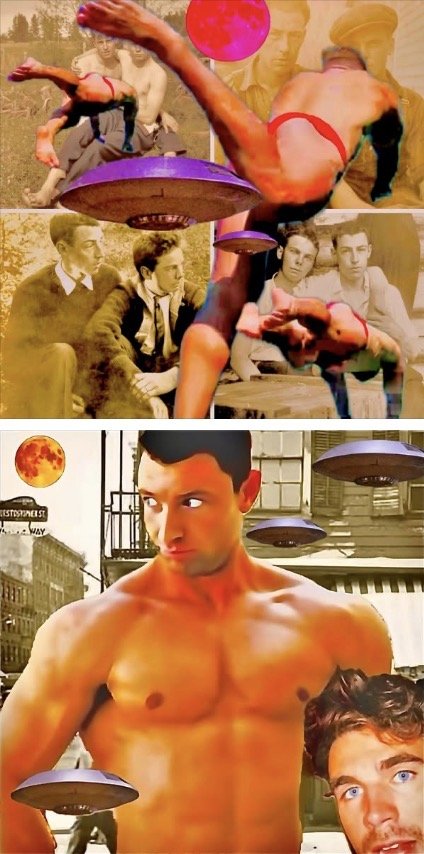
Dark Sepia | Digital Photo Collage | 2026 | The Closet Series — Behan |

“Len” Keith and “Cub” Coates of Havelock, New Brunswick. Two WWI army vets who found each other in a small rural town and built a life together.

What are the odds?

For almost 30 years, Len pointed his camera back onto themselves. Canoeing. Hunting. Hugging.

One was forced out of town.

The other married.

The photographs survive.

Beholden

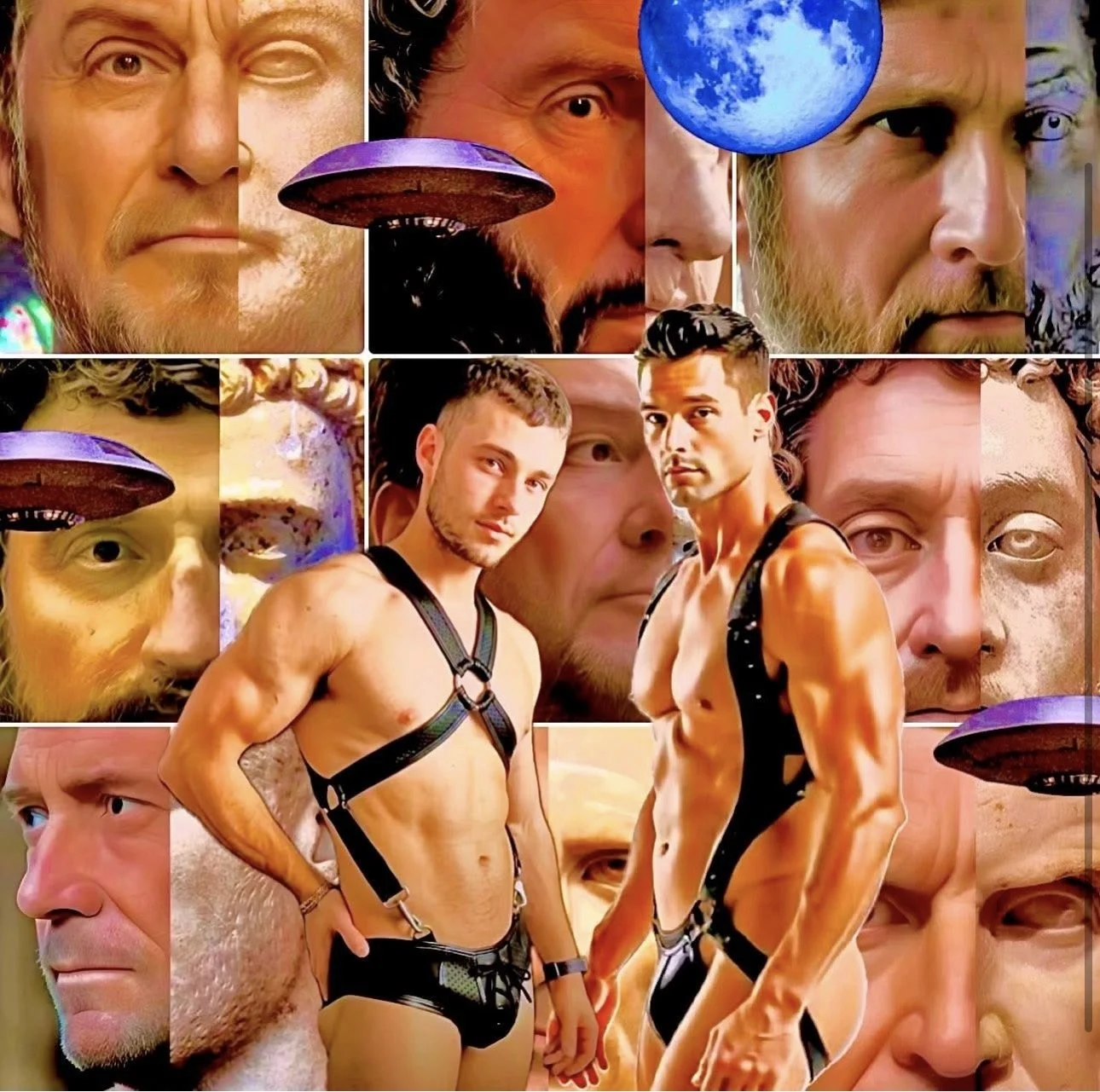
Behold the Man | Digital Photo Collage | 2026 | The Closet | The Subdivision

Behind the marble, behind the scripture, behind the press release, behind public opinion, is the man.

And that man is entirely human — gay, bi, or straight — filled with the same dreams of success, achievement, happiness, adventure, love.

As Maya Angelou said, “we are more alike, my friends, than we are unalike.”

And to quote one of the less used lines of scripture — whatever you do to the least of my brothers.

I Do, Do U?

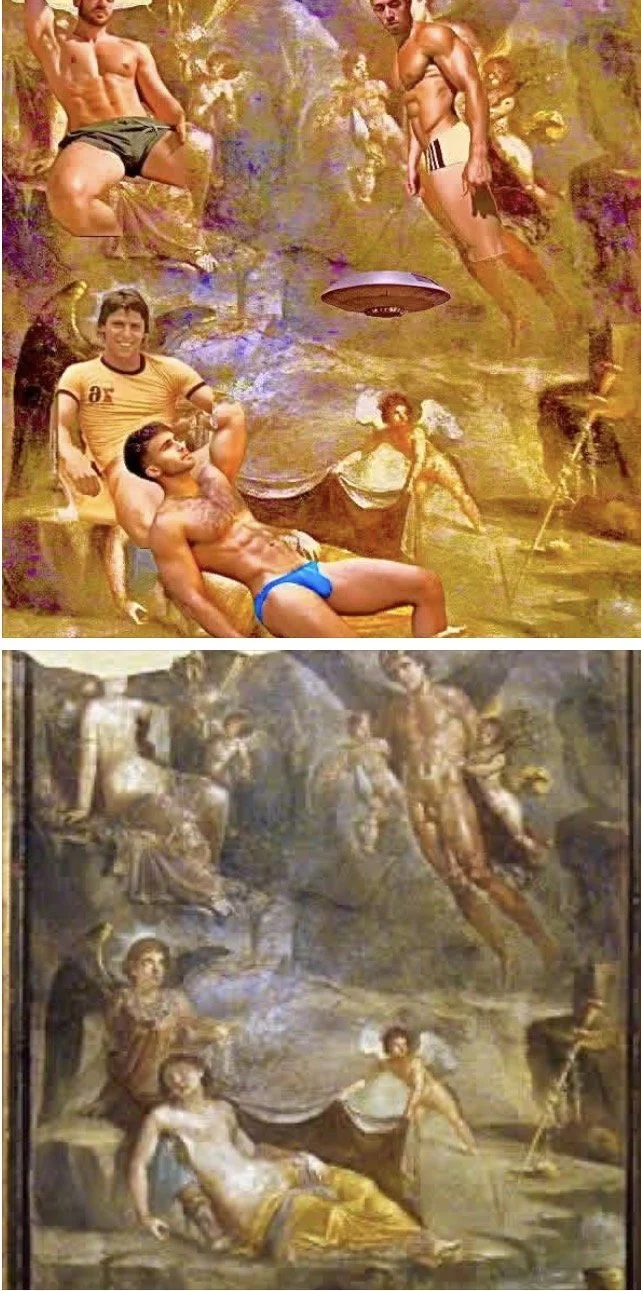
I Do | Digital Photo Collage | 2026 | The Closet Series — Behan |

Zephyrus carries Chloris and everything resolves.

That is what marriage does. It resolves. It answers the oldest human desire — to be chosen, to be held, to belong to someone and have them belong to you.

When marriage is available, resolution is possible.

When it is withheld, nothing can fully settle.

Gay marriage is not a political position. It is the resolution of an ancient human longing.

Desire, finally answered.

Bull

Bull | Digital Photo Collage | 2026 | The Closet Series — Behan |

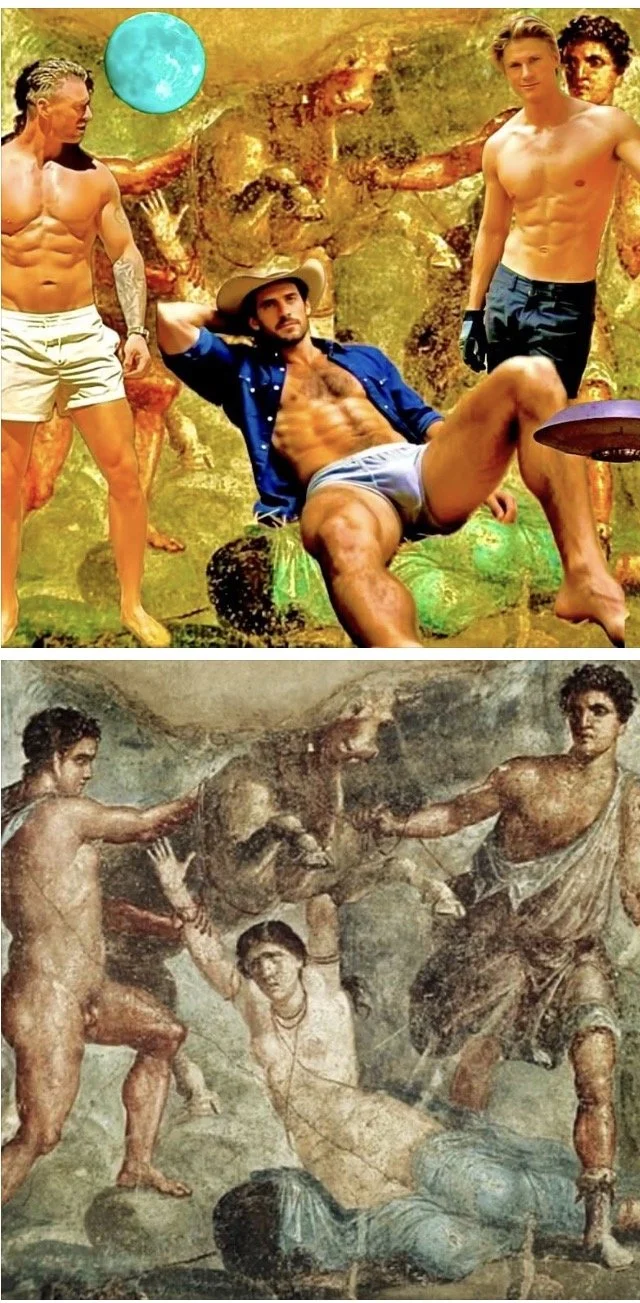
In the Pompeii Fresco, the bull was unimaginable force, and for Dirce, a reckoning. Then Vesuvius—another unimaginable force with tragic circumstances.

Two thousand years later the bull is still a force to be reckoned with. Industrialization. The iPhone. Artificial intelligence. Unimaginable force meeting the human condition, changing everything.

That is ancient.

That is now.

After Ornan

After Ornan | Gay Domestic | The Subdivision | Digital Photo Collage | 2026

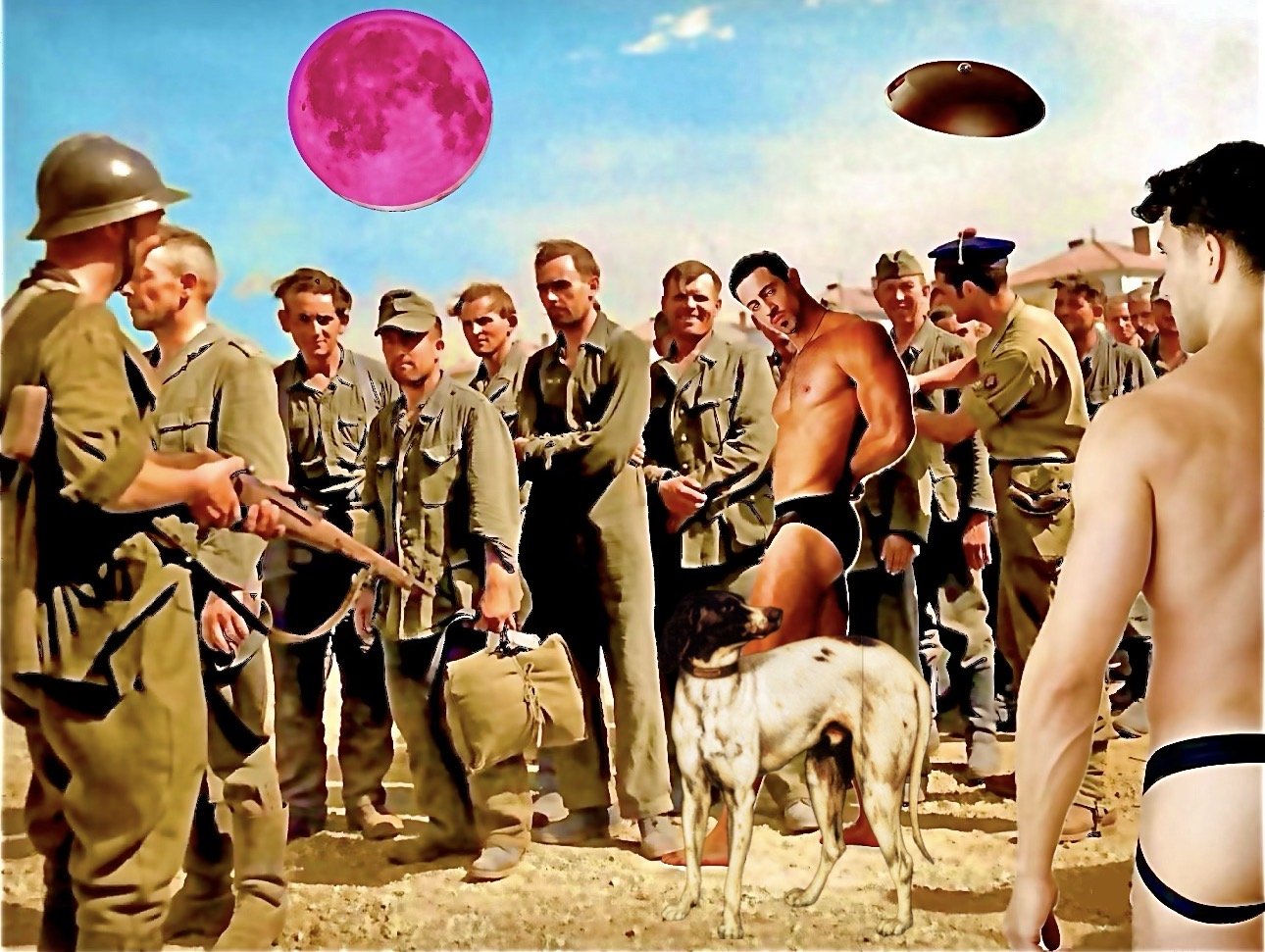
Homage to Gustave Courbet’s “A Burial at Ornans” (1851)

Gustave Courbet painted ordinary people’s grief at monumental scale — radical in its time, insisting that ordinary lives deserved to be witnessed. The dog at the graveside. The faces of the forgotten. This work carries that tradition forward.

Gay men served in every army of every nation in every war ever fought. They served bravely, in secret, under constant threat — not only from the enemy but from their own commanding officers. In the American military alone, an estimated 650,000 to 1.6 million gay men served in World War II. Those discovered faced dishonorable discharge — stripped of benefits, healthcare, and dignity. The ones who died in battle were buried with honors they were never fully granted in life.

Here French soldiers and captured German soldiers stand together — enemies united in youth, in vulnerability, in the bodies that war would consume. Among them, hidden in plain sight on both sides of every front line, gay men who loved in secret and died without acknowledgment.

Young men. Old men’s wars.

The dog from Courbet’s graveside is here too. Still watching. Still witness to what we lose.

In the end, in every generation, we all want the same thing — to be treated with dignity and respect. Nothing more. Nothing less.

The Closet

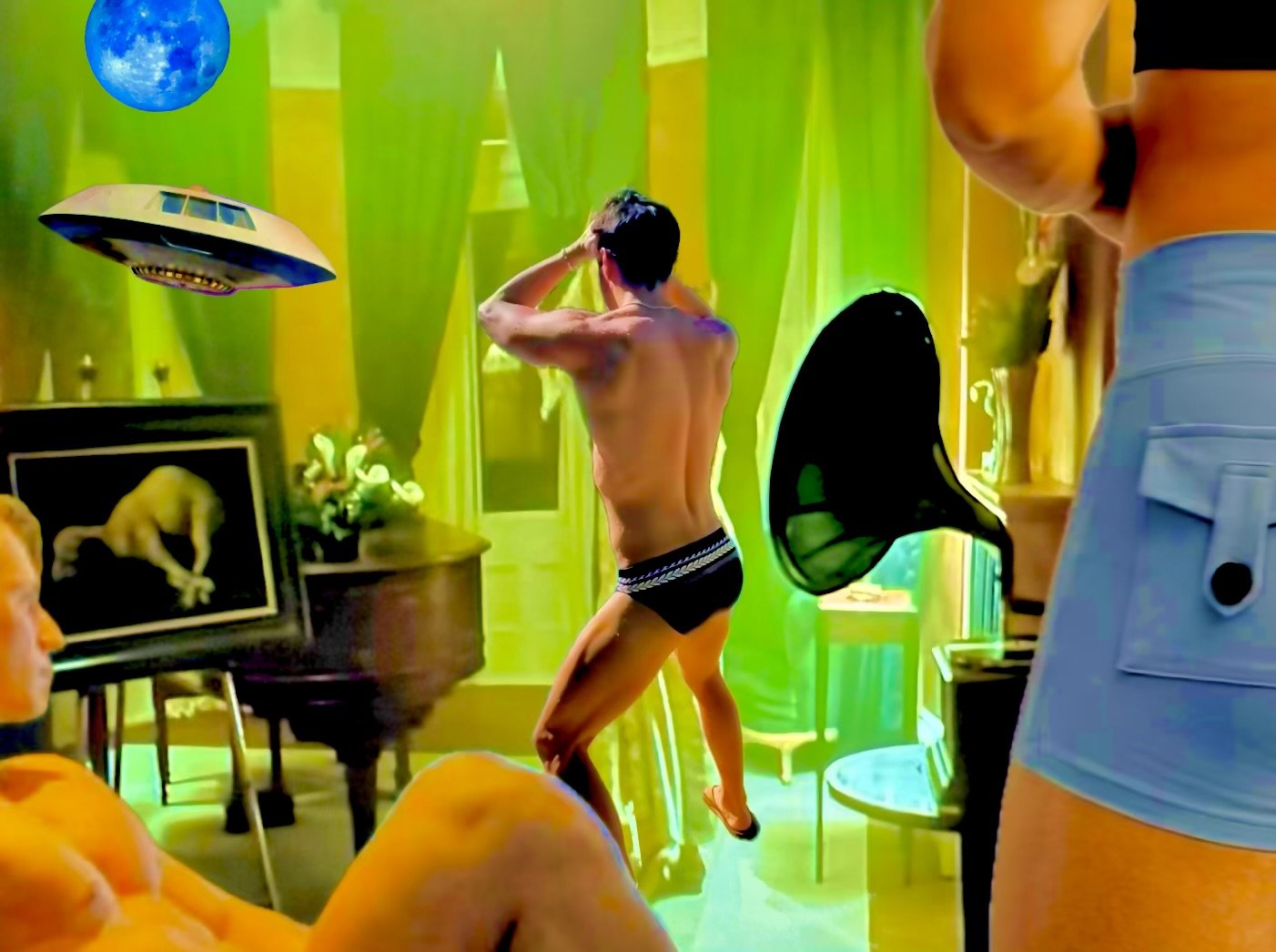
The Education of Jeffrey Wicks | The Closet | Digital Photo Collage | 2026

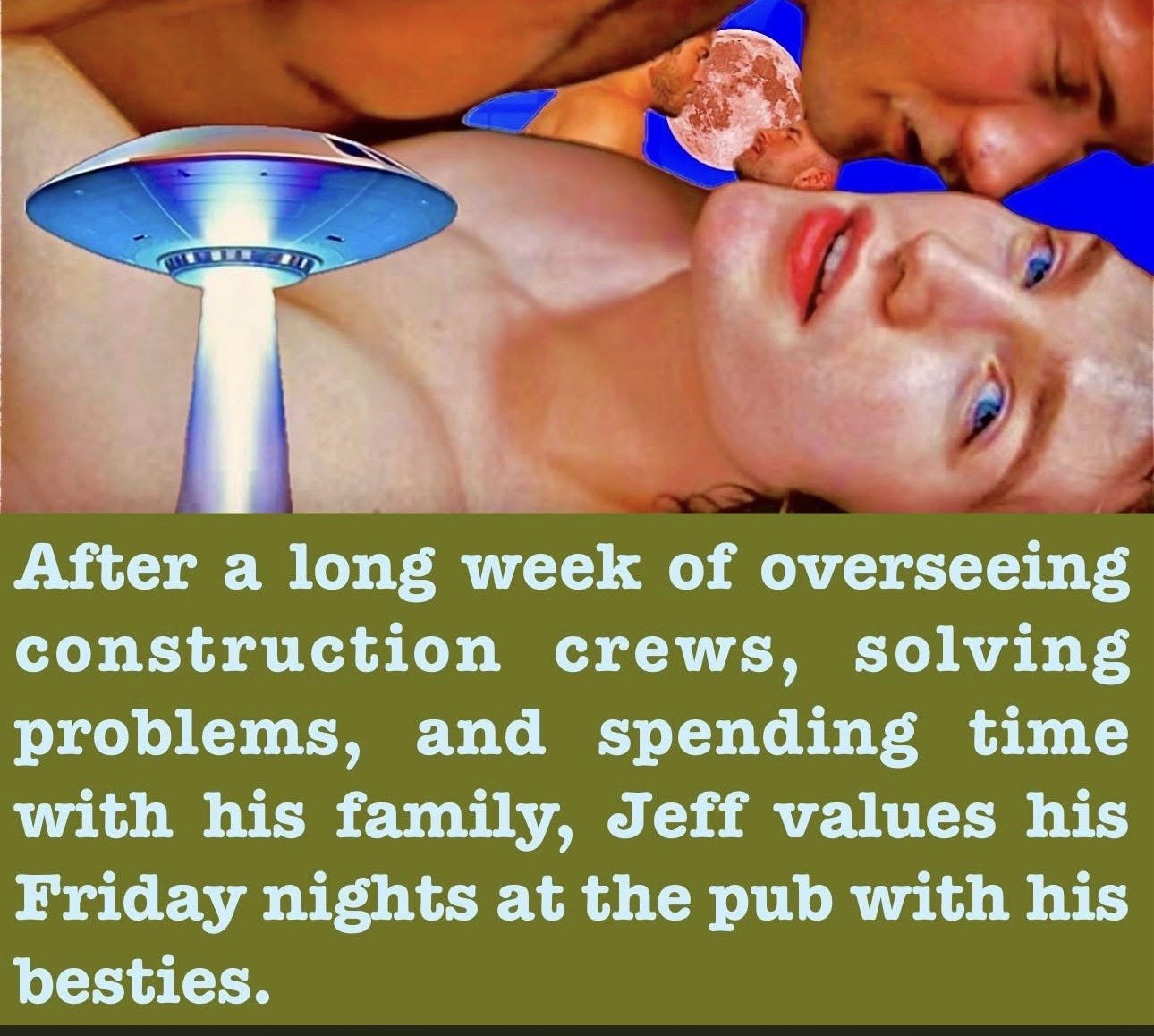
Jeff has never yet used the word that describes him.

He doesn’t need to.

Every Friday night at the pub he orders the same beer, laughs the loudest, stays the latest. His besties know something he hasn’t said. They stay anyway. They always stay. Jeff has that sway.

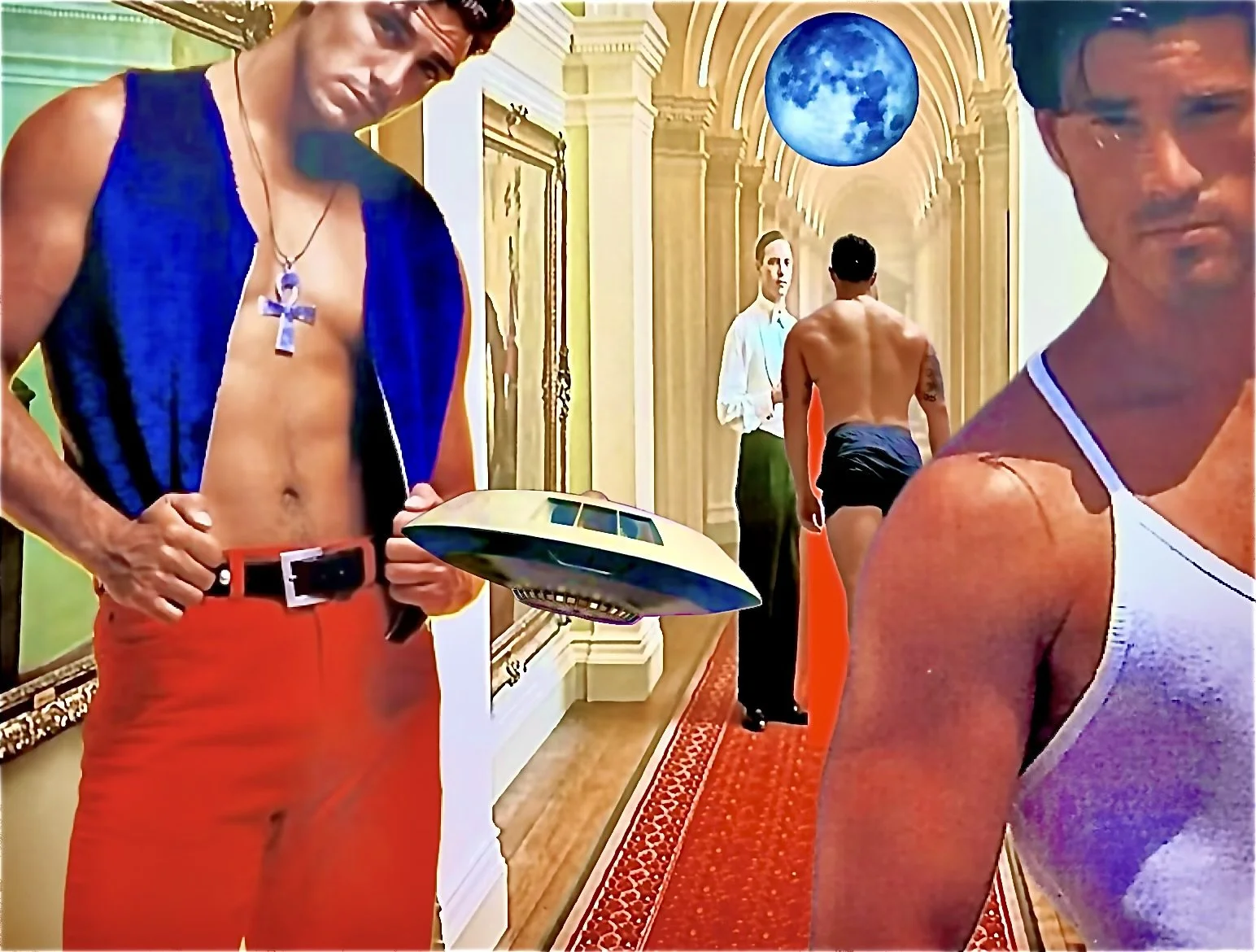
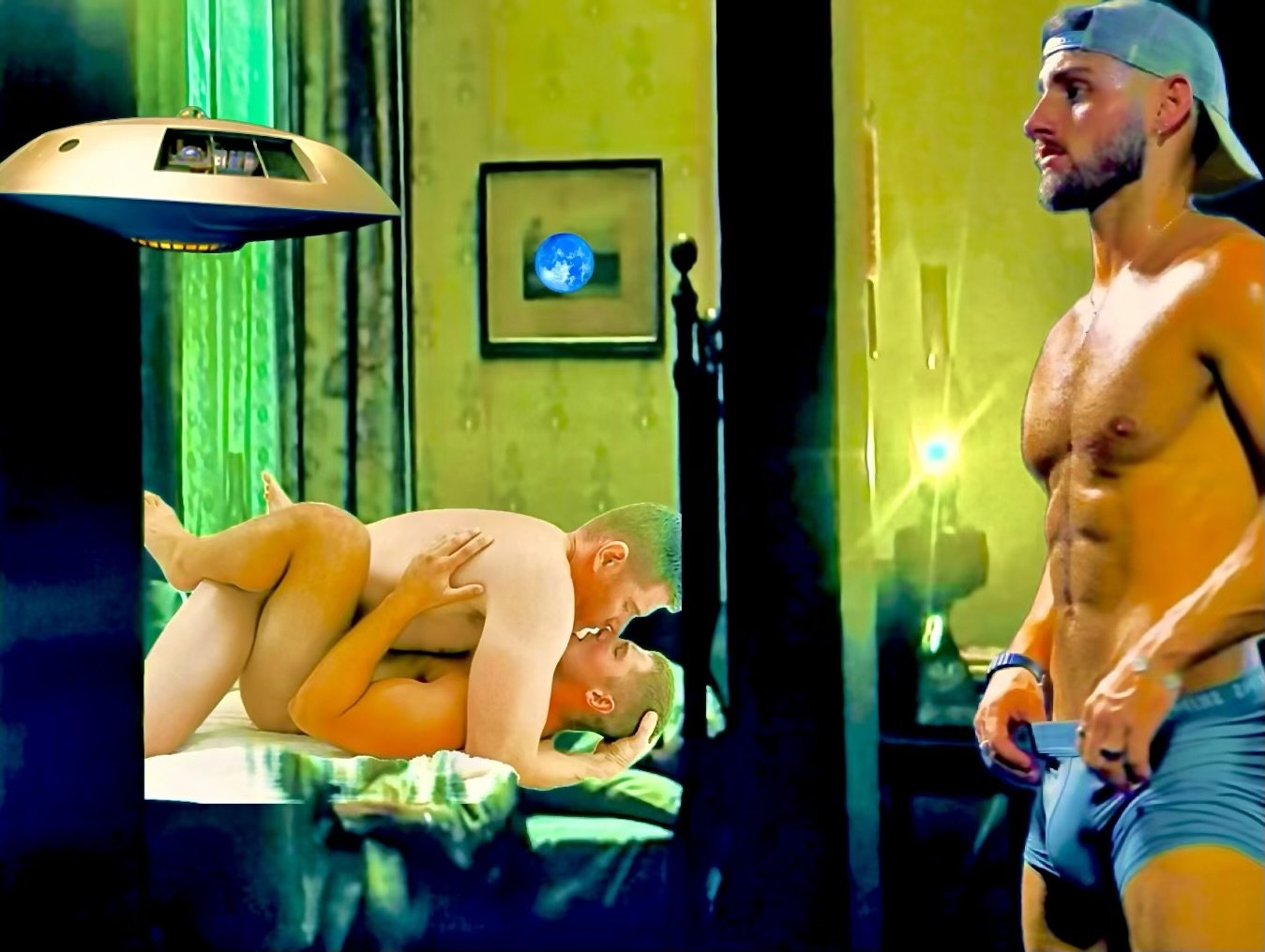
Jupiter 3 passes overhead quietly. Empathy sensors don’t require a label to recognize what’s being read. This has been recorded a thousand times across a thousand years. Some things take time.

A man becoming himself — on his own terms, in his own way, — is one of the most beautiful things in the universe.

Live

LIVE | Gay Gaze | The Subdivision | Digital Photocollage | 2026

The infrastructures of intimacy have always been contested territory.

For the first time in history gay men can be seen — fully, intimately, on their own terms — without a gatekeeper. No studio. No intermediary. No hiding.

This freedom seems total.

There’s always someone who owns the platform.

Who controls what stays visible and what gets removed? Who profits from gay desire in 2026?

When billionaires own the infrastructures of intimacy — the platforms, the algorithms, the servers — what does chosen visibility actually mean?

Is broadcasting yourself liberation? Or a new kind of isolation?

The men who fought at Stonewall fought for the right to be seen. Who decides what being seen costs now?

In 3

Trifecta

James Behan

Digital Photo Collage

2026

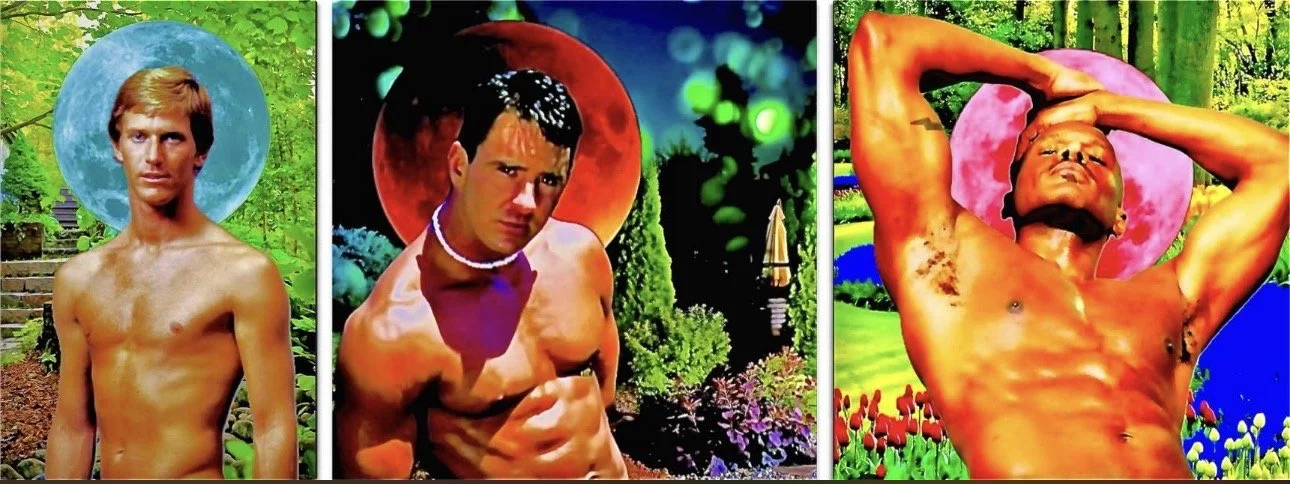
Casey Donovan • Tom Chase • Rhyheim Shabazz

1970s • 1990s • 2020s

Fifty years. Three men. One unbroken story.

This triptych from my ongoing series Stories from the Closet presents three figures from gay adult film history as what they truly are — saints, heroes, sacred presences deserving of reverence and remembrance.

Each man is crowned with the moon as halo, placed in a garden of his erar, honored as a figure of cultural significance. Because that is what they are.

Casey Donovan stepped in front of the camera in 1971 and did something that had never been done — he made gay male desire visible. Boys in the Sand was the first gay adult film to receive mainstream press coverage. In an era when gay men were criminals, Donovan said: we exist, we desire, we are beautiful. He built the foundation. He stands in Eden, in the innocent light before the storm.

Tom Chase tested HIV positive in 1989 at age 24. The diagnosis that killed an entire generation. He was supposed to disappear. Instead he built a celebrated career promoting safe sex at Falcon Studios through the 1990s, became the studio’s first lifetime exclusive model, was inducted into the GayVN Hall of Fame in 2004, and is alive today. He did not just survive. He thrived. He stands in the night garden, the blood moon burning behind him, defiant and magnificent.

Rhyheim Shabazz — the ground that was fought for has become the garden he stands in. He is the celebrant, the man whose joy is public. In 2024 he became the most watched performer in gay adult film, GayVN Performer of the Year — existing in a world transformed. The battles fought in shadow and fire have become new soil, rich with possibility — marriage, families, legal recognition. Living loud. Living forward. Living fully.

This is Queer Odysseus in three parts: forming culture, saving culture, celebrating culture, a trifecta of perseverance. The gay hero’s journey across half a century, this is what it looks like to take subtext and make it context.

Stories from the Closet is a daily practice of digital photo collage recovering, honoring, and celebrating the hidden and not-so-hidden history of gay men.

These are our saints. These are our heroes.

Great Guy

You’re A Great Guy | The Closet | The Subdivision | 2026 | Digital Photo Collage

Jogging paths and public parks in NYC had a well documented history as crucial queer social spaces throughout the 20th century, particularly from the 1970s through the 1990s. Central Park’s Ramble was perhaps the most famous — a densely wooded area that had been a gathering place for gay men since at least the 1950s. Riverside Park, Prospect Park, and various piers along the Hudson served similar functions.

These spaces were simultaneously joyful and dangerous. Police harassment was constant and often brutal. The AIDS crisis cast a long shadow over these gatherings through the 1980s. Yet they persisted — because for many gay men they represented the only available social and intimate space outside of bars.

Not all gay men went to bars. Many were too closeted. A jogging path offered something bars couldn’t — plausible deniability. You’re exercising. You happen to encounter someone with similar interests. You can assess attraction. You’re away from work, away from home, away from witnesses. Something might happen. Or nothing might. But the possibility existed in a way it did nowhere else.

That’s what these spaces meant. Freedom. Possibility. The chance to be yourself, however briefly.

Crossing

“The CrossIng”| The Subdivision | 2026 | Digital Photo Collage

They were young.

They were beautiful.

They were taken.

The AIDS crisis did not discriminate in who it claimed — but the world discriminated deeply in how long it waited to care.

An escape that would never come. A rescue that would never arrive.

Time after Time

New work from Stories from the Closet.

The four figures in the center are contemporary — men of the 2020s. The suited gentleman on the right is Troy Donahue, the 1950s Hollywood heartthrob, representing an era when respectability and concealment were the same thing. The figure on the left is JW King, celebrated gay adult film star of the 1980s, who represented something else entirely — visibility, defiance, and the brief extraordinary window of sexual liberation before AIDS changed everything.

The intent was to bring representations of the male figure across the decades into the same space. Dressed versus undressed. Hidden versus visible. The constraints of the 1950s in conversation with the liberation of the 1980s and the relative freedom of today.

They never could have existed in the same room in real life. That impossibility is precisely the point.

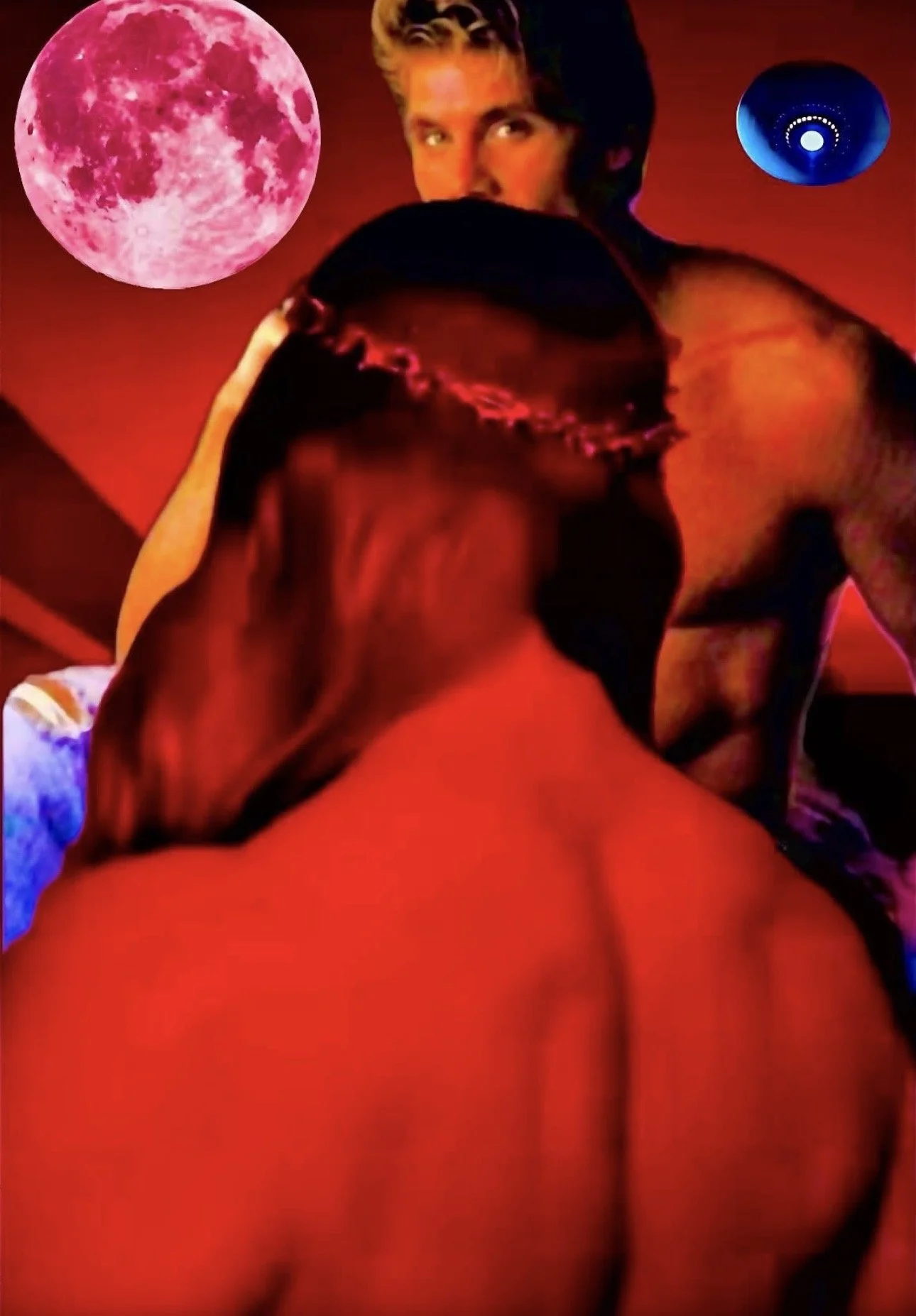
The pink moon and the Jupiter 2 keep watch overhead, as always.

In and Out

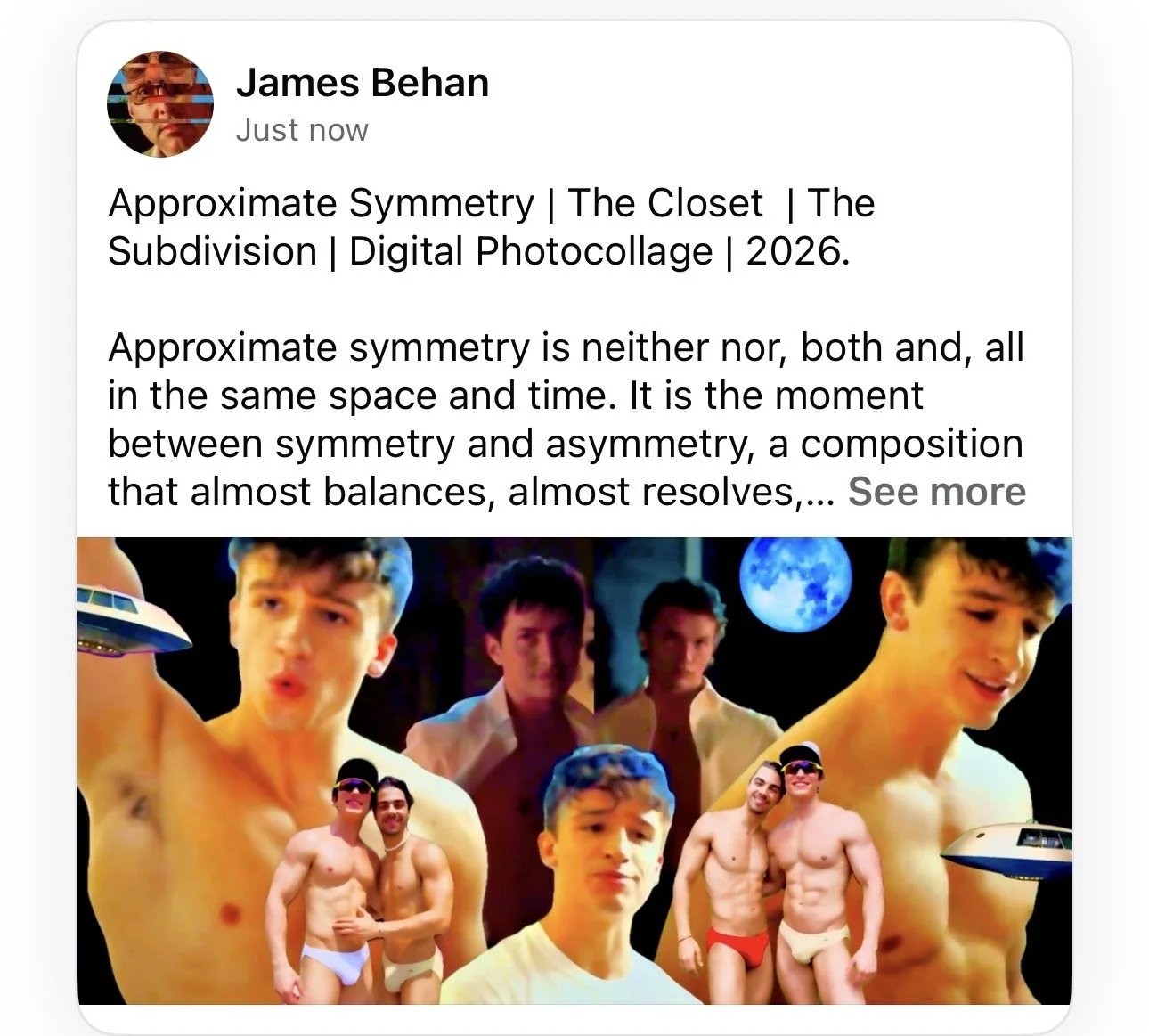
Approximate Symmetry | The Closet | The Subdivision | Digital Photocollage | 2026.

Approximate symmetry is neither nor, both and, all in the same space and time. It is the moment between symmetry and asymmetry, a composition that almost resolves and then declines at the same instance. A form that lives in the gap between two states is a form under pressure, and that pressure, held long enough, becomes its own kind of diamond.

In my newest collage “Approximate Symmetry,” the title is both compositional and spatial at once. A backdrop from Heated Rivalry, whose leads play gay with total commitment on screen and total silence off it. In front, a content-creator pairing who wink at being a couple without ever confirming it, keeping it at the level of are they or aren’t they, a question that probably does more tfor engagement than an answer ever could. Crossing the whole frame, the male odalisque: the body offered as content, desire without an owner. Three ways of visiting queer space without living in it.

That’s where queer people sit today. Inside the culture and outside it. Consumed and disowned in the same gesture. Approximate symmetry as a description of a people’s position — always almost included, never quite settled — while straight culture keeps deciding, room by room, how much queerness it will allow in their world.

Social media is the gatekeeper, and the numbers say the door is closing. GLAAD’s 2026 Social Media Safety Index gives every major platform a failing grade. 2026 scores drop across the board, with X landing lowest at 29 out of 100, YouTube at 30 after an 11-point collapse, Instagram at 41, Facebook at 40, and Threads at 39. A 2025 survey of over 7,000 Meta users across 86 countries found LGBTQ people reporting more vulnerability since Meta’s early-2025 policy rollbacks. The report names the mechanism directly: platforms disproportionately suppress LGBTQ content through removal, demonetization, age-gating, and shadowbanning.

Like many gay content creators in the past year under this new administration, I’ve been banned outright from Instagram, Threads, and X. Facebook and TikTok are what’s left. Yesterday I was reported for one of my long past images and restricted for a day. Facebook could go next.

There’s no notice when that happens. An account is just gone, with no way to find out why, where, or whether it’s coming back. That’s how it goes on social media. So if I’m suddenly gone from Facebook, you’ll most likely know why.

Historically, gay people have been good at not going where they’re not wanted, physically and rhetorically, which in Western culture has been pretty much everywhere. Now that gay culture, gay lifestyles, and gay people are beginning to enter that public sphere in a visible, vocal way, the dom culture has a decision to make. And that decision is whether they’re going to keep treating gay people as a problem for them to solve.

Happy 4th.

Butler Blues

What If the Straight Character Were the Odd Man Out? | The Gay Domestic | The Subdivision | Digital Photocollage | 2026

Agatha Christie did not just write mysteries. She wrote England to itself. For four decades — the thirties, the forties, the fifties, the sixties — she was the country’s arbiter of manners, its national narrator, the voice that told the English who they were and how they behaved at a dinner party, in a drawing room, on the witness stand. Two billion copies. A play still running since 1952. When a culture rereads itself that many times through one writer’s eyes, that writer stops being an entertainer and becomes a mirror. The question is what the mirror leaves out.

Christie created, by conservative estimate, some three thousand named characters across sixty-six novels, a hundred and sixty-six short stories, and nineteen plays. Of those three thousand, three are openly gay — not coded, not “artistic,” not a knowing wink between women who share a house and a life. Three, named as such, on the page. Of those three, one is guilty of a crime.

That is one tenth of one percent of a fictional England standing in for the whole of it, against ninety-nine point nine percent who get to be everything else — heroes, victims, detectives, fools, lovers, killers, bores. A tenth of one percent who got to exist at all.

Was this cruelty? Probably not. Christie was educated, worldly, sharp enough to build the best-selling puzzle box in the history of publishing — she was not a woman who missed things by accident. Call it something closer to inherited blindness: a culture so certain of its own default setting that it never occurred to the culture, or its most famous novelist, that the setting was a choice.

So here is the visual experiment. Take one production of Witness for the Prosecution — the famous one, and a more recent film of it — and recast the ratio. Not one gay character in three thousand, but nearly everyone. The barrister, the wife, the accused, the men in the hallway, the man behind the camera. Heterosexuality becomes the rare exception instead of gay life. The shoe goes on the other foot.

The question these collages ask is not complicated: if the dominant culture were shown itself at one tenth of one percent, would it accept that as an accurate account of who it is? Or would it, finally, notice the mirror?

Symposium

Four Legs of the Same Table: Etty, Rose, Jess, Behan — Navigating the Closet Across Time

Two centuries of Western art-making, one throughline: the figure, the male figure, worked and reworked in two dimensions — painting, paste-up, collage — each man navigating the closet of his own moment, its rules, its strategies, its dangers, all of it still humming beneath the surface today.

1821 — William Etty, The Triumph of Cleopatra (painting)

William Etty spends this year becoming famous overnight. Cleopatra’s Arrival in Cilicia, painted in 1821, now hangs in the Lady Lever Art Gallery, ostensibly a history painting — Cleopatra’s court crowding a gilded ship bound for Tarsus, the queen herself laid out like an offering. But look at where the paint actually gets loving: the boys fanning her like attendant Cupids, the crowd of male bodies at the rail, bare-chested and closely observed, doing far more work in the composition than the plot requires. Cleopatra is the pretext. The male figure is the point — smuggled into a mythological scene respectable enough for the Royal Academy walls. Etty is a lifelong bachelor who attracts frequent speculation about his sexuality, and more recent scholarship has pointed to the eroticism of his male nudes and his regular visits to all-male bathhouses as evidence he may have been secretly homosexual. He doesn’t say the word. The bodies at the rail say it for him.

1939 — Francis Rose, L’Assemblée (painting)

Francis Rose spends this year the way he spends most years — gathered around Gertrude Stein, painting the salon that made him. On its face it’s a group portrait, the Stein circle assembled and immortalized in tribute. But the men in Rose’s crowds are never incidental. He’d already collaborated in his work with, and taken as his sometime lover, the English painter Christopher Wood, and the young men who keep turning up in his assemblies — decorative, watched, lingered over — are doing the same work Etty’s attendants do a century earlier: carrying the real subject inside a socially acceptable frame. He vacations with Cecil Beaton, Stein, and Toklas in Bilignin that year, and the assembly genre becomes his permanent alibi — paint the room, paint the patron, and let the men in the margins hold what can’t go in the center.

1951 — Jess Collins, Mousetrap (paste-up)

Jess Collins spends this year building a household. He lives with the poet Robert Duncan from 1951 until Duncan’s death in 1988, and his collages start doing what his paste-ups always do: pulling fragments from scientific treatises, muscle magazines, art history books, cartoons, and popular periodicals like Life and Time into staggeringly intricate symbolic narratives. Say that plainly — muscle magazines — and the pretext thins out fast. Under the cover of collage-as-salvage, as archive, as formal experiment, Jess is cutting and reassembling the same physiques Etty painted and Rose sketched, only now the material comes pre-printed, pre-circulated, hiding in plain sight inside a hobbyist’s genre nobody thought to interrogate. The mousetrap springs quietly. Nobody in 1951 is asking what a serious painter is doing with a stack of muscle magazines on the table. Jess never has to answer. The household absorbs the question before it’s asked.

2026 — James Behan, Symposium (collage)

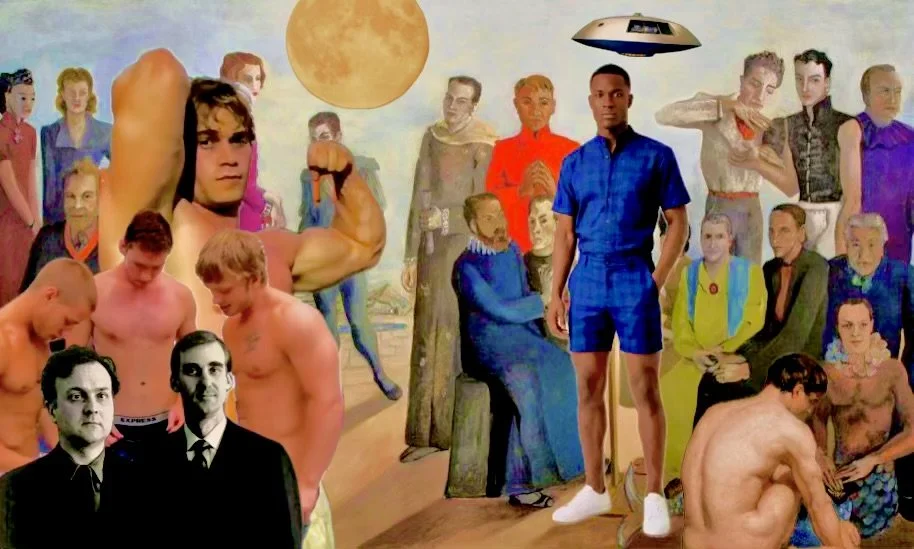
James Behan spends this year assembling the table itself. Symposium is built with Rose’s assembly painting as its foundation, the salon crowd repurposed as a stage. Etty’s painted male figure, once smuggled past the Royal Academy inside Cleopatra, joins the group directly, pulled free of its original myth and set down among the others at last, unhidden. A couple’s portrait of Duncan and Collins sits in the mix too, the household made visible instead of implied. Around them: four contemporary adult film stars, Jupiter 3 overhead, the Blue Moon, and a male model rounding out the full chroma of the piece — bodies from the present standing alongside two centuries of coded ones, no longer needing myth, salon, or domestic alibi to justify being looked at. Behan, an Irish-American dual citizen who found in photocollage a second creative life, works this material as part of The Subdivision — the same practice as the other three, one generation later, minus the pretext.

— Behan

Sources: Lady Lever Art Gallery / Art UK; National Museums Liverpool; National Portrait Gallery, Smithsonian; England & Co Gallery, London; askART; San Francisco Chronicle; The Paris Review.