Four Legs of the Same Table: Etty, Rose, Jess, Behan — Navigating the Closet Across Time
Two centuries of Western art-making, one throughline: the figure, the male figure, worked and reworked in two dimensions — painting, paste-up, collage — each man navigating the closet of his own moment, its rules, its strategies, its dangers, all of it still humming beneath the surface today.
1821 — William Etty, The Triumph of Cleopatra (painting)
William Etty spends this year becoming famous overnight. Cleopatra’s Arrival in Cilicia, painted in 1821, now hangs in the Lady Lever Art Gallery, ostensibly a history painting — Cleopatra’s court crowding a gilded ship bound for Tarsus, the queen herself laid out like an offering. But look at where the paint actually gets loving: the boys fanning her like attendant Cupids, the crowd of male bodies at the rail, bare-chested and closely observed, doing far more work in the composition than the plot requires. Cleopatra is the pretext. The male figure is the point — smuggled into a mythological scene respectable enough for the Royal Academy walls. Etty is a lifelong bachelor who attracts frequent speculation about his sexuality, and more recent scholarship has pointed to the eroticism of his male nudes and his regular visits to all-male bathhouses as evidence he may have been secretly homosexual. He doesn’t say the word. The bodies at the rail say it for him.
1939 — Francis Rose, L’Assemblée (painting)
Francis Rose spends this year the way he spends most years — gathered around Gertrude Stein, painting the salon that made him. On its face it’s a group portrait, the Stein circle assembled and immortalized in tribute. But the men in Rose’s crowds are never incidental. He’d already collaborated in his work with, and taken as his sometime lover, the English painter Christopher Wood, and the young men who keep turning up in his assemblies — decorative, watched, lingered over — are doing the same work Etty’s attendants do a century earlier: carrying the real subject inside a socially acceptable frame. He vacations with Cecil Beaton, Stein, and Toklas in Bilignin that year, and the assembly genre becomes his permanent alibi — paint the room, paint the patron, and let the men in the margins hold what can’t go in the center.
1951 — Jess Collins, Mousetrap (paste-up)
Jess Collins spends this year building a household. He lives with the poet Robert Duncan from 1951 until Duncan’s death in 1988, and his collages start doing what his paste-ups always do: pulling fragments from scientific treatises, muscle magazines, art history books, cartoons, and popular periodicals like Life and Time into staggeringly intricate symbolic narratives. Say that plainly — muscle magazines — and the pretext thins out fast. Under the cover of collage-as-salvage, as archive, as formal experiment, Jess is cutting and reassembling the same physiques Etty painted and Rose sketched, only now the material comes pre-printed, pre-circulated, hiding in plain sight inside a hobbyist’s genre nobody thought to interrogate. The mousetrap springs quietly. Nobody in 1951 is asking what a serious painter is doing with a stack of muscle magazines on the table. Jess never has to answer. The household absorbs the question before it’s asked.
2026 — James Behan, Symposium (collage)
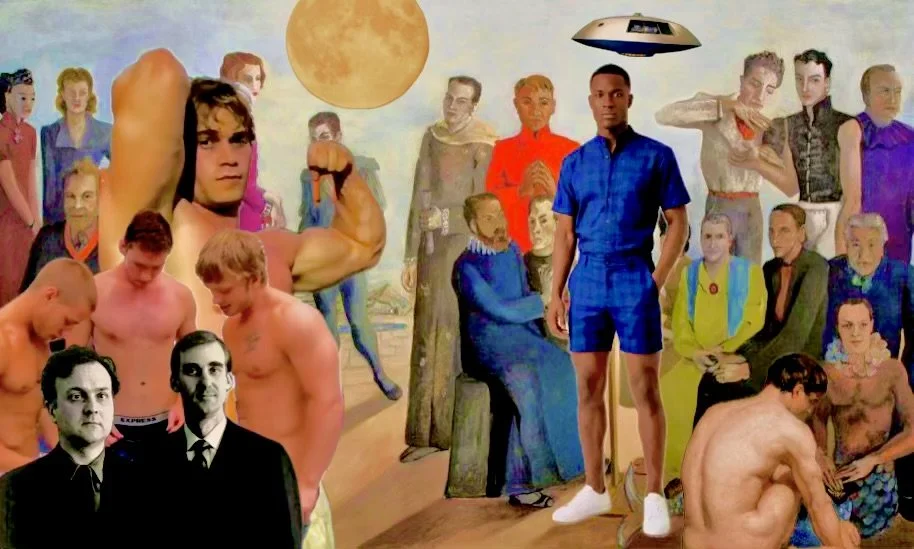
James Behan spends this year assembling the table itself. Symposium is built with Rose’s assembly painting as its foundation, the salon crowd repurposed as a stage. Etty’s painted male figure, once smuggled past the Royal Academy inside Cleopatra, joins the group directly, pulled free of its original myth and set down among the others at last, unhidden. A couple’s portrait of Duncan and Collins sits in the mix too, the household made visible instead of implied. Around them: four contemporary adult film stars, Jupiter 3 overhead, the Blue Moon, and a male model rounding out the full chroma of the piece — bodies from the present standing alongside two centuries of coded ones, no longer needing myth, salon, or domestic alibi to justify being looked at. Behan, an Irish-American dual citizen who found in photocollage a second creative life, works this material as part of The Subdivision — the same practice as the other three, one generation later, minus the pretext.
— Behan
Sources: Lady Lever Art Gallery / Art UK; National Museums Liverpool; National Portrait Gallery, Smithsonian; England & Co Gallery, London; askART; San Francisco Chronicle; The Paris Review.