Jess and James: Wild Wild West Collaging
The car has always been a closet with wheels.
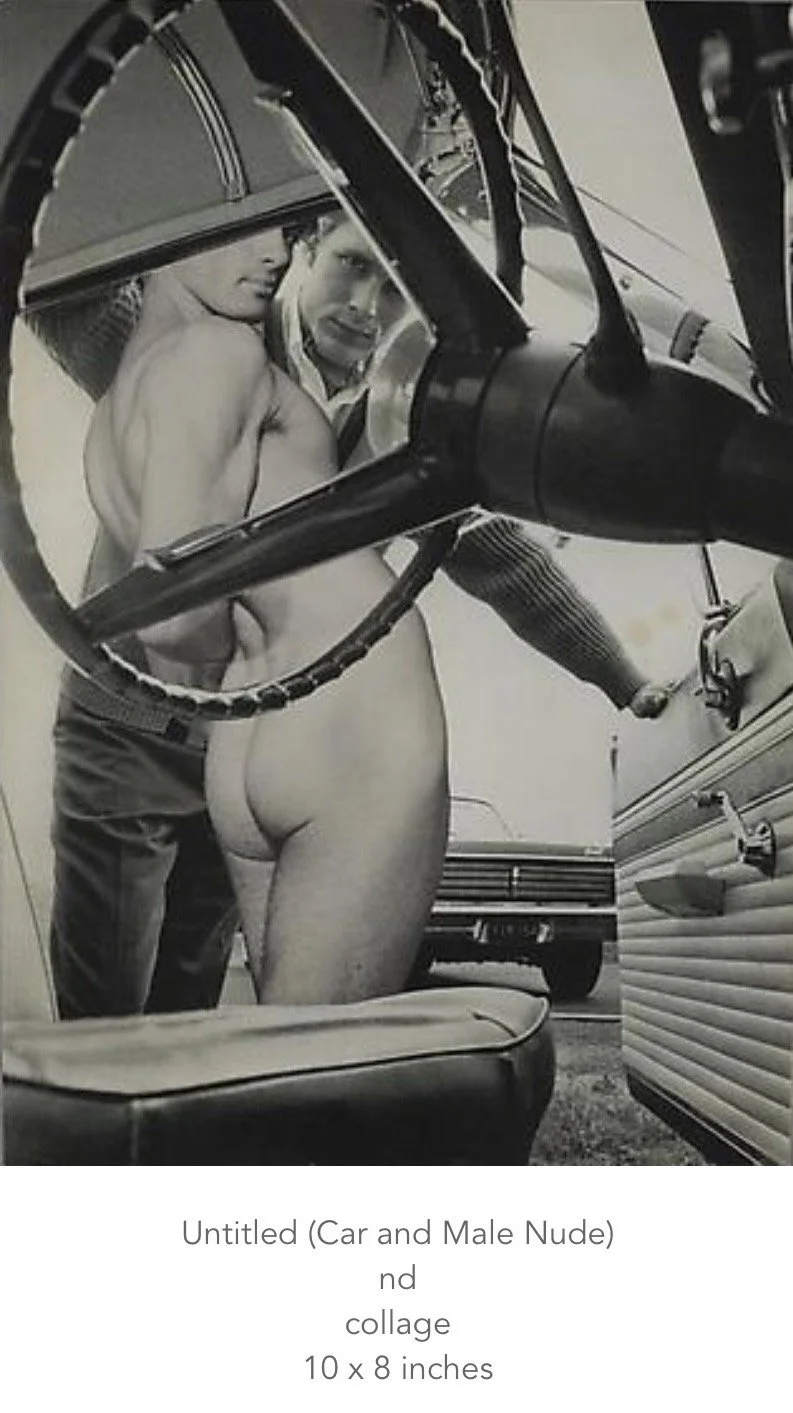
Untitled (Car and Male Nude) is the work of Jess — born Burgess Franklin Collins, a Cal Tech-trained chemist who worked on the Manhattan Project before he broke with his family, his given name, and his career in the same gesture, and gave the West Coast forty years of paste-ups instead. Jess built his life and his art alongside the poet Robert Duncan, his partner for thirty-seven years until Duncan’s death in 1988, and his household in San Francisco’s Mission District became, by every account, a workshop for two men who treated collage and companionship as the same discipline. He called himself, simply, Jess. San Francisco called him, at his death, its essential artist.
This particular paste-up mounts a black-and-white photograph inside a convertible’s steering wheel: a shirtless man caught in three-quarter profile, his companion pressed close behind him, both faces angled toward the camera and toward each other at once. The car’s dashboard mirror doubles the intimacy it frames. It is unmistakably a Jess — the antique chrome, the salvage-bin tenderness, the same instinct that filled Pauline Kael’s Berkeley walls with fantastical murals and populated a hundred collages with clippings rescued from thrift stores and muscle magazines alike.
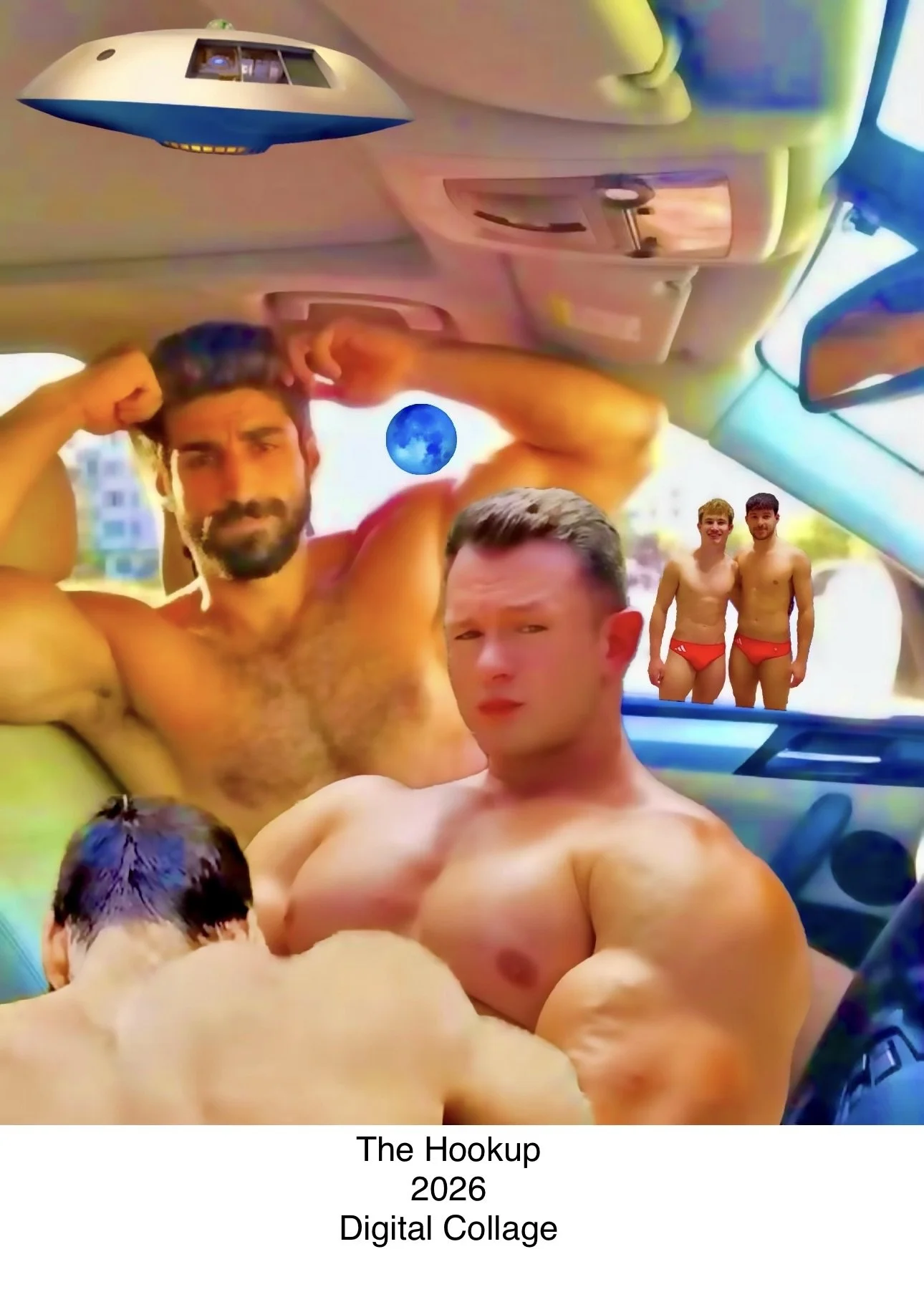
Call the newer piece James. The Hookup borrows the same ground, an automobile’s interior, but does almost everything else differently, and the difference is the argument — one queer collagist answering another across sixty years and an entire technological revolution in how the answer gets made.
Jess is a closed circuit. Two men, one gaze exchanged through a mirror rather than face to face, the dominant figure positioned in front, weight forward, the companion folded slightly behind and beneath him. The black-and-white palette does what monochrome always did for Jess and his generation: it flattens the erotic into the classical, the pin-up into the sculpture, the risk into something a viewer in 1960-whatever could plausibly call art history and mean it as cover. This is a couple, private by necessity as much as by choice. The car itself, its wheel, its window, its parked twin idling in the background, reads as a vessel built to seal exactly two men inside it, safely, from a world that had not yet made room for them anywhere else.
James steers away from this closed circuit toward the polyamorous pursuit of pleasure. The three figures in the foreground repeat Jess’s dominant-submissive architecture almost exactly, two men flexed and lit and facing outward, the other folded into his chest, head bowed in worship, seen only from behind. And a third element enters through the side window: two more men, small, distant, dressed alike in red, watching from what might be a beach or might be nowhere at all. The car that once sealed a couple inside it now has an audience. It is a stage; the fulsome relationship no longer bound by the frame.
This is the whole distance travelled between the two pieces. Jess documents desire as containment, an act performed where it can be private, historically because it had to be. James documents desire as visibility, an act performed where it can be seen, because in 2026 the getting-caught is no longer the danger. Color does this work as much as content does. Where Jess drains the image of hue to grant it the alibi of art history, James floods the image with a heat-lamp palette that refuses any alibi at all. Nothing here is trying to pass as a Wesselmann. It knows exactly what it is.
The dominant-submissive pairing survives the trip across sixty-some years intact. What changes is the room around it: two becomes a suggestion of many, private becomes witnessed, earthbound becomes interplanetary.
Jess and James parking. It tracks.
— Behan