Hide the Body
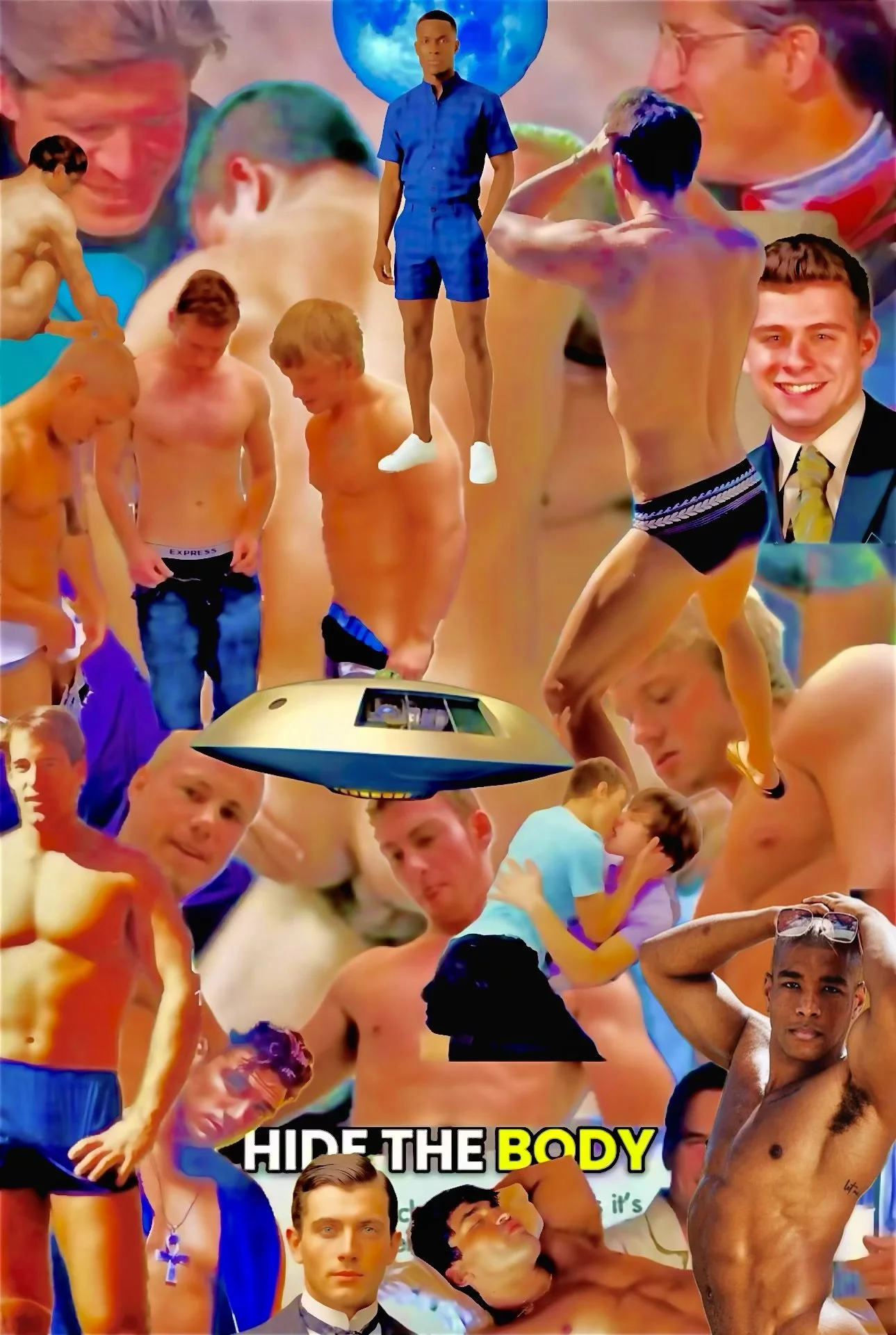
The Gay Gaze | The Subdivision | digital photocollage | 2026
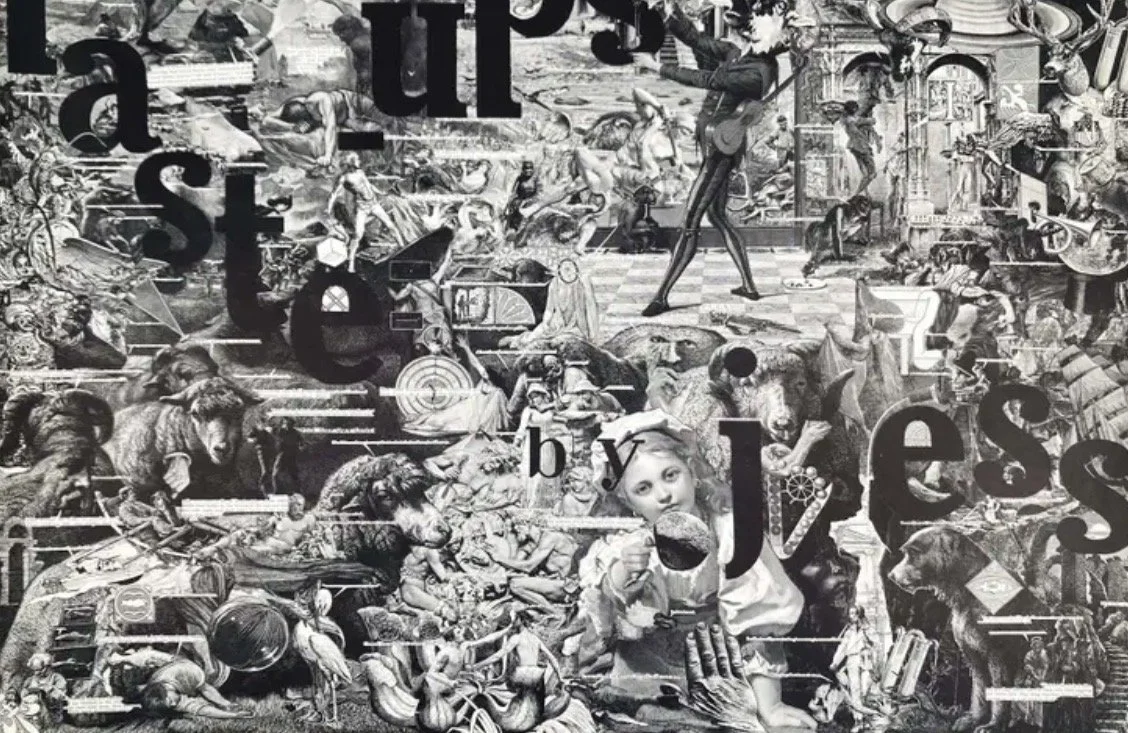
Folk collage has always been the closet’s native medium. Long before digital tools, gay artists were already doing this work with scissors and rubber cement — Ray Johnson mailing fragments of desire disguised as correspondence, Jess pasting men’s magazines into altarpieces nobody in 1955 was allowed to call altarpieces. The genre survived because it could say the unsayable in pieces. A photograph alone is evidence. A hundred photographs cut and reassembled is folklore.
Hide the Body borrows that same domestic scrappiness — the scale of a scrapbook page, the DIY seams left visible on purpose — and crowds it with the ordinary bodies of ordinary men: shirtless in driveways, adjusting waistbands, caught mid-laugh at somebody’s wedding reception. Jupiter 3 hovers above them, unbothered, doing what it always does in this work: witnessing without judgment. The flying saucer beneath drifts through the composition like a rumor nobody can quite pin down — is it comic relief, or is it the getaway vehicle every closeted man of a certain generation kept idling in his head, just in case?
Artist Focus: Jess
Jess Collins spent the back half of the twentieth century building “Paste-Ups” out of found magazines and domestic ephemera, a body of work that reads today as its own private grammar — meaning smuggled in through juxtaposition rather than stated outright. He came up through the Beat and San Francisco Renaissance circles, which gave his collages a mythological density most folk assemblage of the period didn’t bother with. He wasn’t interested in shock. He was interested in accumulation, the way a hundred small images can say what one image can’t afford to.
For thirty-seven years he was partnered with the poet Robert Duncan, a relationship that ran from 1951 until Duncan’s death in 1988 and that neither man treated as a secret, exactly, so much as a fact that didn’t require an announcement. That distinction matters here. Jess didn’t make coded work because he was hiding. He made coded work because coding was simply the native language of collage — the same language Hide the Body is speaking in, decades later, with a digital set of scissors.
The Blue Moon overhead is doing quiet work too. It’s the moon of memory here, not threat — the moon under which men found each other before there was a word for what they were finding. Against it, the astronaut figure in his blue jumpsuit looks almost bureaucratic, a company man sent to file a report on a species that was never actually hiding, just filed under the wrong heading.
This is a piece about evidence. About how many bodies it takes, stacked one against another, before a culture stops being able to pretend it didn’t see them.
The Gay Gaze does not ask permission to look. It has already been looking the whole time.
— Behan