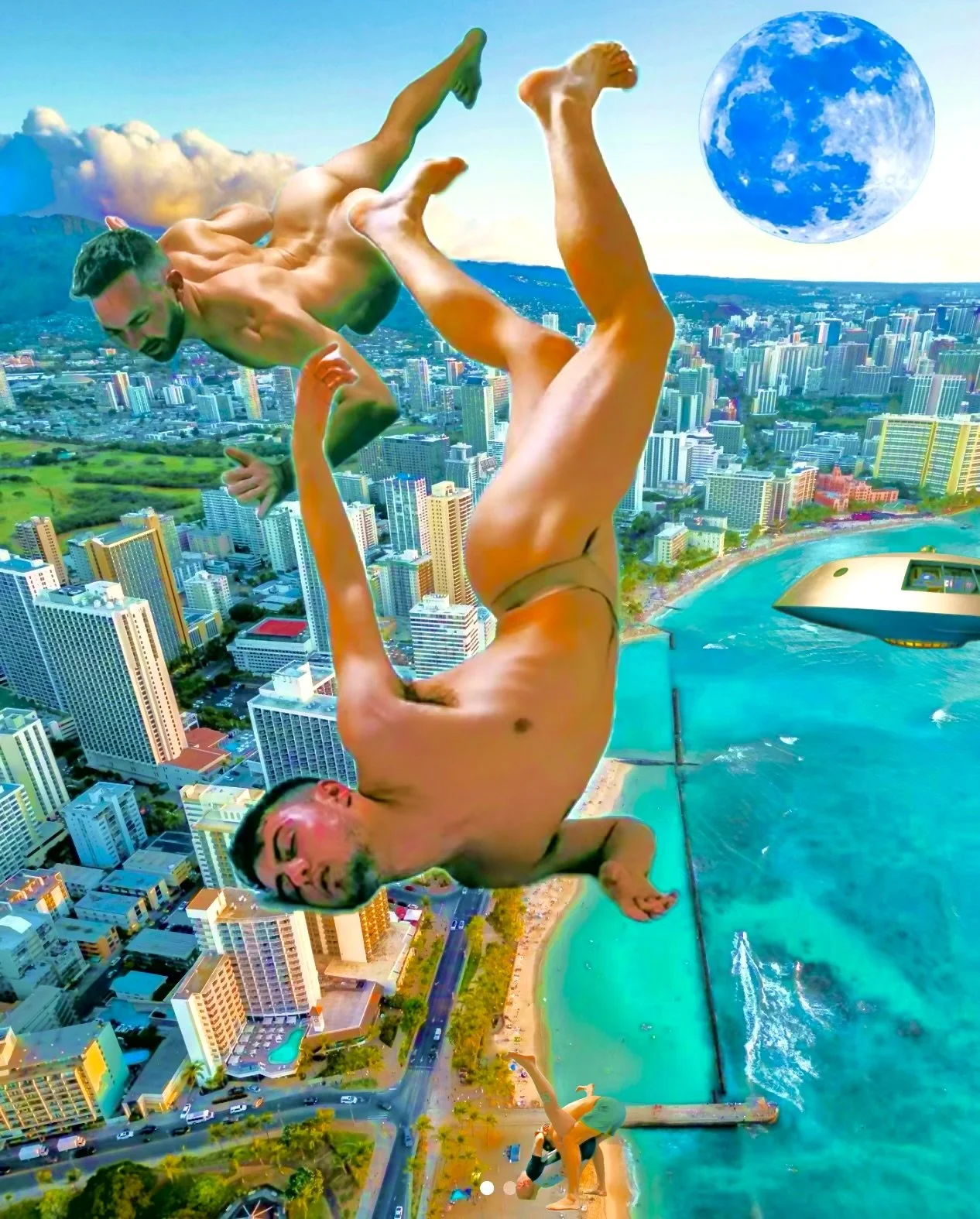
Icarus Falling From AI over Hawaii is my newest collage. It takes the oldest story about a man lifted by technology and dropped by it, and sets it over Waikiki in 2026.
The subject is the one Rubens and Gowy painted in the 1630s: a young man who trusts the machine further than its maker warned him to, and an older man who can only watch. Today the machine is artificial intelligence. The one in danger of falling is all of us.
Icarus
The story comes from Book 8 of Ovid's Metamorphoses. Daedalus, the craftsman who built the Labyrinth for King Minos, is held on Crete. He makes wings of feathers bound with thread and wax for himself and his son.
He gives one instruction: fly the middle course. Too low, and the sea soaks the feathers. Too high, and the sun melts the wax.
Icarus climbs toward the sun. The wax softens, the feathers come loose, and he falls into the sea that still carries his name, the Icarian Sea. Daedalus lands safely and buries his son.
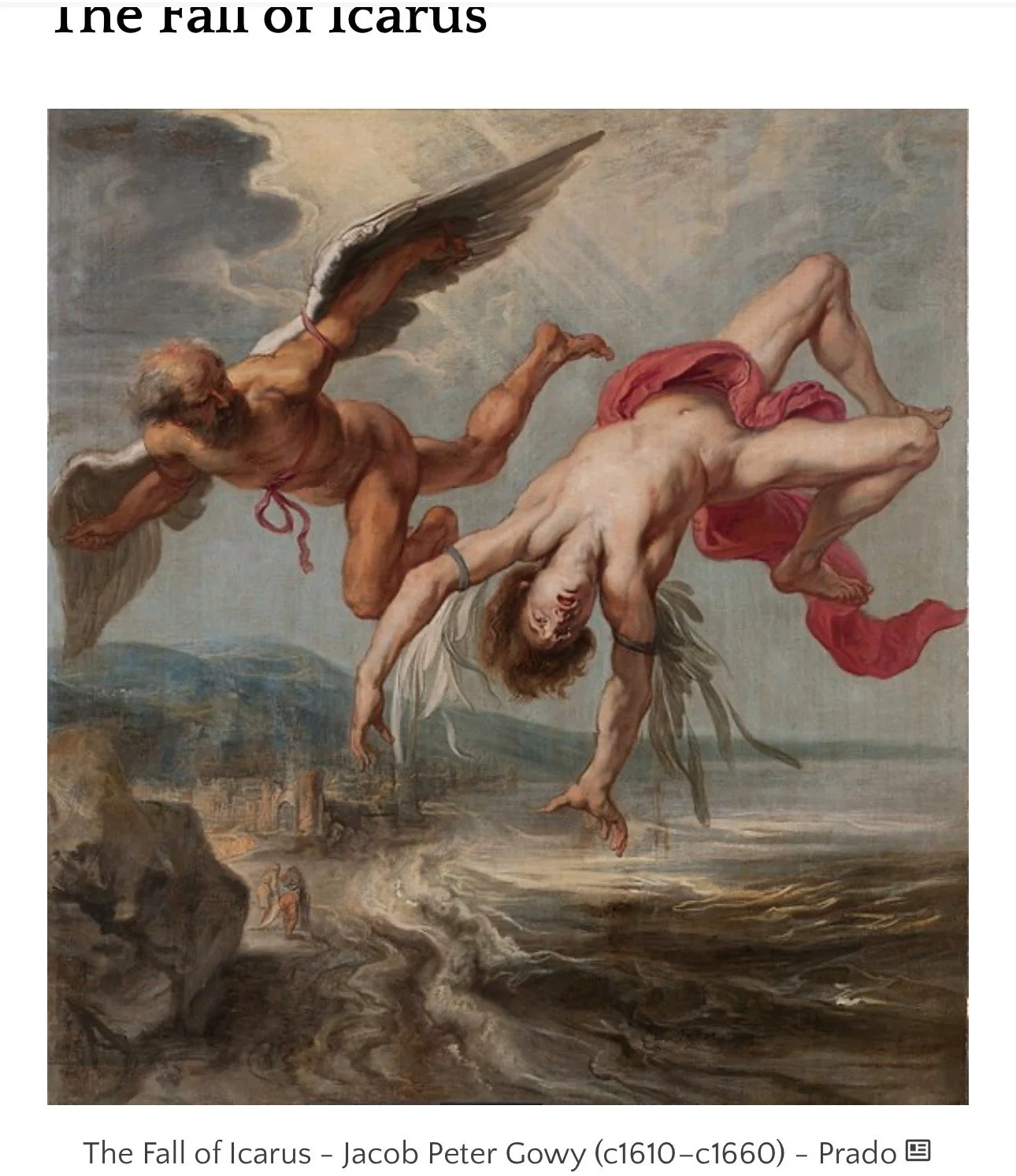
Painters have returned to the fall for five centuries. The Landscape with the Fall of Icarus in Brussels, attributed to Pieter Bruegel the Elder, shows Icarus as two legs in the water while a ploughman keeps ploughing. The Baroque puts the body at the center. Rubens sketched the fall around 1636 for Philip IV's hunting lodge, the Torre de la Parada. Jacob Peter Gowy painted the finished canvas, now in the Prado.
In Gowy's painting, Icarus hangs upside down, arms toward the water, red drapery pulling loose, feathers stripping from his arms. Daedalus flies above him with his mouth open and a hand reaching out, too far away to catch him. Two small figures stand on the shore below.
Myth gave painters and patrons a sanctioned reason to show the male nude. Gowy's Icarus is one of the clearest Baroque examples. The commission called for about sixty scenes from Ovid for Philip IV's hunting lodge, including Rubens's own Abduction of Ganymede, in which Zeus carries off a beautiful youth to be his cupbearer and lover. Under the title of classical literature, the King of Spain filled a lodge with large paintings of muscular male bodies.
The setting matters. The Torre de la Parada was a hunting lodge, a place built for men. The king went there with his hunting companions. Its walls held hunting scenes, portraits of the king and princes in hunting dress by Velázquez, and Rubens's Ovid, full of nude male bodies. The closest comparison today is the 1960s bachelor pad: a space designed for men, decorated for men, and organized around the hunt.
Humanity Falling From AI
The myth is about technology and its limits. Daedalus is the engineer. Icarus is the user. The wings work exactly as designed. The failure comes from how they are used.
AI follows the same structure. The companies and researchers who build it publish warnings about its risks, as Daedalus did. The public adopts it faster than those warnings can be tested. It writes, draws, answers and decides, and each task handed to it is one less task people practice themselves.
Icarus does not fall because of the sun alone. He falls because he forgets the wings are wax. The risk with AI is the same: a reliance that grows until people no longer know how to work without it, or remember that they once could.
The Nature of Homage
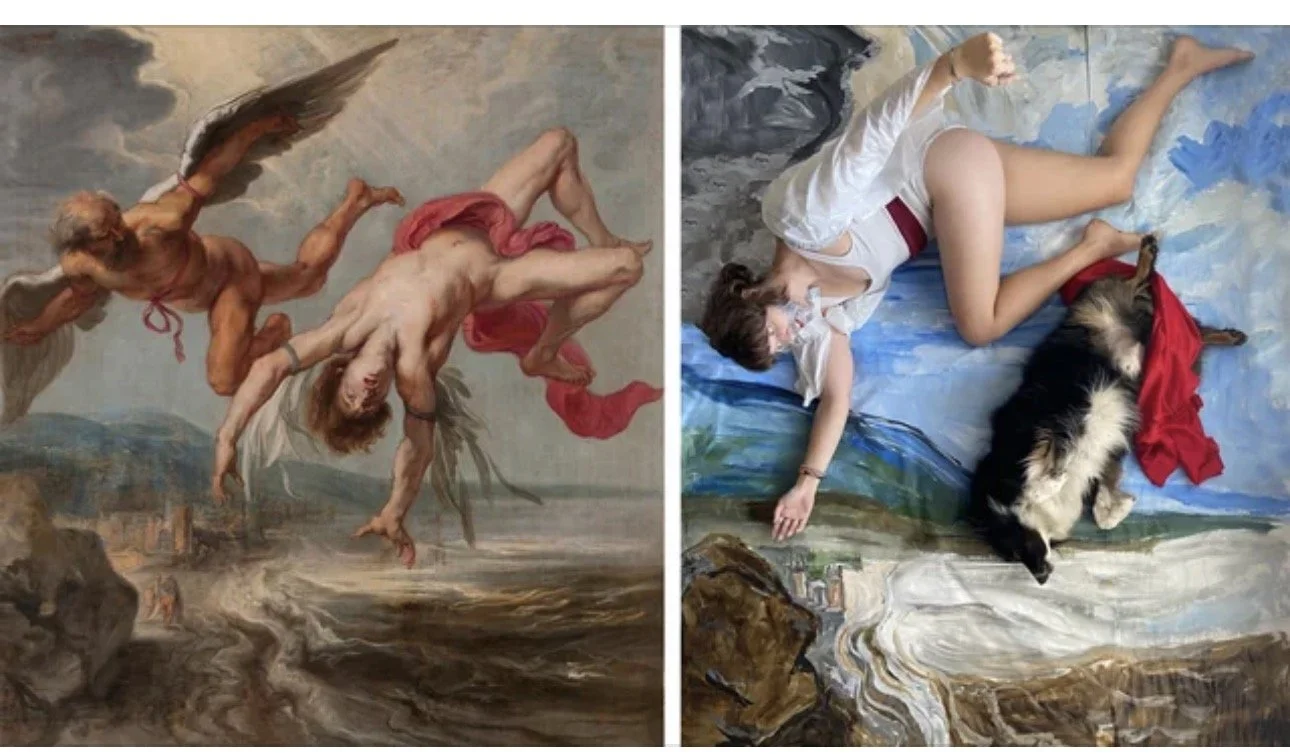
Gowy's painting is already a homage. The design is Rubens's, and Gowy carried it out. The Torre de la Parada commission ran to dozens of scenes from Ovid, most of them painted by other Antwerp artists from Rubens's sketches. Even the Bruegel in Brussels is most likely a copy of a lost original.
A second image in today's feed shows how far the chain reaches. Someone recreated Gowy's composition at home. A painted backdrop of sky, shore and sea is laid on the floor and photographed from above. A woman in a white shirt takes Icarus's pose, a red cloth replaces the drapery, and a black-and-white dog lies where Daedalus flies.
A copy stands in for the original. A homage needs the viewer to know the original. It repeats the structure of an earlier work so that both are seen at once. The new work borrows the authority of the old one, and the old one gains a new reading.
The Western tradition has always worked this way. Rubens copied Titian. Gowy painted Rubens. Manet's Olympia answers Titian's Venus of Urbino. The recreation in the feed answers Gowy. My collage answers all of them.
Icarus Falling From AI over Hawaii
The ground is an aerial photograph of Waikiki: hotel towers, the pink Royal Hawaiian at the shoreline, the breakwaters, the turquoise water and the green slopes behind the city. Gowy's Aegean coast becomes the most developed beach in one of the most isolated island chains on earth.
Both figures come from my feed. The younger man takes Icarus's position: upside down, legs bent, one arm reaching toward the water. The bearded older man takes Daedalus's position above and behind him, looking down. Neither has wings. Whatever held them up is already gone.
A blue moon hangs above them, marking time as it does in my recent work. To the right is the Jupiter 2 from Lost in Space, the 1960s picture of the future. It hovers, untouched. The technology stays in the air. The men do not.
The sky matters. Current technology puts all our information in "the cloud" while we remain below. The technical term is cloud computing: our data and software are stored and run on remote servers reached over the internet. Email, photographs, social media feeds and AI models all live there.
The cloud is on the ground. It is made of data centers, warehouse-sized buildings full of servers that use large amounts of electricity and water. The name comes from the cloud shape engineers drew in network diagrams to stand for the internet.
Some of it is in the sky. Satellite internet systems such as SpaceX's Starlink keep thousands of satellites in low Earth orbit, sending data from space to people on the ground.
At the shoreline, two smaller figures copulate in the sand. They are the bystanders from Gowy and Bruegel, the people on the shore while the fall happens overhead. They are engaged in life while death happens above.
Gowy's Icarus is a muscular male nude at the center of a royal commission. Mine is a man from today's feed, in a thong, over a resort city. The subject has not changed in four hundred years. The context has. That is the work: taking subtext and making it context.
The fall of Icarus is an allegory with one warning: be wary of overconfidence in new technology. It held in ancient Greece, where the myth began. It held in Ovid's Rome. It held in the court of Philip IV. It holds in 2026.
Circumstances change. The story stays the same. It repeats itself.
— Behan