Variations on a Fugue | Digital Photocollage | On Gays Who Dream | The Gay Gaze | Te Subdivision | 2026
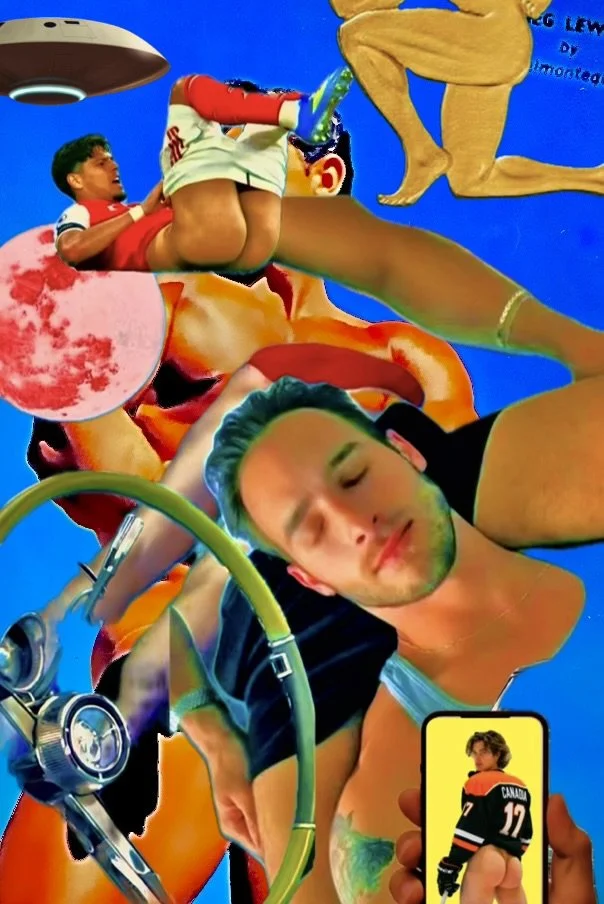
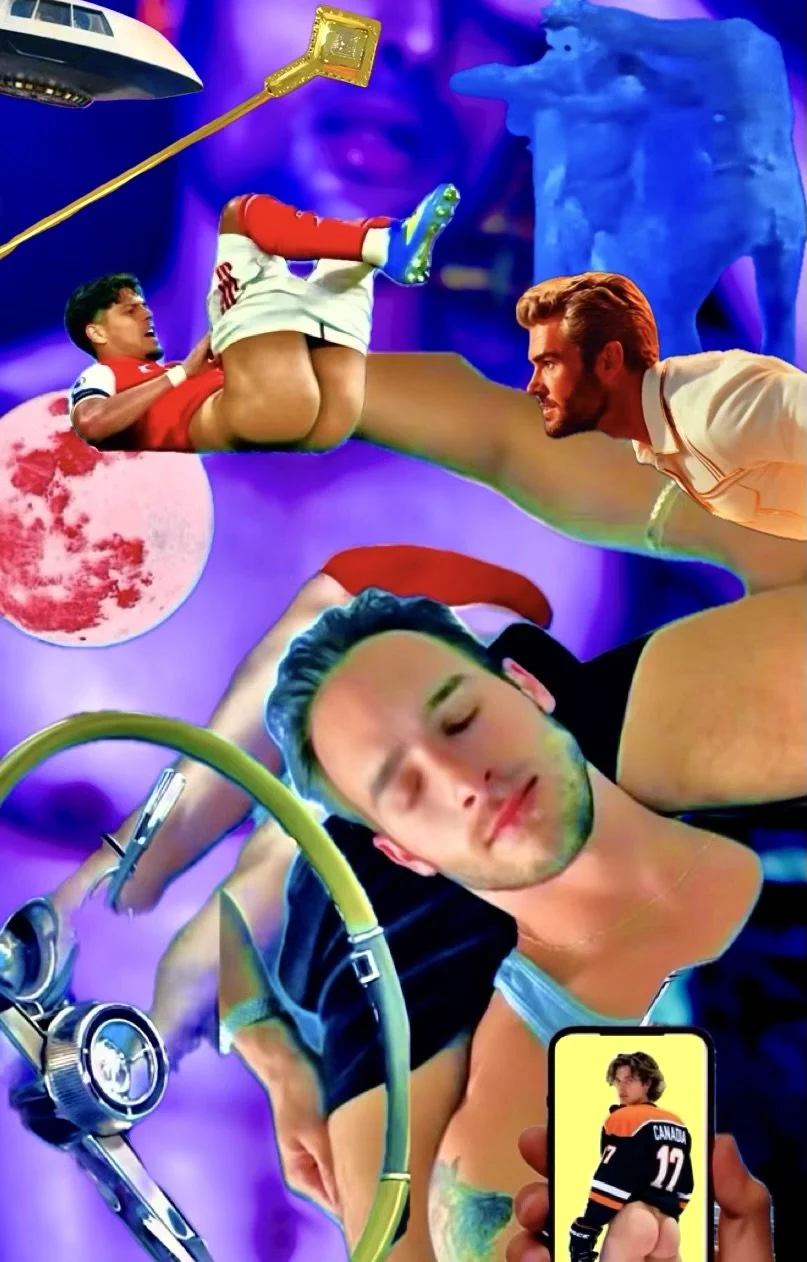
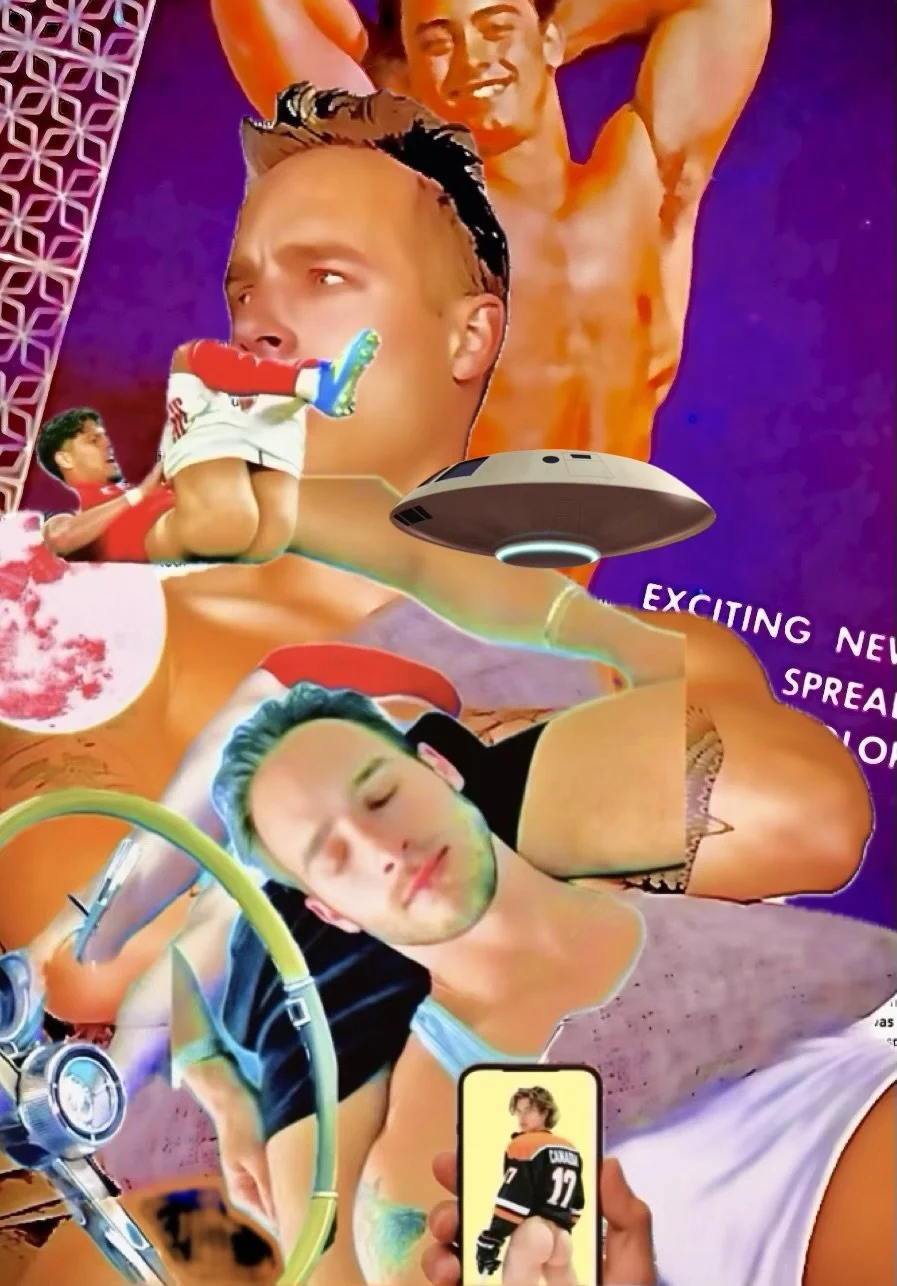
A body sprawls across the frame at a scale nothing else in the image can match — a leg here, an arm there, a face turned sideways and half-asleep at the center of it all, other men orbiting in fragments too small to be anything but decoration on something larger than themselves. This is the colossus: not one man but the accumulation of many, dreamed into a single recumbent giant too big for the frame to hold steady.
The set follows a fugue’s own logic. A fugue states its subject once, cleanly, before the rest of the piece takes that subject apart and puts it back together in new keys, new speeds, new voices layered on top of the original line. The pool image here is that subject — the first version made, blue water beneath the whole composition, the figures arriving in their most unforced arrangement. Everything after it is variation: the color shifted into blood orange, the frame cropped tighter around the sleeping face, the whole thing repackaged as a pulp magazine cover, “BEEFCAKE” bleeding in at the edges like type intruding on a dream. None of the variations are lesser. They’re what a fugue does with its subject once it’s been stated — testing what the idea can survive, how far it can be pushed before it stops being recognizably itself.
Beneath these visual variations is a real question, and it turns out someone has actually gone looking for the answer. A small study out of Germany recently asked something almost nobody had bothered to ask before: do gay men and straight men dream differently? The researchers polled over a hundred men about their inner lives while asleep, and the results were, on the whole, reassuringly unremarkable — nightmares, anxiety dreams, the ordinary furniture of a sleeping mind, distributed about the same regardless of who a man loved awake. But a few differences did surface. Gay men reported more sexual dreams. A higher ratio of men to women populating the dreams themselves. More romantic content generally, more of it involving other men.
Which is, on reflection, not remarkable at all. It would only be surprising if the desiring mind clocked out the moment the eyes closed — if orientation were something a person could set down at bedtime the way you set down a phone. It isn’t. The dreaming brain, it turns out, is simply continuing the same conversation the waking one was already having, just without the editor on duty. No closet operates at three in the morning. No audience to perform correctness for. Whatever a man actually wants surfaces on its own schedule, unsupervised, the moment consciousness stops managing the story.
That’s the real subject of this collage, more than any single figure in it. A fever dream isn’t a hallucination out of nowhere — it’s ordinary desire running at a higher temperature than the waking hours allow, all the fragments a life doesn’t have room to arrange neatly stacking on top of each other instead: an athlete’s leg, a stranger’s face, a hockey jersey glimpsed on a phone screen, a UFO drifting past all of it as though even the fantasy needed an exit route. The colossus isn’t a person. It’s what accumulates in a mind that has spent its waking hours being careful, the moment the carefulness finally goes off duty.
— Behan
Source: study on sexual orientation and dream content, Journal of Homosexuality, cited via Happening Out Television Network, “New Study Considers If Gay & Straight Men Dream Differently,” January 2025.