Forever in the Boom Boom Room: Generation Jones, Gay Culture, and the Face That Won’t Grow Old Without a Fight
There’s a memorable scene in 1971’s Willy Wonka & the Chocolate Factory: Mike Teavee, obsessed with television, shrinks himself down to fit inside the screen. The Oompa-Loompas cart him off to the taffy-pulling machine to be stretched back to normal size — except normal can never be normal again. He comes out a little too tall, too thin, warped by the process of trying to be restored to what he was.
If you were born between 1960 and 1965, you were somewhere between six and eleven years old when that scene played out on the movie screen. You’d already sat through the golden goose laying her eggs, Gene Wilder’s flat, unreadable stare, the boat ride through the tunnel that felt less like a fantasy and more like a fever dream.
This group didn’t just watch a movie about candy and consequence. They absorbed, early and indelibly, a set of pictures about bodies transformed, bodies punished, bodies that don’t come back quite right.
A Generation Without a Name
Ask someone born in 1962 what generation they belong to and watch them hesitate. Too young for Woodstock, too old for MTV, they don’t recognize themselves in the Boomer narrative of the Summer of Love, and they’re a full cultural cycle removed from Gen X’s latchkey cynicism. For years this cohort had no name of its own — just an asterisk wedged between two much larger generations.
The label that stuck, coined by the writer and producer Jonathan Pontell, is Generation Jones: the group betwixt and between Woodstock and Lollapalooza. This cohort has a genuinely distinct psychology — one shaped by watching idealism curdle into practicality just as they were old enough to notice, but too young to have been responsible for any of it.
And for gay men in this specific window — born 1960 to 1965 — there’s a second, much darker asterisk attached to that identity. This is the age group that came of age right as the AIDS crisis broke, and it is the cohort that lost the most people to it. Men who were in their late teens and twenties, just old enough to have come out, just old enough to have started building a community, when an entire generation of older gay men who might have shown them how to grow old simply weren’t there anymore.
Missing Elders
This is the part of the story that doesn’t get said often enough: youth obsession in gay culture isn’t vanity, for a huge swath of gay Generation Jones, there was no template. The men who would ordinarily have modeled what it looks like to age as a gay man — to be fifty, sixty, seventy, comfortable and visible — were gone.
So the question isn’t really “why is gay culture so youth-obsessed.” The more honest question is: does this generation actually know how to grow old?
When your cultural elders are erased before they can teach you what dignified aging looks like, youth doesn’t become an aesthetic preference. It becomes the only fluent language you have. You don’t chase youth because you’re afraid of aging in the abstract. You chase it because nobody showed you the beauty of growing older.
The Face as the Last Marker
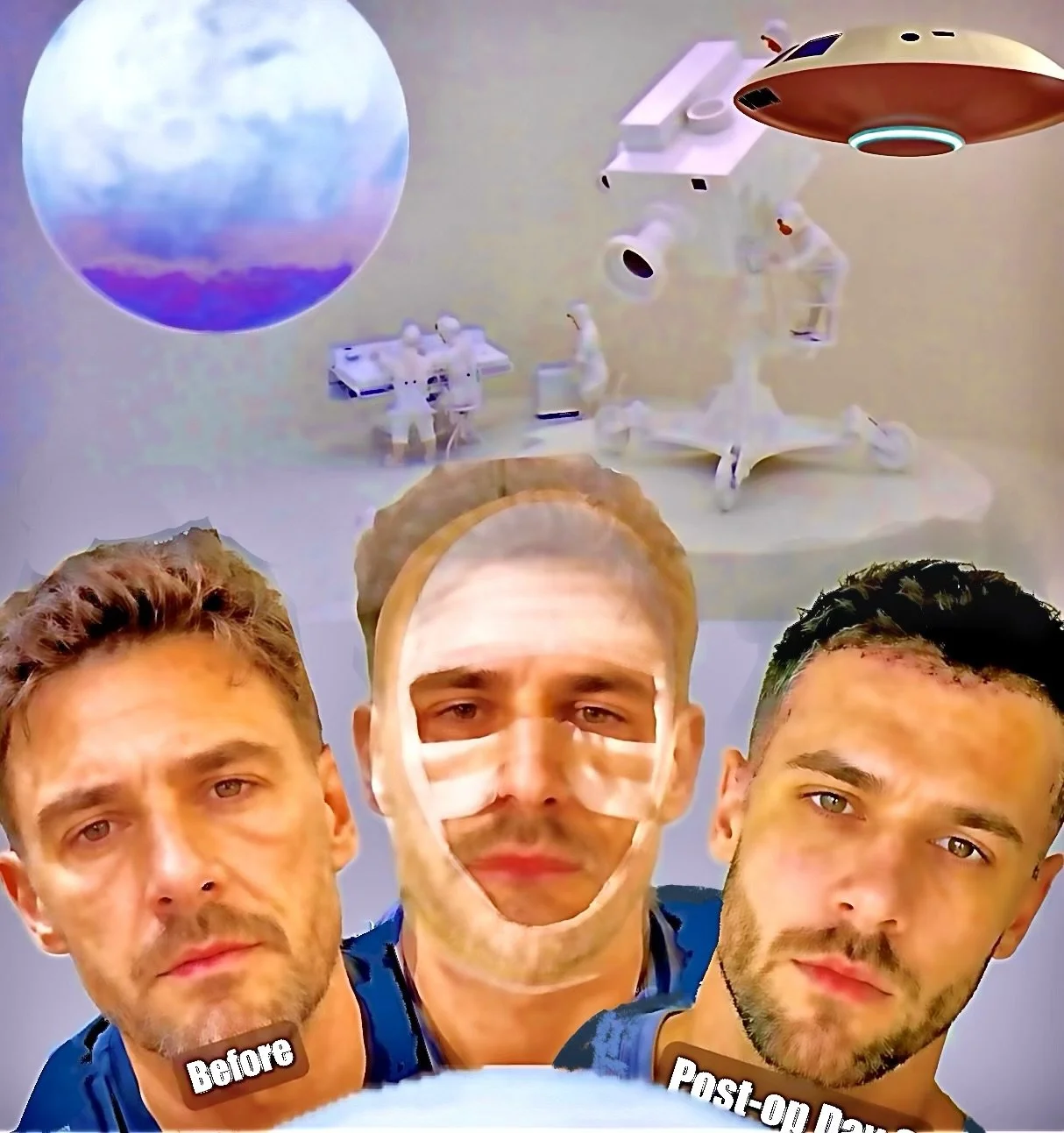
Plastic surgery culture among gay men — the fillers, the facelifts, the Botox rituals booked as casually as a haircut — gets read from the outside as pure narcissism, a community fixated on the mirror. But look at where the effort concentrates. It’s almost always the face. Not the whole body, not some general anti-aging campaign — the face specifically, the one part of a person that carries recognition, memory, desirability, and belonging all at once.
For a generation that came up watching a candy-colored fantasy about bodies being stretched and warped back into shape, and then spent their twenties watching the men just ahead of them disappear, and then their peers disappear next, the face becomes a negotiable territory.
You can’t get back the decade the epidemic took. You can’t recover the mentors who should have aged in front of you. But you can, perhaps, keep the face looking like it belongs to someone who’s still early in the narrative, still has time, still gets to be looked at rather than looked past.
That’s a different thing from vanity. It’s closer to a coping mechanism dressed up as a cosmetic procedure — an attempt to visually opt out of a timeline that was violently interrupted multiple times.
Not Youth-Obsessed; Just Youth
Maybe that’s the real reframe. It’s not that gay culture, or this generation within it, is uniquely obsessed with youth as an abstract ideal. It’s that a specific cohort of gay men is youth, there by circumstance rather than choice — because the people who should have modeled the next chapter were taken from the story before they could write it.
The Oompa-Loompas sang their warnings as cautionary jingles about a generation who wanted too much, too fast, from the screen and the candy coated wallpaper. But watch that scene again as someone born in 1962 might have watched it: a body sent through a machine designed to restore it, and coming out the other side changed, stretched, not quite the same — but still, unmistakably, there.