Fast Forward on the Last Word
Robinson, Zeffirelli, Gentileschi, Tassi
1967
Bruce Robinson, a twenty-year-old drama student, is cast as Benvolio in the film adaptation of Romeo and Juliet after director Franco Zeffirelli performs oral sex on him during preparation for the film. It is Robinson’s film debut, his big break, and he is straight. What transpires is not about desire, but the absence of a real choice. A twenty-year-old drama student, in his film debut, working under one of the most powerful directors in the industry, is not in a position to say no without risking the opportunity of a lifetime.
1611
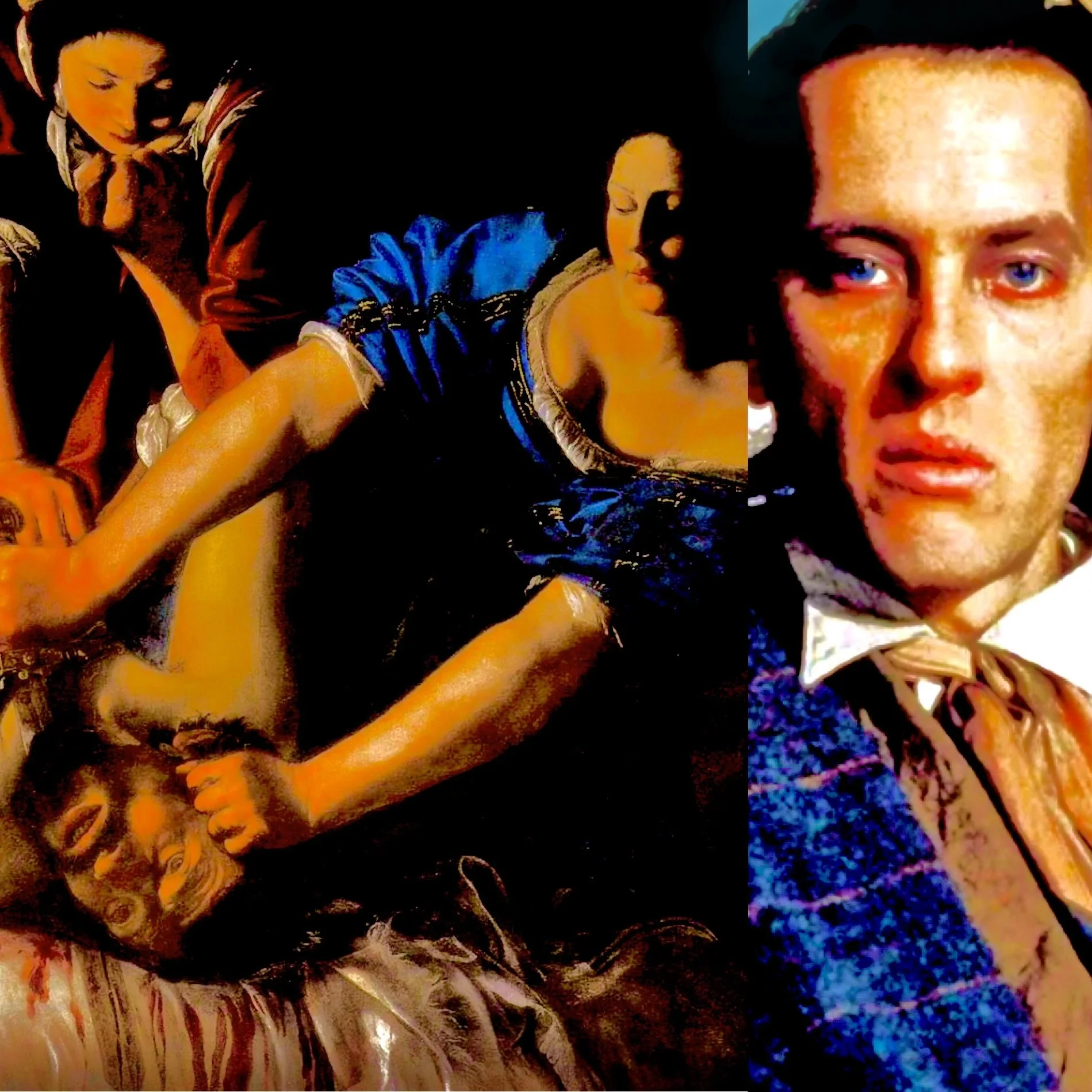
The Italian Baroque painter Artemisia Gentileschi is raped by Agostino Tassi, a painter her own father has hired to tutor her. The trial that follows lasts seven months and includes Gentileschi being tortured to test the truth of her testimony. Tassi is convicted but serves no sentence. In the years that follow, Gentileschi paints several versions of Judith Slaying Holofernes, showing the widow Judith mid-act, gripping the general Holofernes down by the hair with the help of her maid, driving the sword through his neck with visible physical effort. Many art historians note a resemblance between the face of Holofernes and Tassi, and read the paintings as Gentileschi reclaiming, on canvas, an authority the courtroom and the culture around her refuse to give her. She has the last word.
1987 / 1998
Robinson has his too, twice over. In 1987, twenty years after Rome, he writes and directs Withnail and I, in which a lecherous, upper-class older man named Uncle Monty makes aggressive advances toward a young actor staying at his country house, a character widely understood to be based on Zeffirelli. Then in 1998, thirty-one years after the fact, Robinson says what the film had only gestured at, telling an interviewer plainly what Zeffirelli did to him in 1967. Zeffirelli gets to remain, publicly, one of the most celebrated directors of the twentieth century. Robinson takes his time, but he gets there: first in fiction, then on the record.
The last word is real, but it is not the same as the first word. Tassi dies a free man, his sentence never served. Zeffirelli spends the rest of the century being celebrated, and dies decades later with his reputation largely intact. The paintings and the film do not undo any of that. What they do is put something permanent on the other side of the ledger: an account that outlasts the men who assumed no account would ever be given.