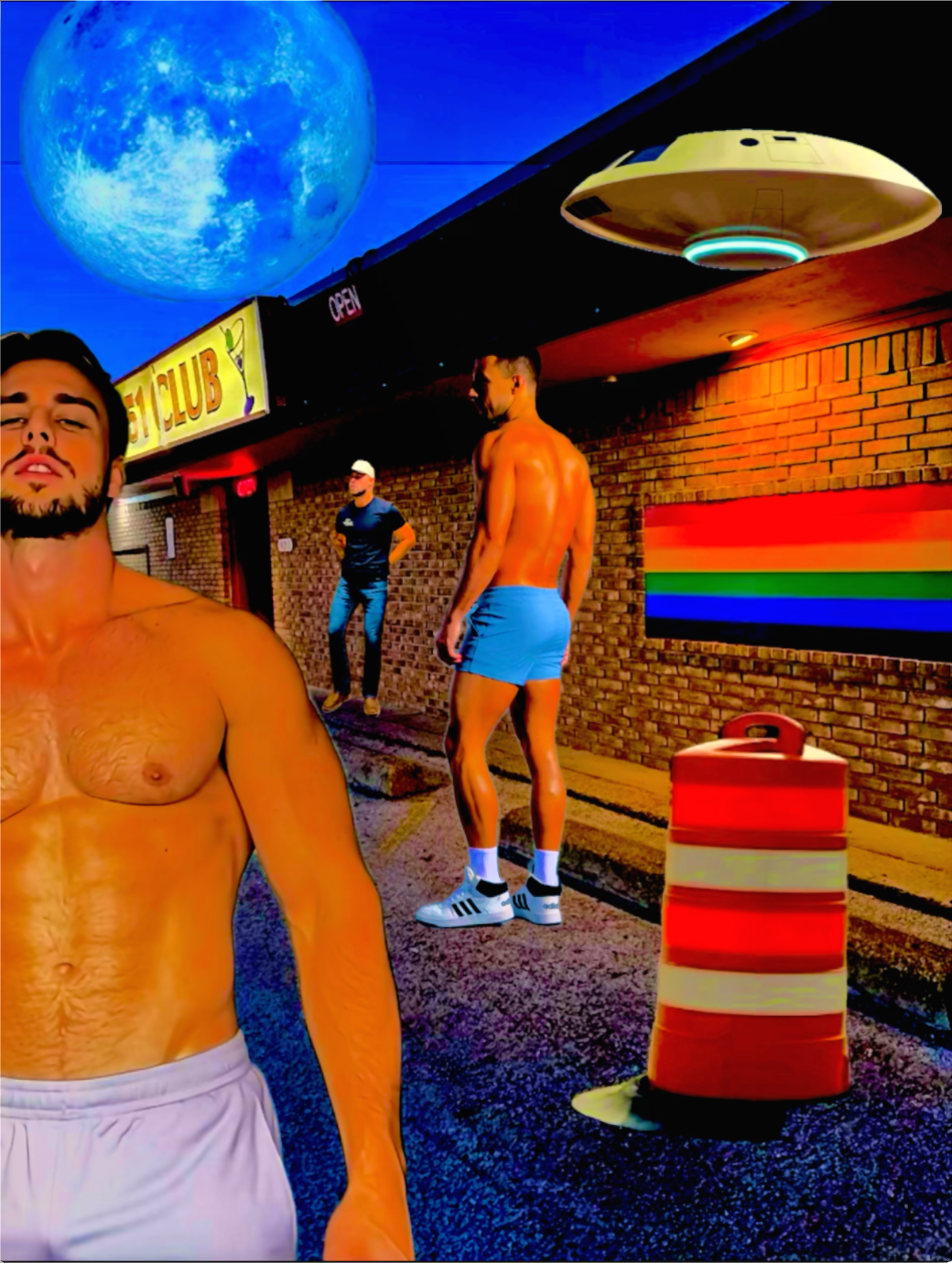
Tough Gays
Back in the late 80’s, when I was a young artist building an independent style and a story, I worked as a waiter in Arlington, Texas. Some nights after work I’d stop into a gay bar called the 651, on Division Street — a podunk place that was home to a dedicated group of drag queens who performed there regularly.
One night as I was leaving, another young man came out of the bar and approached me. He started talking, and it was clear he was interested in me. Meanwhile, some men across Division street, hanging around the parking lot of straight bar, started heckling us. The young man's response startled me completely. There was no fear in him at all. He was utterly and completely masculine. The straight men backed down. It was, or so I thought at the time, the first time I had seen this kind of gay man, a tough gay — masculine, interested in me, wanting me to stay, and utterly prepared to slay dragons.
In that moment I saw that tough gays exist, even though I haven’t always been able to recognize them. The tough gay man’s masculinity is entirely genuine and unperformed. Being gay is just one fact about him. It does not reorganize his interests, determine his occupation, affect his manner, or consume his self-understanding as a man.
My nature as an artist is to observe. That’s my modus operandi. But my ability to observe the gay male, and the tough gay in particular, has been truncated by cultural conditioning — the faulty assumption that gay men are somehow failed men. That conditioning (in its purest form the closet) creates a real blindness to the masculine gay man, even when he’s standing right in front of us. Looking back, I don’t think I only encountered the tough gay once or twice in my life. I think it happened all the time. I simply wasn’t able to see it, because I was told not to see it, and because I’d also been taught to follow instructions, as part of that same conditioning. That night broke through. It was a moment of forever freedom.
And that understanding of the tough gay is not without precedent. Martin Levine, who studied gay men’s lives through the 1970s, and R.W. Connell, who interviewed gay men directly about masculinity, both found the same thing I saw that hot summer night in that parking lot: large numbers of gay men whose manner, work, and self-understanding were indistinguishable from any straight man’s, with who he wanted to be with as the only real difference.
The encounter with that young man lasted maybe three minutes. He went back into the bar and I went home. But that moment changed me — a Matrix-style moment, long before the Matrix was a thing. I understood that the world as I’d been seeing it was not the world that actually existed. A visual artist’s goal is always to see more. I’m grateful to that young-now-old man. I think of him from time to time. When I do, I wish him well.