Introduction
Charles Demuth (1883–1935) is one of the first American modernists. He is also a gay man working in a period when his life cannot be shown openly. His art reflects both facts.
This post presents three of his watercolors next to three of my digital collages. Each collage is an homage. Each one takes what Demuth places beneath the surface and puts it on the surface.
What Demuth Has to Do
Demuth builds a successful public career. He becomes known for delicately colored watercolors of flowers, fruit, and figures, and for Precisionist paintings of architecture and cityscapes. Over his career, he completes about 750 paintings and 350 drawings, receives favorable reviews, and sells numerous works.
He spends time in New York and Provincetown, but Lancaster, Pennsylvania remains his home throughout his life. In New York, he takes part in the bohemian life and gay subculture of Greenwich Village.
Two Kinds of Work
Alongside the public work, Demuth makes watercolors of the nightclubs, performers, and bathhouses he knows in Greenwich Village. He keeps the openly homoerotic watercolors private throughout his career and almost never shows them publicly. In his will, he leaves all of his watercolors to Robert Locher, and among them is a series of explicitly homoerotic paintings of gay life in New York.
Between the public and the private work, there is a third category: works that can be shown, but that carry a meaning for viewers who know how to read them. This is how Demuth survives professionally while remaining honest to himself. The three works below come from that practice.
One: The Acrobats
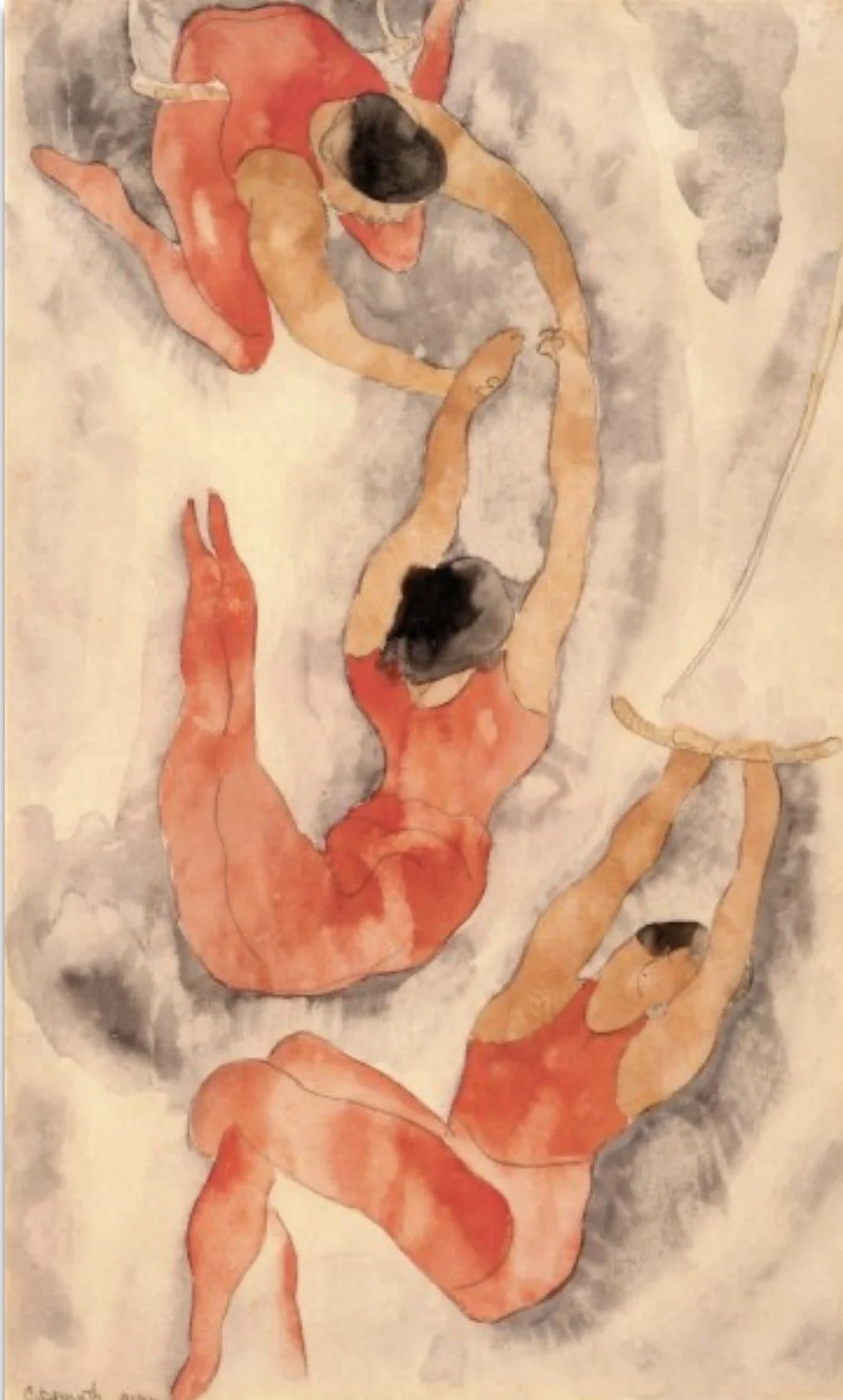

Demuth paints a series of vaudeville images between 1914 and 1919, and acrobats are among his favorite subjects. In these watercolors, the attention falls on the male body in performance. The tights cover the body completely while showing its full shape.
The Acrobats keeps the attention on the male body in performance, but the performance now takes place on social media. The figures float without a floor, as Demuth's acrobats do. The covering is gone, both literally and figuratively.
Two: The Discotheque
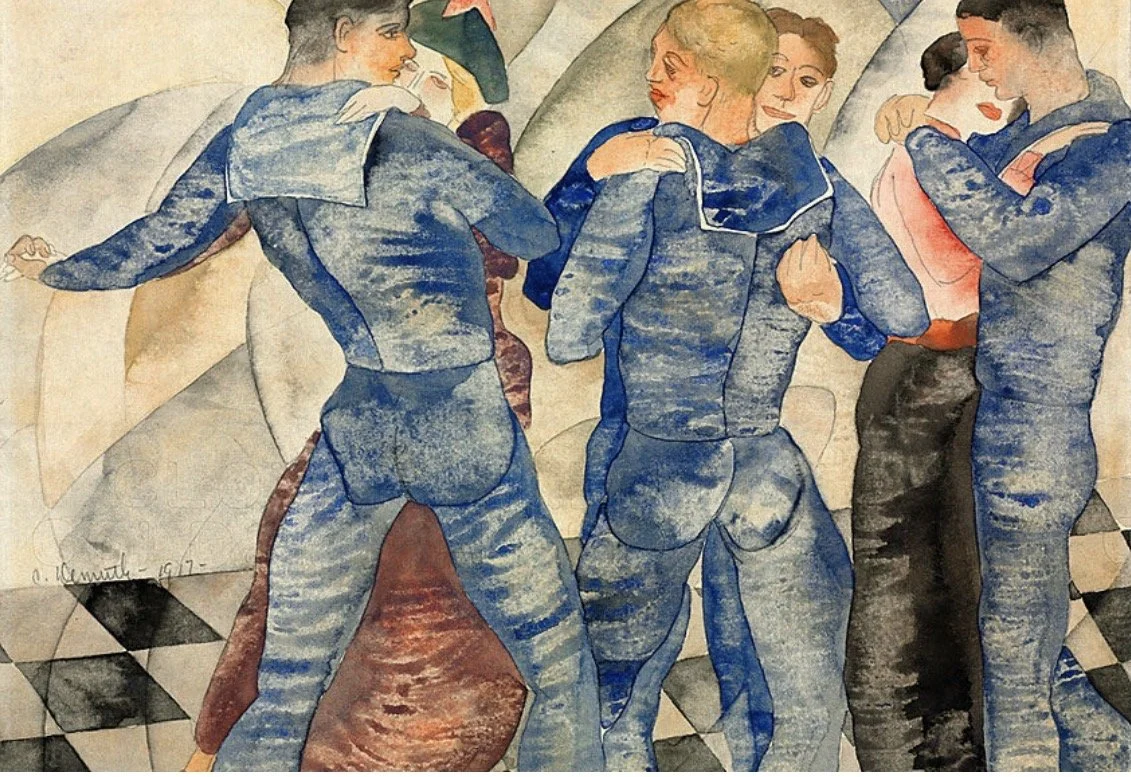

Demuth paints Dancing Sailors twice, in two almost identical compositions. Both show three couples on a dance floor. In the center, two sailors dance together, while the others dance with women. The women give the scene a respectable surface. The two sailors at the center carry its actual subject.
The Discotheque moves the dance hall to a nightclub. The same male couple appears three times across the horizontal expanse, embracing and kissing. The repetition answers Demuth's three couples. The longing in the watercolor is fulfilled in the collage.
Three: The Beach X 2 2026

Demuth spends many summers in Provincetown, beginning in 1914. In the early 1930s he returns to the figure with a series of openly homoerotic works, and his last pieces are figural watercolors made in Provincetown in 1934.
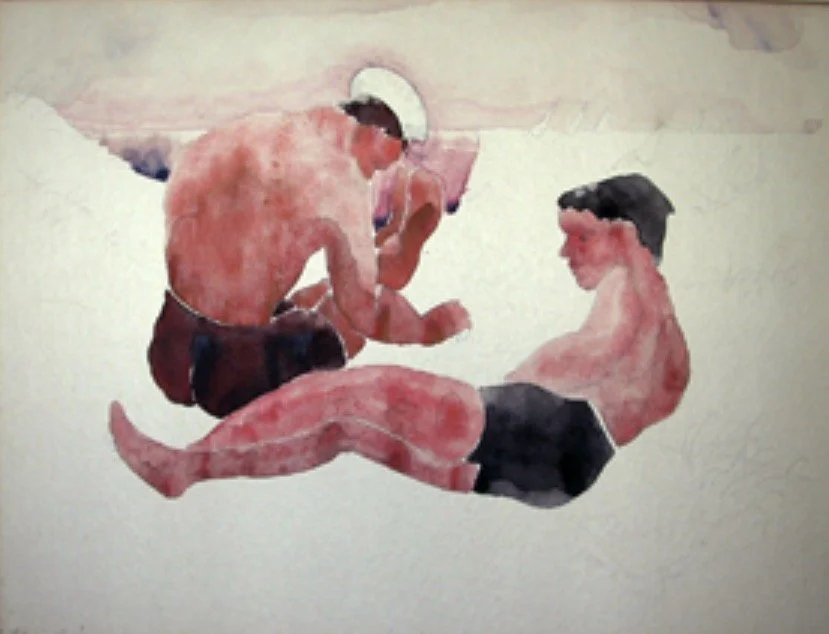
In this watercolor, two men in dark swim trunks share an empty beach. One, in a white sailor cap, sits bent toward the other. The second reclines on one elbow, his legs stretched across the sheet. Large areas of the paper are left bare or only drawn in pencil, and nothing else is on the beach.
The collage repeats the arrangement. One man is raised on his hands behind; the other reclines on one elbow across the foreground. Dark trunks become briefs.
The main change is the setting. Demuth's men are alone, on a beach with no one else present. In the collage, the beach is full of people and umbrellas. The two men are in public, and they are not hiding.
Working in Code
Demuth and artists like him are forced to work in code. They do so magnificently and with great heart. Their paintings record what they are not permitted to say directly, in a form that allows the work to be made, kept, and in some cases shown.
These three collages are made a little over one hundred years later. They do not need the code. The subtext of Demuth's watercolors becomes the context of the collages.
Cleveland Museum of Art. Charles Demuth, Dancing Sailors, 1917. clevelandart.org
Museum of Modern Art. Charles Demuth, Dancing Sailors, 1918. moma.org
Demuth Foundation. "Stop 6: The Colonial Theater." demuth.org
New Britain Museum of American Art. "Charles Henry Demuth." nbmaa.org
The Art Story. "Charles Demuth." theartstory.org
Westmoreland Museum of American Art. "Celebrating LGBTQIA+ Artists in the Collection: Charles Demuth." thewestmoreland.org
Weinberg, Jonathan. Speaking for Vice: Homosexuality in the Art of Charles Demuth, Marsden Hartley, and the First American Avant-Garde. New Haven: Yale University Press, 1993.