
An Homage to Charles Demuth's Dancing Sailors
The Discotheque (2026) is a digital collage made as an homage to Charles Demuth's watercolor Dancing Sailors (1918). The two works are made a little over one hundred years apart. Demuth's sailors express a longing that his era does not allow him to show directly. The Discotheque shows that longing fulfilled.
The Watercolor
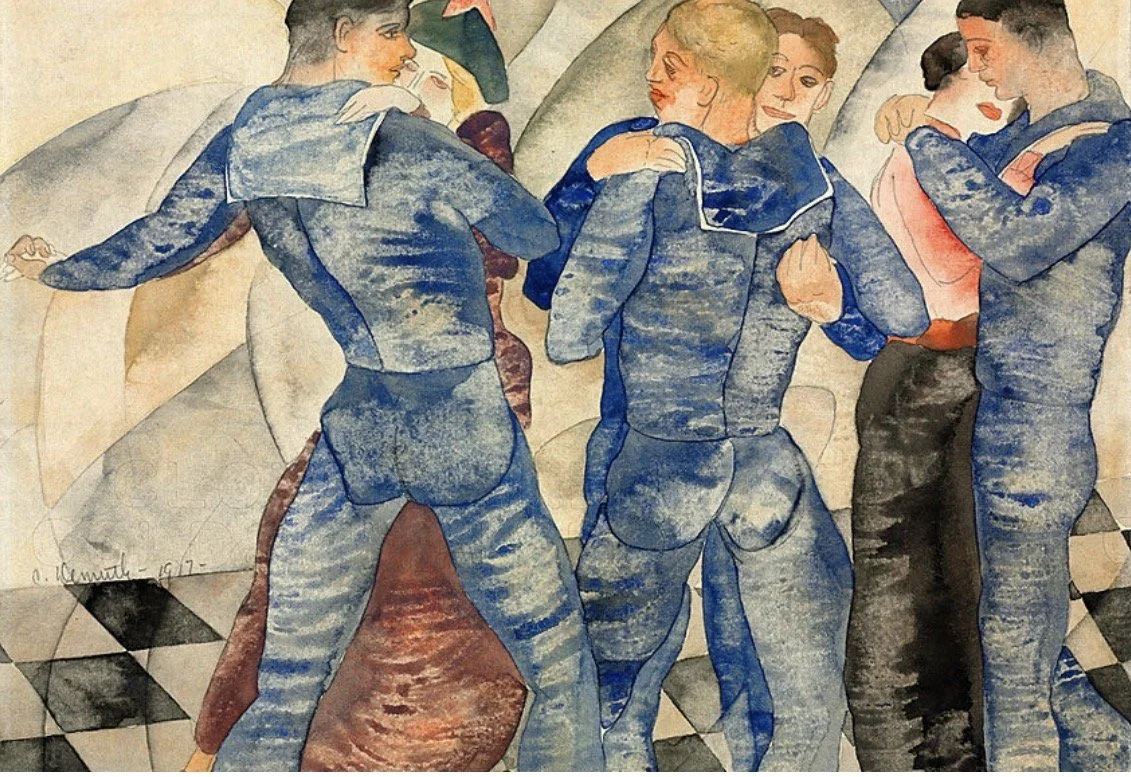
Dancing Sailors is a small work in watercolor and pencil, measuring 8 by 10 inches, in the collection of the Museum of Modern Art in New York. Demuth paints the subject more than once; an earlier version from 1917 is in the Cleveland Museum of Art.
The scene is a crowded dance hall. Three sailors dance with women. The sailors' uniforms dominate the composition, and the tight navy wool shows the shape of their backs, shoulders, and legs. The women are mostly hidden behind the men.
The Gaze Between the Sailors
The meaning of the watercolor is in where the sailors look. The sailor on the left turns his head toward the center of the picture. The blond sailor at the center turns his head back toward him. Their gazes meet over the shoulders of the women they hold.
In this period, sailors dancing with other men is not unusual. Demuth places his sailors with women instead, and the tension of the picture comes from that substitution. The women give the scene a respectable surface. The exchanged look between the two men carries the actual subject.
Working in Code
Demuth draws these scenes from his experience of New York's Greenwich Village nightlife, where he paints nightclubs, performers, and bathhouses. His most explicit watercolors of gay life stay private during his lifetime; in his will, he leaves them to Robert Locher.
Works such as Dancing Sailors are built so that a general viewer sees a dance hall, while a viewer who knows the code sees two men looking at each other. Artists like Demuth are forced to work this way, and they do so magnificently and with great heart.
The Discotheque
The Discotheque moves the dance hall to a nightclub. The background shows a crowded dance floor, red and pink club lights, and the dark space of the room at night.
Across the horizontal expanse of the image, the same couple appears three times: two men in an embrace, kissing. The repetition answers Demuth's three dancing couples. In the watercolor, each sailor holds a woman. In the collage, each man holds the man he is looking at.
The navy of Demuth's uniforms reappears in the dark tank top of one figure. The earth and the flying saucer, recurring elements in this series, place the scene outside ordinary time and location.
From Longing to Fulfillment
In Dancing Sailors, the two men can only look at each other, and only for the length of a turn on the dance floor. In The Discotheque, there is no woman between them and no need for a code. The embrace that the sailors cannot have is the central image of the collage, repeated three times.
The subtext of Demuth's watercolor becomes the context of The Discotheque.
— Behan
Sources
Museum of Modern Art. Charles Demuth, Dancing Sailors, 1918. moma.org
Cleveland Museum of Art. Charles Demuth, Dancing Sailors, 1917. clevelandart.org
Queer Art History. "Charles Demuth (1883–1935)." 2017. queerarthistory.com
Demuth Foundation. "Stop 6: The Colonial Theater." demuth.org
Weinberg, Jonathan. Speaking for Vice: Homosexuality in the Art of Charles Demuth, Marsden Hartley, and the First American Avant-Garde. New Haven: Yale University Press, 1993.