An Homage to Charles Demuth
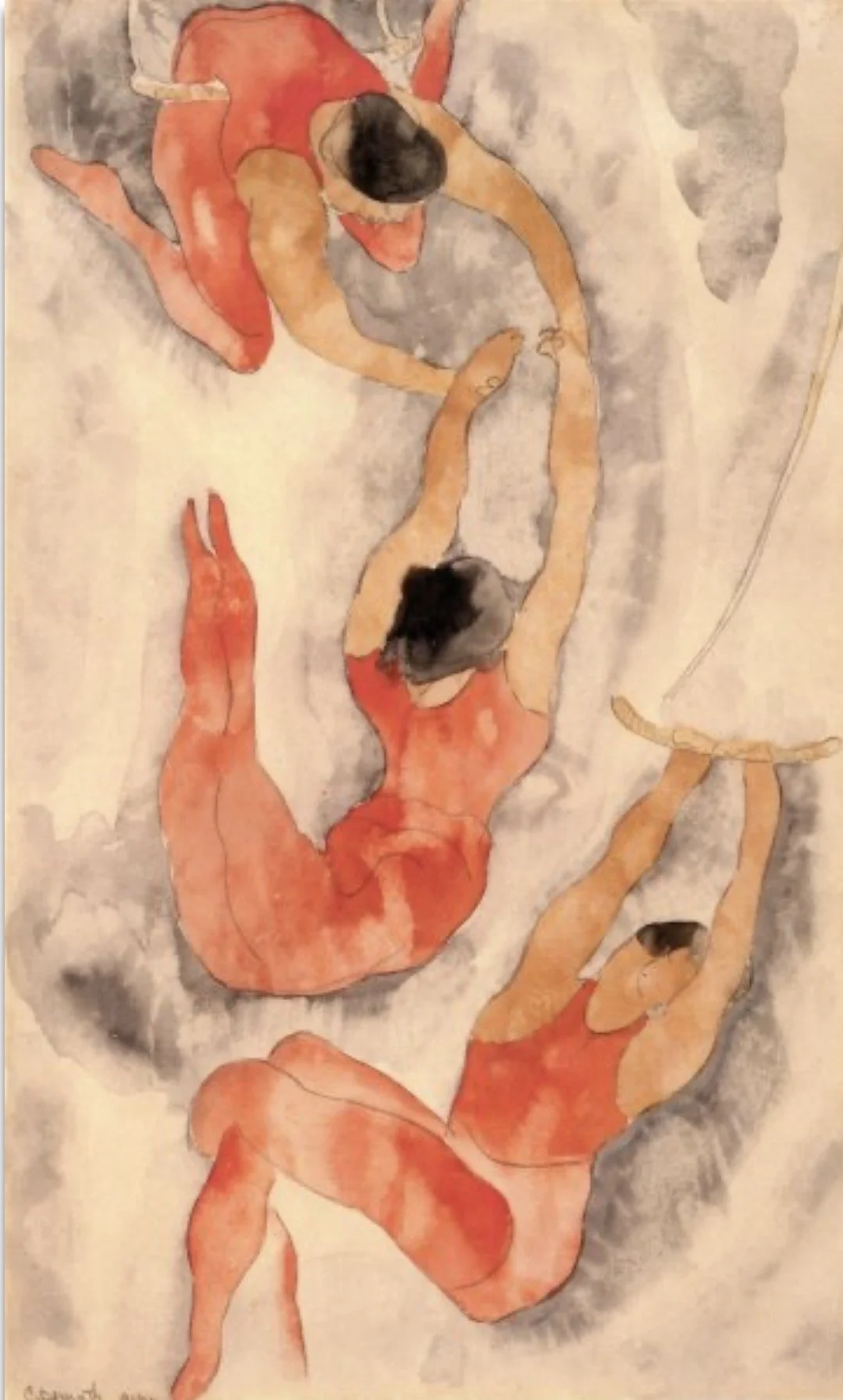
The Acrobats is a digital collage made as an homage to Charles Demuth (1883–1935) and his watercolors of vaudeville acrobats. Demuth's acrobats carry a meaning that only part of his audience can read. This collage states that meaning openly.

Two Kinds of Work
In the same years, Demuth makes openly homoerotic watercolors. They show sailors and scenes at the Lafayette Baths in New York, including a 1918 self-portrait set in a Turkish bathhouse.
These works stay private. In his will, Demuth leaves all of his watercolors, including the series showing gay life in New York, to his partner Robert Locher.
The acrobats are different. They are made to be exhibited, and their meaning depends on what a viewer knows how to see.
The Male Body in Performance
In the acrobat watercolors, the attention falls on the male body in performance. The Barnes Foundation notes that in In Vaudeville: Two Acrobat-Jugglers (1916), a cascade of flowers draws the eye to the central figure's muscular legs. The Barnes places the work alongside Demuth's watercolors of the gay nightclubs, cafés, and bathhouses he frequents in Greenwich Village.
Scholars describe the sexual ambiguity in these works as signaling the homosexuality of the subject and the artist, in a way that perhaps only Demuth's inner circle would detect. The central study of this coding is Jonathan Weinberg's Speaking for Vice: Homosexuality in the Art of Charles Demuth, Marsden Hartley, and the First American Avant-Garde (1993).
The Same Attention, Now from Social Media
The Acrobats keeps the attention on the male body in performance, but the performance now takes place on social media. Every figure in the collage comes from images that men post of themselves. These men are both the performers and the people presenting the performance. The man looking at his phone places the audience inside the image.
The poses repeat Demuth's. One figure lies with his arms raised behind his head, in the same position as an acrobat gripping a trapeze bar. Another stretches horizontally across the bottom of the composition, as Demuth's middle acrobat folds through the center of his.
None of the figures stands on a floor. The moon and the flying saucer place them in the air. The reds and oranges of Demuth's tights become the colors of the background textile.
The Covering Is Gone
The main change is the costume. Demuth's tights cover the body completely while showing its full shape, and that covering allows the work to be exhibited in 1916.
In The Acrobats, the covering is gone, both literally and figuratively. What Demuth's audience had to recognize or decipher, the viewer of this collage sees directly. The subtext of the watercolors, beautiful in their own way, becomes the context of the collage.
— Behan
Sources
Barnes Foundation. In Vaudeville: Two Acrobat-Jugglers, 1916. collection.barnesfoundation.org
Demuth Foundation. "Stop 6: The Colonial Theater." demuth.org
LancasterOnline. "Demuth Foundation updates provide fuller portrait of artist's life, sexuality." lancasteronline.com
Title Magazine. "Charles Demuth's Watercolors." 2012. title-magazine.com
Weinberg, Jonathan. Speaking for Vice: Homosexuality in the Art of Charles Demuth, Marsden Hartley, and the First American Avant-Garde. New Haven: Yale University Press, 1993.