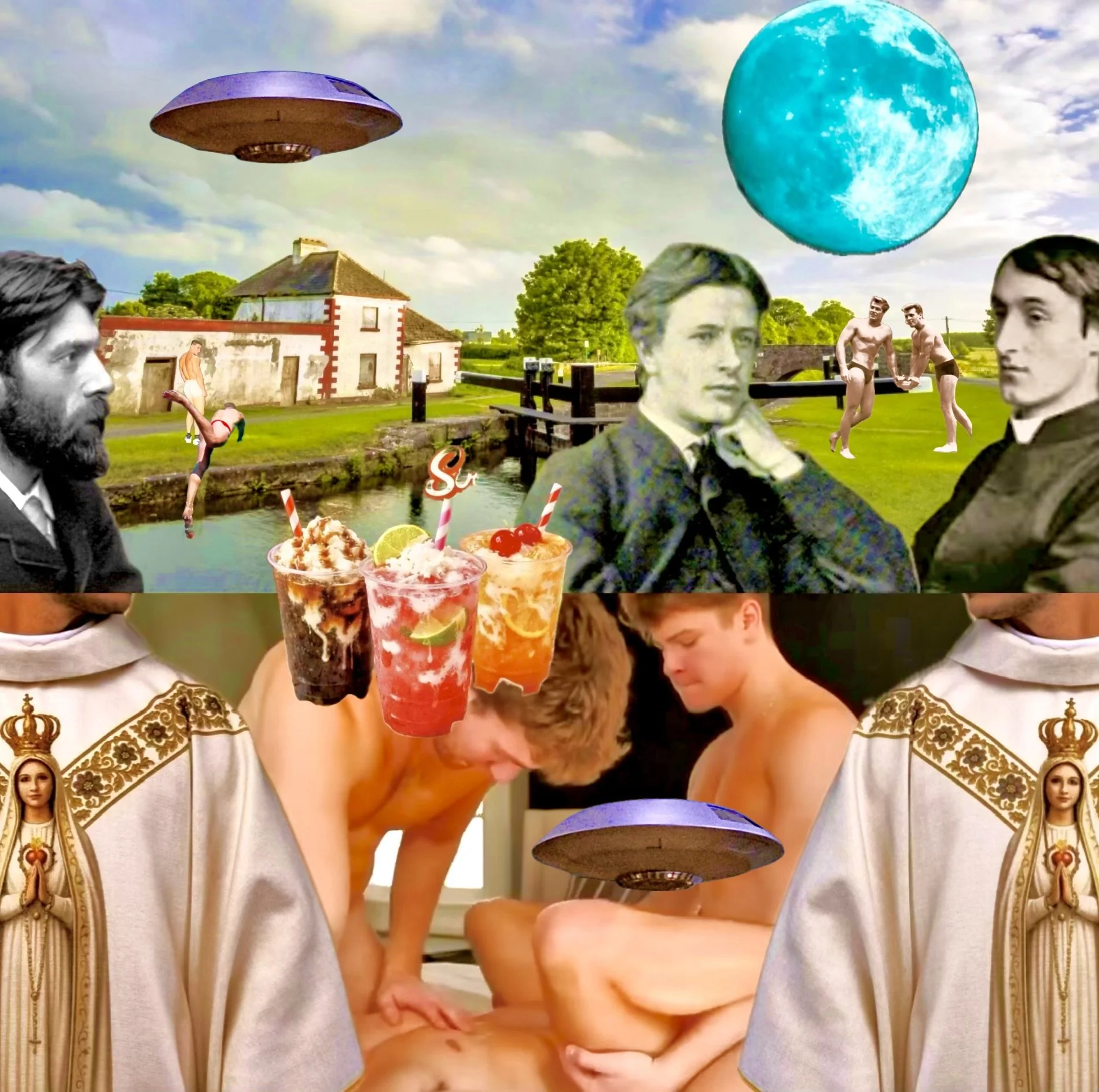
“Three Nineteenth Century Men with an Acknowledged Intense Friendship That Got Absorbed by the Closet and the Dominant Culture’s Penchant for Burying Queer Love and Expression Through a Skewed Historical Lens”
Digital Photocollage 2026
Three Men in the Green Ferment
Jerry (Gerard Manley Hopkins, 1844–1889)
He was a poet and a Jesuit, a man whose senses were so finely tuned to the physical world that every blade of grass was a theological event. He recorded in his private Oxford journals an obsessive, guilt-ridden preoccupation with male beauty — what he called, with anguished precision, “imprudent looking.” He struggled. He prayed. He converted to Roman Catholicism in 1866, took his vows, and redirected the whole force of his desire into God and nature. Literary critics have spent a century calling this sublimation. The closet has another word for it.
Diggy (Digby Mackworth Dolben, 1848–1865)
He was an Anglo-Catholic poet, younger than Jerry by several years, handsome and emotionally intense, the kind of young man who writes poems that are, as one scholar put it plainly, homoerotic. He was besotted with a classmate named Marchie Gosselin who barely noticed him. Jerry was besotted with Diggy. The whole arrangement was a perfect Victorian triangle of longing and misdirection. Diggy drowned in 1865 at the age of nineteen, before anything could be named or resolved. He took his portion of the story with him into the water.
Rob (Robert Bridges, 1844–1930)
He was a fellow Oxford student who became Britain’s Poet Laureate and the primary reason Hopkins’s poems survived at all. Their friendship lasted twenty-six years, right up until Jerry’s death in 1889. It was Rob who kept the poems. It was also Rob who, after Jerry died, had all of his own letters to Jerry returned and destroyed — so that whatever he had written, whatever he had felt, whatever passed between them in twenty-six years of correspondence, is gone. He kept Jerry’s poems for twenty-nine years before publishing them. When he finally did, he attached a preface that left readers wondering why he had bothered. The closet, by then, was firmly in charge of the archive.
Together, Jerry, Rob, and Diggy inhabited a world of intense male friendship that Victorian culture permitted only so long as it remained unnamed. They frolicked — and that word is chosen deliberately — in the idyllic green landscape of Monasterevin, Ireland, in what one might fairly call the last innocent moment before society arrived with its categories and its consequences. The green ferment embraced their sweet love for one another. The canal ran quietly beside them. The sky was the color of everything possible.
And then Society Intervened
Letters were burned. Identities suppressed. Poems withheld. The history was not destroyed so much as carefully rearranged — passed through the skewed lens of a dominant culture that had no language for what these three men were to each other, and no intention of finding one.
The Collage as Reclamation
No archive contains a photograph of Jerry, Rob, and Diggy together. No biographer assembled them in the same frame. The historical record kept them separate — individual entries, individual footnotes, individual tragedies. What this collage does is refuse that separation. It puts the three men back together in the landscape they shared, back in the green ferment of Monasterevin, back where they were before society arrived with its categories. That act of assembly is itself the argument. The Closet Series does not illustrate history. It corrects it.
A Personal Note from the Artist
My grandmother was born and raised in Monasterevan at the turn of the twentieth century. I visited there in 1982 and walked under the thatch roof of the hundred year old family homestead. So this collage and this story of these three literary men who spent time in Monasterevin is very close to me. For example, I have two grand uncles, two brothers of my grandmother, who were born in the 1890s, who lived together as ‘confirmed bachelors’ their entire lives in that family home. During my visit I remember the window over the sink piled high with tea cups stained black from years of living. So this is personal to me — and sadly it’s reflective of an ongoing personal family history of generational repression of queer identity and expression.
Final Thought
What The Closet Series does with Jerry, Rob, and Diggy is what it does with all its subjects — it restores the expansive reading. It does not speculate beyond the evidence. It simply refuses the restrictive one. These were three nineteenth century men with an acknowledged intense friendship that the historical record has consistently underread, understated, and in Rob’s case literally incinerated. The poems survived. The love survived, encoded in every line. The Aquarian moon was watching then as it watches now — witness and truth, patient across centuries, waiting for someone to say what the archive was always trying to say.
The Closet Series 2026 James Behan