California Blue
On 1980s California Gay Culture, the AIDS Crisis, and the Films of William Higgins
Let us put this to rest.
At a legal and cultural level, gay adult film is neither sinful nor immoral. It is legal expression made by and for consenting adults, protected by the same constitutional framework that protects every other form of speech and creative expression in this country. The notion that homosexuality itself is sinful or immoral has equally no place in our laws or our dominant culture. It is entirely appropriate for a minority religious tradition to hold that view within its own walls. It is not appropriate — it is in fact a form of cultural aggression — to allow that view to shape legislation, public policy, or the social contract that governs all Americans regardless of faith. A religion that seeks to codify the diminishment of other people’s lives is not expressing faith. It is operating as a hate group. And hate groups, like any other destructive force, should be contained — not celebrated, not legislated, and not permitted to define the terms of a pluralist democracy for everyone else.
This essay is about a people being oppressed by an intolerant minority. And it is time to stop.
To understand why this argument is not abstract but urgent, you have to understand what was actually happening in California before AIDS arrived — what was being built, what was being lived, and what was taken. Because the people being judged were not abstractions. They were young men in the sun, building something that had never existed before in American life.
One man who lived through it in the Castro described that era in three words: party, party, party. Translated into the language of what it actually was: freedom, freedom, freedom.
The 1970s had delivered something genuinely new to American gay life: a geography of freedom. Gay men from across the country migrated to San Francisco’s Castro District, drawn by word of mouth, by the promise that a different kind of life was possible. By the summer of 1978 — what many recall as the high point of the Castro’s development — a new society had taken shape. Gay softball leagues. A gay chorus. Three gay and lesbian newspapers. Gay men building institutions, building community, building a world that had never existed before on American soil.
California was the backdrop and the metaphor. The state had always promised reinvention — the frontier, the Gold Rush, the movies, the counterculture. Now it was promising something else: the freedom to be exactly who you were, in full sunlight, without apology. The decade of the 1980s dawned on a San Francisco gay community with well-established political clout and a fully realized culture of sexual liberation. Gay Pride and Gay Power were in full bloom. Harvey Milk was in office.
And the sun was everywhere. The colors were neon and pastel and luminous. Ocean Pacific — OP — was selling its bright geometric sportswear out of Huntington Beach surf shops and into national chain stores, its designs moving from primary color stripes to bold neon shapes as the decade shifted. Izod Lacoste polos in every pastel shade defined the preppy aesthetic. The movies that captured California for the nation — Fast Times at Ridgemont High, Valley Girl, The Karate Kid, The Lost Boys — were drenched in that same saturated light, that same cheerful insistence that pleasure was the point and the coast was paradise. Don’t worry. Be happy. The tan will last forever.
The California Look
In this context, William Higgins was doing something that deserves to be understood as more than pornography. He was making documents.
Higgins founded Catalina Video in the late 1970s and spent nearly two decades producing gay adult films with what the industry called the “California Look” — sun-drenched, athletic, outdoors, unapologetically physical. Pacific Coast Highway. Sailor in the Wild. California Blue. Boys of Venice. These were not underground productions shot in shame and shadow. They were made in the same California light that lit every other film being made in the state — the rocks at Joshua Tree, the beaches of Malibu, the golden hills of the interior. Gay men as beautiful and physical and joyful as any other young Americans, doing what young Americans do in the California sun.
Higgins got into the pornography business, he said, because the gay films of the mid-1970s were “so bad” that he decided to start making them himself. He brought production values, narrative ambition, and a genuine aesthetic to a form that had been operating largely in the dark. His films won industry awards. They were distributed internationally. They gave the gay men who watched them something the mainstream culture systematically denied: the sight of themselves, at ease, at play, in their bodies, in their pleasure, without punishment.
This is not a small thing. For gay men across America — isolated in conservative towns and families, invisible in their schools and workplaces, told by their churches that their desire was an abomination — these films were lifelines. To judge these films, and this lifestyle, and the men they were made for — read the disclaimer at the start of any gay adult film, which has always been explicit about its intended audience — by the standards of any single religious tradition is to misunderstand what they were and what they did. No one denomination has the authority to determine the moral weight of a lifeline. All marginalized communities understand this dynamic: visibility is a necessity, not a luxury. The men who found themselves in those images — recognized, present, joyful, real — were not sinning. They were surviving and thriving.
There is a persistent and revealing irony in the straight male relationship to gay male culture. Straight comics have long mined gay men for material — but the laughter has always had an undertow of something else. Envy. The freedom is visible. The happiness is visible. The comfort in the body, the ease with pleasure, the absence of the particular straight male terror of being seen wanting something — all of it visible, and all of it apparently infuriating to men who have been told that desire must be managed, hidden, performed only in the right contexts with the right people. Some straight men have said openly that they wish they were gay — and the laughter that follows is the laughter of a contradiction that the culture cannot resolve. The oppressive sentiment and the secret wish occupy the same man at the same time.
And then there is gay for pay — straight men appearing in gay adult films because, as they will tell you directly, the pay is better. Which it is. The straight man who will perform desire for another man on camera for money, while insisting on his heterosexuality, is perhaps the most complete expression of the contradiction. The culture says one thing. The body, and the bank account, say another. Clark sits at the breakfast table. The oatmeal goes cold. He hates it cold.
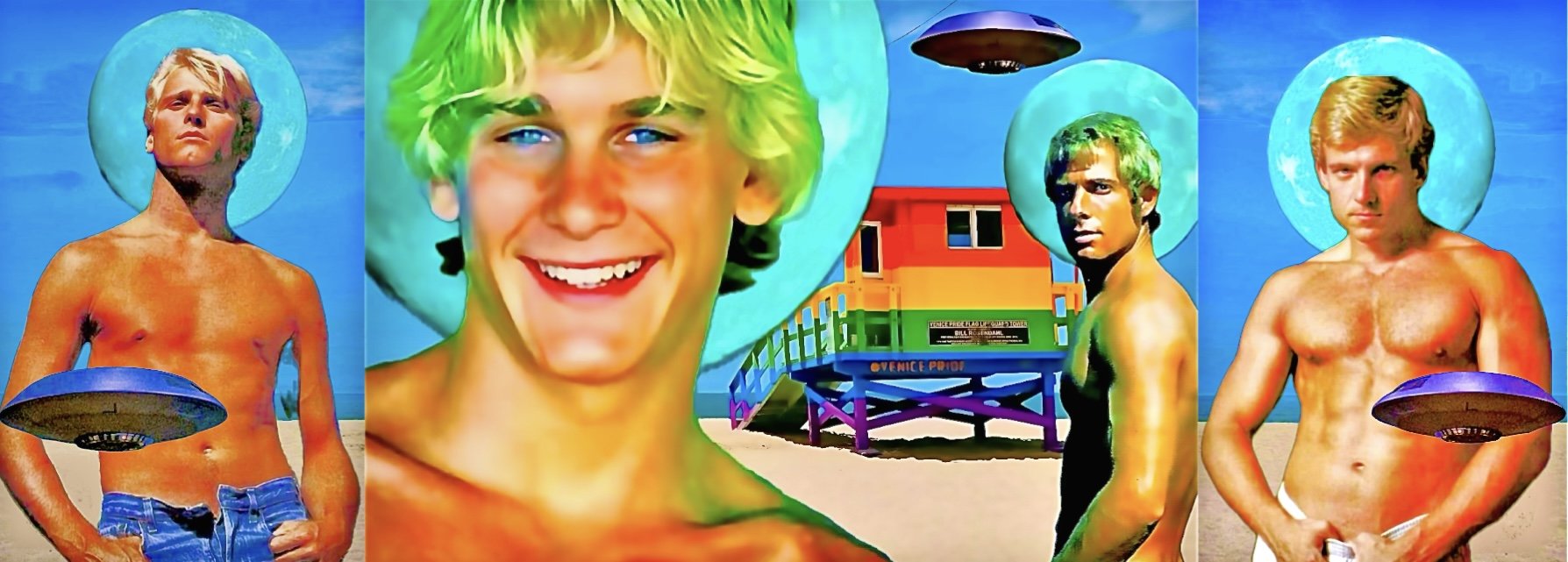
This essay references collages that draw directly on this tradition. The central figure — striped shirt, director’s chair, California sun, the Aquarian moon watching overhead and Jupiter 3 hovering nearby — is the man at the center of the decade. Comfortable in his body. Comfortable in his desire.
And Then the Light Changed
The initial clusters of a rare pneumonia and an unusual cancer appeared in Los Angeles’s gay community in 1981. By 1982 and 1983, the virus was moving through San Francisco’s Castro District with devastating speed. San Francisco General Hospital pioneered what became known as the San Francisco Model — patient-centered, compassionate care delivered in dedicated AIDS wards that became a global standard. The community organized with extraordinary speed and courage: hospices, legal support networks, grassroots education campaigns, organizations like Project Open Hand delivering meals to the sick. The AIDS Memorial Quilt, conceived by activist Cleve Jones in 1987, grew to become the largest community folk art project in American history — each panel a name, a life, a person the culture had been prepared to forget.
The federal government watched in silence.
Ronald Reagan did not make his first public speech on AIDS until 1987 — six years into the epidemic, by which time more than 20,000 Americans had died. In 1982, his press secretary laughed when a journalist asked whether the president was tracking the spread of the disease. When Reagan’s close friend Rock Hudson was dying of AIDS in 1985, Nancy Reagan declined to intervene on his behalf. Senator Jesse Helms amended a federal appropriations bill to prohibit AIDS education that might “encourage or promote homosexual activity” — meaning, in practice, education that might save lives. The administration that preached traditional values and family strength looked at a generation of young men dying and chose silence. It chose it deliberately, repeatedly, and for years.
Dr. Marcus Conant, one of the first physicians to confront AIDS as it moved through the San Francisco gay community, lobbied the Reagan administration in 1982 for an emergency public education campaign. The president waited five more years to publicly mention the crisis. “Ronald Reagan and his administration committed a crime,” Conant said later, “not just a sin.”
The Cruelty of the Outing
Among the many devastations AIDS visited on gay men, one of the cruelest and least discussed was the forced outing it produced on a massive scale. Young men who had built lives in California — who had moved west for exactly the freedom the Castro and the beach culture and the films of William Higgins represented — suddenly found their private lives exposed in the most brutal way imaginable. A diagnosis was not just a medical event. It was a revelation. It told families, employers, communities, churches, everything they had not been told and had not been invited to know. Men who had been navigating the closet with care and courage for years were stripped of that navigation in an instant, at the moment of greatest vulnerability, with no preparation and no choice.
Conservative families who had managed not to know — who had perhaps suspected but had not been required to confront — were suddenly confronted. And many of them responded not with love but with the theology of judgment. AIDS was God’s punishment. The diagnosis was confirmation of everything they had feared and condemned. Young men died rejected by the people who were supposed to love them most, outed by a virus into a family that had decided, on religious grounds, that their lives had been a sin. This is among the most complete cruelties in the history of the American family. It deserves to be named as such.
The Families
The conservative families who saw AIDS as God’s judgment were not an abstraction. They were real, and they were numerous, and they were the reason many gay men died alone. Young men who had come to California for freedom, who had built lives in the Castro and on the beaches and in the sun, found themselves sent home to die in communities that had always regarded them as aberrations. Or they died in San Francisco, surrounded by a chosen family that the official culture refused to recognize, mourned by people who had no legal standing and no institutional support and built everything from scratch anyway because what else do you do when the world abandons you.
The gay euphoric delirium of the 1970s was replaced by the sobering crisis of the 1980s. But AIDS, which had the potential to destroy the gay liberation movement, in fact brought the community closer than ever before. It created new solidarities — between gay men and lesbians, between the sick and the healthy, between those who had been politically active and those who had never been before. It produced ACT UP, Shanti, Project Open Hand, the Coming Home Hospice, the Quilt. It produced a generation of activists who had learned, at catastrophic cost, that silence equals death.
What the Collages Hold
What Behan’s collages hold is the whole of it — the joy and the danger, the sunlight and the reckoning. The bodies in motion on the California rocks and beaches, caught in the specific golden-orange light of Higgins’s films. The Aquarian moon witnessing. Jupiter 3 hovering.
The era the films document was real. The men in them were real. The freedom they were experiencing — briefly, fiercely, in full California light — was real. And what ended it was not nature. It was not God’s judgment. It was a government that decided, for reasons of ideology and political convenience and moral cowardice, that some Americans were not worth saving.
And so we return to where we began.
At a legal and cultural level, gay adult film is neither sinful nor immoral. Homosexuality is neither sinful nor immoral. These are not opinions. They are the settled conclusion of every major medical, psychiatric, and legal institution in the developed world. The view that they are sinful belongs to a minority religious tradition and should remain there — contained within its own walls, practiced among its own faithful, and stripped entirely of its ambition to govern the lives of people who do not share its faith. When that ambition escapes those walls and enters the legal system, the school system, the hospital, the family — when it is permitted to determine who receives care and who does not, who is protected and who is expendable — it ceases to be religion. It becomes a hate group with a tax exemption.
This essay is about a people being oppressed by an intolerant minority. The California sun is still there. The freedom is still worth fighting for. And it is time to stop.
The Closet Series has been watching. The Aquarian moon knows. Jupiter 3 was never lost in space. — Behan.