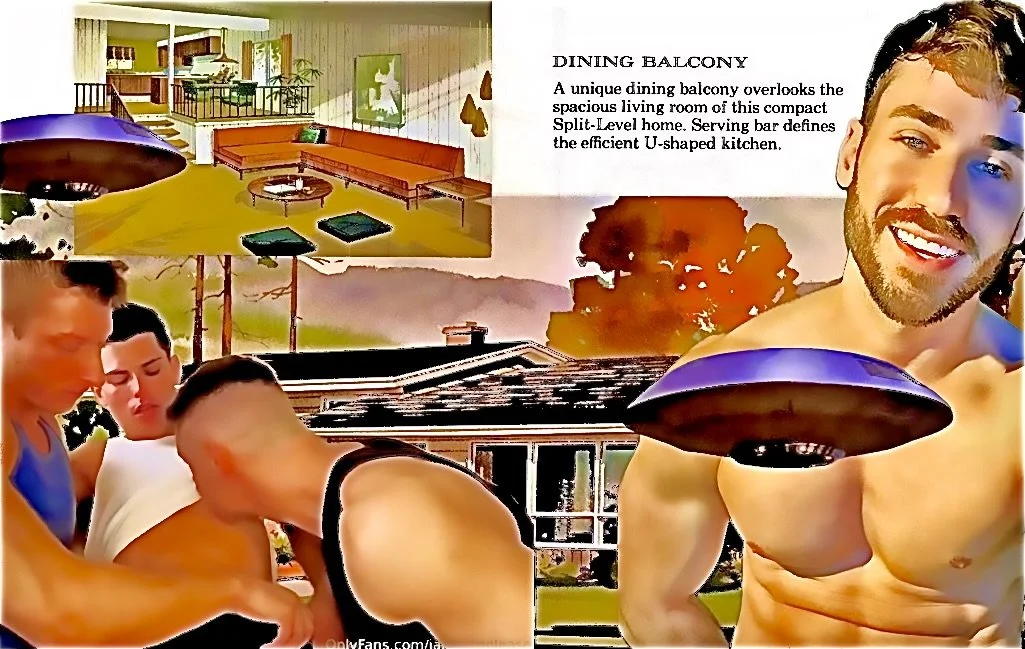
Domesticity and Other Rituals
Digital Photo Collage 2026 James Behan
Domesticity is the great fiction of the postwar American century — the idea that the home was a settled, knowable space with settled, knowable people in it.
Mid-century modernism disagreed. It rejected Victorian ornament, historical precedent, the weight of the old world.
Clean lines.
Open plans.
New materials.
New ways of living.
Its argument was not merely aesthetic — it was social and philosophical. The open floor plan dissolved the hierarchy of rooms and the hierarchy of people within them. The rejection of inherited ornament was also a rejection of inherited social codes.
The mid-century modern home was built for the new at the expense of the old. And the new in the twentieth century was women’s rights, civil rights, gay rights, Latino rights, Asian rights.
That is what the dominant culture did not anticipate when it bought into the carport and the efficient U-shaped kitchen. It thought it was purchasing an aesthetic. It was purchasing a social revolution.
It is not a surprise that gay men and women have always loved mid-century modern architecture. They recognized what it was saying before the dominant culture did. They preserved it, restored it, and lived in it — most visibly in Palm Springs, where the gay community literally saved the buildings the mainstream had abandoned.
The architecture spoke to people who understood its actual argument. The house was ready for them before the culture was.
Someone get the door please.