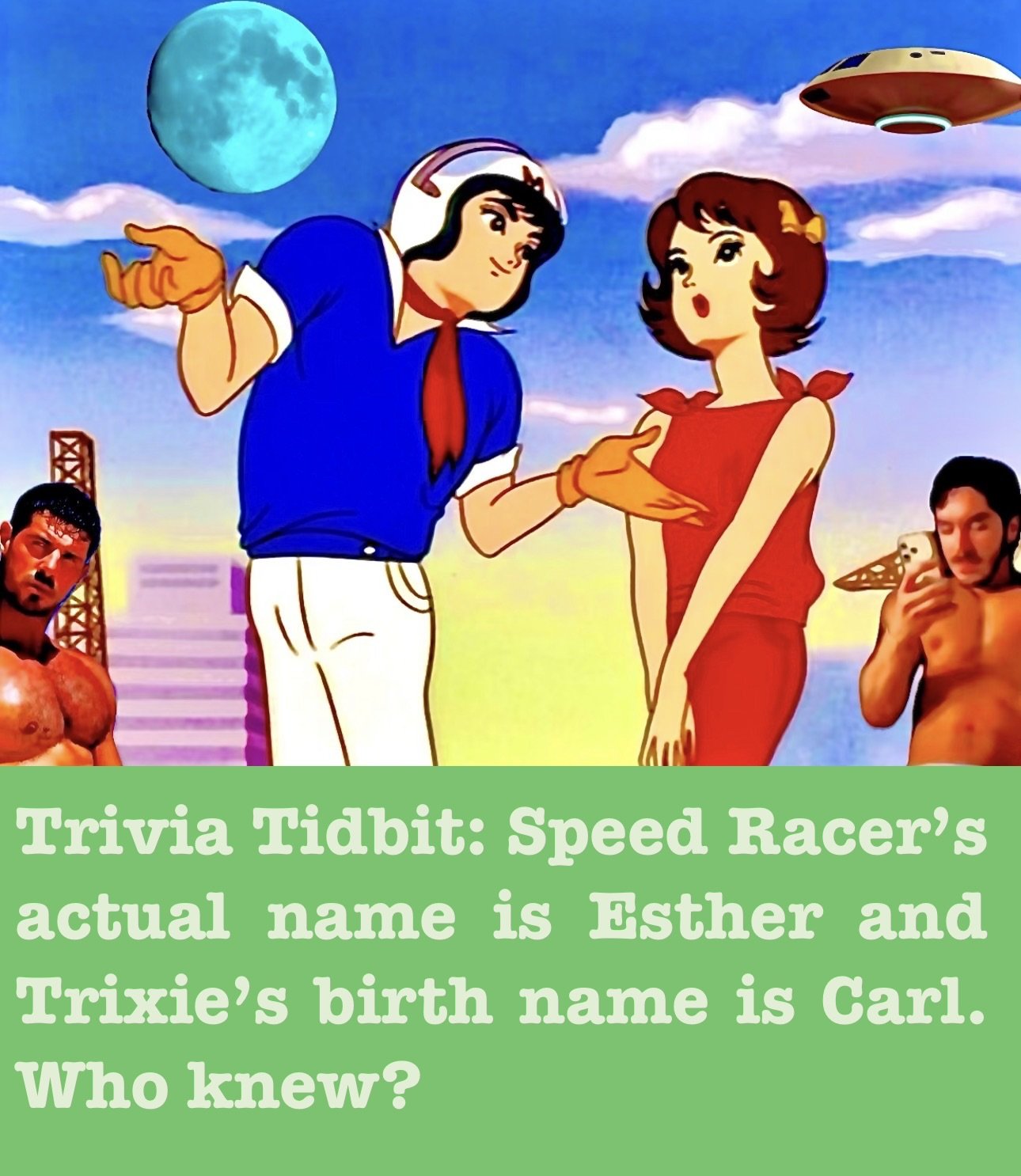
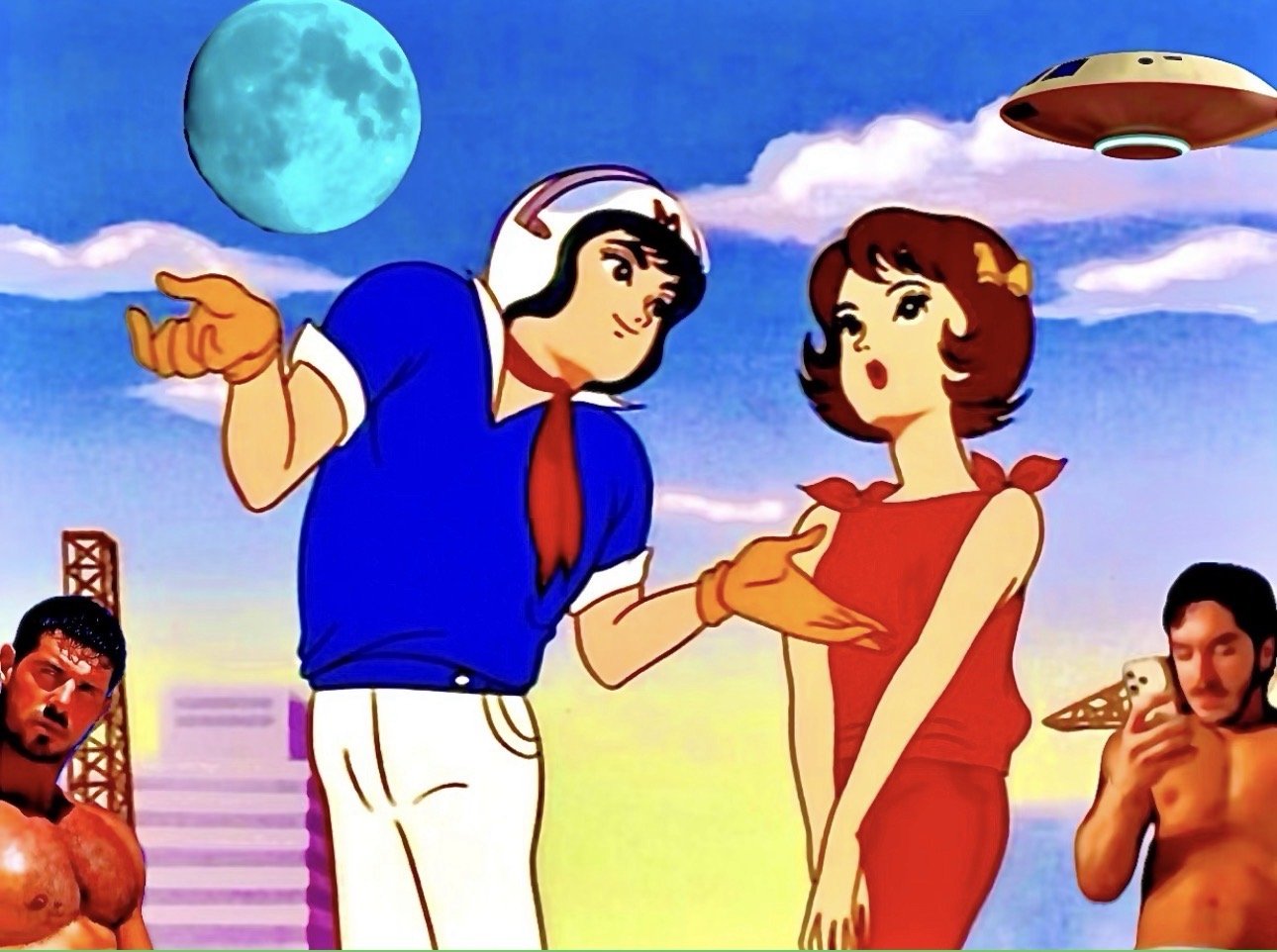
Go Speed Racer Go Queer!
Digital Photocollage, 2026 | The Closet Series — Behan
Trivia Tidbit: Speed Racer’s actual name is Esther and Trixie’s birth name is Carl. Who knew? The Aquarian Moon knew. Jupiter 3 always hoped. The Closet Series watched every episode.
And while watching, noticed something.
Gay people were always in cartoons. They just weren’t allowed to be gay.
What they were allowed to be was a joke. The mincing villain. The lisping sidekick. The character whose gender nonconformity existed purely for the audience to laugh at. From the earliest days of American animation, queerness was present — encoded, weaponized as comedy, and never taken seriously.
Bugs Bunny appeared in drag on at least 45 separate occasions. Chuck Jones, one of the creators of the character, admitted in the 1990s that he always imagined Bugs as transgender. And yet Bugs was never gay. He was a gag. The dress was the punchline, not the person. He married a man in at least three cartoons in the 1950s — and nobody called it what it was.
Disney’s Ferdinand the Bull (1938) was described by scholars as “not necessarily gay, but definitely queer” — a bull who refused to conform to expectations of masculinity. The Reluctant Dragon (1941) was called “extremely queer.” These characters were present. They were just deniable. Queer enough to register, straight enough to defend.
The pattern held for decades. Effeminate characters populated Saturday morning television as figures of gentle ridicule — too precious, too dramatic, too much. Their queerness was the costume, not the character. They existed to be laughed at, not identified with. Gay children watching these cartoons absorbed the message that was being transmitted: people like you are funny. People like you are not serious. People like you are not the hero.
It wasn’t until 2013, when Steven Universe aired, that a mainstream animated series made queer characters central rather than peripheral — ultimately featuring over 39 LGBTQ+ characters, with a nonbinary, bisexual showrunner behind the whole thing. That is eighty years of American animation between Bugs Bunny in a dress and a cartoon that actually meant it.
Speed Racer and Trixie are just fine.
The question is: how is their straight audience?
Sources
• Wikipedia: History of LGBTQ Characters in Animation
• Messy Nessy Chic: How Bugs Bunny Became a Queer Icon
• SpiritLive Radio: Queer Representation in Cartoons: A Trip Through Time