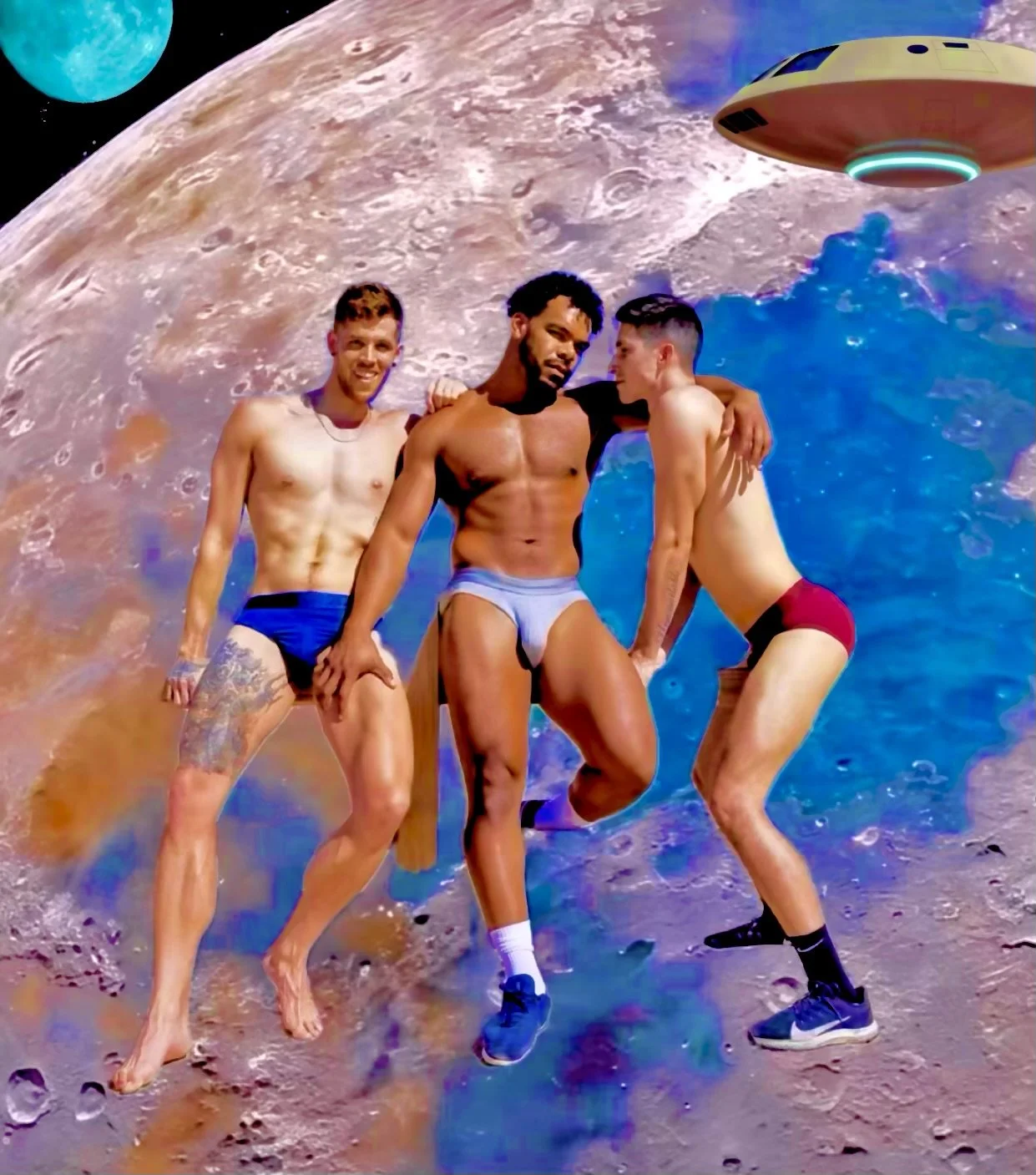
Moon Shot
Digital Photocollage, 2026 | The Closet Series — Behan
NASA did not accidentally exclude gay astronauts. NASA deliberately, systematically, and institutionally shut the door on them. Not because they weren’t qualified. Not because they didn’t want to go. Because NASA decided they were disqualified by who they were, and built a bureaucratic apparatus to make sure of it.
Early NASA astronauts in the Mercury, Gemini, and Apollo programs were required to take two mandatory heterosexuality tests. Apollo astronaut Jim Lovell recalled one of them: “When the inkblots came up, we looked at them and, sure enough, we’d always see some feminine anatomy in there to make sure that we gave the proper sexual response.” The Rorschach inkblot test — administered by NASA to screen out gay men. In 1994, NASA asked a flight surgeon to formally include homosexuality as a psychiatrically disqualifying condition for astronaut selection.
NASA recruits heavily from the US military, which banned openly gay people from serving entirely until 1993 — and even then only partially, under Don’t Ask Don’t Tell, which itself wasn’t fully repealed until 2011. The pipeline from military service to astronaut corps meant that the military’s exclusion of gay people became NASA’s exclusion of gay people by default. You could not be openly gay and serve. You could not serve and become an astronaut. The closet was built into the system at the foundation.
It was not until 2016 that NASA created an LGBTQ Special Emphasis Program. Sixty years after the space program began.
Sally
Sally Ride was firmly ensconced in the closet when she became the first American woman in space in 1983, and is now recognized after the fact as the first LGBTQ+ person to have left the atmosphere. She stayed in that closet for the rest of her life. She died in 2012 — twenty-nine years after her first mission, nearly three decades after she looked down at Earth from space and saw it whole — and she never once said a word publicly about who she loved. Think about what that tells you. Not about Sally Ride, whose courage in every other dimension of her life was beyond question. But about the closet itself. About the weight of intolerance so severe, so sustained, so credible in its threats, that one of the most celebrated and accomplished women in American history calculated that silence was still the safer choice in 2012. The Republican Party, which spent those same decades legislating against gay existence at every level of government. The religious right, which spent those same decades declaring gay people unfit for public life. The Reagan administration, which watched gay men die of AIDS by the thousands and said nothing for years. NASA itself, which required heterosexuality tests of its astronauts and as recently as 1994 sought to classify homosexuality as a disqualifying psychiatric condition. These were the forces that held the closet door shut. Sally Ride did not choose silence. She was silenced. She came out at her own funeral because that was the first moment it was safe enough to tell the truth.
The Number
791 people have flown into space.
Only one has come out as gay.
Only one.
The Collage
Three men on the lunar surface. The Aquarian Moon overhead, large and patient. Jupiter 3 bearing witness from the upper right corner of the frame, as it always does — present, watching, unhurried. The lunar surface they stand on is not imaginary. The question of who belongs there is not rhetorical.
The question isn’t whether gay people belong in space. The question is when are they going to be allowed to go.
Sources
• Space.com: Why Aren’t There Any Openly Gay Astronauts? (2012)
• Live Science: Why Aren’t There Any Openly Gay Astronauts? (2012)
• Slate: Sally Ride Lesbian — Why Did the First American Woman in Space Stay in the Closet? (2014)
• LensCulture: The Gay Space Agency — Mackenzie Calle
• PhMuseum: The Gay Space Agency — Mackenzie Calle
• SentIntoSpace.com: LGBTQ+ People in the Space Industry (2023)
• QueerBio.com: The Queer Presence in Space Exploration
• CBC News: Astronaut Sally Ride Comes Out Posthumously (2012)
• Pink News: Documentary About Trailblazing Lesbian Astronaut Sally Ride (2025)