He’s a Man’s Man’s Man’s Man’s Man
Compare two compositions, five hundred years apart.
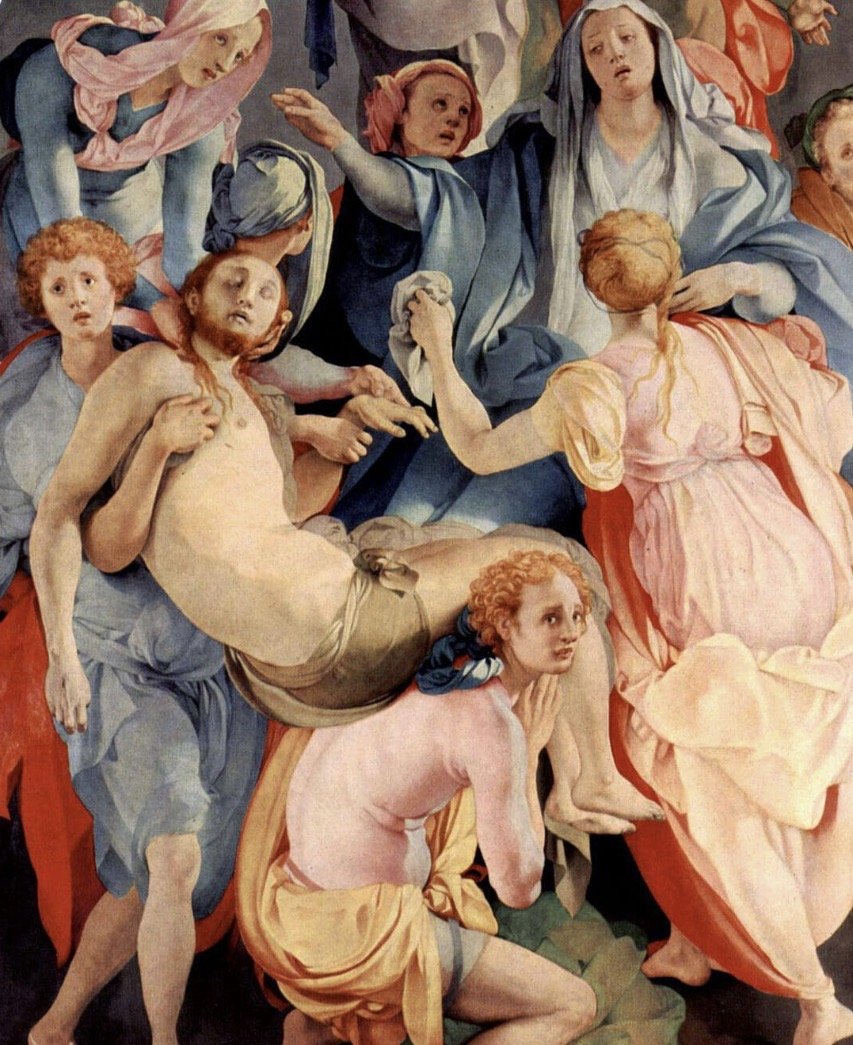
Pontormo’s “Deposition from the Cross” breaks every rule of the scene it depicts — no cross, no ladder, figures floating in an airless, color-drenched cluster that shouldn’t hold together and somehow does. Mannerism uses that kind of compression to signal crisis a normal composition can’t carry.
This collage borrows the same architecture. Bodies pressed together in a barbershop that has nothing to do with grief, staged with the same claustrophobic intimacy — one man cradled, another looking straight into the lens, a Blue Moon and Jupiter 3 presiding overhead. Where Pontormo’s figures mourn a body coming down, these figures are holding each other up inside a room explicitly built to insist they never would.
That room is real. At the beginning of the Trump era, a D Magazine feature on Dallas men’s grooming quotes a barber who “politely barks from the back of the shop, ‘Sorry. This is a gentlemen-only establishment,’” whenever a woman opened the door by mistake. Women weren’t welcome. That wasn’t a question — it’s stated plainly, treated as charm. The article never says whether an obviously gay man would be welcome in that chair either, but it’s not hard to guess.
The real question is pure business: why would anyone build a model that excludes women and possibly gay men — historically the two demographics that spend the most on hair, grooming, and personal care — in favor of a customer base that has, for decades, spent the least? That’s not tradition. That’s leaving money on the table on purpose.
The answer isn’t economics. It’s Texas politics over the last thirty years. This is a state that had Ann Richards in the governor’s mansion within living memory — a genuinely blue Texas. What’s replaced that is a hard turn into Orthodox-adjacent Christian-right territory, where masculinity isn’t just performed, it’s policed, and the barbershop door is one small outpost of a much larger project.
And the tell is what that culture now tolerates in its own leaders. A sitting president, a darling of the Christian right, with a long, well-documented history of affairs, and a Texas Republican Senate nominee whose campaign has weathered a widely reported alleged affair, winning his runoff in a landslide. The Christian right isn’t holding its nose through this. It’s celebrating it. Adultery, once disqualifying, now reads as proof of a certain kind of manliness— an appetite for authority as evidence of power, with infidelity as a credential.
D Magazine published this piece in September 2017, several months into a new political era, hostile to women and gay men, and that’s troubling in my view. Pontormo’s Deposition is a painting of desperation — a body taken down in the middle of catastrophe, mourners holding each other up because there’s nothing else left to hold. This collage borrows that gravity on purpose, because Texas right now is not a metaphor. Women are dying from restricted access to reproductive care. Gay men are facing real harassment in a state that has grown openly hostile to them. Some sort of acknowledgement from a publication would be welcome if it hasn’t already been made.
Ultimately this collage isn’t about a chair so much as who Texas has decided is worth protecting — and right now, the seat is getting smaller, not wider.
— Behan