Two Stills, One Light
Two becoming one — a classical, timeless phrase, biblical in its intonation, pervasive throughout Western culture, the idea of two merging into a single whole. That is, in fact, the nature of these two works: formally independent images, self-sustaining, equally interesting each in their own right, merging together to become seamlessly integrated, inseparable — one.
The Wrestlers
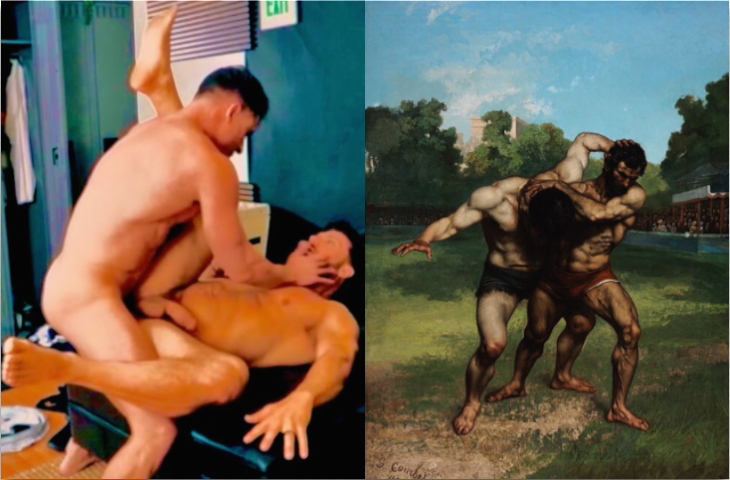
Gustave Courbet painted The Wrestlers in 1853, working, as always, from something he’d actually seen — a real match, staged at the old hippodrome on the Champs-Élysées, two men straining against each other in front of a crowd. Courbet was a Realist by conviction, not by default; he built an entire career on refusing to idealize a body into something classical, something safer than what was actually in front of him. Even so, writing to his parents about the Salon showing, he admitted he’d “covered their nudity” — proof that the classical half of this pairing wasn’t as chaste in its own moment as it now reads. Even a painter this committed to unflinching observation still worked inside a limit someone else had drawn.
The film still beside it shares that same basic grammar: two male bodies locked together, a diagonal thrust of limb against limb, weight and effort caught at the exact moment neither man has yet won. Set the two side by side and the vocabulary is nearly identical — not because one is quoting the other, but because two bodies in real physical contest only have so many ways to arrange themselves. Courbet drew the same lines a camera draws a century later, because the bodies themselves were always going to draw them first.
The Vessel
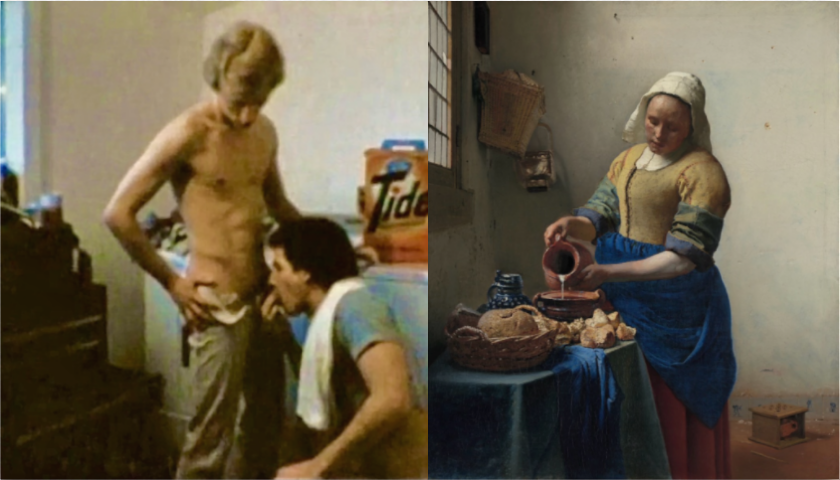
Vermeer’s The Milkmaid, painted around 1658, isn’t about contest at all. It’s about absorption — a woman entirely inside a small, ordinary task, pouring milk from a jug with a stillness so complete the viewer feels almost intrusive watching it. Nothing in the painting performs for anyone. That’s the whole quiet genius of it.
The still beside it works on that same register, not the Courbet’s. Two figures caught in a private, unglamorous room — a laundromat, a box of Tide in frame — absorbed in something entirely their own, unbothered by an audience that technically exists but isn’t being acknowledged. It isn’t about matching poses. It’s about matching interiority: two images, three centuries apart, both built around the same rare thing — a person caught fully inside a private act, asking nothing of whoever happens to be looking.
Two Kinds of the Same
Physicality and interiority — contest and absorption — these are two different energies, and the two pairings shouldn’t be read as saying the same thing twice. But underneath both sits one shared fact, worth naming plainly rather than dressing up: whether the medium is a nineteenth-century oil painting or a late-twentieth-century adult film, both are, in the end, simply light, arranged on a surface, describing a body. The vocabulary doesn’t change nearly as much as the culture insists it should.
Which is really the whole point of placing two images next to each other in the first place. Not two artworks displayed together, but one new artwork, made entirely out of the gap between them — a gap that, once closed by proximity, stops existing at all.