The Original Room
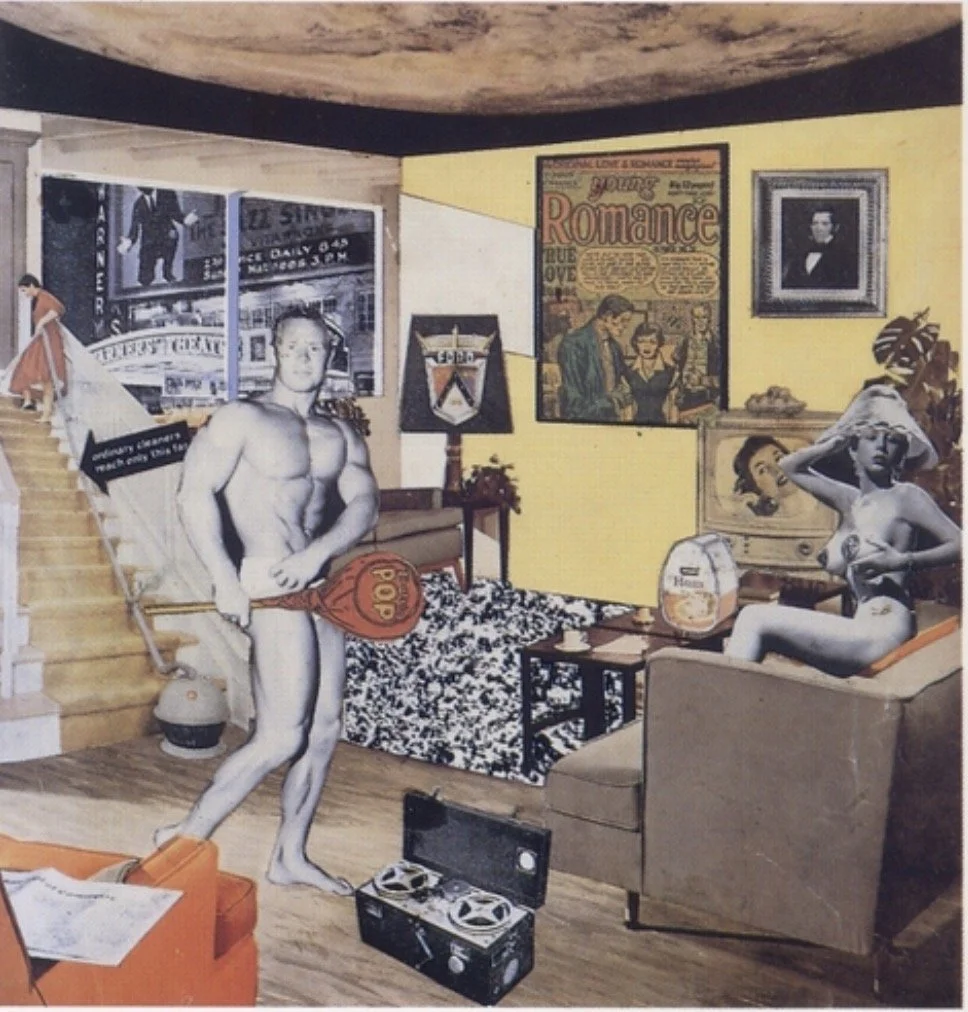
In 1956, Richard Hamilton makes a small collage for This Is Tomorrow, an exhibition at the Whitechapel Gallery in London. He titles it Just what is it that makes today's homes so different, so appealing? It is printed in the catalogue and on the poster, and it becomes one of the founding images of Pop Art.
The room is a catalogue of postwar promise. A bodybuilder holds a giant Tootsie Pop. A woman poses on the sofa. A tape recorder sits on the floor. A vacuum cleaner climbs the stairs, with an ad arrow claiming that ordinary cleaners reach only this far. A canned ham rests on the table. A television, a comic-book cover, a Ford emblem, and a movie marquee fill the walls. Above it all, the ceiling is a photograph of the Earth.
The message is simple. The good life can be bought, and it is coming to every house.
Seventy Years Later
Today the most talked-about new homes are not in the suburbs. They are underground.
Survival condominiums are built inside decommissioned missile silos. Billionaires dig shelters beneath ranches in Hawaii and estates in New Zealand. These spaces come with pools, theaters, gyms, and air filtration systems. They are sold as protection from collapse, war, pandemic, or unrest.
They are also sold to very few people. The luxury bunker is the clearest statement yet from the top 1%. It assumes that a disaster is coming, and it plans for only one group to survive it in comfort.
The New Room
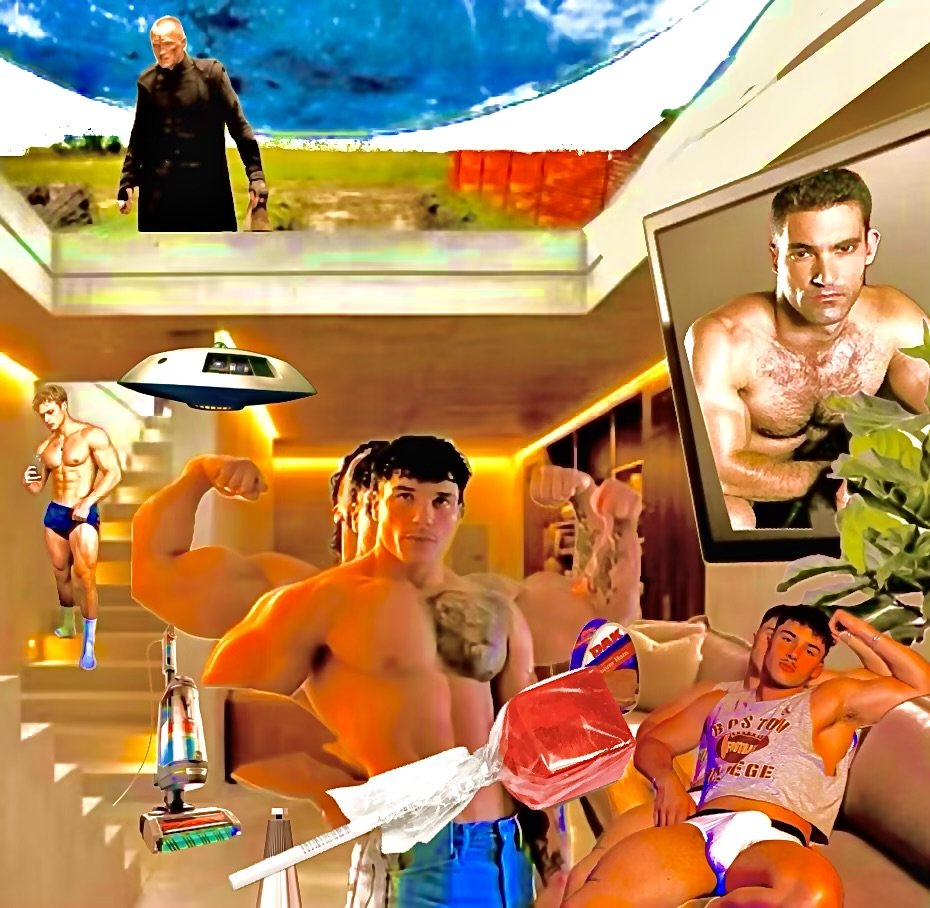
My collage keeps Hamilton's layout and moves the room below ground.
The ceiling is no longer a picture of the Earth. It is an opening to the surface: grass, a fence, the sky, and a man in a black coat looking down into the shelter. The danger is up there. The residents are down here.
The bodybuilder returns, multiplied and flexing, still holding an oversized lollipop. The woman on the stairs with her vacuum is replaced by a young man in briefs, phone in hand, with a cordless vacuum waiting at the bottom step. The woman on the sofa is replaced by a man in a college tank top. The television is now a wall-sized screen. The canned ham is still on hand, because every bunker needs a pantry. A flying saucer hovers near the stairs, the old fear of the 1950s still in the room.
Subtext Made Context
Hamilton's bodybuilder comes from a physique magazine. In the 1950s, those magazines are among the few places gay men can find images of other men, published under the cover of health and fitness. Hamilton places that figure in a conventional household beside a pin-up woman.
In my room, the household is all men. What sits in the margin of the original is the subject of this version.
Similar, Unaffordable
Hamilton asks what makes homes different and appealing. The honest answer for bunkers is that they are all the same: concrete, filtered air, stored food, and a door that locks from the inside. What separates them is price.
This collage imagines the opposite of the current model. If bunkers are needed, everyone gets one. The same canned ham, the same screen, the same safe room, for the same reason that public schools, public libraries, and public shelters exist. Safety in a crisis is not a luxury product.
If the people building these shelters believe the future requires them, the question is not how to buy one. The question is why only they are planning to live through it.
— Behan
Sources
Richard Hamilton, Just what is it that makes today's homes so different, so appealing?, 1956, collage, Kunsthalle Tübingen.
This Is Tomorrow, Whitechapel Gallery, London, 1956, exhibition catalogue.
Richard Hamilton, letter to Alison and Peter Smithson, January 16, 1957, in Collected Words 1953–1982 (Thames and Hudson, 1982).
Guthrie Scrimgeour, "Inside Mark Zuckerberg's Top-Secret Hawaii Compound," Wired, December 2023.