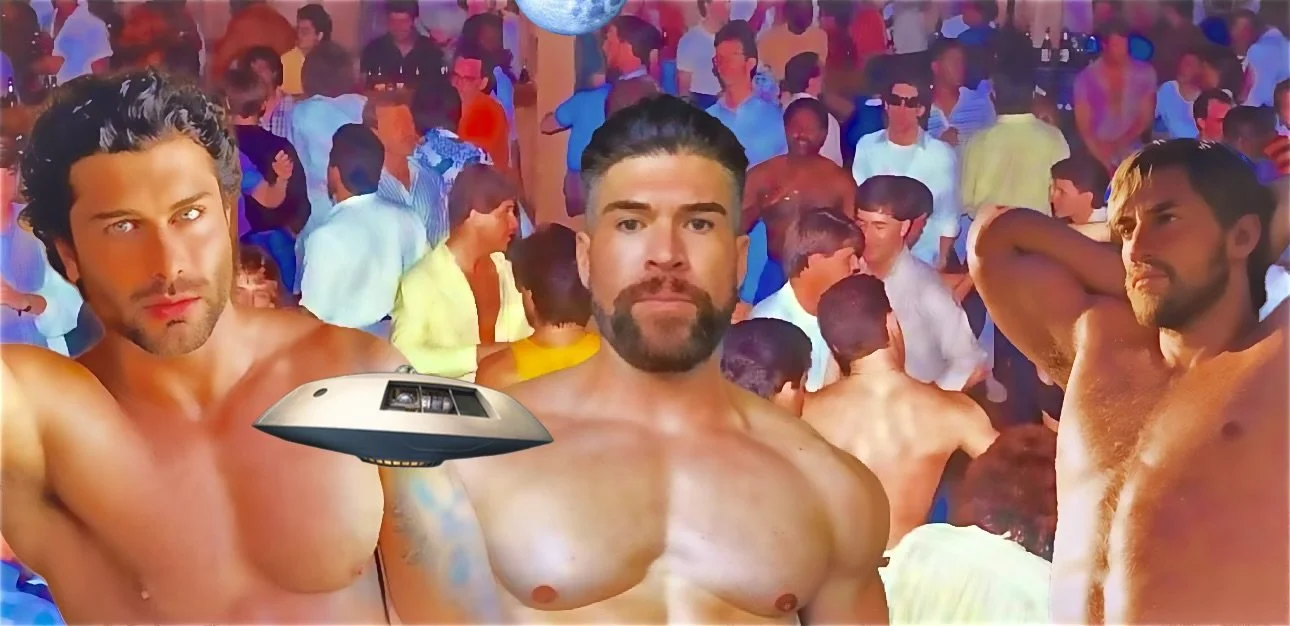
The ground of this collage is a photograph of the dance floor at the Village Station, the gay disco on Cedar Springs at Throckmorton. In October 1979, men on that dance floor were arrested for dancing. In the collage, three men from today stand in front of the crowd with their shirts off, and no one comes for them.
The raid on the Village Station is the first time gay men arrested in a Dallas bar raid fight the charges in court instead of quietly pleading guilty. The Dallas Voice later calls it "Dallas's Stonewall."
The club opens in the summer of 1979. A sign at the door states that it is "gay-owned and gay-operated."
Shortly before 1 a.m. on October 25, 1979, Dallas vice officers arrive during a busy night. Undercover officers are already inside. Police arrest about ten men for public lewdness and a bartender for a liquor violation. One account reports that the men were doing the bunny hop.
Raids like this are routine in Oak Lawn in the 1970s. The usual outcome is a guilty plea, a fine, and probation, because a public trial could cost a man his job and his family.
This time the response is different. General manager Charlie Hott posts bond for patrons who cannot afford it, files a civil suit against the city, and puts up signs asking witnesses to come forward. "STOP POLICE HARASSMENT" is painted on the side of the building. More than 600 people attend a community meeting and learn how to file harassment complaints.
In court, Judge Chuck Miller acquits two defendants because the officers' testimony is inconsistent. District Attorney Henry Wade moves the remaining cases to another judge. Miller accuses him of forum shopping, and Wade agrees to assign cases at random. Most of the remaining cases end in guilty verdicts, and at least two are later dismissed.
The lasting result is that the community organizes. The raid opens a dialogue with the police department for the first time, and the department assigns a liaison officer to the gay community.
Jupiter 3 and the blue moon hover over the dance floor, as they do in every collage in this set. They are the unseen witnesses, and they stand for the viewer. In 1979 the witnesses Hott needed came forward. The crowd in this photograph is the community that made that possible.
The Village Station later becomes S4, which still operates on Cedar Springs.
— Behan
Sources: Sam Childers, "Dallas's Stonewall," Dallas Voice / The Dallas Way (2018); Campbell Read, "A Key Turning Point," Dallas Voice (2009); "Cops Raid the Village Station," D Magazine (January 2010); Wikipedia, "Village Station police raid."