The Modern-Day Eunuch
The culture has a script for gay men who end up alone, and it is not a script about tragedy. Get a dog. Take up a hobby. Throw yourself into charity work. Find god. These are offered, gently and often sincerely, as solutions — as if solitude were a condition to be managed rather than a wound to be acknowledged. No one hands a grieving widower a leash and calls it even. But a lonely gay man is regularly handed exactly that, along with the quiet expectation that he will be grateful for it, and grateful, too, for not asking for anything more.
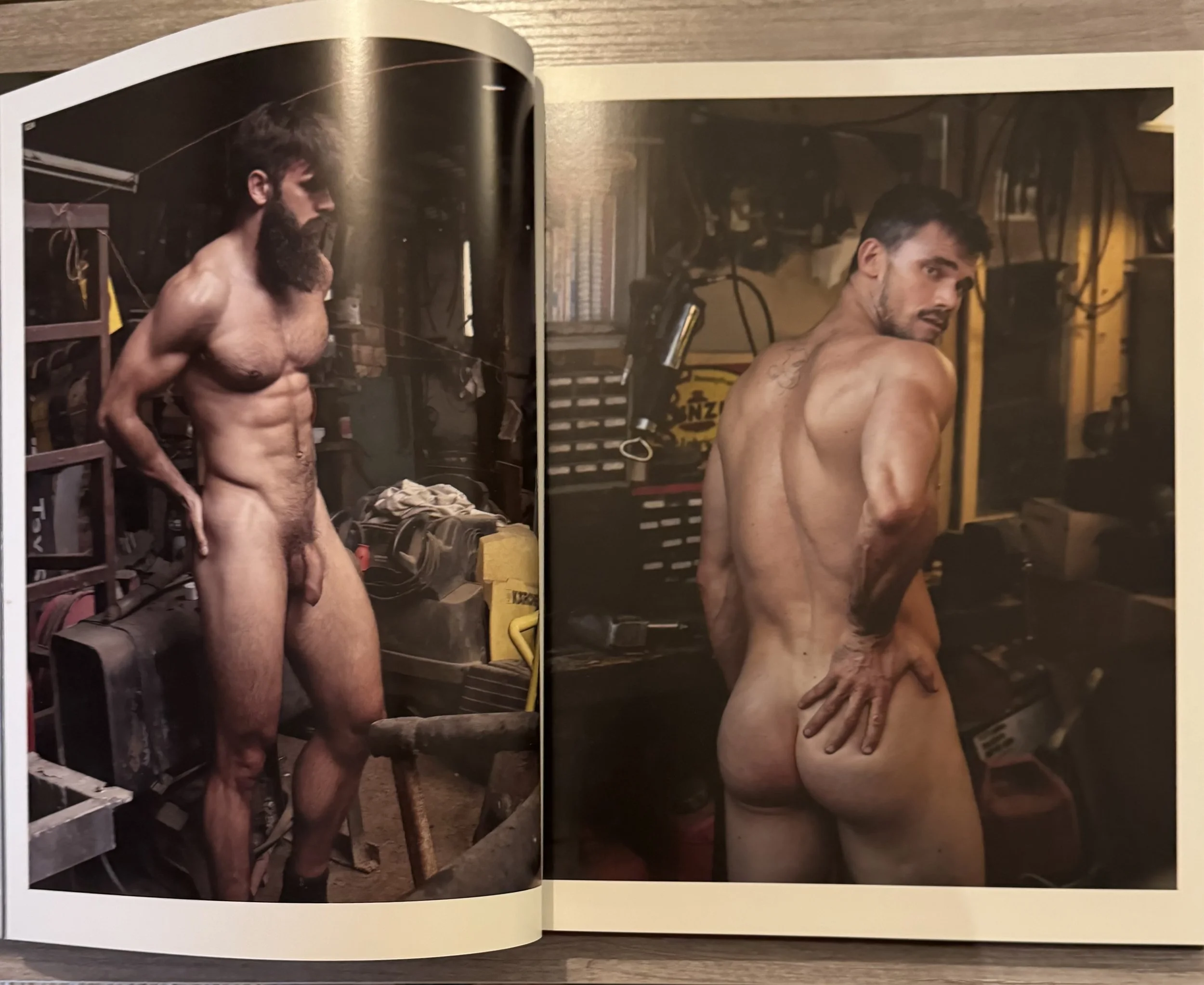
The Subdivision’s three most recent collages — a truck window, a corner store, a garage — all begin at the same site: an image built for solitary consumption. A thirst trap. A reel. A picture-book spread with a spine running down the middle. Each source image sells attention one man at a time, and each collage answers by refusing the premise, populating the frame until the man is no longer performing alone. The work is not subtle about its argument. It is making the case, image by image, that the aloneness gay men are so often pictured in is not natural. It is manufactured, and it is expected, and the expectation has a long history.
Boys in the Band is as good a place as any to see the manufacturing at work. The film gets remembered as a landmark of early gay representation, and it is one, but look closely at what it actually resolves. Alan, the straight college friend whose unexpected visit derails the party, spends the whole night circling something he never names — old rumors of an affair with another man, a visible discomfort he can’t quite explain even to himself. By the end, he calls his wife and reconciles with her, on screen, confirmed, done. Hank and Larry, the film’s one gay couple, get something far less certain: after a night of accusations about infidelity and commitment, they go upstairs together, and the film lets the audience assume reconciliation without actually showing one. Given everything the film has spent two hours establishing about Larry’s resistance to monogamy, calling that ending a real partnership requires more faith than the text earns. What the film gives outright, without ambiguity, is a straight marriage restored. What it gestures at, and lets the audience fill in, is a gay relationship that may or may not survive the morning. Michael, the host, gets nothing at all — he ends the night sobbing in a friend’s arms and then walks alone into a church.
This is worth sitting with, because Boys in the Band was not made by people hostile to gay life. Mart Crowley was gay. He knew this world from the inside. And even his own instrument, gay-affirming to the extent that instrument could be in 1968, could not resist the old shape: the straight man gets restored to partnership, cleanly, while the gay men are left in various states of unresolved aloneness, self-loathing, or unearned hope. If the closet was a trick the culture played on gay men, this is the sleight of hand at its center — even the stories built to defend gay life default to picturing it as fundamentally solitary, as if solitude were simply what being gay costs.
The psychology bears this out in ways that are no longer speculative. Sexual minority adults report markedly higher rates of loneliness and social isolation than their straight peers, and researchers working from the minority stress framework first developed by Ilan Meyer have traced why: living under chronic, minority-specific stress — discrimination anticipated even when it isn’t present, identity concealment, a lifetime of learning to expect rejection — makes intimacy itself feel unsafe to reach for. The isolation is not incidental to the stigma. It is one of the primary mechanisms by which the stigma does its damage, and it compounds: gay and bisexual men who have internalized shame about their own desire become more isolated, and isolation itself becomes a source of further distress, a closed loop with no obvious exit.
None of this is an argument against solitude itself. A man who chooses to be single, who wants his own company and finds it sufficient, is not the subject of this essay. That kind of aloneness can be chosen fearlessly, held without apology, lived as a complete life rather than a diminished one. The tragedy isn’t solitude. The tragedy is solitude imposed by a culture that has spent a century telling gay men, in a thousand small and large ways, that they are meant to be modern-day eunuchs — desired, sometimes, looked at, often, but never quite entitled to the same ordinary partnership it hands straight men without a second thought. And when that imposed aloneness produces exactly the sadness anyone would predict, the culture has a second script ready: the lonely gay man becomes pathetic, his late-night encounters read as desperate rather than human, his solitude treated as evidence of some personal failing rather than the cost of what was demanded of him.
The Subdivision’s answer to all this isn’t an argument so much as a correction, made one collage at a time. Populate the frame. Close the gap the spine insists on. Give the man in the truck a companion, the man in the store a boyfriend to mind the cart, the men in the garage a shared space instead of a shared page. It is a small gesture, repeated. But so was the original exclusion — small, repeated, built into pictures long before anyone thought to call it a pattern.
— Behan
Sources: Meyer, I.H., “Minority Stress and Mental Health in Gay Men,” Journal of Health and Social Behavior (1995); Meyer, I.H., “Prejudice, Social Stress, and Mental Health in Lesbian, Gay, and Bisexual Populations,” Psychological Bulletin (2003); “Minority Stress and Loneliness in a Global Sample of Sexual Minority Adults,” Archives of Sexual Behavior (2022); The Boys in the Band, dir. William Friedkin (1970), screenplay by Mart Crowley.