Sources
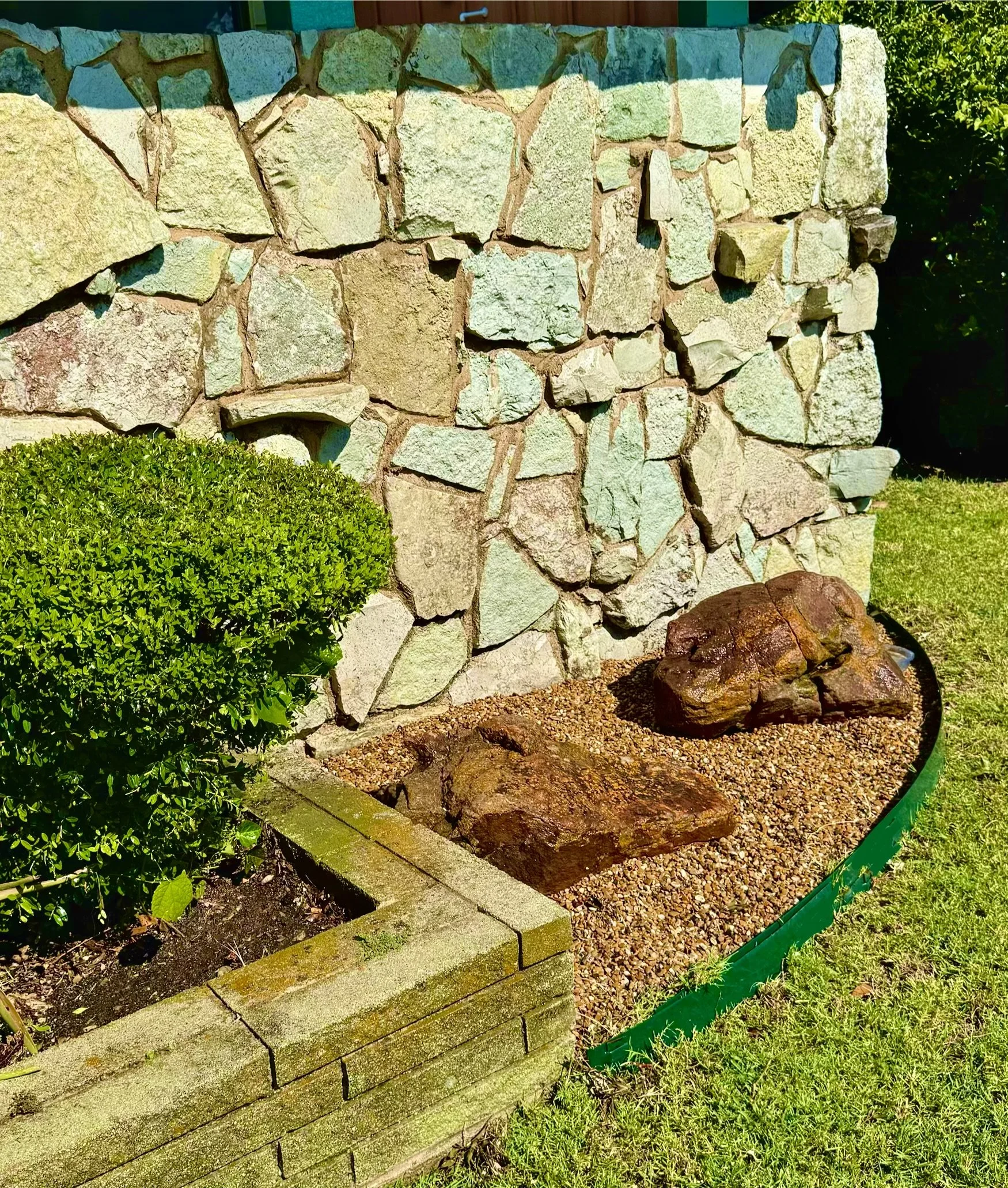
There’s a moment on the facade of my 1962 ranch rambler where a stone wall meets a length of manufactured brick planter, and I keep returning to that seam. The wall is Austin Stone — a yellowish-white Cretaceous limestone quarried from the earth beneath the home’s footprint, common in South Dallas masonry precisely because it’s local, durable, and irregular by nature. No two pieces are the same color or shape, laid by hand so the mortar lines wander wherever the stones told them to. The planter beside it is uniform block, cast from a mold, identical to every other length of the same product sold in 1961.
That question — handmade or manufactured, original or curated — turns out to be the whole argument buried underneath the two styles I orbit: mid-century modern and cottagecore.
Mid-century is, at its root, a celebration of the factory. It came out of the post-war American boom, when wartime advances in molded plywood, fiberglass, steel, and vinyl suddenly became available for furniture and homes instead of aircraft and splints. Designers like the Eameses took materials built for mass production and made them beautiful. Suburbs filled with tract housing — open floor plans, glass walls, flat roofs — because mass production had made good design affordable to a growing middle class for the first time. The style doesn’t apologize for being manufactured. It’s proud of it. Clean lines, repeatable forms, the machine’s precision as an aesthetic virtue in itself.
Cottagecore is the opposite instinct, and it’s older than its 2018 Tumblr christening suggests. Its lineage runs through the Arts and Crafts movement of the late 1800s, which was explicitly a revolt against mass production — designers like William Morris rejecting the factory in favor of hand-thrown ceramics, hand-loomed textiles, natural wood worked by a person rather than stamped by a machine. Before that, it runs through the Arcadian ideal in ancient Greek writing — the fantasy of rural simplicity as an escape from the corruption of the city. Every iteration is a reaction to something: industry, wealth, hustle culture, whatever the busy world of the moment happened to be. The style’s whole appeal rests on the idea that no two handmade things are ever quite alike.
So when the two sit in the same space, they’re not just mixing colors and textures. They’re putting two competing philosophies of how a thing should be made into the same square footage. One trusts the machine. One trusts the human hand.
For me, the interesting part is the seam itself — the space between the two. A stone wall built stone by stone, no two alike, backed by a manufactured edge that repeats itself perfectly down the length of a garden bed. Original presentation against curated presentation. Both win. And as a species, we tend to like a win-win.
Maybe that’s the real inheritance from both movements, not the aesthetic vocabulary but the underlying question they were each trying to answer in their own era: what do we want made by a hand we can trace, and what are we glad to let a machine do perfectly, every time? The rooms and gardens that hold both without smoothing over the difference are the ones that feel most satisfying to live in.