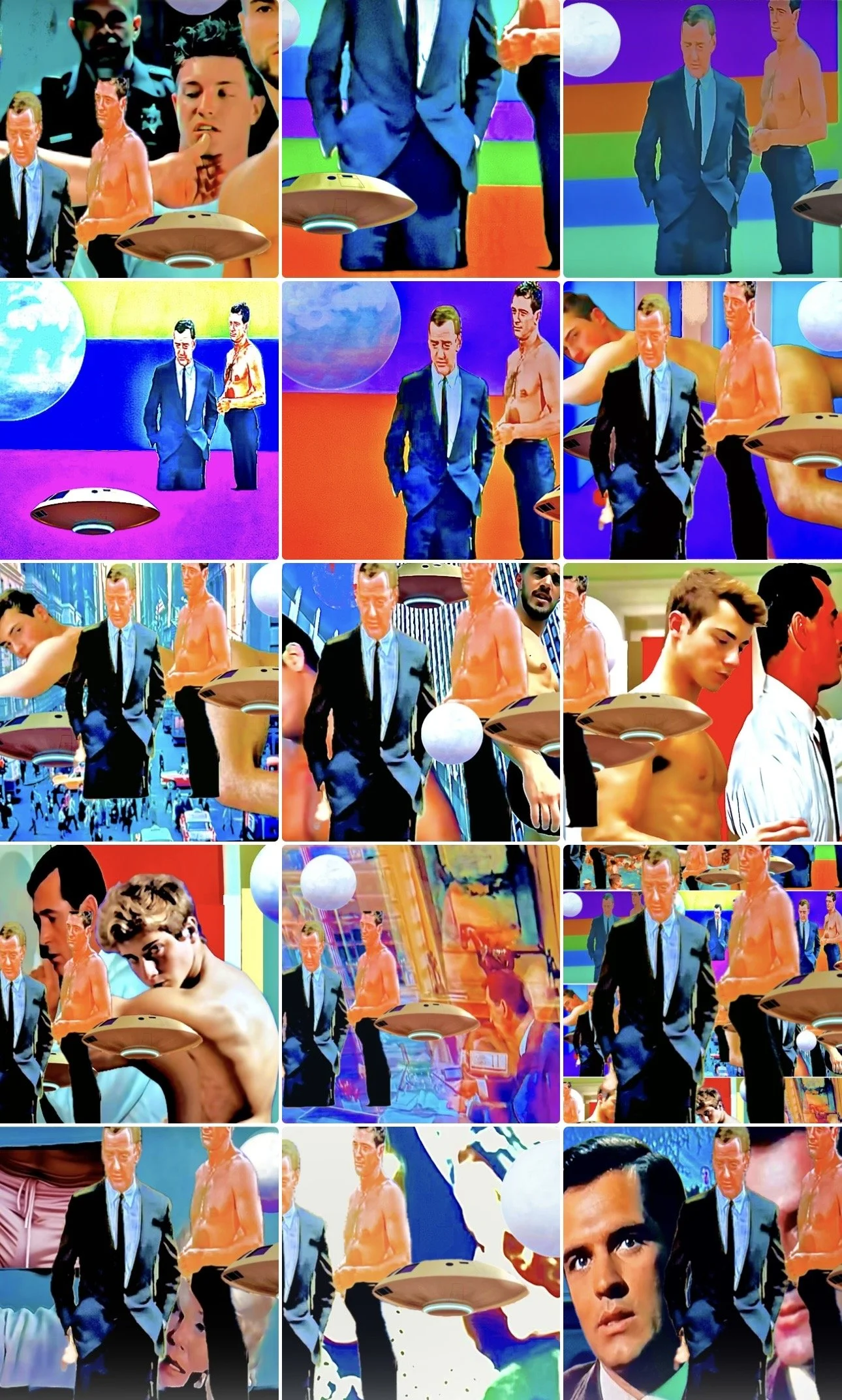
Sequence
A story rarely moves in a straight line. It circles. It leaves something unresolved in the first frame and asks the rest of the piece to carry that weight forward, panel by panel, until the thread finally closes — or doesn’t.
These two works operate the same way medieval church cycles did: a sequence of images meant to be read in order, each one returning to the same figures, the same gestures, so that meaning accrues through repetition rather than through a single decisive image. You didn’t need every panel of a fresco cycle to tell the whole story. You needed the rhythm of coming back to it.
Here, the recurring figures are a suited man and a bare-chested one — the same pairing lifted from a run of romantic comedies built around a woman standing between them. In those films the two men were rivals, foils, comic obstacles to a heterosexual ending. But the camera lingered on them anyway — the scheming, the physical closeness, the tension that the plot kept explaining away. That unnamed current is the loop this piece keeps returning to. Remove the third figure who was always the official reason for their proximity, and what’s left is the thing the story circled around without ever naming: desire, held at a distance, arriving again and again in a different room, a different light, a different color field, never quite landing, never quite leaving.
That’s the nature of a loop. It isn’t stasis — it’s an orbit. A planet doesn’t return to the same point in space each year; it returns to the same relationship, changed by everything that happened in between. Conversation works this way too — like planets we circle back to the same subject, the same unresolved question, and each pass changes slightly what we’re able to say. The loop isn’t a failure to move forward. It’s how understanding and apprehension builds, not in a single moment of arrival, but in the accumulation of returns.
Sequence asks the same question a stained-glass cycle asks, and the same one an unresolved scene in an old comedy asks without meaning to: what happens to longing when it’s never allowed to resolve, only repeated.