A Comparative Look: Two Collage Practices, One Genre
Collage keeps returning to the same problem: what happens when a body is placed inside material that was never made for it. Two current practitioners, working independently and in different mediums, arrive at that problem from opposite directions.
Simon Welsh, based in Sydney, works in physical collage — cut paper, embroidery thread, glued objects. Behan Works works digitally, compositing photographic elements and recurring symbolic icons into a single flattened image. Placing one work from each practice side by side makes the differences in method, and the differences in what each method allows, visible.
The Two Works
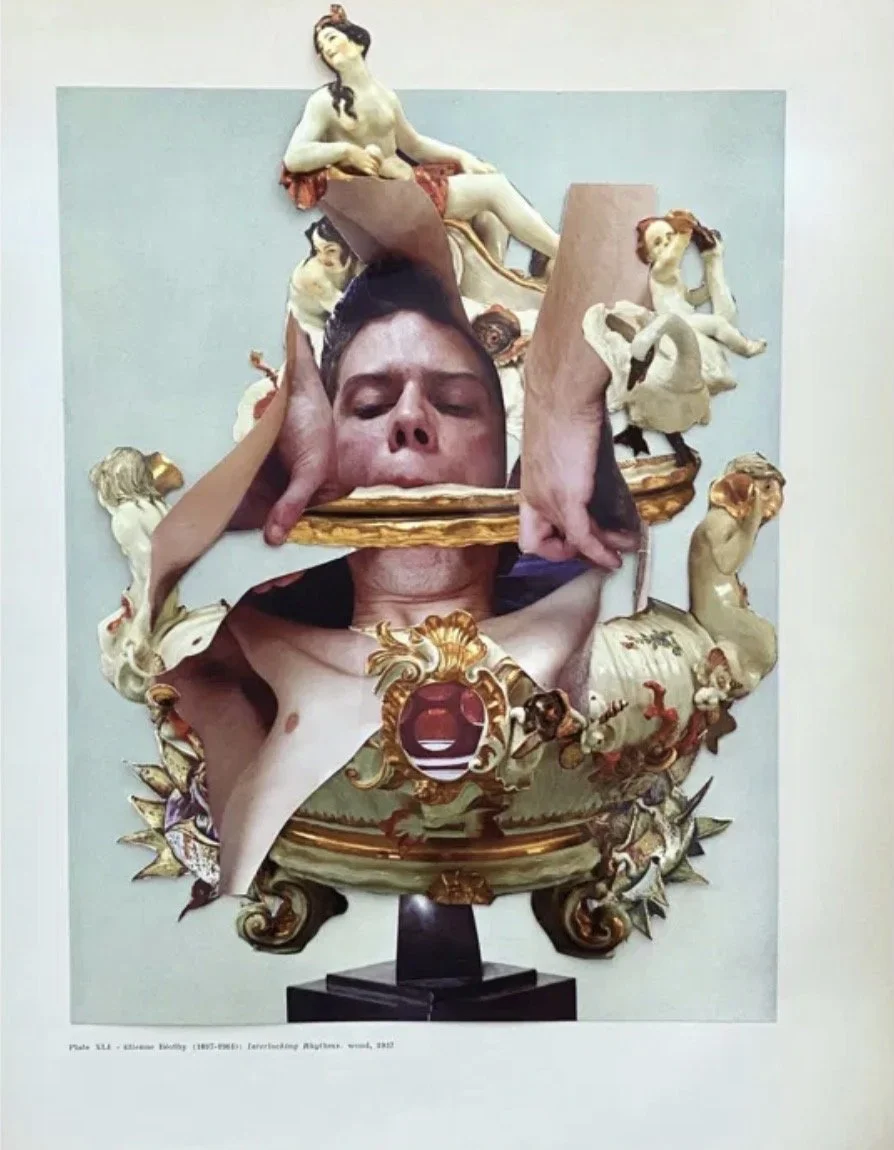
Welsh’s piece takes a plate from a 1937 book on the sculptor Étienne Béothy — an ornate porcelain figure group — and interrupts it with a photograph of a man’s face and torso. The man’s head tilts back through a gap torn in the porcelain image. His arms extend upward, hands gripping the gilded rim of the vessel as though it is load-bearing.
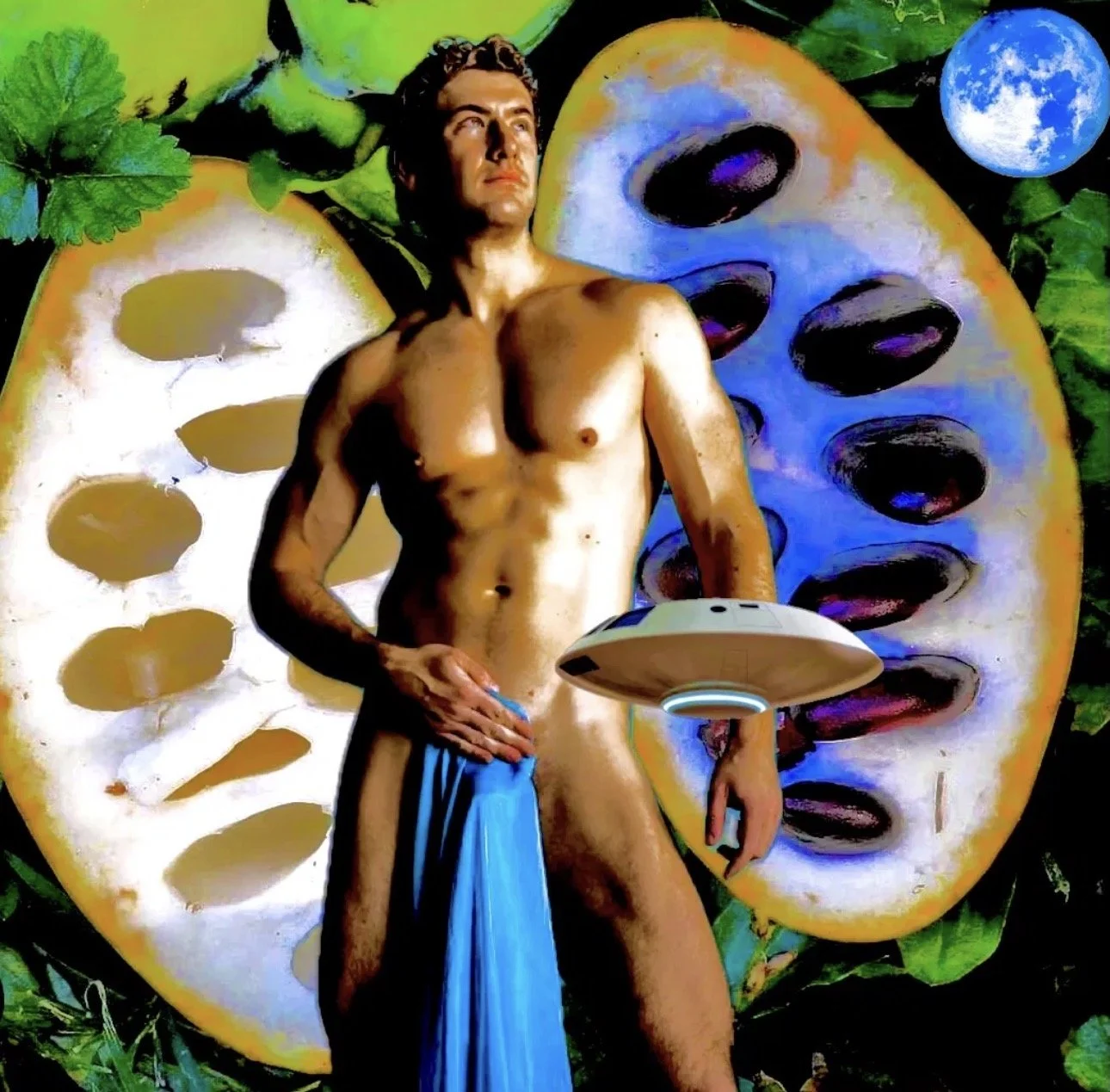
The Behan Works piece places a standing male figure in front of a halved piece of fruit, cut open to show its interior in cross-section. A recurring icon — a small flying saucer — sits at the figure’s hip. A blue moon appears in the upper corner. Both objects belong to an ongoing symbolic key used across the body of work: the saucer marks escape, rescue, or witness; the blue moon marks longing and desire.
What the Two Works Share
Both center a single male figure, framed symmetrically by one object roughly equal in visual weight to the body. In both cases, that object is ornate or organic rather than plain — porcelain scrollwork in one, the branching cellular interior of fruit in the other. The effect in both is closer to an icon or a devotional image than a portrait.
Both also depend on appropriated material. Welsh explicitly credits the source plate as part of the work. Behan Works draws its fruit photography and film stills from existing images repurposed as backdrop. Neither piece originates its own photographic content — the authorship lies in the arrangement, not in the capture.
Where the Two Works Diverge
The clearest difference is in how the central object relates to the body.
In Welsh’s piece, the porcelain and the figure are fused. The man’s arms disappear into the gilded rim; his hands appear to be gripping and bearing weight from the object itself. The photographic body and the printed porcelain occupy the same physical space, cut and reassembled so that neither element is fully separable from the other.
In the Behan Works piece, the fruit functions as backdrop. The figure stands in front of it rather than being woven into it. The composition reads as a stage set, with the object supplying atmosphere and meaning rather than physical support.
This difference traces directly back to method. Hand-cut collage forces physical decisions about where one image ends and another begins — the edge itself becomes part of the composition. Digital compositing allows layers to remain visually distinct even when arranged in the same frame, which makes fusion possible but not automatic.
Process as the Real Subject
The comparison points to a structural difference between the two practices rather than a difference in ambition.
Welsh’s work is organized around single, self-contained statements. Each piece draws on its own set of source material and stands alone. Behan Works is organized around a recurring symbolic system — the saucer, the moon, the meanings attached to each — that spans many pieces and asks to be read cumulatively rather than one image at a time.
Neither approach is more demanding than the other. They are simply solving different problems: one is about what a single image can hold, the other is about what a body of images can build together over time.