The Horseshoe Crab
The horseshoe crab lives where light does not reach it. It moves along the dark floor of the water, shaped the same way for hundreds of millions of years. It is a secret presence in an otherwise brightly lit world.
In its emergence from that silence, from what has stayed obscured, it can look intimidating at first. A hand lifts it out of the water and into daylight, and the first reaction is rarely wonder. The shape is unfamiliar. Something that has only ever existed in hiding, seen suddenly in the sun, can look fearsome.
This is close to what a young person can feel coming out as gay. The process itself is frightening, for many, and that fear is real — underscoring the actual weight of the moment. What is hidden, unaccustomed to light and unrecognized by those who have never seen it, is brought into the open, and the first response, on both sides, can be unease.
But appearance is not the end of the process. Appearance turns to observation. Observation turns to understanding. And understanding—once something is understood— it can be appreciated, even celebrated, where a moment before it could only be feared.
The Diptych
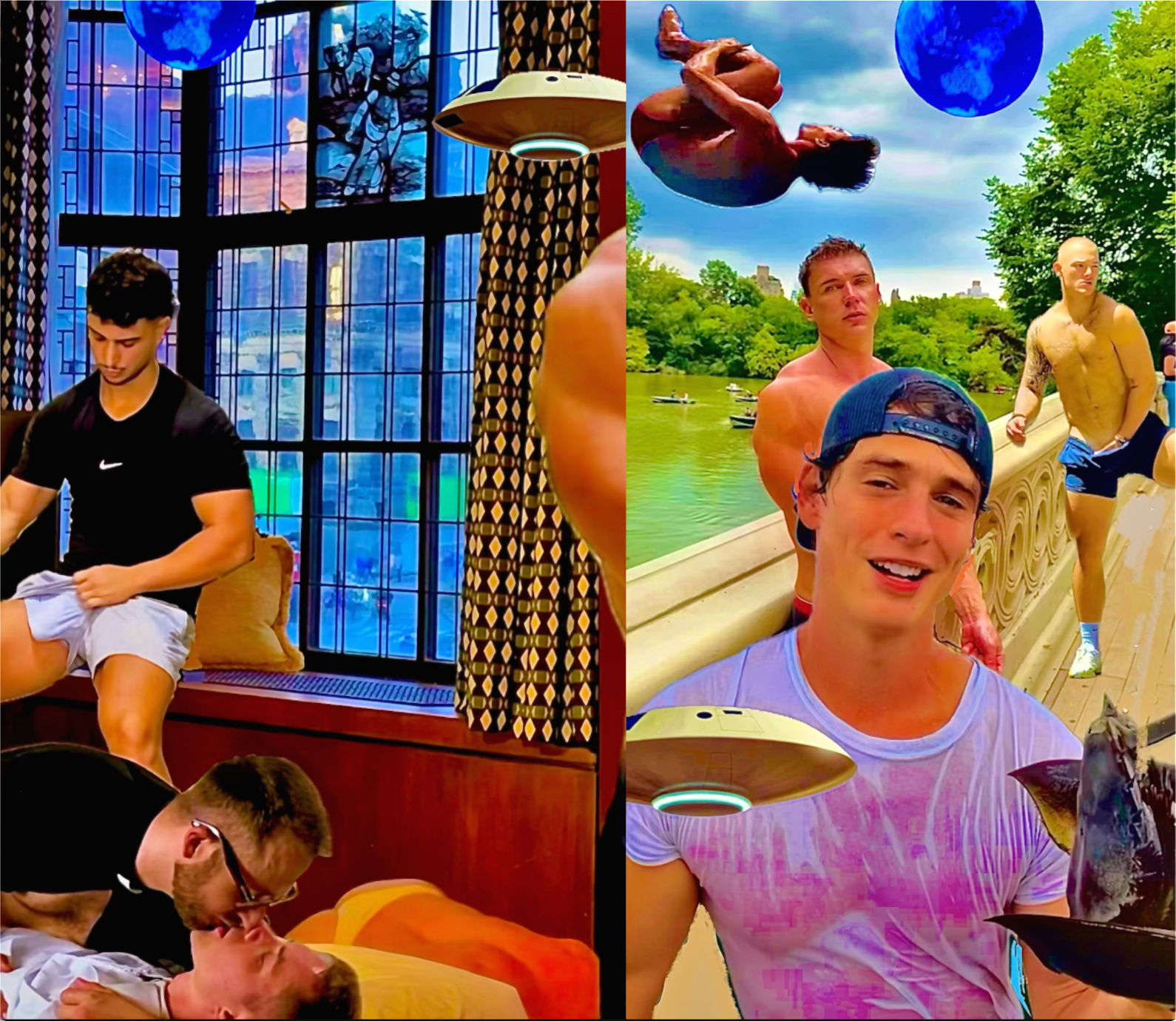
The image holds this movement across two panels and three recurring symbols. The left panel is interior — a stained-glass window, a man undressing on a window seat, a couple kissing on a bed below, all close and low-lit, the water the crab moves through unseen. The right panel is exterior — a bridge, a lake, full daylight, men visible in the open air to anyone passing, the light the crab is lifted into. A blue moon floats in both panels, standing for longing and desire that exists the same on either side of the water. And a flying saucer appears in both as well — called Jupiter 3, standing for reclamation, transformation, rescue, and freedom. Together, the two panels and the two floating symbols trace one continuous passage: from what is hidden and misunderstood, to what is seen and embraced.
The Legacy
The legacy of the horseshoe crab is endurance. It has survived nearly every extinction the planet has produced, unchanged, against odds that eliminated most other living things around it. That same endurance is what best describes being queer in a world that often does not understand it, and does not always tolerate it. Survival is the legacy. Endurance is the legacy. What remains, after every attempt to erase it, is still here — still moving—still whole.