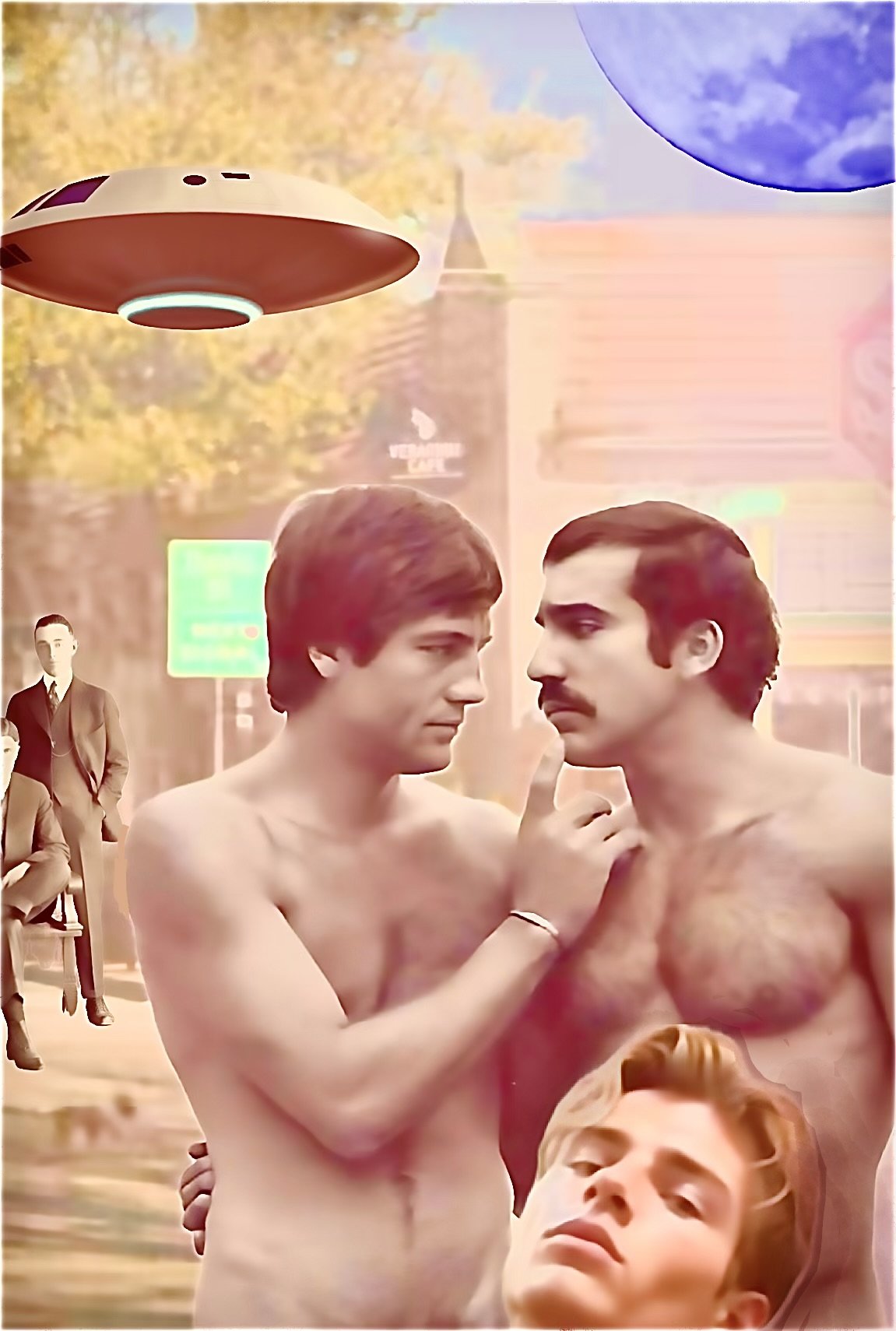
What a Man | Gay Gaze | The Subdivision | Digital Photocollage | 2026
Five men, one hundred years, three decades of birth, each fifty years apart, all sharing one frame — the men from the 1920s in the background, the men from the 1970s in the middle, and the man from the 2020s at the very front. Not just three looks. Three different official answers to the same question: what is a man allowed to be?
The 1920s
The men in the background belong to an era defined by restraint — social restraint above all else. There was one gender, understood as fixed and self-evident. There was one orientation, assumed and unquestioned. The rules weren’t merely suggested, they were structural, and a man’s entire public self was built around visibly obeying them. Nothing about being gay, or bisexual, or anything other than the single sanctioned category was permitted to exist in daylight, let alone in a photograph. Manhood here wasn’t really about the body at all. It was about compliance, the suit, worn on the outside, where everyone could see it.
The 1970s
Still a suit, but now it’s all about leisure. The men in the middle belong to a genuinely different world — an era of expression rather than restraint. Men were finding their feminine sides. Gay rights had become a public, organized movement rather than a private, dangerous secret. Bisexuality entered the mainstream conversation in ways that would have been unthinkable fifty years earlier — even Penthouse, a men’s magazine built for a straight readership, ran essays exploring it. This was a decade of real openness: access to alternative materials, alternative thinking, alternative lifestyles, all suddenly circulating in the culture rather than being suppressed by it. If the 1920s asked a man to comply, the 1970s asked him to expand.
The 2020s
The man in the foreground belongs to right now, and right now doesn’t have a clean answer the way the other two decades did. We seem to be moving forward and backward at the same time. A significant part of the population wants to return to something like the 1920s — restraint, fixed categories, a single sanctioned way to be a man. Another significant part wants to keep pushing forward the freedoms the 1970s opened up. Both pulls are happening simultaneously, creating an unbelievable cultural tension. What a man is allowed to be right now isn’t settled. It’s being actively fought over, in real time, with no guaranteed outcome.
Restraint, expression, and now — contest. We don’t know who wins. We can only hope.
— Behan