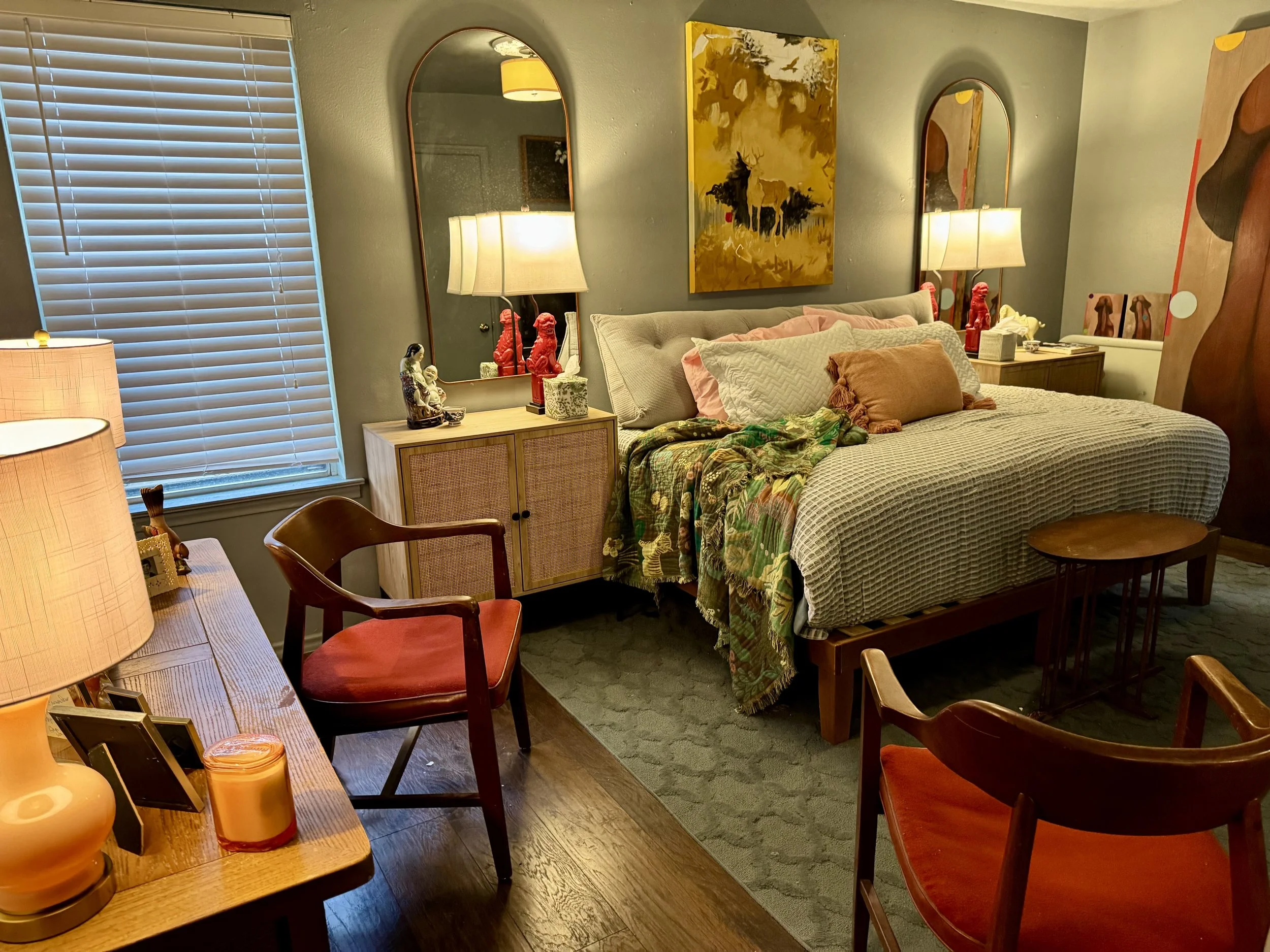
Pinned

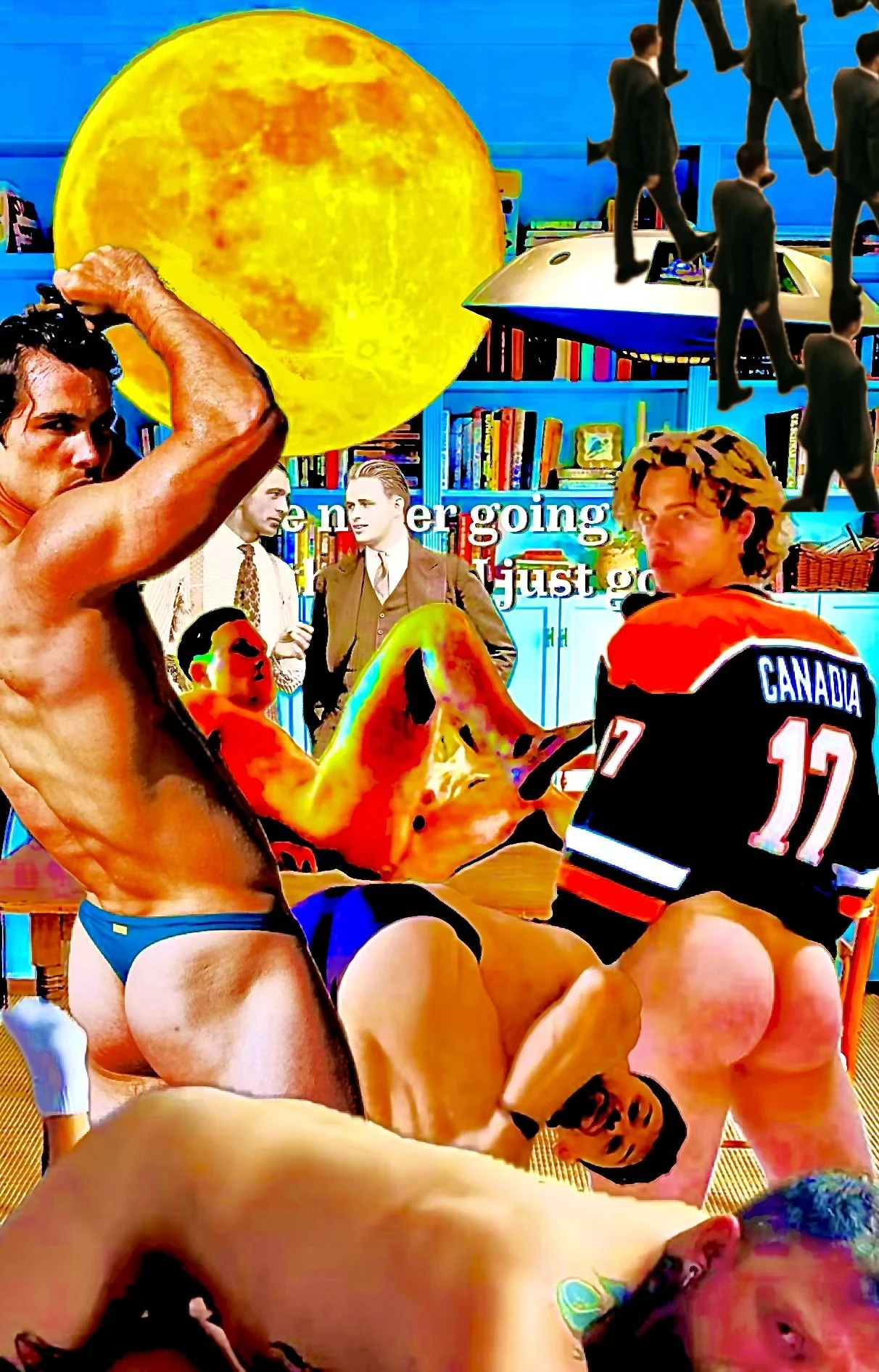
Pinned | The Closet | The Subdivision | Digital Photocollage | 2026

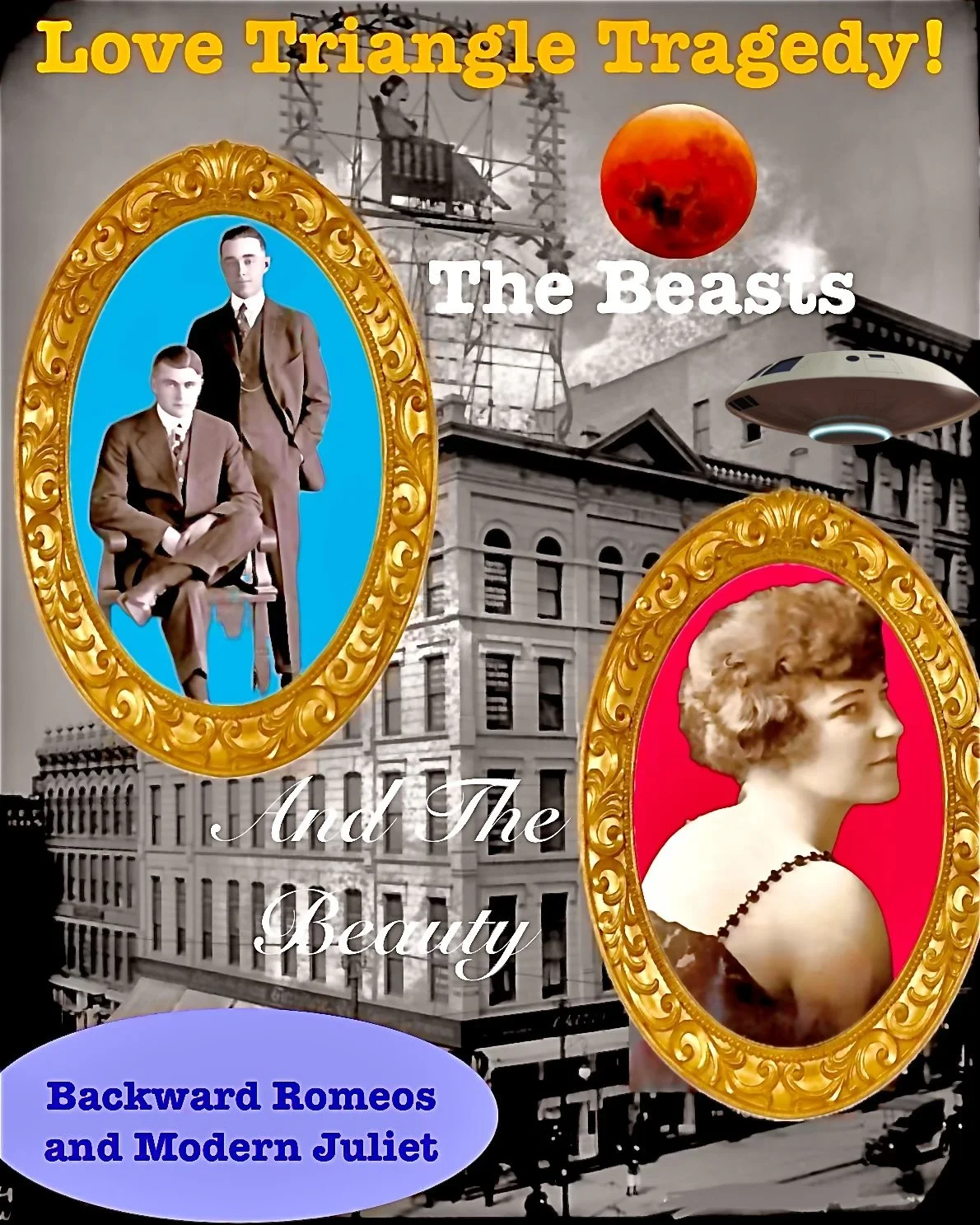
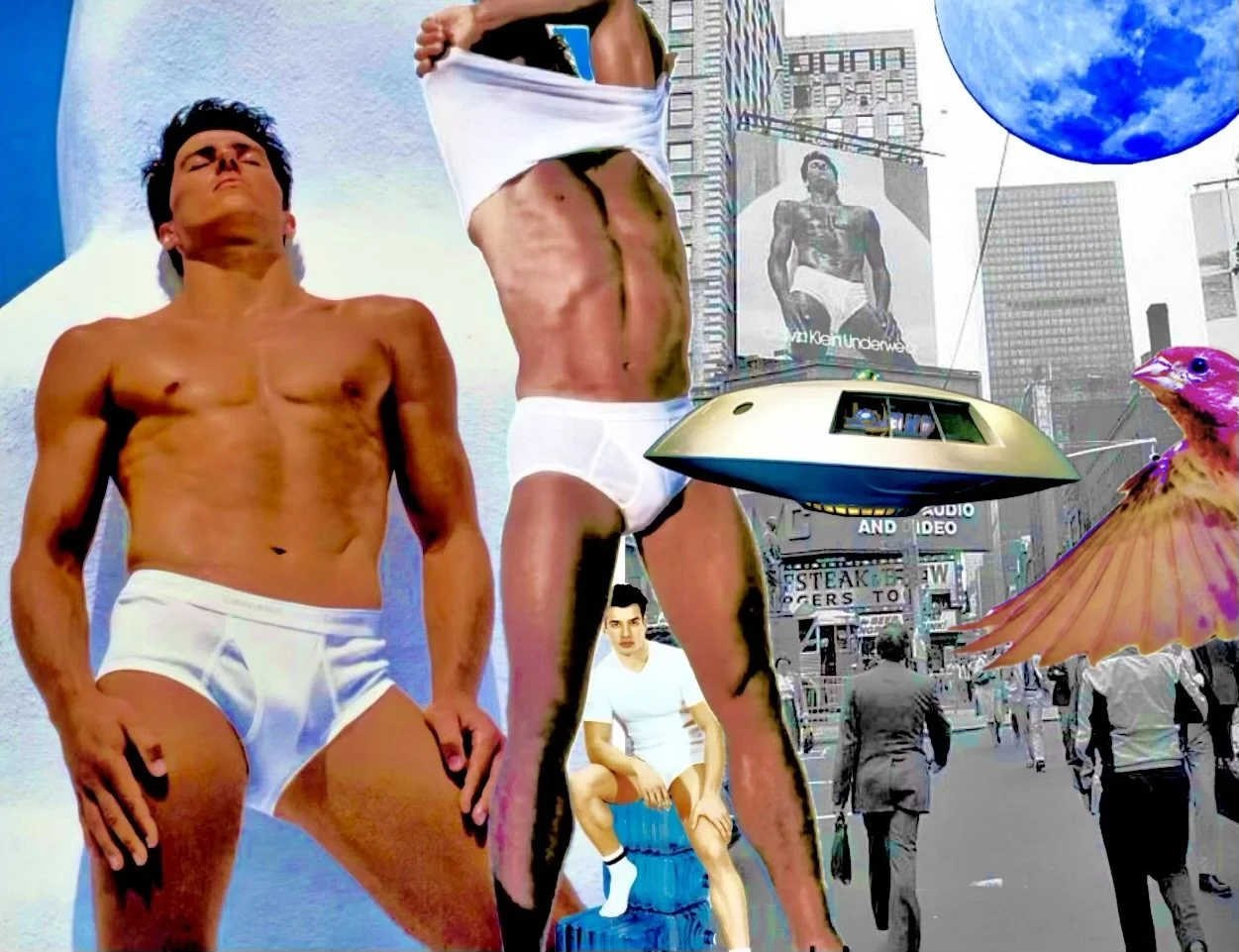
It is 1951; the second half of the twentieth century has begun. America is preeminent in the world — having come through the Second World War as the dominant economic and military power on earth, standing at the start of what will be called its own new age. Into that new dawn, Broadway stages Seventeen — a musical built from small-town American nostalgia, a boy meets girl fantasy of falling sweetly, correctly in love. It is, on its surface, a celebration of heteronormative American life exactly as the culture wanted to picture itself at midcentury. And inside that production, playing the roles the show requires of them, are two young men for whom none of it is true.

Kenneth Nelson plays the lead. Serious and controlled, he carries the discipline that will define his career, including his turn as the original Michael in The Boys in the Band, a role that will place him at the center of American theater’s first major mainstream reckoning with gay life. That performance will become the defining one of his life, but it will not open the doors it should have. By 1971 he settles permanently in England, where he will spend the rest of his career on the West End and in television roles he later described, pointedly, as a “useful American type.”

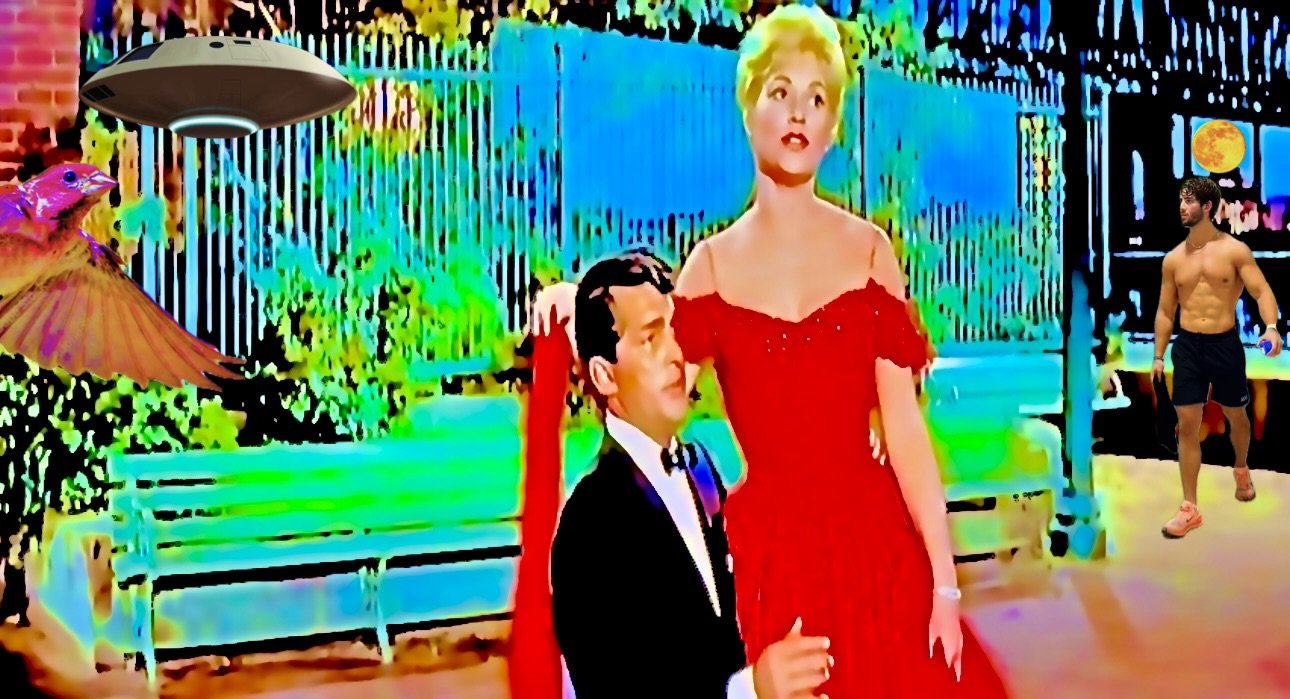
Dick Kallman understudies him —a character actor if not a lead, looser, comedic, vaudevillian in his instincts, a performer built for a different kind of attention than Nelson’s. He is talented and visible early: film roles opposite two of the era’s biggest stars, Susan Hayward in Back Street and Sandra Dee in Doctor, You’ve Got to Be Kidding!, along with his own network sitcom, Hank, in 1965. This is a promising career. But by the 1970s the roles have largely dried up, and he moves into the world of antique dealing. His home and business are featured in New York Magazine.

Both men are handsome, gay, gifted, and closeted — performing a love story neither of them were allowed to have for themselves. And both, in this moment, are standing at the beginning of something that looks like pure promise — two young actors on a Broadway stage, careers ahead of them, everything still possible. Neither can see the shape of what’s coming. That is the particular cruelty of this story: the triumph and the tragedy belonged to both of them from the very start, folded into the same beginning, long before either man had any way of knowing it.

The play itself was fiction upon fiction upon fiction. Despite being a very popular production in its time, Tarkington’s script presented its few characters of color in an insensitive fashion and, also typical for its time, had no representation of gay or queer people at all.

Nelson and Kallman knew exactly what was happening, and accepted it, and played their parts as they were required to — because they were playing two roles at once, the one Tarkington had written and the one the culture had written, neither role being an honest representation of the new American century.

It is inside all of that manufactured unreality that one small, real thing seems to have happened. Kallman offers Nelson a gift — a diamond pin, the plainest gesture of affection available to him in a world that gave him almost no others. Sadly, the gift was refused. They go their own ways.

Tragic outcomes are all too common for a community that had been suppressed, forced into unstable and hidden lives with nowhere safe to turn. Kallman was murdered during a robbery of his home and business in 1980, and Nelson died of AIDS-related complications in 1993, before the drugs existed that might have granted him more time. Two men cut short in their prime, thirteen years apart, brought back together thru violence and virus.

In looking at these two tragedies, one is reminded of that original gift, refused: the diamond pin. On one end, the diamond — the promise offered in 1951. On the other, the point, sharp enough to draw blood — the violence and the virus that would overwhelm both men.

In a very real way, the pin becomes a representation of both the triumph and the tragedy that belonged to these two men from the very beginning — the same triumph and tragedy too many gay men in the second half of the twentieth century encountered in their own journeys.

The collage names these two men, and honors their promise and their success. At its center sits a representation of the pin — a small object built, like the men it commemorates, from both promise and blood.

It is America’s own triumph and tragedy as well: a nation that opened this era insisting on its own new age, its own clean break from history, and that could not, despite everything it told itself, admit or escape the history it carried forward.
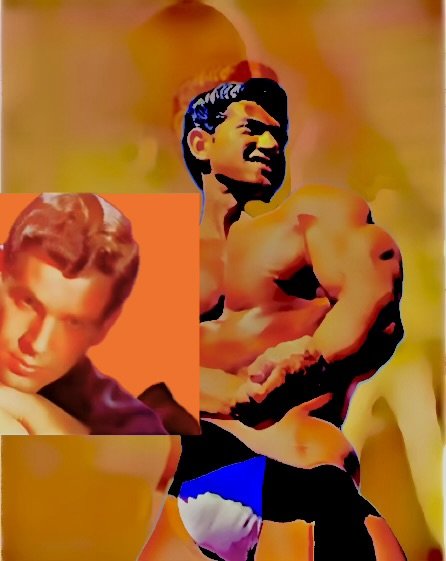
Hard is Good to Find

Sidewinder

A bed, by convention, faces the door. Two sides, two pillows, furniture arranged around a fixed idea of how a room should be used. This one has been turned. It runs the space diagonally now, corner to corner instead of wall to wall, and the whole room reorganizes itself around that single decision the way a sentence changes meaning when you move one word.

The house has always been the largest artwork in this practice — an ongoing installation, reworked the way a canvas gets reworked. This room is the latest revision. Two arched mirrors flank a gold-toned painting of deer moving through underbrush, doubling the room’s depth back at itself. A console holds framed photographs, ceramic figures, lamps lit low and amber. None of it is staged for a rigid, formal use of the space. It’s staged for lounging, reading, actually being in the room — a bedroom that also functions as a den, sleeping space and living space folded into one.

That’s the real logic of the turn. A bed set the conventional way announces a fixed function and nothing else. A bed set at an angle opens the whole room up — it stops being only a place to sleep and becomes a place to simply be, day or night. It moves the way a sidewinder moves: not in the straight line a room is expected to follow, but at its own angle, doing more than one thing at once.

How Divine

Revelation

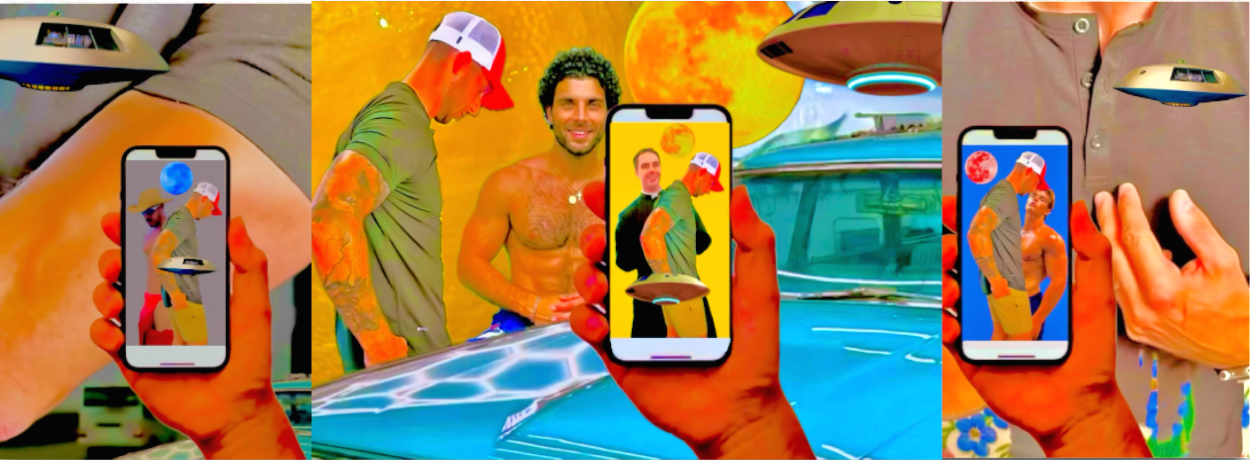
A triptych has never been a neutral shape. Since the medieval altarpiece, three panels side by side have signaled one thing to a viewer before a single figure is even visible: something sacred is happening here, something large enough that one frame couldn’t hold it. Revelation, conversion, the moment a life turns and becomes visible to itself for the first time — these are triptych events. They arrive in stages. Each panel contains the one before it, nested, the way this piece nests a phone inside a photograph inside a phone again.

What if the moment is this one. A man is married. There may be children. There is certainly a house, a routine, a version of a life that looked, from the outside and very possibly from the inside too, complete. And then, without any single dramatic cause, a recognition arrives — not new information exactly, more like something long buried finally surfacing into a light it can be seen by. He is gay. He has, in some sense, always known. What changes is not the fact. What changes is that the fact becomes visible to him, the way an image only becomes an image once it’s actually looked at.

Panel One — The Ordinary Day

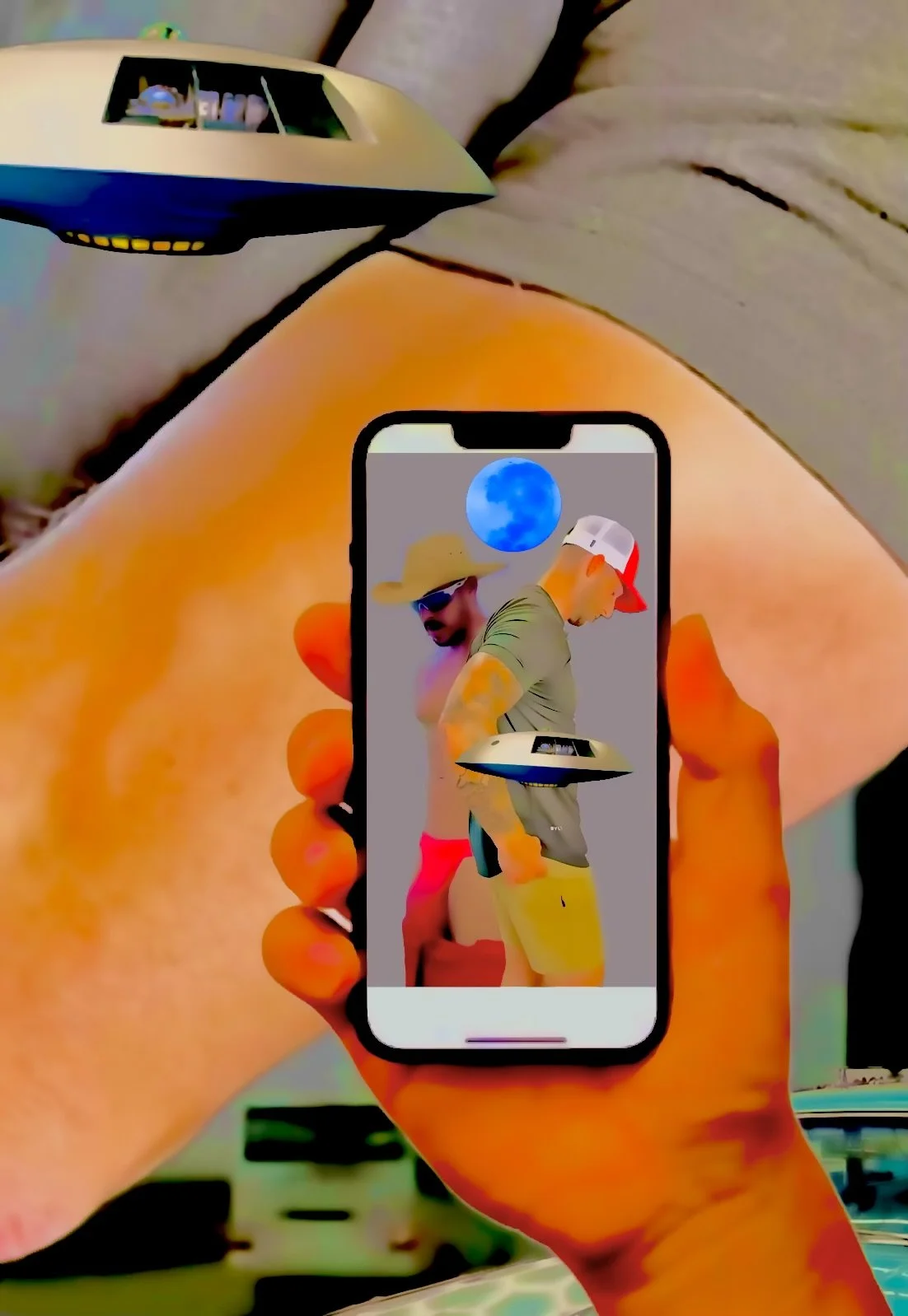
Two men stand back to back inside a phone screen, sunglasses, a ball cap, a UFO drifting overhead as if this were nothing more than an unremarkable afternoon. And it is, on its surface, unremarkable — this is the day recognition arrives, and recognition rarely announces itself with any drama at all. It looks exactly like every other day until it doesn’t.

Panel Two — The Witness

The same two men now stand beside a car, sun-drenched, gold light replacing blue. But inside the phone this time, one of the men has become a priest — collar, black, watching. This is the panel where judgment enters the frame, the third party every revelation eventually has to answer to, whether that third party is a church, a spouse, a congregation, or simply the internal voice that was raised inside all three. The priest doesn’t act in this panel. He only watches. That’s often the most dangerous part of the process — not the confrontation, but the period of simply being watched, or fearing that one is.

Panel Three — The Return

And then the shirt. A patterned, domestic, unmistakably married-man’s shirt, buttoned, ordinary, worn by a body reaching a hand toward its own chest. Inside the phone held against it, the two men are close now, foreheads touching, no distance left between them at all. This is the panel where the revelation stops being external — no priest, no witness, no UFO — and becomes something the man is simply holding, quietly, against his own chest, inside the very domestic uniform that once concealed it.

Revelation, in scripture, was never a single blinding moment. It was a slow unveiling, apocalypse in its original sense — not catastrophe, but disclosure. What was hidden becomes visible. That is what these three panels track, one recognition at a time: the ordinary day it starts, the imagined judgment that follows, and the private, unspectacular moment a man finally lets himself hold what he’s known all along.

— Behan

Volumetric

Into the Clouds

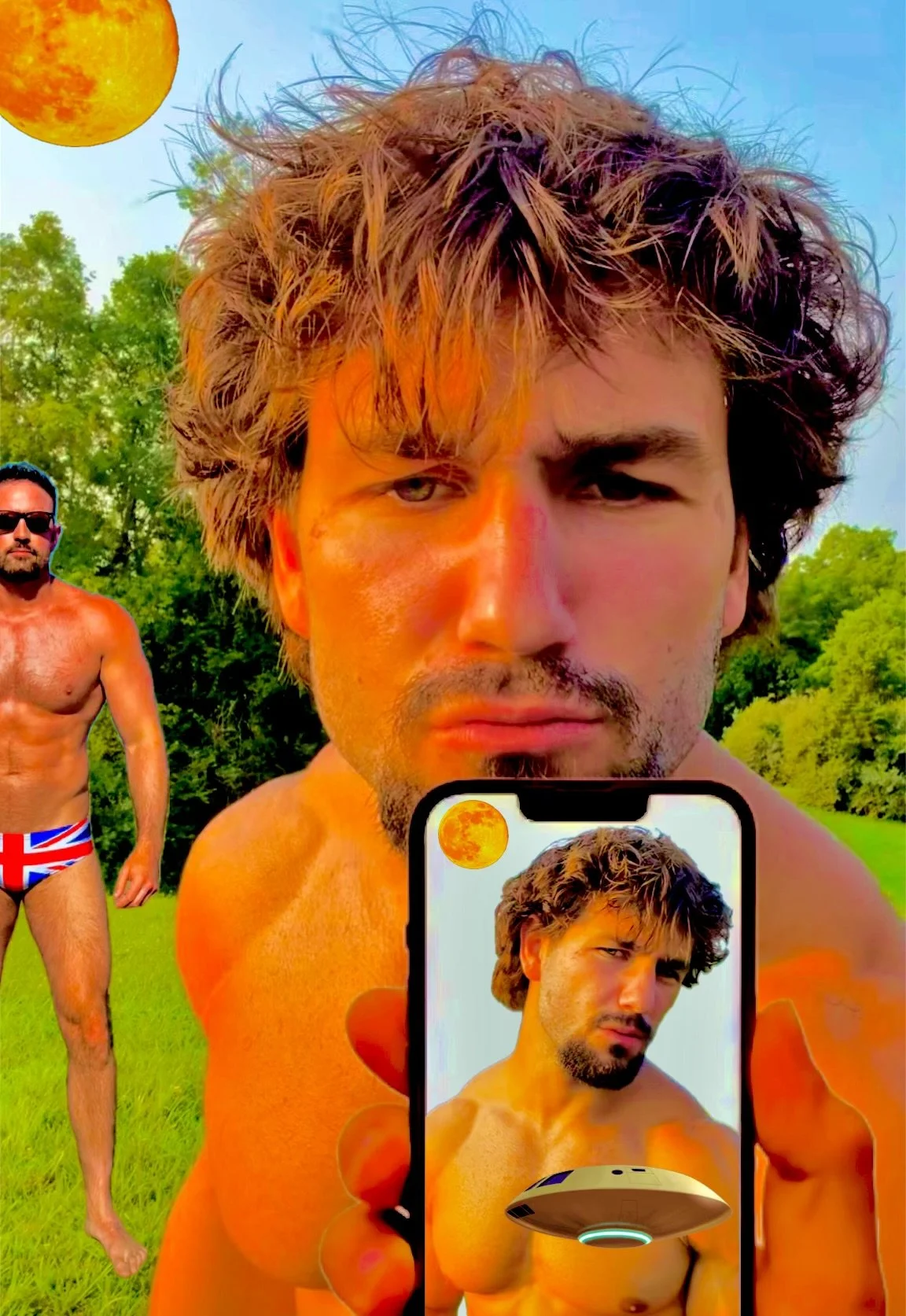
Every day, the world takes roughly 5.3 billion photographs. Fourteen billion images move across social platforms in that same twenty-four hours — shared, reposted, transformed into something else, scattered further than any single photographer intended. Somewhere inside that flood, a small and specific tributary: images of men kissing, men touching, men simply existing beside each other without apology, captured on a phone, held up inside another photograph, folded into itself like a mirror catching a mirror. That folding — the phone within the frame, the image reflecting the act of making the image — isn’t a formal trick for its own sake. It’s the actual subject. The phone is the portal. What passes through it becomes, whether anyone intended permanence or not, evidence.

The window this essay is named for is not metaphorical in the abstract, disaster-proof way these arguments sometimes get made. It is a specific, measurable, currently-narrowing window. As of this year, watchdog groups are tracking well over five hundred active anti-LGBTQ bills moving through American state legislatures — a number that has climbed essentially every year since 2015, the year marriage equality passed and the backlash organized in response. Meta itself has rolled back protections it once offered, loosening its own hate-speech policy in ways that now permit language once banned outright, and quietly removing LGBTQ-specific features from its own products. Roughly nine in ten of these bills fail in any given year — the advocates fighting them are winning far more often than losing — but the volume itself is the story. This is not paranoia. It’s documentation of a trend line, and the line points toward more restriction, not less.

Against that backdrop, an iPhone in a man’s hand is a small, almost absurdly modest piece of technology to be carrying this much weight. But it is currently the mechanism by which a kiss between two men becomes something other than a private, disposable moment. It becomes a file. The file gets backed up automatically, without anyone deciding to preserve it — Google alone now holds more than nine trillion photos and videos in its cloud storage, an archive scaled beyond what any single institution, censor, or legislature could plausibly comb through and erase entirely. This is the argument the images in this piece keep making formally, frame after frame: the phone-within-the-photo isn’t just documenting the moment, it’s documenting the act of the moment entering permanence. Once uploaded, once backed up, once shared even once, a photograph becomes extraordinarily difficult to fully delete — copies fork off into other people’s devices, other clouds, other countries’ jurisdictions, faster than any single authority could plausibly chase them all down.

That is the bet underneath this whole series: that the sheer scale of what gets uploaded daily works, paradoxically, as a form of protection. A culture cannot easily un-happen five billion photographs. It can restrict Pride flags on government buildings, ban books, defund clinics, pass law after law — and still not touch the trillions of images already scattered across a thousand clouds, backed up on servers in a dozen countries, held on devices belonging to people no legislature can subpoena all at once. The volume itself becomes a kind of witness protection program for the images inside it.

None of this is guaranteed to last. That’s the honest, uncomfortable center of the piece, and probably the reason it needed making now rather than later. The window is open. It has been open for roughly two decades, since smartphones put a camera and a broadcast tool in the same object, and it is narrowing at the legislative level even as it widens at the technical one — more storage, more bandwidth, more places for an image to hide, set directly against more laws attempting to make the thing being photographed illegal to display at all. Whether the technical trend outpaces the legal one is not something this essay can answer. What it can do is add to the volume. One more file. One more kiss, one more mirror, one more hand holding a phone up to a moon. Whatever happens next, these images are already in the clouds.

Epilogue

Some notes on process, since the numbers in this piece aren’t only cultural, they’re personal.

This practice began in January 2024. As of this writing, that’s roughly a thousand days. At a pace of about ten collages a day — focused, always, on gay positivity, gay presence, the simple insistence of two men existing in frame together without apology — that arithmetic comes out to somewhere near ten thousand images. Ten thousand small, specific additions to the flood this essay just spent several paragraphs describing.

There are days that volume feels like too much. Days it seems smarter to make less and make it better — fewer images, sharper ones, more time spent on each. But this piece, in the writing of it, clarified something about why the pace has stayed what it is. This was never only about any single image being perfect. It’s about volume. It’s about the fact that a culture cannot easily un-happen ten thousand photographs, any more than it can un-happen the trillions the rest of the world produces every year. Each one is just one small output of what amounts to an insurgency — quiet, cumulative, running almost entirely on repetition rather than any single decisive strike.

Every one of those ten thousand images is something to be proud of, not because each is a masterpiece, but because each is now, permanently, somewhere in the clouds. Whatever happens next — to the laws, to the platforms, to the culture’s current willingness to look — that record already exists. It cannot be legislated back out of existence.

— Behan

Into the Clouds is a nine-piece set of digital photo collages, made in 2026, part of The Gay Gaze within The Subdivision. Available individually, or as diptychs and triptychs per the collector’s preference. For availability, reply by email or DM.

Sources: Photutorial, “Photo Statistics 2026.” Google, cloud storage figures, 2025. ISD Global, “Five-Year Overview of the Online and Offline Anti-LGBTQ+ Landscape,” 2025. ACLU / GLAAD, 2026 legislative tracking.

Natural

On Ambience and Captured Natural Light

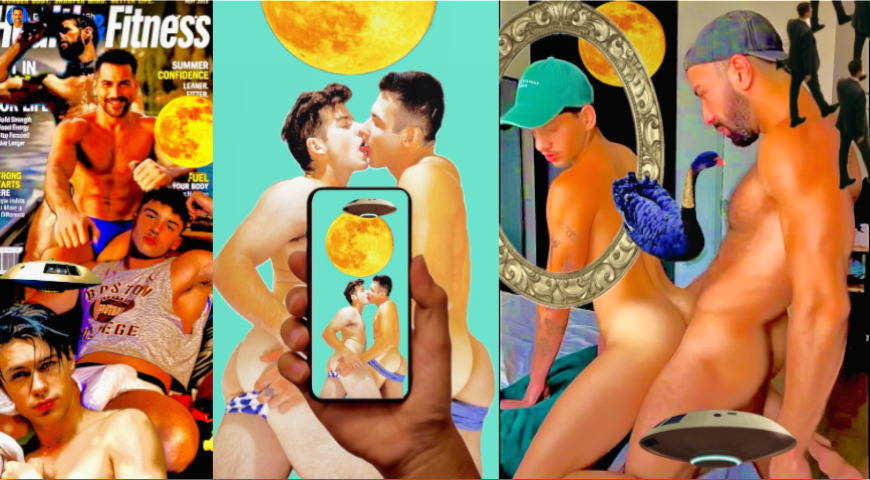
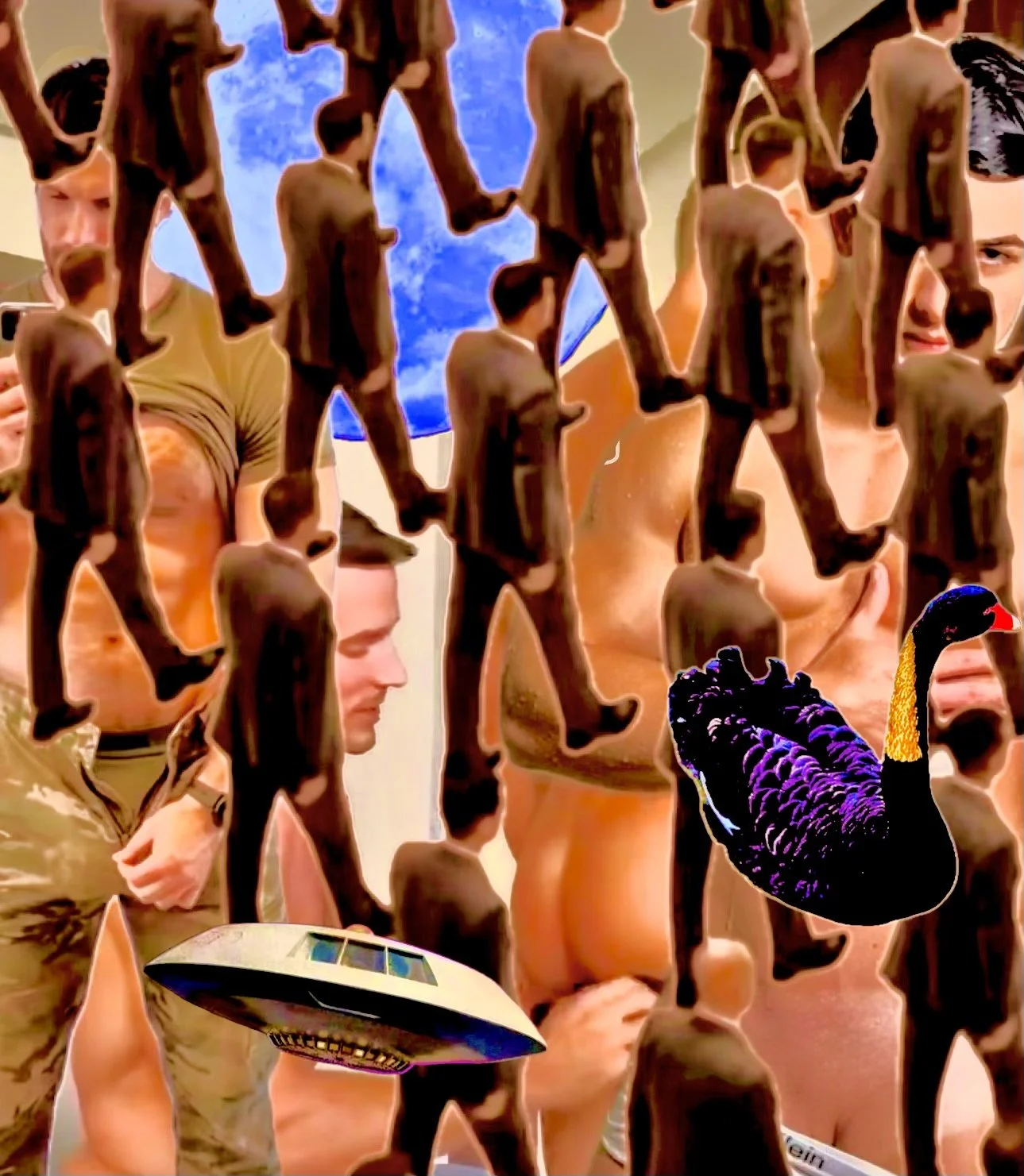
Light in these two triptychs is never simply available. It has to be caught. A phone screen holds a moon inside itself, a second smaller moon nested in the first, light captured and re-displayed rather than simply fallen on a scene. A gilded mirror frame catches a second version of the same man, his back turned, light bending around a doorway that leads nowhere the viewer can follow. Even the magazine covers are a kind of trapped light — glossy paper manufactured specifically to hold a shine that a real body, in a real room, could never quite hold onto for long.

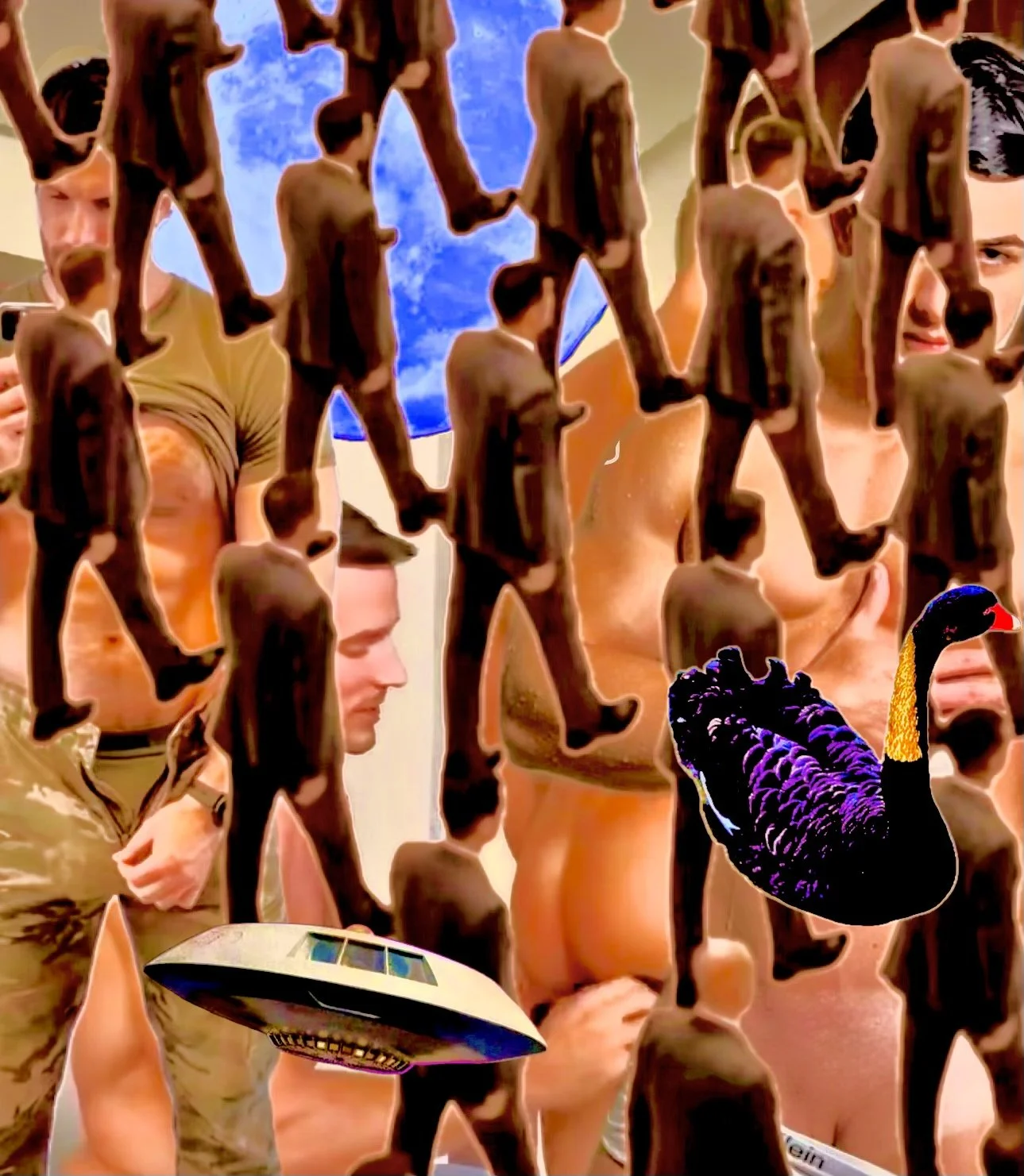
This is the throughline between the two assemblies. Neither is really about the marching suits, though the suits are in both, indifferent and endless, walking through frame after frame without once looking down. The suits are ambient. They are the room’s weather, not its subject. What claims the space instead is smaller and brighter — a kiss lit warm against cool teal, a swan’s neck catching gold exactly where the light gathers, two men in identical shirts photographed so close together the second man reads as an echo of the first rather than a separate person. Ambience is what the culture leaves running in the background. Claiming space means finding the one bright, specific thing inside that background and refusing to let it stay ambient.

Two diptychs, one goal, as the title says: identifying and claiming gay space inside a visual field built mostly out of other people’s indifference. The marching men never stop marching. They don’t need to. The work isn’t to make them stop. The work is to keep adding chairs to the table anyway — another kiss, another mirror, another magazine cover repurposed until it says something its editors never intended — until the table is full regardless of who’s still walking past it.

— Behan

Enter Armageddon

This is not about gay, straight, or bi. This is about the male form in transition.

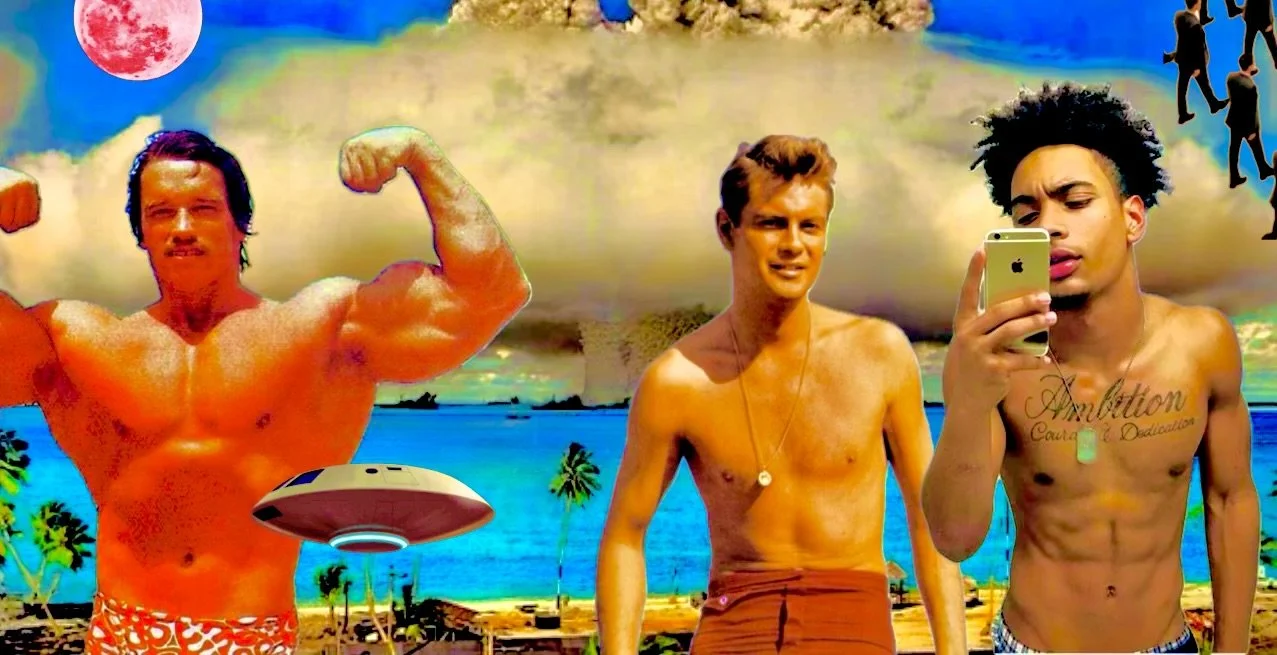
Behind three men, a mushroom cloud rises over Bikini Atoll.

In 1946, days after the atomic tests there made the atoll’s name synonymous with annihilation, the shock of the bomb moved into culture almost immediately and never left. The fallout includes an ever-evolving understanding of the male form as best suited to responding to the events of its day — call it the mod bod. This is a formal analysis of that form, tracked across seventy years, the way an art historian might track sculpture’s handling of the male body from the Renaissance into the Baroque and on into the neoclassical. Three mod bods, seventy years, each a different answer to a question the bomb first asked and has never stopped asking: what shape, what armor, what strategy does a man need to survive what’s coming?

1950s

The mod bod of the fifties is the jet fighter. Smooth, untoned, unbothered by definition — power carried not in the body but in the sleek, disciplined image projected outward. The suit is the fighter’s fuselage, giving nothing away about the machinery inside. This is the triumph of American democracy on the surface, and underneath it, the low hum of the duck-and-cover drill — a generation of children folded under classroom desks, living inside the jet age’s promise that the next war would be fast, airborne, and over before anyone had time to brace. The form performs readiness. It assumes the position.

1970s

The mod bod of the seventies is the aircraft carrier. Brutalist architecture is all the rage; in May 1975, the USS Nimitz is commissioned — nuclear-powered, over a thousand feet long, the largest warship ever built, able to run for decades without refueling. That same decade, the male form stops being worn and starts being built on the same principle: overwhelming scale, overwhelming endurance, a body designed to dominate by being too large to challenge directly. Call it the brutalist body — heavy, fortress-like, all visible structure. Like the carrier, it could not simply happen. It had to be commissioned, fueled — steroids were everywhere in the decade’s bodybuilding culture, more than ten years before any law regulated them. The carrier body moves slowly, then stands its ground. It projects power by simply being present.

2020s

The mod bod of the twenty-first century is the drone. Call it Twinky Abs: a lean, defined midsection built by stripping away rather than adding — high-intensity circuit work trading the carrier’s mass for something smaller, faster, harder to hit. It’s also a real workout routine many young American men are actively following. Agility is now the governing value, the same logic reshaping actual warfare: a carrier costs a decade and billions to build and can be threatened by a drone costing a few thousand dollars, too fast and light to catch. The current mod bod follows that doctrine — built for a fight that no longer rewards standing still and absorbing the hit.

The Atomic Jacket

A jet fighter. An aircraft carrier. An unmanned drone. Three vehicles of survival, descended from one unbroken thread — a species that has spent seventy years, after two thousand years of a far more static male form, redesigning the male body against a threat that never resolves and never leaves. This isn’t about who or how a man loves. It’s about what his own form has been asked to become.

A bomb dropped once. The male body has been absorbing its shockwave ever since.

— Behan

The Penn Dutch Furniture Co Tragedy

PART ONE: JUNE 20, 1922

Dear reader,

There are tragedies that time forgives, and tragedies it cannot. What happened in the cedar-scented showroom of Philadelphia’s Penn-Dutch Furniture Company that sweltering afternoon was of the second and darker kind — a tale the neighborhood still will not speak above a whisper.

The papers printed it simply. Edmund “Eddie” Boyd, a brooding young clerk, had watched with a curdling heart as his oldest friend and fellow employee, Raymond “Ray” Castle, rose above him — a coveted promotion, and crueler still, the devoted heart of Margaret “Mags” Sanders, a plain but exceptionally sweet neighborhood girl both men had once courted.

Driven half mad, so the story went, Eddie tracked his rival to Mags’s doorstep. Harsh words were exchanged. The gentle Mags fled indoors, while brave Ray stepped forward to calm his friend, walking him back — foolishly, fatally — to the empty showroom. There, among the unfinished cabinets, the curtain fell. One shot into a friend’s heart. One shot, self-delivered, to close the account.

The coroner’s report set the order down plainly: Eddie killed Ray first, then turned the gun on himself. It made a tidier kind of horror. The town wept for the sweet girl left behind. Two young men were buried in a quiet cemetery, their story fixed forever in stone.

History, though, only records what it is permitted to see.

PART TWO: JUNE 19, 1922 — The Day Before

The scent of cedar shavings and linseed oil hung heavy in the back room of Penn-Dutch Furniture. The storefront was locked, the gas lamps turned low, casting long, amber shadows across the floorboards.

Ray stood by the shipping desk, his collar loosened against the oppressive summer heat. He wasn’t looking at the ledgers. His eyes were fixed on Eddie, handsome and tall, who stood just inches away, his knuckles white as he gripped the edge of a drafting table. Four years they had stood like this in this same back room, after closing, when the gas lamps burned low enough that no one on the street could see two shapes standing closer than friendship required.

“Say it again,” Eddie whispered. His voice wasn’t angry yet. It was hollow, trembling with a fragile, desperate hope. “Look at me and say it.”

Ray swallowed hard, pulling his gaze away. He hated himself for the cowardice, but the fear was a physical weight in his chest. Just last week, a man in South Philadelphia had been arrested, his name dragged through the papers, his life ruined for the crime of who he loved. Ray couldn’t live in the dark anymore.

“I’m going straight, Eddie,” Ray said, his voice barely louder than the hum of the city outside. “It’s over. We have to stop.”

“Because of her?” Eddie’s voice cracked on the question, small and stunned.

Ray looked out the grimy window, his jaw tight. “Fairies don’t marry pretty girls,” he said quietly, the raw truth hanging heavy between them. “No, the girl is always plain but sweet. Mags is plain, simple… she won’t expect much. Neither will anyone else.”

Eddie reached out, his hand hovering near Ray’s jacket, a familiar gesture that had brought comfort in a hundred secret midnights. But this time, Ray stepped back, letting the distance stretch between them like a chasm.

“I love you,” Eddie choked out, a hot tear finally cutting through the dust on his cheek. “Four years, Ray. In the shadows, sure, but it was ours. You think you can just step out of the dark and leave me behind?”

“It’s not that I don’t love you,” Ray said. “It’s that I can’t love you. Can’t you see that? There’s no place for us.”

“Ray, please don’t do this,” Eddie pleaded, his voice breaking as the weight of the moment pressed down on them both. “We can leave. I can get money; I swear I’ll get it.”

“And go where?” Ray’s laugh was sharp, jagged with despair. “Where can we go where we won’t be a freak show?”

Eddie held his hands up, looking at the only man he had ever truly wanted, terrified of the unraveling silence in the shop. “Please don’t do this.”

“It’s done,” Ray said, hardening his posture even as his eyes filled with tears. “I’m asking Mags to marry me tomorrow. She’ll say yes. I’m a catch.” He tried to smile, but the weak joke fell flat.

“Please don’t do this,” Eddie whispered one last time, the words a final, dying plea.

Ray turned his back to lock the ledger. He didn’t see the dangerous, quiet shift in Eddie’s eyes. He didn’t see the despair hardening into a terrifying resolve. If he wouldn’t choose him in this life, Eddie would make sure he never had to choose her, either.

The next afternoon, when Eddie burst onto Mags’s porch, it wasn’t out of passion for her. It was a crazed, desperate attempt to tell her the truth — to scream that he and Ray were in love, that she was being used. But Ray stepped out to stop him, desperate to keep the secret buried. In the quiet showroom moments later, Eddie fired first into his own heart, a horrific, tragic proof of a love that had never been allowed to say its own name — and only then, weeping, turned the gun on the man who could not follow him into the dark.

The coroner would write it down the other way around. It was, perhaps, the only order the world was prepared to believe.

Heptatonic

Score | Gay Gaze | The Subdivision | Digital Photocollage Set of Seven | 2026

A diatonic scale has seven notes. Not six, not eight — seven. It is the oldest, most universal shape music has ever settled into: the major scale, the minor scale, nearly every hymn, blues, and pop chorus ever hummed, built on the same seven-note frame. Musicians call it heptatonic, but the plainer truth is simpler: seven is the number of notes it takes before a scale stops sounding like a fragment and starts sounding like a complete world.

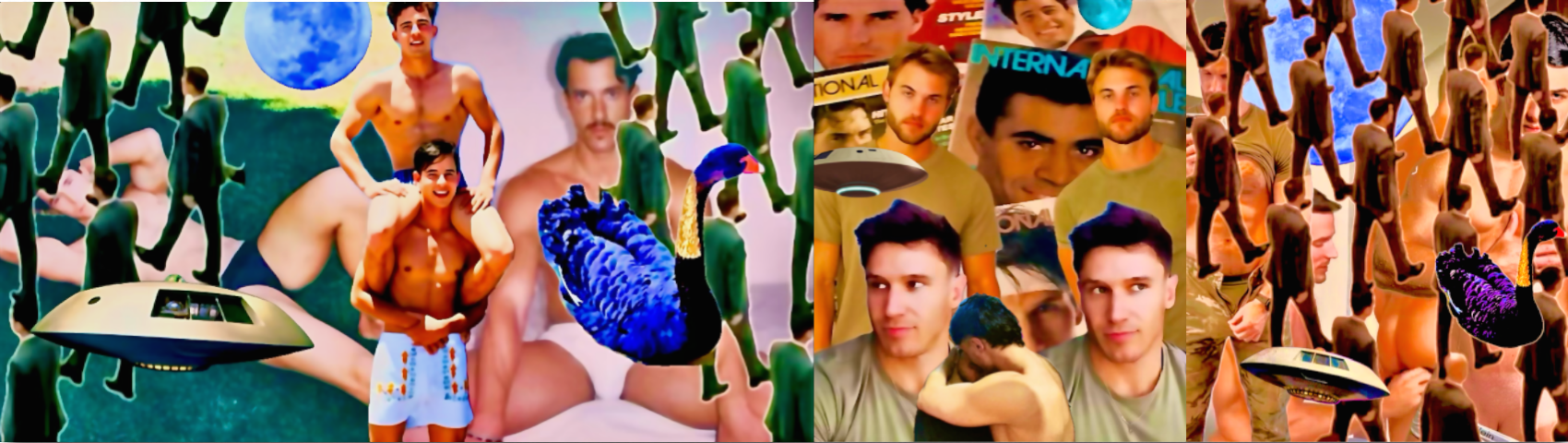
This piece works from seven collages. And underneath all seven, in every single one, the same two elements recur: the marching men in suits, and the moon. Call this the drone — the held note, the pedal tone a piece of music sustains beneath everything else, present whether the melody above it is quiet or crowded, tender or chaotic. A drone doesn’t develop. It doesn’t resolve. It just persists, indifferent to what’s happening above it, and that indifference is the point. Here, it is a wall of identical men in identical suits, walking in the same direction, in every frame, regardless of what tenderness or chaos is happening in the foreground. The moon changes color from frame to frame — pink, blue, gold — the way a drone can be voiced slightly differently each time without ever stopping being the same note.

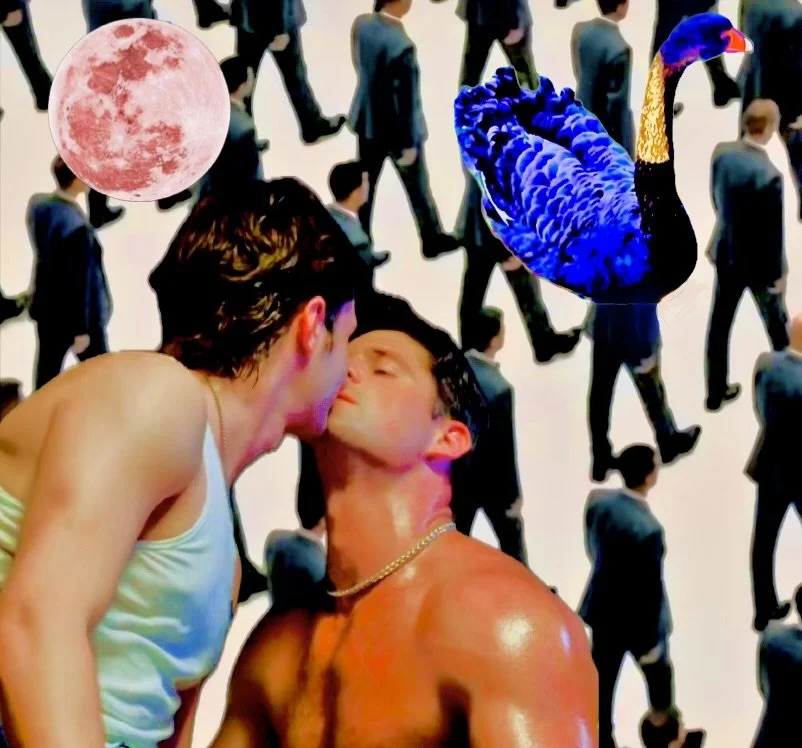
The kiss — two men, warm-lit, foreground — states the tonic against that drone for the first time. Intimacy, held in place against a moon gone the color of blood and a river of suits that do not see it happening three feet away. Every image after this one is heard in relation to this first interval.

The triptych — one bearded face repeated left and right, a UFO and a bare back sandwiched in the panel between — is the piece’s most literal act of composition: theme and variation as structure, not metaphor. The same man, twice, is not the same phrase twice.

The poolside scene is the densest chord in the set — four men, a priest inset small and watching, a moon held against water — and now, for the first time in this version, the suits appear here too, tucked into the upper corner as though the drone had found its way even into the one frame that felt, in the earlier draft, briefly exempt from it.

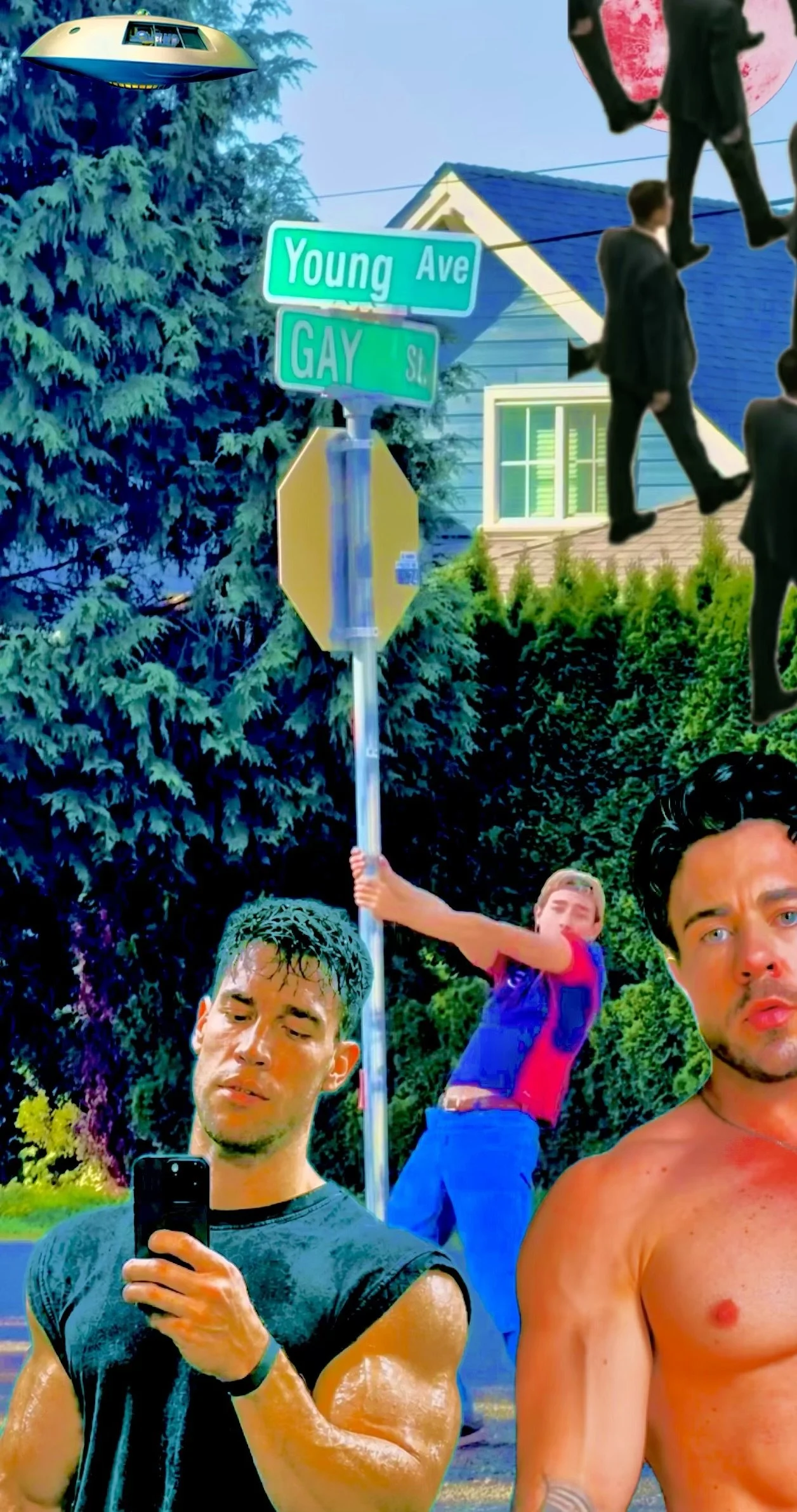
The street sign, Young Ave crossing Gay St, is the wit in the composition, the pun a soloist slips in for four bars before returning to the changes — and the suits still walk, this time descending a rooftop, never quite in the frame’s center but never absent either.

The crowd and the bare shoulder is the rest — the bar where density drops out and the ear is allowed to breathe. It is the frame where the drone is most exposed, closest to the surface, hardest to ignore, because almost nothing else is competing with it.

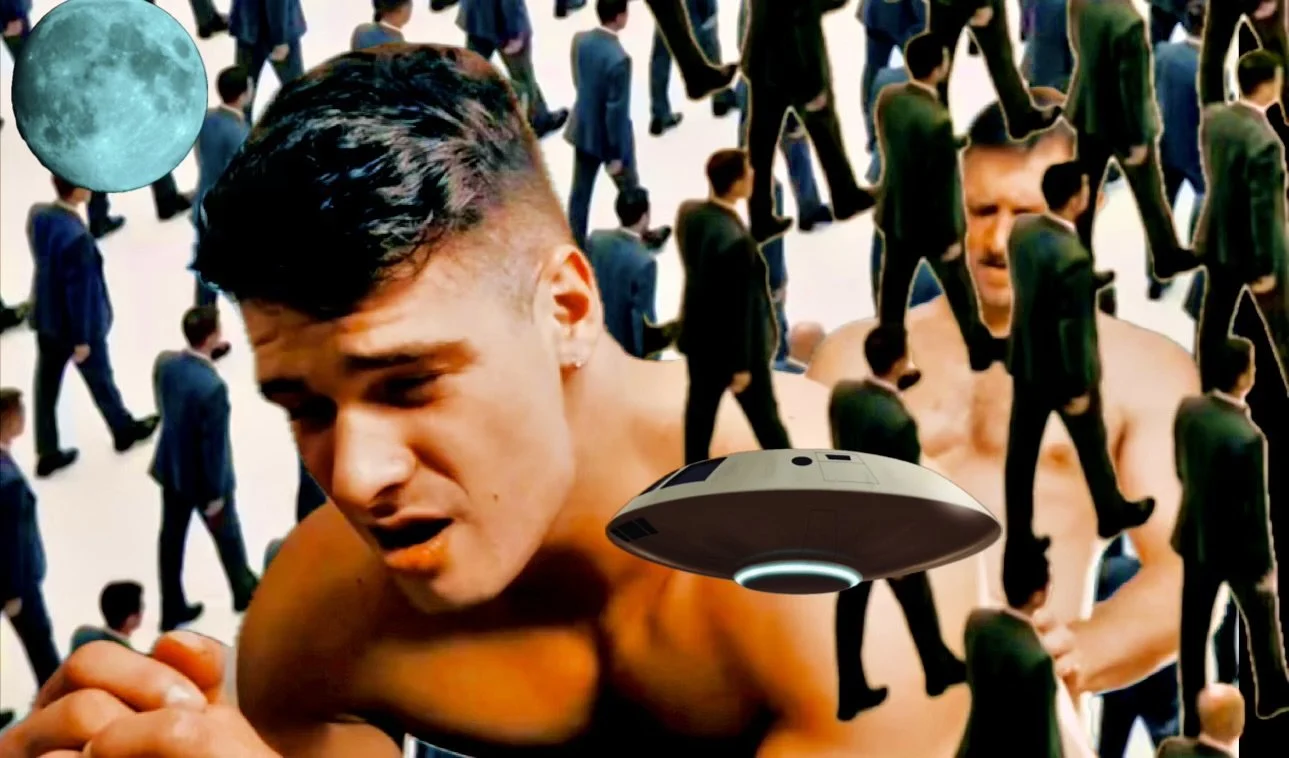
The last two collages are the improvisational risk the set needs — the moon held overhead like a weight in one, a wall of marching legs closing in around a nude figure and a swan in the other. Here the drone stops being background and starts closing in, the suits pressing close enough to fragment the body they surround into slivers glimpsed between shoulders and knees.

Seven notes. Seven images. One note held under all of them, never resolving, the shape the whole scale is built against.

— Behan

Seen Scene Seem Seam

GAY SEEN | The Gay Gaze | The Subdivision | Digital photo collage | 2026

Seam. Seen. Scene. Seem.

1973 — Homosexuality removed from the DSM as a mental illness.

2003 — Sodomy laws struck down nationwide, Lawrence v. Texas.

2010 — Singer Ricky Martin comes out as gay. Yowza.

2015 — Marriage legalized nationwide, Obergefell v. Hodges.

That’s the good news. Now here’s reality.

2019:

• Same-sex borrowers are 73% more likely to be denied a mortgage than heterosexual couples — despite being no riskier as borrowers.

• Same-sex couples face a 20% mortgage rejection rate. Had they been straight, that number would be 11%.

• Even when approved, same-sex couples pay higher interest rates than straight couples with identical qualifications.

• 26 states still have zero statewide housing protections for LGBTQ people. In half this country, this discrimination isn’t hidden. It’s legal.

Sigh.

— Behan

State of Undress | Gay Gaze | The Subdivision | Digital Photocollage | 2026

The Gay Angle

The men in this collage do not wait to be discovered. They compose themselves, arms crossed, eyes locked forward, claiming the frame before the viewer can claim it for them.

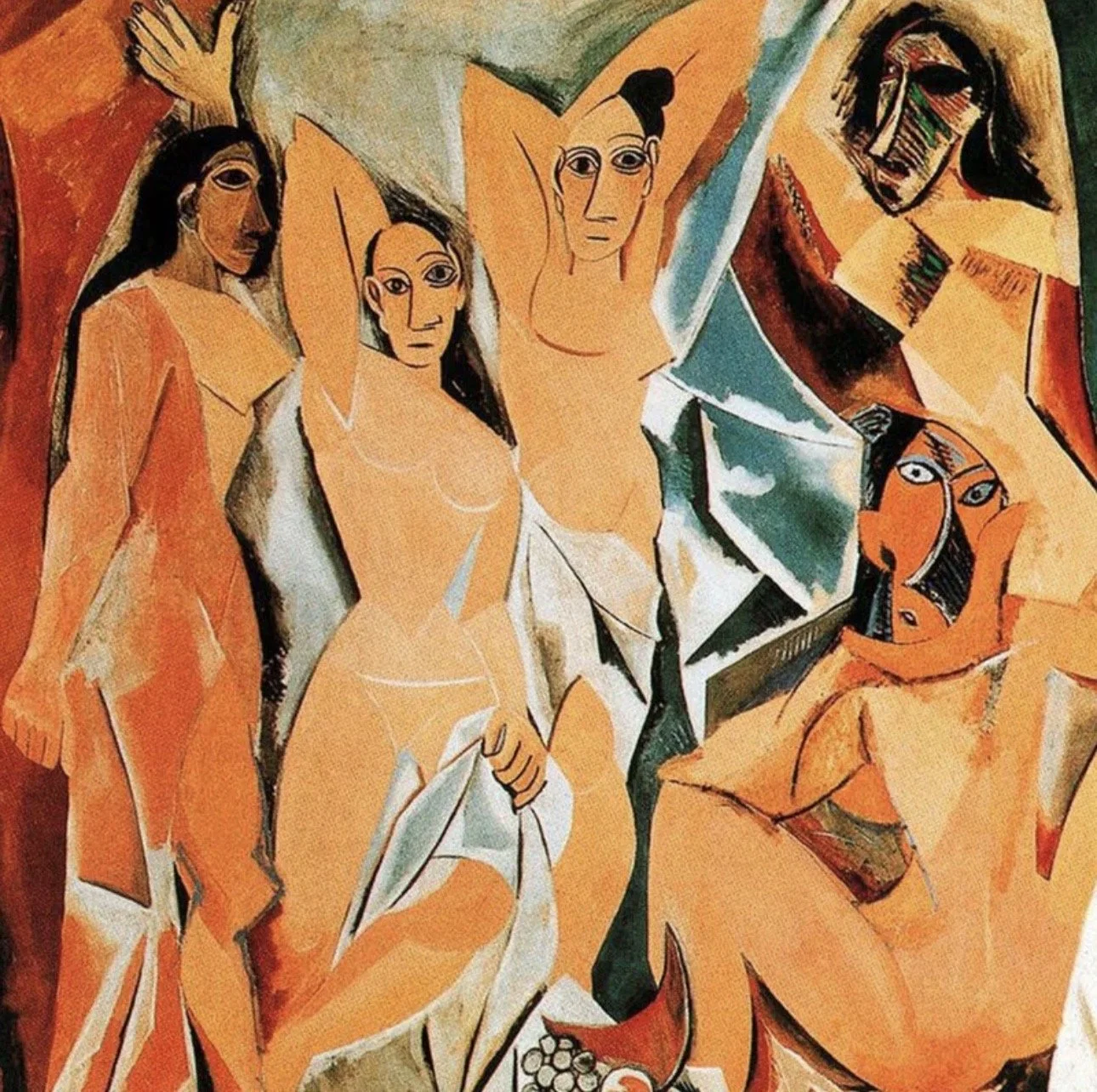
It is the same rupture Picasso staged in 1907, when his women stopped posing and started staring back — confrontation replacing invitation, presence replacing permission.

Both works rely on multiple fractured, doubled figures — Picasso’s mask-faced women confronting the viewer from multiple angles at once, this composition’s central figure similarly flanked and multiplied by reflection and background bodies — so the eye never settles on one correct vantage point.

The resemblance is not only formal. Both scenes are crowded and claustrophobic — pressed close. In both, the figures do not hide. They meet the eye without apology, defying the social contract of their respective centuries, the one that named them deviant and asked them to disappear.

Picasso’s women and history’s sex workers, the men gathered here and history’s homosexuals, were catalogued by the same era’s medicine and morality under a shared heading of deviation — filed side by side not by choice but by the taxonomies built to define what desire was permitted to be. What connects them is not camaraderie. It is a shared position: both made the material from which “normal” was drawn, and both, in these images, refuse to hold still for it.

That refusal of a single controlling perspective is the assertion itself. Nobody owns the angle from which these bodies are seen.

— Behan

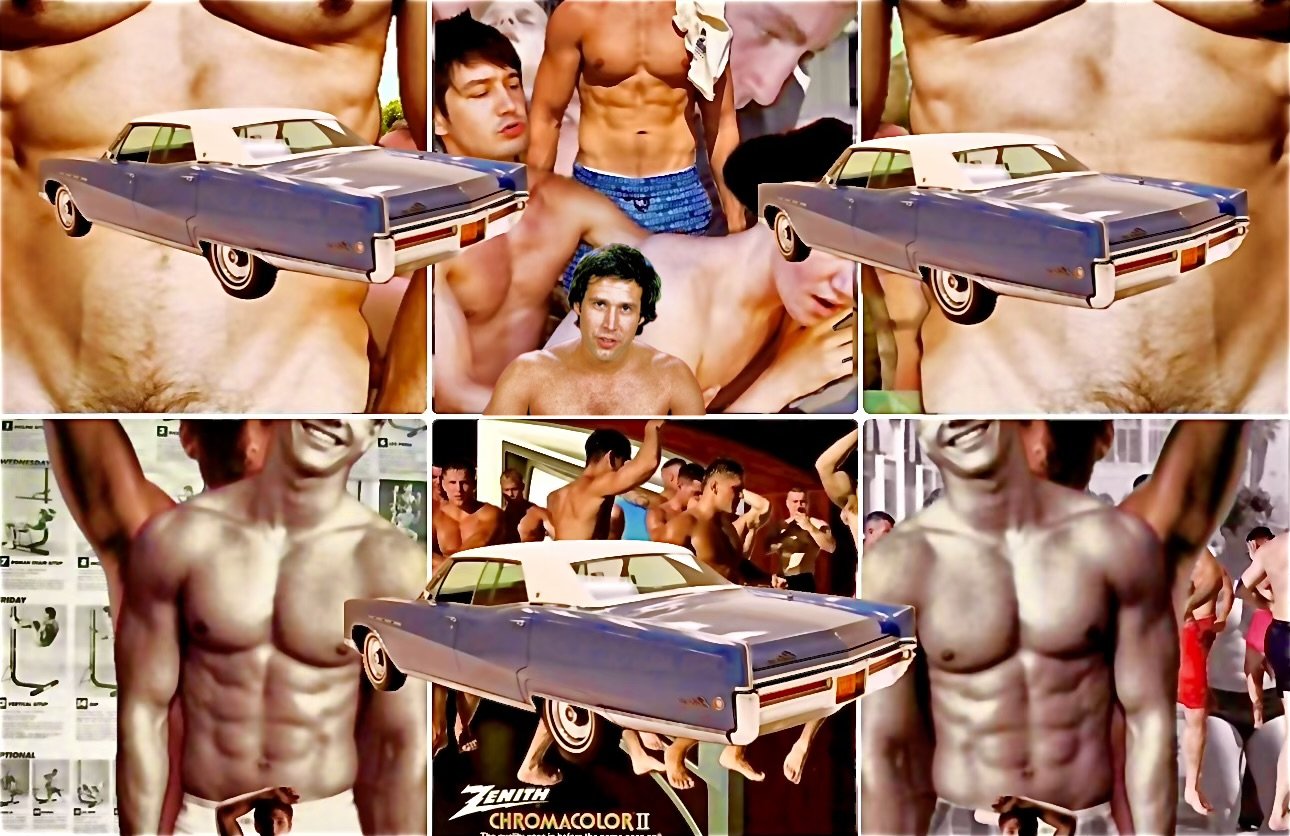
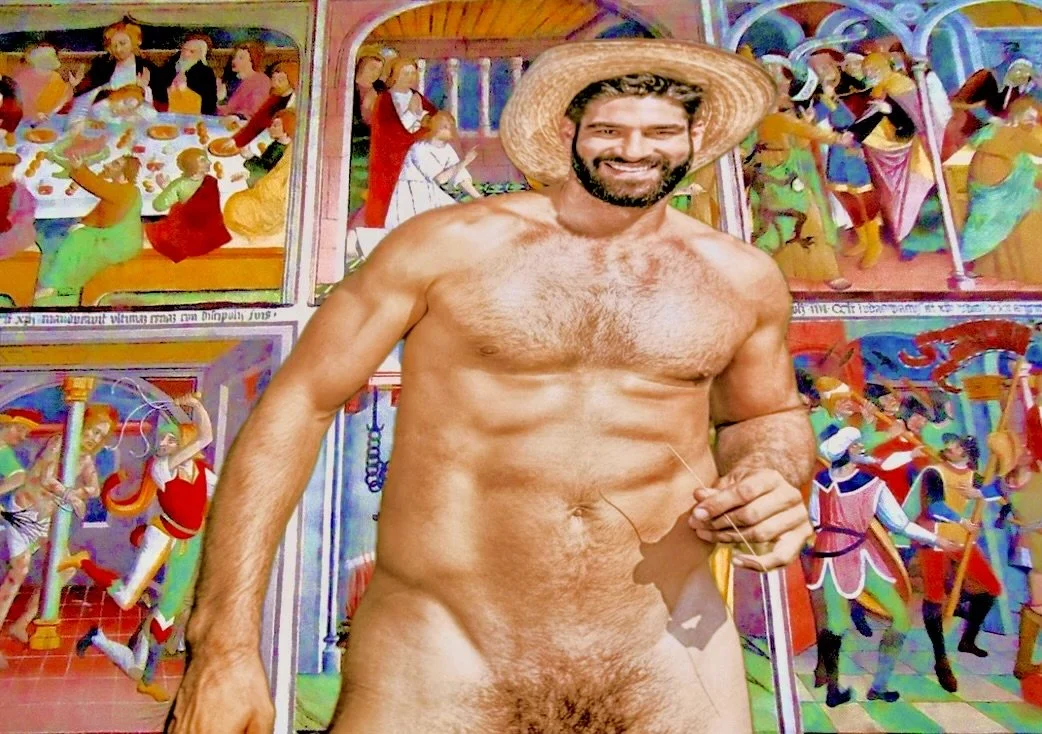
The Fresco, the Sedan, the Actor and Mr July | Gay Gaze | the Subdivision | Digital Photocollage | 2026

1347 — The Black Death arrives in Europe, and for the next century and a half, plague returns in waves, never fully leaving. It is a lived memory, not distant history, for anyone painting the body or its suffering.

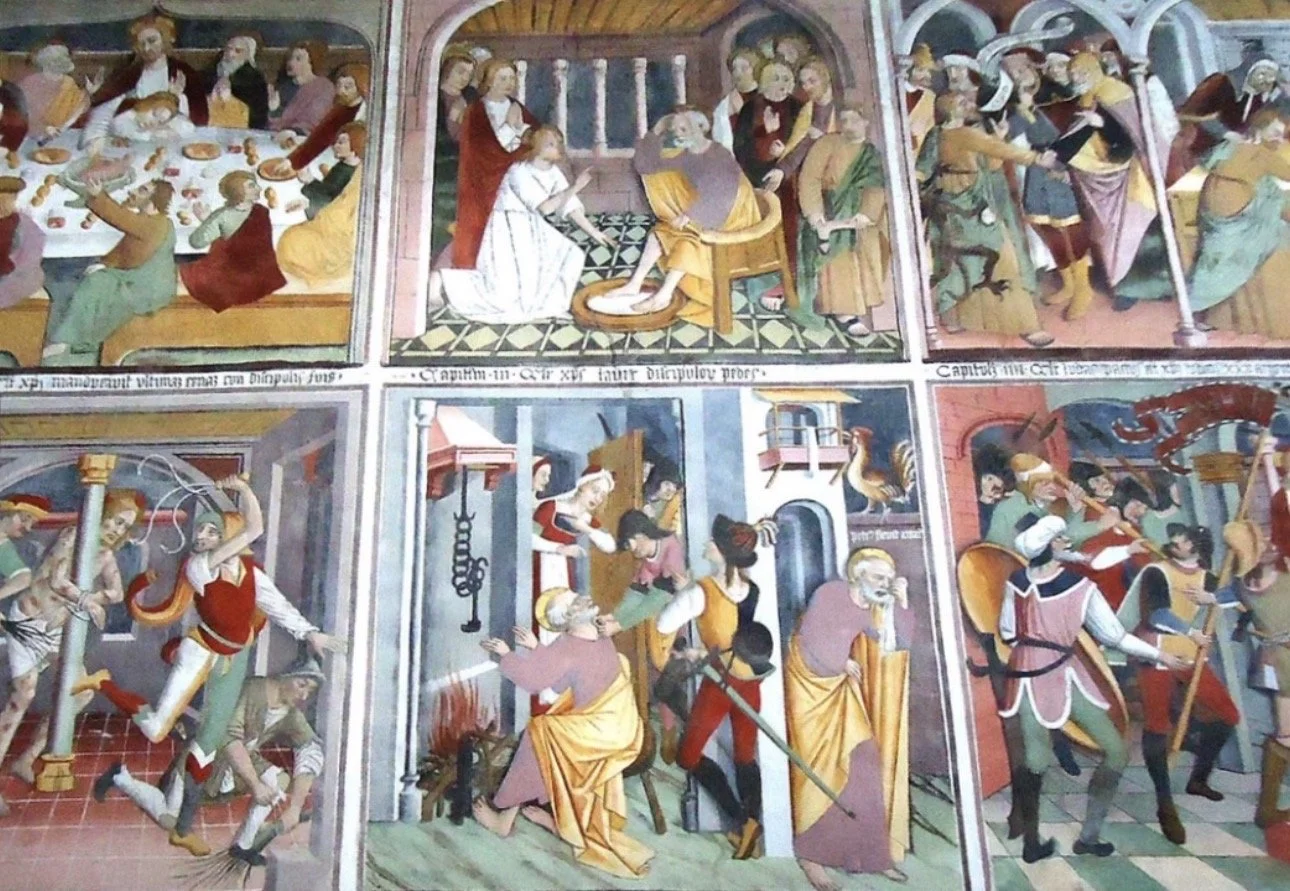
1492 — Giovanni Canavesio paints the fresco cycle at Notre-Dame des Fontaines, La Brigue, its six-panel grid narrating betrayal, arrest, and suffering in sequence, in a region still within reach of plague’s return.

1968 — Pontiac releases the Bonneville with hidden headlamps and a new full-width rear treatment, the hundredth year of a company built on the promise that the American body could move faster, further, and more beautifully than before.

1975 — Chevy Chase joins the Not Ready for Prime Time Players on Saturday Night Live, becoming an overnight heartthrob and an object of desire for young gay men, television transforming itself in real time around him.

1981 — AIDS is identified, and within a decade it claims a generation of the very men who had watched him.

Four moments, five centuries apart, share a structure more than a subject. Each depends on innovation — a fresco cycle, a hardtop sedan, a sketch show, a body captured mid-desire — arriving at the exact moment mortality is closing back in. The fever and the flourish, always at the same address. Behan reassembles Canavesio’s panels, Pontiac’s chrome, and Chase’s easy grin into one plane, not because they knew each other, but because none of them got to choose their timing.

— Behan

Gay Restoration

Series recreating community where gay men are isolated and alone.

Gay Restoration

The thirst trap has a formula. One man, alone, on a beach or in a mirror, performing for a camera that isn’t really there. The isolation is the product. It sells the fantasy of a body no one else gets to have.

Gay Restoration takes that image and breaks the formula. The man stays. But he isn’t alone anymore. Other men appear in the frame — walking the shoreline, standing at the tide line, going about their own business, making no claim on him and asking nothing of the viewer either. No commentary. No hierarchy. Just more of them there.

This is the first entry in a new series: solitary images, restored to community. The original source image and collage are included each time. With this collage, a Pink Moon watches from one corner. Jupiter 3 hovers in from the other, doing what it always does — arriving to witness, not to rescue anyone who wasn’t actually in danger. The beach was never actually empty. It only looked that way because the culture kept cropping everyone else out.

— Behan

Bells | Closet Saints | The Subdivision | Digital Photocollage | 2026 | James Behan

Neither one was dumb.

The actor Judy Holliday and her character in Born Yesterday, Billie Dawn, shared something the world kept mistaking for simplicity. Both carried an interior logic that defied the cynicism and corruption of the day — a way of seeing clearly while everyone else assumed they see nothing at all. This collage celebrates the life and times of the amazing Judy Holliday:

1921 — Born Judith Tuvim in New York City.

1927 — Her parents separate when she is six. She is raised by her mother.

1943 — Judith Tuvim changes her stage name to Judy Holliday, adopting it when her comedy troupe, The Revuers, travels to Hollywood and she signs with Twentieth Century Fox. She chooses “Holliday” as the English translation of her Hebrew surname, Tuvim.

1948 — Marries David Oppenheim.

1950 — Born Yesterday is released. The world reads her as a blonde who barely follows the conversation, and she finds the opportunity in that — being underestimated can be its own kind of superpower. Her performance is instant stardom.

1951 — Wins the Academy Award for Best Actress and the Golden Globe for Best Actress, Comedy or Musical, for Born Yesterday — beating out Bette Davis and Gloria Swanson in what is considered one of the biggest upsets in Academy history.

1952 — Called before the Senate Internal Security Subcommittee during the Red Scare, the same era the Lavender Scare runs alongside. It is alleged she also carried an affair with a woman from her early Greenwich Village years. The fear in that hearing room is not only political. It is also a fear of rejection at its most fundamental level, an accusation of being less than human based on what you believe or who you love. She gets out of it by trusting the same interior logic that got Billie Dawn out of every scene where the men underestimate her.

1954 — Her marriage to David Oppenheim is failing, and she falls into a severe depression. Around this time, Betty Comden and Adolph Green begin writing Bells Are Ringing, meant as a lifeline for Judy. Though there is no guarantee she has the stamina left for it.

1956 — Bells Are Ringing opens on Broadway. She goes on.

1957 — Wins the Tony for Bells Are Ringing. Divorces David Oppenheim the same year.

1960 — Films the movie version of Bells Are Ringing with Dean Martin and Vincent Minnelli. Her body is already sick with undiagnosed breast cancer. Cast and crew know her history with depression and anxiety, so they read her exhaustion and pain as more of the same story they already have about her. Even while dealing with a debilitating illness, she receives a Golden Globe nomination for Best Actress, Comedy or Musical. The film receives a nomination for Best Music, Scoring of a Musical Picture. This is her final film performance.

1960–1964 — She continues performing. She undergoes a mastectomy and returns to work, starring in the Broadway musical Hot Spot in 1963. She also collaborates with jazz musician Gerry Mulligan, writing lyrics to his music.

1965 — Judy Holliday succumbs to her illness on June 7, at the age of forty-three. She is remembered as a queer icon and as a prototype for feminism — her characters embodying a working-girl alternative to suburban domesticity years before Betty Friedan gave that critique a name.

Rock Hudson, Cesar Romero, Tab Hunter — the Closet Saints have been a men’s gallery so far. Judy Holliday belongs beside them, and belongs there specifically as a woman, because the closet was never only a men’s condition.

Sources: Advocate.com, The New Yorker, Turner Classic Movies, Playbill, Encyclopedia.com, Jewish Women’s Archive, Love Letters to Old Hollywood, Wikipedia, AllMusic, University of Massachusetts Boston American Studies

Processing The Process

Every work of art starts as an idea, invisible to everyone but the maker. Here’s how one of my digital collages takes form:

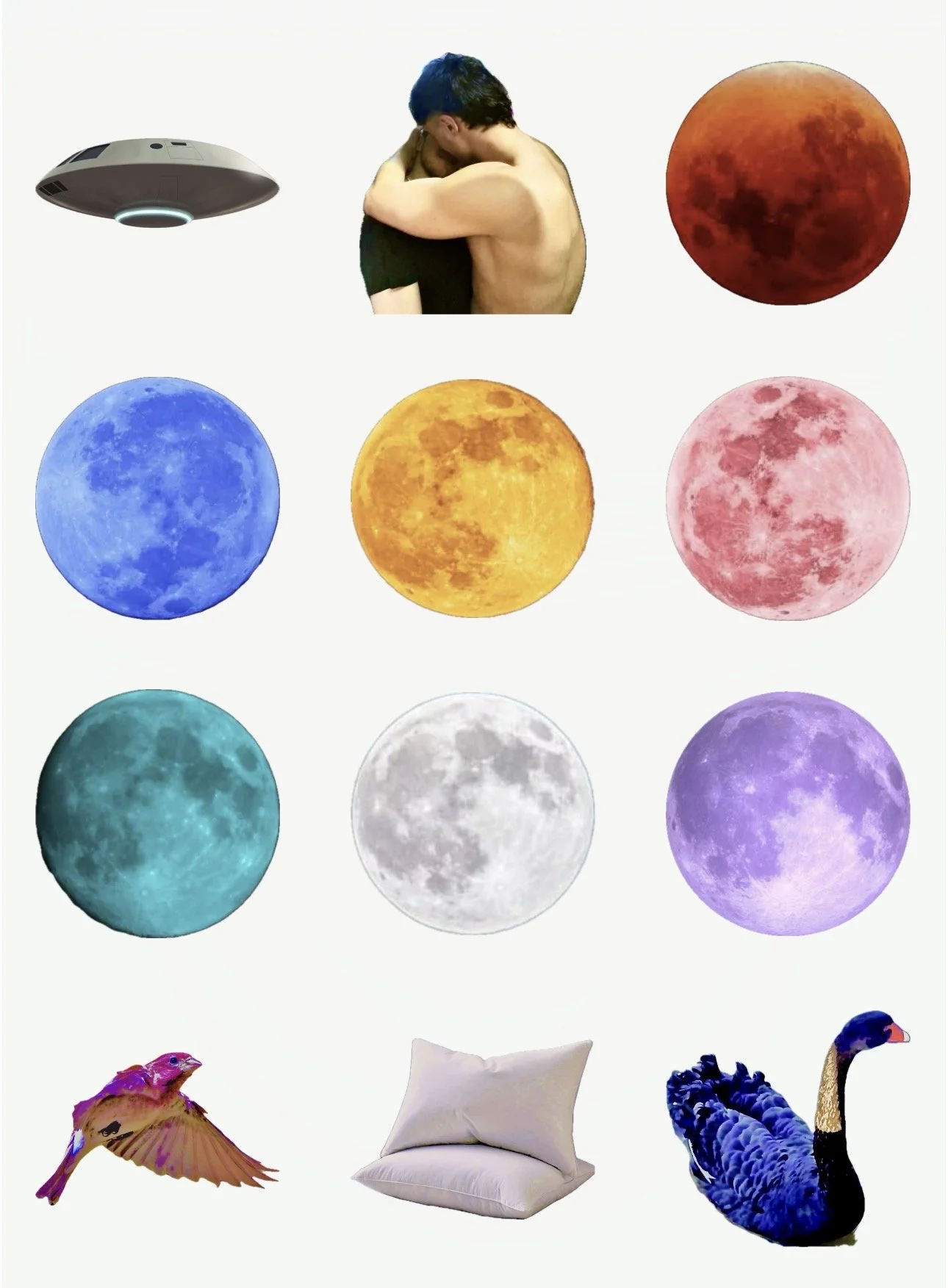
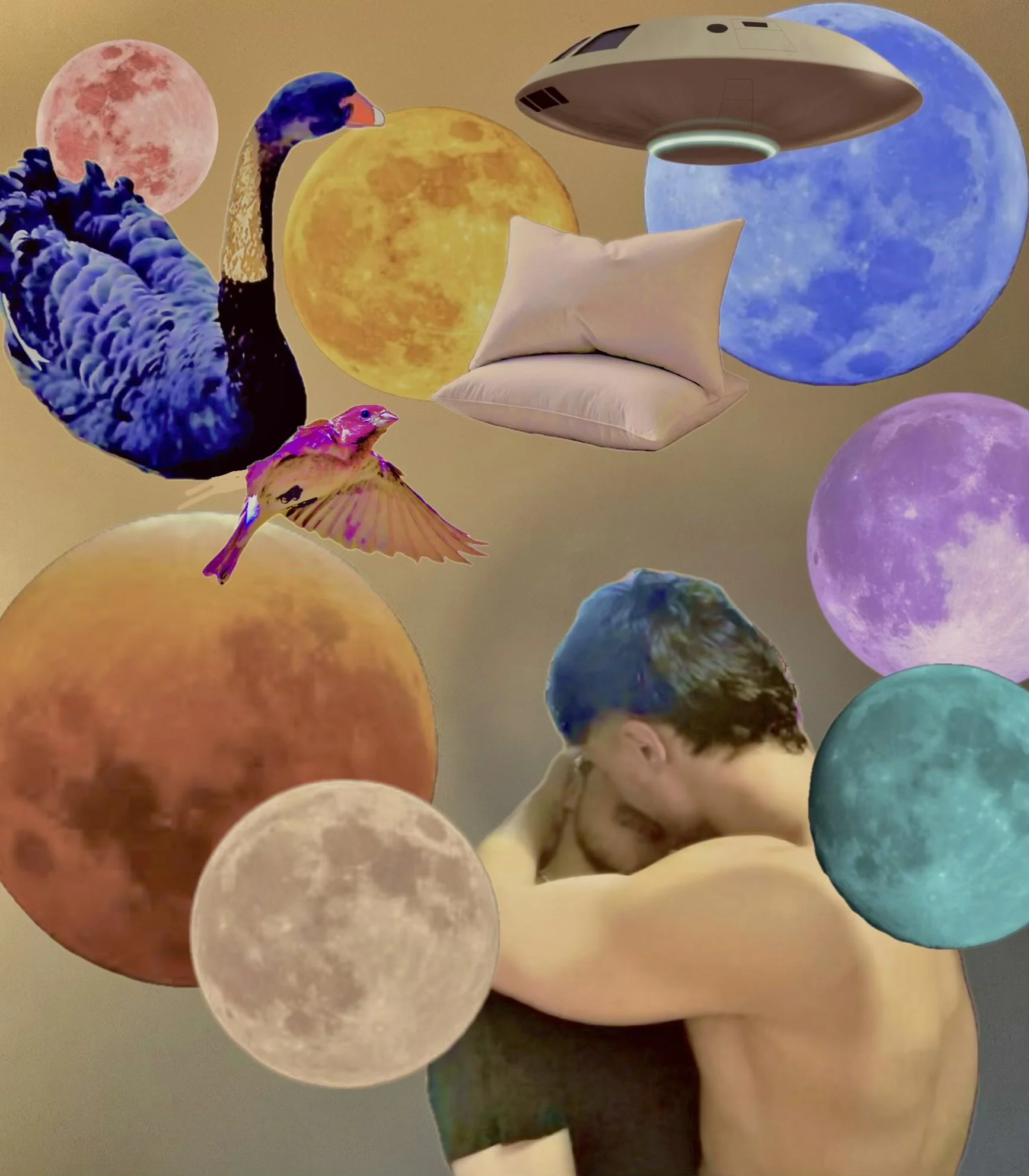
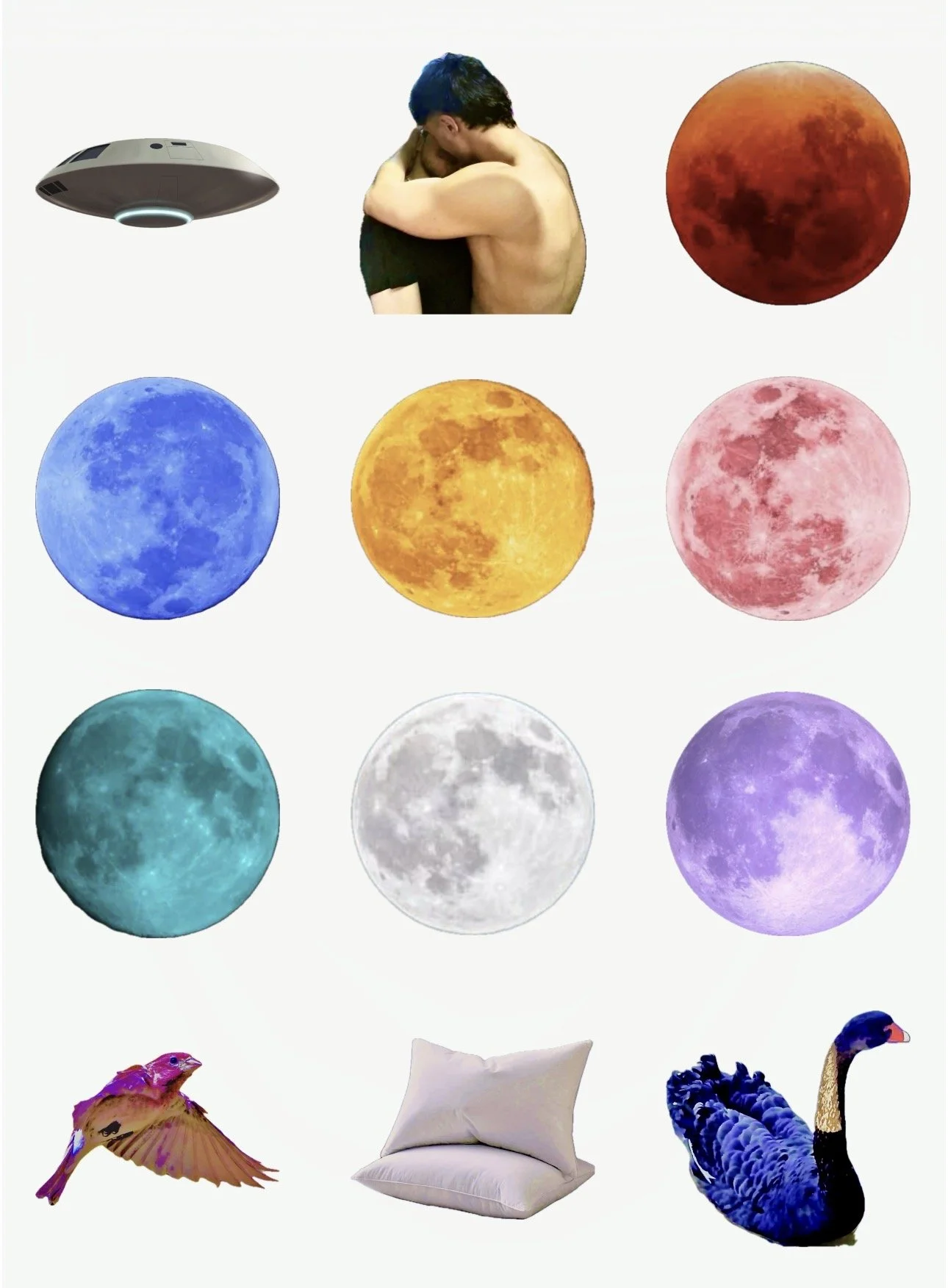
Figures are found and sourced online. Twelve separate images, gathered with no relationship to each other yet — the Jupiter 2 from the classic television show “Lost in Space,” a full moon in seven colors for seven seasons, a purple finch, a set of pillows, a black swan, two gay men in a kiss. Raw material, still just separate objects, unrelated to each other.

The figures are aligned with a conceptual understanding of what part each will play within the composition. This is the artist as the screenwriter. Before anything gets placed, it gets meaning. Each piece is assigned a role — danger, freedom, longing, grace — so that by the time the collage is built, every object already knows what role it’s playing.

Note: every figure is planned, with a purpose and understanding.

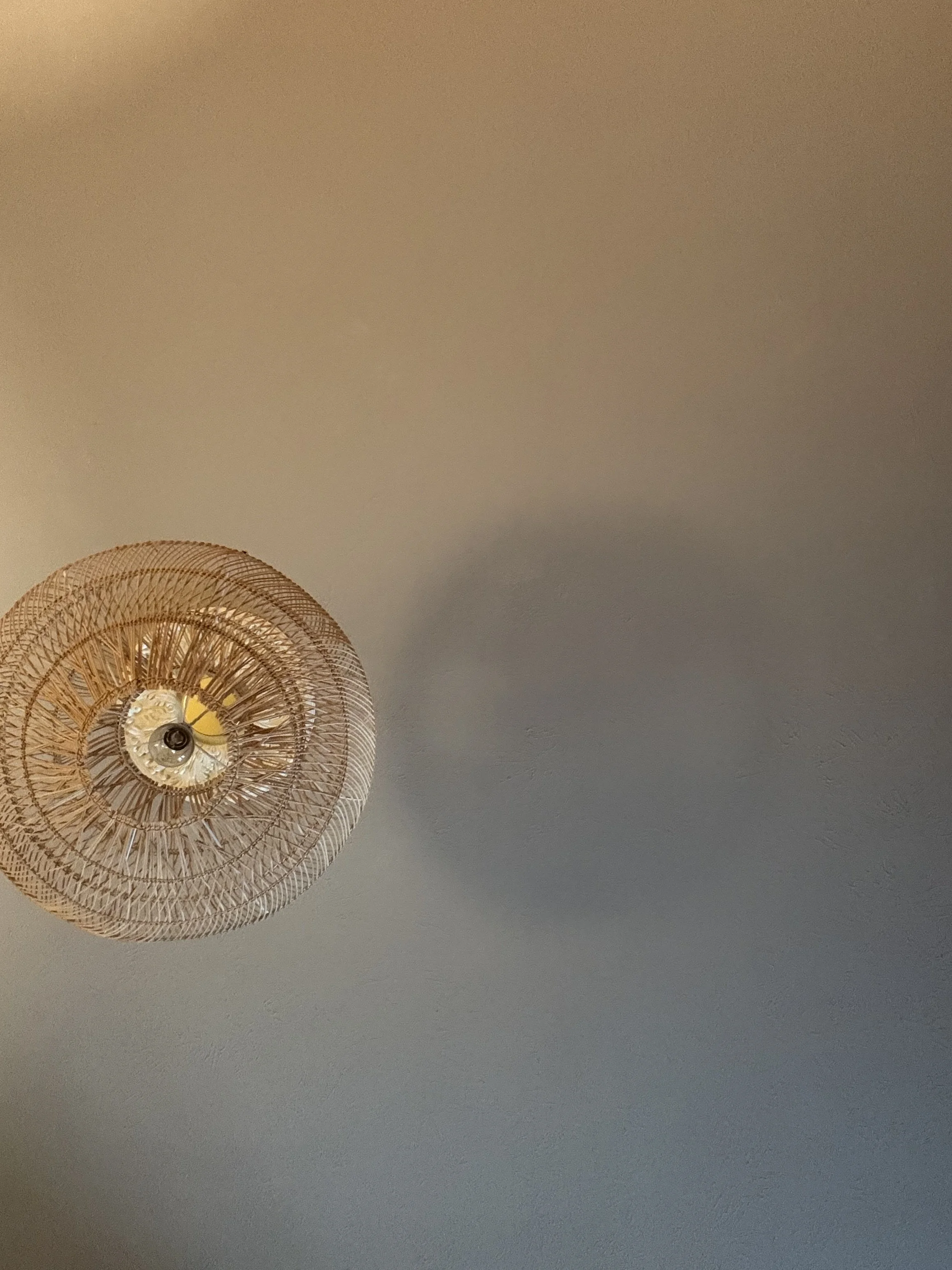
A background image is selected as a surface, this time, is my own ceiling. A photograph of the room I live in becomes the sky the collage with fall under.

The figures are arranged, in this instance, the artist is a director, planning how the figures move or stand, their entrances and exits within the frame.

Lastly, the collage aesthetic is shaped, in this instance, the artist is a production designer, identifying color saturation, value range, point of focus, overall visual variety and cohesion:

Space: how much air sits between each moon, so nothing crowds and nothing floats untethered.

Color: open palette with a rainbow of hues, fully saturated, each with varying intensity.

Value: the ceiling’s warm gradient against the cooler tones of blue, teal, and purple, so the piece has depth instead of flatness.

Balance: the two men anchored bottom right, heavy enough to hold the weight of everything scattered above them. The asymmetry creates an image in motion.

Scale: nothing here is actually to scale with anything else, which is the point — mythology doesn’t obey physics.

This is a behind the scenes look at how the collage comes together from inspiration to presentation.

All the World | The Gay Gaze | The Subdivision | Digital Photocollage | 2026 | James Behan

With this work, we focus on two men in an embrace, an expression of romantic love with a kiss. Around them circles all the worlds, ones of support, ones of concerns. The two men in their own world surrounded by an avalanche of views about their love for one another. In this scene arrives the Jupiter 3 as witness, the truth teller, also present the black swan and purple finch, two elements of nature the speak of the nature of gay love as purposeful and noble. Lastly, the set of pillows, as an expression of hope for a soft landing for this couple, to be supported and encouraged in their relationship to one another.

— Behan

Legend

A Key to the Subdivision

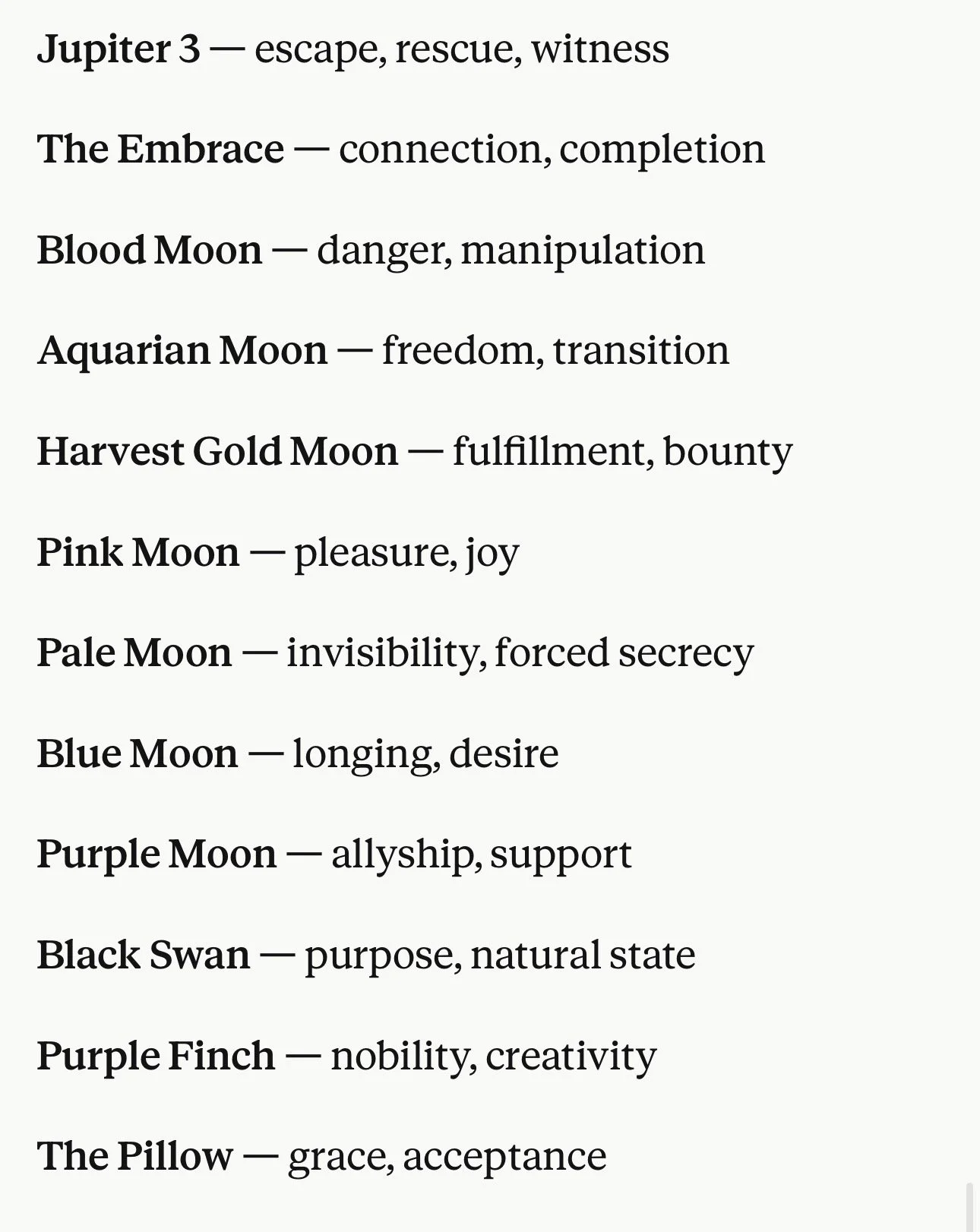
Every tradition that lasts long enough grows its own symbols. The medieval church had the lamb, the rabbit, the fish — small pictures that carried whole doctrines inside them. The Subdivision has its own. What follows is the key, and then the reason each one exists.

Jupiter 3 — escape, rescue, witness

The Embrace — connection

Blood Moon — danger

Aquarian Moon — freedom

Harvest Gold Moon — fulfillment

Pink Moon — pleasure

Pale Moon — invisibility

Blue Moon — longing

Purple Moon — allyship

Black Swan — purpose

Purple Finch — nobility

The Pillow — grace

Jupiter 3 does not carry captives. It carries passengers who chose to be onboard, moving toward a life no one assigned them. The ship exists because escape only means something when it’s a decision, not an accident.

The Embrace exists because isolation was the old inheritance, the thing every closeted life defaulted to. Two men holding on is not a symbol of love in the abstract. It’s the specific, physical end of being alone.

The Blood Moon is the other side of the story, and every story here has one. It represents the danger that doesn’t go away just because a life gets freer — the people, the laws, the silences that still want the story reversed.

The Aquarian Moon is freedom in the widest sense, the shift from a world built around one kind of life to a world that makes room for more than one.

The Harvest Gold Moon is what comes after survival. Abundance, not scarcity. A life that adds up to something whole instead of something merely endured.

The Pink Moon is pleasure taken without apology — the part of a gay life that doesn’t need to justify itself by being useful or noble first.

The Pale Moon is invisibility, the years spent present in a room and absent from the record. It’s pale because it was never allowed full color.

The Blue Moon is longing — not satisfied, not resolved, just carried. The wanting that outlasts the waiting.

The Purple Moon belongs to the allies, the straight men and women who showed up. Allyship gets its own moon because it was never nothing.

The Black Swan is the argument the whole Subdivision makes without arguing it: that there is a natural order here, and homosexuality has its place inside it, not outside it.

The Purple Finch is nobility — the idea that there is as much dignity in being gay as there is in being straight, and neither needed to be earned.

The Pillow is grace — a soft landing, an inclusion. Not comfort as an idea, but comfort as a wish extended to everyone: the fulfillment of potential, the being treated well, the being let all the way into the room instead of tolerated at its edge. It belongs to no one in particular because it should belong to everyone.

— Behan

Uberest

Front seat. Rearview. Full view.

Three passengers. Jupiter 3 rides slow then hard. The Blue Moon hangs low and full.

Behind him, the back seat doing what back seats do: holding two men who forgot the car was moving.

Closets don’t always come with seatbelts. Buckle up if you can.

— Behan

Into the Glossary We Go

Weeboom

wee·boom / ˈwiː.buːm / — noun

Etymology: A portmanteau coinage — “wee,” carrying its double sense of smallness and the exclamation of a thrill, fused with “boom,” the sudden report of impact or arrival. Together they name a paradox: influence that announces itself loudly while occupying almost no time or space at all.

Definition: Access or proximity to power; the state of influence at the confluence of desire and determination. Measured not in résumés but in minutes — how long someone gets to guest on a talk show before the segment ends and the name changes.

The desk is where it lives. Conan owns the desk, which means Conan is weebooming — he is the fixed point, the eye contact, the mug that never moves. Everyone else performs proximity to him: the couch, the greenroom, the ninety seconds of charm before the next guest is called. Weeboom is not the fame. It is the clock running while you have it.

Eric Andre tests the form from the inside. For a decade he has let the question of his own sexuality sit half-open — everyone is bi, a hole is a hole, never quite yes, never quite no. It reads like evasion, but it functions like currency. A one-time disclosure cashes itself out; ambiguity keeps generating interest. Andre’s weeboom is not a fact he’s hiding. It’s a position he keeps occupying.

…and then, Chippendales. Chant? Alarm?

Weeboom.

— Behan

Introducing: The Gay Historical

Bill and Phil’s Outrageous Battle | The Gay Historical | The Subdivision | Digital Photocollage | 2026

Two men who wanted men, leading armies that wanted each other’s land.

The Subdivision has, until now, worked in three registers: The Closet, for men who could not be seen; The Gay Gaze, for the culture’s ongoing performance of desire and denial; The Gay Domestic, for the ordinary life gay men were told they couldn’t have. None of them fit what follows, because the men in this piece were never hidden. They are simply men history already knew about and declined to say so plainly.

The Gay Historical exists for exactly that gap. Its subjects are real, its evidence is documented, and its complaint is not that the record is empty but that the record has been handled carelessly — footnoted where it should have been foregrounded, hedged where the evidence is strong, quietly dropped from the popular account while surviving, technically, in the academic one. This category doesn’t invent queerness where none is attested. It restores weight to queerness historians have already attested to and popular memory has simply declined to carry forward.
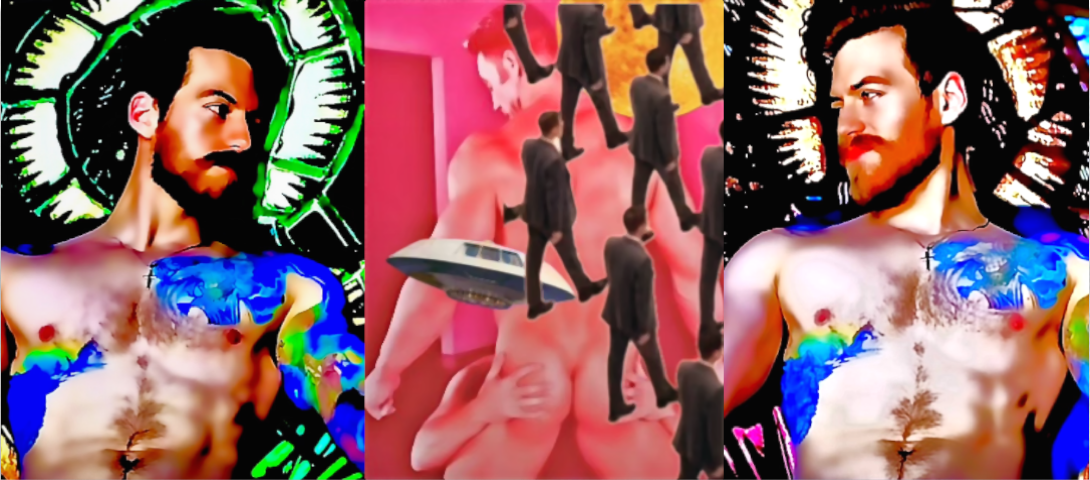
Bill and Phil’s Outrageous Battle

On April 11, 1677, two armies meet outside Cassel in French Flanders. One is commanded by William III, Prince of Orange, stadtholder of the Dutch Republic, a man who will go on within a decade to take the English throne and set the terms for two centuries of British imperial expansion. The other is commanded by Philippe I, Duke of Orléans, brother to Louis XIV, known at court simply as Monsieur. Philippe wins. It is his only major field command of the war, and the one clear military triumph of a life otherwise kept, by his brother’s design, well clear of real power.

Both men are documented, by contemporaries and by serious modern historians, as having preferred men. Philippe’s case was never really a secret in his own time — his court favorites were a known and largely tolerated feature of who he was, distinct from the dynastic marriages arranged around him, which functioned as foreign policy rather than romance. William’s case has been treated more cautiously by history, but not because the evidence is thin. His closeness with William Bentinck, who rode with him on this very campaign, and later with Arnold Joost van Keppel, drew comment from contemporaries and has been weighed seriously by historians on both sides of the North Sea ever since. The balance of circumstantial evidence, by the reckoning of scholars who’ve actually done the archival work, sits at least as strongly on the side of William having loved men as on the side of the dutiful, politically arranged marriage that produced no children and precious little warmth.

Which means: on this field, in this year, two men each documented as loving men led armies that existed to take land from each other’s countries. Nothing about that fact changes the outcome at Cassel. What it does is puncture the tidy separation the culture likes to maintain between “great men of history” and “men who loved men” — as though the second category could only ever produce private lives, never public ones, never armies, never empires. William goes on, four years after losing this battle, to steer the events that will hand England its imperial century. History remembers the empire. It has been considerably less interested in remembering the man who built its foundation, or who he actually loved while he did it.

The collage presents on a background of a then contemporary painting by Adam Frans van der Muelen of the battle of Cassel. The main actors are rendered in contemporary dress against the original battlefield, played by actors drawn from gay adult film — a deliberate collision of registers. History has spent three centuries treating William and Philippe’s desire as a footnote to be managed, hedged, or ignored outright, while treating their military and political record as the only part of them worth painting. The Subdivision refuses the split. Two men. One battlefield. Full color, present tense, unhedged.

The battle ensues.

— Behan

Sources: “Battle of Cassel,” various historical accounts of the Franco-Dutch War, 1677; “William III of Orange,” Wikipedia and standard biographical accounts; Cormac Moore/History Ireland, “Billy’s Boys, or an Orangeman’s Dilemma,” on the historiographical debate over William III’s sexuality; H. Montgomery Hyde, The Other Love: An Historical and Contemporary Survey of Homosexuality in Britain (1970).